

Stage town on the Camino
Caldas de Reis
Pontevedra, Galicia, Spain
- places to stay
- 36
- Caminos
- 3
- Elevation
- 21 m
Caldas de Reis is the town of warm water: since 1881, thermal water at almost 50 degrees has flowed from two lion heads in the middle of town, and in the washhouse next to it pilgrims soak their feet. King Alfonso VII, later emperor, is said to have been born here in 1105. Santiago is still 44 kilometres away.
Right now in Caldas de Reis (as of October 2026)
- Albergues in winter: Most albergues are open all year. As Pozas Termais and the Therma Pilgrim Hostel close at the end of October, Argemira stays open until 30 November.
- The gold is locked away: The famous gold treasure of Caldas is kept in the Museo de Pontevedra, where it has been temporarily off display since 15 October 2026. Caldas has a replica.
How long to stay?
An afternoon is enough. Caldas is a small town, and its best sights lie close together: the hot fountain, the washhouse, two churches, the bridge over the Bermaña and the park on the Umia. You can see it all comfortably on foot after you arrive. If your legs are tired, add a soak in one of the two thermal spas. There is no need for a rest day here, especially with Santiago only two stages away.
Caldas de Reis in Ninja numbers
- Almost 50 degrees is the temperature of the water that has flowed from the fountain in the middle of town since 1881. Sources give 48 to 50 degrees. For a foot bath, head to the washhouse next door.
- 44 kilometres is the distance from Caldas to the cathedral of Santiago. The day after tomorrow you are there.
- 190,327 pilgrims arrived in Santiago in 2025 on the Portuguese Way and the Coastal Way. Both routes pass through Caldas; only those who take the Variante Espiritual from Pontevedra skip the town.
- 41 gold pieces from the Bronze Age are what remains of the treasure a man found near Caldas in 1940 while working in the fields. Before the Guardia Civil stepped in, about half had been sold in secret and melted down.
Arriving: down to the warm water
From Pontevedra it is 21.4 kilometres, a gentle stage through villages and woodland. In the last kilometres you pass through Briallos and Tivo; from Tivo it is another 1.9 kilometres. You enter Caldas beside the church of Santa María and walk down to the bridge over the Umia. After it you turn left into Rúa Laureano Salgado, and there is the thermal fountain. Along Rúa Real, pedestrianised since 2000, you cross the town centre to the old bridge over the Bermaña.
In brief: the hot springs of the kings
The Romans called the place Aquis Celenis, after the Cileni people and the warm water. It was a station on the Roman road Via XIX, which linked Braga with Lugo and Astorga, and in late antiquity it was even briefly a bishop's seat. Caldas owes the name "de Reis", "of the Kings", to the tradition that Alfonso VII, son of Queen Urraca, was born here in 1105. Pilgrims came from the twelfth century at the latest, and in the fifteenth century there was a pilgrim hospital here. From 1780 the bathhouses were built, and Caldas became a spa town.
Warm water for tired feet
The sulphurous water comes hot out of the ground and has been used for centuries to treat skin, respiratory and rheumatic complaints. The public fountain, the Fonte das Burgas, is not a pool you can bathe in. But the warm water runs into a public washhouse right next to it, and there pilgrims dip their feet after the stage. It costs nothing. If you want more than a foot bath, go to one of the two thermal spas: the Balneario Dávila in the middle of town or the Balneario Acuña at the entrance to town, which has an outdoor pool on the Umia. In high season you should book ahead.
By the warm water: what to see
Everything important lies on the Camino or a few steps from it.
- Fonte das Burgas and the washhouse: The fountain was built in 1881 in neoclassical style; the water pours from two lion heads and steams visibly on cool days. Traditionally it is drunk as a cure. For pilgrims, the washhouse next door matters more: here you can put your feet into the warm water, free of charge and in conversation with other pilgrims. The fountain stands in Rúa Laureano Salgado, right on the Camino, next to the Balneario Dávila.
- Igrexa de Santa María: You enter the town at this church. Its west portal and apse are Romanesque, the chapels of San Diego and del Carmen were added in the seventeenth and eighteenth centuries, and the bell tower is Baroque. In the tympanum above the portal you can see the Lamb of God, the Agnus Dei. Mass is held from September to June on Mondays and Wednesdays at 20:00, and on Sundays at 9:30 and 11:30 (as of May 2026).
- Igrexa de Santo Tomás Becket: The only church in Galicia dedicated to the Archbishop of Canterbury was built from 1890 to 1894 to plans by Domingo Rodríguez Sesmero. It was built with the stones of Queen Urraca's tower, where Alfonso VII is said to have been born. The reason for the dedication is a pilgrim legend: Becket is said to have stopped in Caldas around 1167 on his way to Santiago. From October to June, weekday Mass is at 19:00, Sunday Mass at 12:30 and 19:00 (as of May 2026). In the Middle Ages, the pilgrim hospital stood nearby.
- Ponte de Bermaña: You leave town towards Santiago over this bridge with three round arches. It is considered Roman in origin, the roadway has been partly renewed, and a stone cross stands at its side. Pilgrims have crossed this bridge for centuries.
- Xardín botánico and Carballeira: From 1863 the town laid out an avenue on the bank of the Umia, which grew into a park with around sixty species of trees and shrubs from five continents and an oak grove with more than 200 oaks. It has been protected since 1962. After the stage, it is the nicest place for an hour in the shade.
Food and drink
The local speciality is lamprea, lamprey, as a stew or in an empanada. For something sweet there is roscón, a ring cake made from eggs, flour, butter and sugar, to which Caldas even dedicates its own festival in April. You will find bars and restaurants near the albergues.
Honestly
- There is no longer a public albergue. The former municipal albergue on Campo da Torre has been privately run since 2021; all albergues in Caldas are private. In spring and summer and at weekends you should book.
- The fountain is not a thermal bath. Some people expect a pool to sit in. At the fountain you can drink, at the washhouse you can bathe your feet; for a proper bath you pay at one of the balnearios.
- Some albergues are at the wrong end. Some lie before the town centre, others beyond the Bermaña bridge. Check the location beforehand, or you will be walking back with your pack.
Where pilgrims sleep
- Albergue de Caldas de Reis Urraca: the former municipal albergue on Campo da Torre, right on the Camino and by the river, under private management and renovated since 2021. It has smaller dormitories and, pilgrims, a lovely terrace by the river. According to alberguescaminosantiago there is no proper kitchen, only a microwave and a fridge. Booking is possible and recommended.
All other albergues are private and cost roughly €13 to €25 in a dormitory (as of August 2026). Most can be booked. If you are looking for a pilgrim albergue without a booking: the Albergue de peregrinos in Briallos is 5.1 kilometres before Caldas.
Ninja tips
- Feet first, shower later: Go to the washhouse next to the fountain before checking in. It is right on the Camino, and after a good 21 kilometres there is nothing better.
- Detour to the waterfalls: If you are reading this while still in Pontevedra: on the way, the short detour to the Cascada del río Barosa is worth it. If you still have energy in the afternoon, you will find the Fervenza de Segade on the Umia, on the road to Cuntis.
- Check where your albergue is: Before booking, see whether your albergue is before or beyond the Bermaña bridge. It saves you the walk back.
- Spanish helps: In several albergues the hosts speak only Spanish, pilgrims. A few words and a translation app on your phone are enough.
- Midday Mass in Santiago: If you want to make the pilgrims' Mass at 12:00 in Santiago the day after tomorrow, extend the next stage beyond Padrón to O Faramello.
Practical tips for pilgrims
- Stamps: On the last 100 kilometres you need two stamps a day. Albergues, churches and bars will stamp your credential.
- Market day: On Mondays there is a weekly market on Rúa Real and at Campo da Torre.
- Shopping: Caldas has everything you need: supermarkets, a pharmacy, bakeries, an ATM and a health centre.
- Tourist office: on Paseo Román López, by the park on the Umia.
- Getting here and away: Caldas has no train station. Buses run to Pontevedra, Vilagarcía, Vigo and Santiago.
Onwards: to Padrón
From Caldas you follow the Camino Portugués Central north over the Bermaña bridge. Pilgrims on the Coastal Way and the Senda Litoral walk this same path. After 5.3 kilometres you pass through O Cruceiro, after 9.7 kilometres through O Pino in the municipality of Valga, and after 15.4 kilometres through Pontecesures on the Ulla. It is 18.7 kilometres to Padrón, through patches of woodland and with more frequent but moderate climbs.
What awaits you tomorrow
Tomorrow you walk through perhaps the most beautiful landscape of the Galician section to Padrón. There, under the altar of the church of Santiago, they show you the stone to which, according to legend, the boat carrying the apostle's body was moored. From the warm springs of the kings to the origin of the whole story: Caldas and Padrón are just one stage apart.
If you chose the Variante Espiritual in Pontevedra, you rejoin the main route in Padrón.
Deep dive: The water of the kings
A long read, in case you want to learn more about Caldas de Reis. About fifteen minutes' reading.
At the hot fountain
As you walk through Caldas, you can sometimes see it from a distance: steam rising in Rúa Laureano Salgado. It comes from a stone fountain with two lion heads, from whose mouths water flows at almost fifty degrees. Next to it is a washhouse where the same water fills a basin. After the stage, pilgrims put their feet in and fall into conversation with one another.
This fountain is not especially old. It was built in 1881. But the water that flows from it is the reason this place exists at all. It was already here when the Romans came, and it has given the town two names: the old Roman one and today's. Caldas means nothing other than "the hot springs". And "de Reis", "of the Kings", tells of a child who is said to have been born here and later became emperor. This text tells the story of the place where you are soaking your feet.
Aquae Celenae
The oldest traces in the area are far older than any town. In the municipality there are burial mounds from the megalithic age and rock carvings, and in the Iron Age people lived here in fortified settlements, the castros. Nine of them are recorded in the municipality. Their inhabitants belonged to a people the Romans called the Cileni or Celeni.
When the Romans conquered the north-west of the Iberian Peninsula, they found hot, sulphurous springs here, and they gave the place a name that joined people and water: Aquae Celenae, the waters of the Celeni. In the Itinerarium Antonini, a Roman register of roads, it appears as Aquis Celenis. The Greek geographer Ptolemy simply calls it Aquae calidae, warm waters.
Around the middle of the first century the Romans built a great road, the Via XIX. It ran from Braga via Tui, Pontevedra and Caldas to Iria, today's Padrón, and on to Lugo and Astorga. In Caldas there was a mansio, a station where travellers could rest. Two tombstones from the first century show that soldiers of the Tenth Legion were also stationed here. The stations of this Roman road, Tui, Pontevedra, Caldas and Padrón, are today the stage towns of your Camino. The place where you are spending the night was already a station almost two thousand years ago.
A bishopric that vanished
In late antiquity, Caldas was briefly more than a resting place. There was a bishopric named after the municipium of Celenis. A bishop from Celenis took part in the First Council of Toledo, around the year 400. The sources disagree about his name; the Spanish Wikipedia gives a different name from the English one.
The bishopric did not last long. By the First Council of Braga in the year 561 it no longer existed. In a register of parishes from the time of the Suebi, drawn up in 569, the church of the Celeni is listed as part of the diocese of Iria, so it was administered from Padrón. Its decline is also said to have been helped by the strength in the area of the teachings of Priscillian, an early Christian ascetic whom the Church had condemned as a heretic.
It is a curious thought: the church of the region moved from Caldas to Iria, and later from Iria on to Santiago, where the bishop's seat is today. Tomorrow and the day after, you walk exactly this route.
A royal child on the Bermaña
After the end of the Roman era, Caldas goes quiet. Only at the beginning of the eleventh century does the town reappear in documents, as Kalidas, and in 1110 a papal bull calls the area Terra Termarum, land of the thermal springs. Then comes the event that gave the town its present name.
On 1 March 1105 a boy was born named Alfonso Raimúndez. His mother was Urraca, daughter of King Alfonso the Sixth of León and Castile. His father was Raymond of Burgundy, a French nobleman who ruled Galicia as count. The reference works and the region's tourism pages name Caldas as his birthplace, more precisely a palace of the couple on the river Bermaña. Later a tower stood on this spot, known as the tower of Doña Urraca.
Here one has to be honest. That the boy was born in Caldas appears today in every reference work, and Caldas has carried the epithet for centuries. From the early thirteenth century the town is called Caldas de Rex, the hot springs of the king, and the learned Bishop Lucas of Tui wrote Caldas de Rege. But there is no birth record from that time, and we have not found for ourselves the medieval source on which the claim rests. So take it for what it is: an old and well-rooted tradition that the town has good reason to cherish.
The boy crowned in Santiago
Why is this child so important that a whole town is named after him? Because his story is closely tied to Santiago, the place you are heading for.
Raymond of Burgundy died in September 1107, when his son was two years old. Urraca became Queen of León and Castile in 1109 and married the King of Aragon. The Galician nobility and the powerful bishop of Santiago, Diego Gelmírez, would not accept this. They put their hopes in little Alfonso. His tutor was Pedro Froilaz, Count of Traba, one of the great lords of Galicia. In September 1111 the boy was raised to King of Galicia in Santiago. According to the English Wikipedia, Gelmírez crowned and anointed him in the cathedral; the sources disagree on the exact date. Gelmírez is the same man who drove forward the Romanesque cathedral of Santiago, under whose roof you will stand the day after tomorrow.
What followed were years full of strife between mother and son, between the queen, the bishop and the nobles. In 1117 there was an uprising in Santiago. The townspeople trapped Urraca in a tower of the cathedral that was still under construction and set it on fire. When she came out, people tore off her clothes and pelted her with stones until some of them calmed the crowd. The queen got free, gathered troops and forced the rebels to surrender.
Urraca died in 1126, and her son became Alfonso the Seventh, King of León and Castile. On 26 May 1135 he had himself crowned Emperor of Spain in the cathedral of León. He died on 21 August 1157 on his way back from a campaign against the Almohads and is buried in the cathedral of Toledo. In Caldas, what remained of him was the name.
An archbishop from Canterbury
On your way through Caldas you pass a church whose name may make you pause: Santo Tomás Becket. Thomas Becket was Archbishop of Canterbury and a friend, later a bitter opponent, of the English King Henry the Second. On 29 December 1170 four of the king's knights struck him down in his own cathedral. He was canonised as early as 1173, and his tomb in Canterbury became one of the great pilgrimage destinations of Europe.
In Caldas they say that around 1167 Becket passed through as a pilgrim on his way to Santiago and stopped in Caldas. That is why the church is dedicated to him, the only one in all of Galicia.
It is a lovely story, and it deserves an honest check. From 1164 to 1170 Becket lived in exile in France, under the protection of the French King Louis the Seventh. He spent almost two years in the Cistercian abbey of Pontigny, then in Sens. His life story in the English Wikipedia knows of no pilgrimage to Santiago. The region's tourism pages tell of the visit without naming a source. We therefore consider it a legend. But it shows something true: the road through Caldas was a road on which people could imagine great pilgrims from distant lands.
The tower that became a church
The church itself is younger than it looks. It was built from 1890 to 1894 to plans by the architect Domingo Rodríguez Sesmero, in a medieval style. And it stands on a story that is literally built into its walls.
The tower of Doña Urraca, which stood on the site of the palace where Alfonso the Seventh is said to have been born, had an eventful life. In 1674 the Archbishop of Santiago ceded it to a nobleman named Alonso Troncoso de Lira y Sotomayor, and it became a seat of justice. In the nineteenth century the town council bought it. The weekly market was held on its grounds, and for a time it served as a slaughterhouse. In 1891 it was demolished. Its stones went into the new church of Thomas Becket.
So the two stories of Caldas, the royal one and the pilgrims' one, come together in a single building. The square where the tower stood is still called Campo da Torre, tower field. The former municipal albergue is there too. If you sleep there, you are sleeping a few steps from the place where an emperor is said to have been born.
Pilgrims on the Umia
Traffic on the Portuguese Way grew from the twelfth century, and Caldas lay right on this route, one day's stage before Padrón and two before Santiago. In the fifteenth century there was a hospital for pilgrims in Caldas. It stood near today's church of Santo Tomás. We have found nothing more about it.
Older than the hospital is the church of Santa María, where you enter the town. Its west portal and its apse date from the Romanesque period. Above the portal you see the Lamb of God, the Agnus Dei, the symbol of Christ that often stands above church doors in Romanesque art. Later, chapels were added, and a Baroque bell tower.
And Caldas has a chapel of Saint Roch, San Roque. He is the saint of plague victims and is usually shown as a pilgrim, with hat, staff and scallop shell, often with a wound on his leg and a dog at his side. In the chapel in Caldas he appears twice as a pilgrim. Stone lintels there date from 1482, the work of a stonemason named Juan Rico. In mid-August Caldas celebrates the feast of San Roque.
A town buys its freedom
Who did Caldas belong to? The question occupied its inhabitants for centuries. At first the town was royal land. In the middle of the thirteenth century it passed to the archbishops of Santiago. In 1254 Archbishop Juan Arias gave it a charter, a fuero, that freed the inhabitants from several taxes. In this document the name Caldas de Reyes appears for the first time.
In 1581 King Philip the Second sold the jurisdiction over Caldas. For the town, that would have meant belonging to a new lord. The inhabitants did not want that. They bought themselves back, as a royal town answerable only to the king, and paid 3,526,255 maravedís for it. A nobleman named Pedro Bermúdez de Castro helped them. It is one of those small stories that show that even a spa town on the edge of Galicia had a will of its own.
In the seventeenth and eighteenth centuries Caldas lived from the linen trade, from weavers, tanners and bobbin lace.
The bathhouses
The warm water was always there, but only late did it become a business. In 1780 a scribe named Joaquín Dávila Mariño had the first bathhouse built, possibly on the remains of Roman baths. It still bears his name today. There the water comes out of the ground at forty-eight degrees and contains sulphur, chloride and sodium. An ancestor of the owning family who had been to the Philippines planted a small grove of bamboo and cane in the garden at the beginning of the twentieth century. In 1923 the house became a spa hotel.
The second spa, the Balneario Acuña, lies at the entrance to town as you arrive on the Camino. Its water was recognised as being of public utility as early as 1813. From 1893 Pedro Acuña Malvar built the house, and it was finished in 1906. Here the water comes out of the earth at forty-two degrees.
In the nineteenth century, Caldas was considered one of the most prestigious spas in Galicia. Guests came to treat rheumatism, skin and respiratory complaints. When the spa visitors came, the town council laid out an avenue on the bank of the Umia from 1863, which in two decades grew into the park and oak grove you see today. Francisco Alcarraz designed the garden. Today around sixty species from five continents and more than two hundred oaks grow there. In 1962 the park was protected as a picturesque site. And right in this spa era came the building of the fountain with the lion heads, in 1881. It was there for everyone, not only for paying spa guests. It still is.
Gold under the eucalyptus
Perhaps the most spectacular story of Caldas has nothing to do with water. On 20 December 1940 a man named Amalio Touceda was working on a plot of land called As Silgadas, north-west of the town, on a hill among eucalyptus trees. About twenty centimetres below the ground he struck gold. Rings, three cups with handles, pieces of bars and sheet metal, a comb. No container was found; perhaps everything lay in a sack or basket that had long since rotted.
What happened next is a sad story. The finders split the treasure into two halves and gradually sold parts of it in secret. About half was sold and melted down. Nobody knows exactly how much there was originally. The finder spoke of about twenty-seven kilograms; another version claims it was much more. In 1941 the Guardia Civil found out and seized what was left. Since February 1942 the remainder has been in the museum of Pontevedra: forty-one pieces, thirteen to fifteen kilograms of gold depending on the source. It is considered one of the largest Bronze Age gold finds in Europe. Its exact age is disputed; estimates range from around 1800 before Christ to considerably later centuries.
When this text was written, in autumn 2026, the treasure was temporarily off display in the museum of Pontevedra while security measures were improved. Caldas has a replica.
Caldas today
Today a little over 9,600 people live in the municipality of Caldas de Reis. Rúa Real, which you walk along, has been a pedestrian zone since 11 January 2000, and on Mondays there is a market along it and at Campo da Torre. Music festivals take place in the park on the Umia. The economy lives from services and industry, from the spas and from the pilgrims.
The pilgrims have become many. In 2025, according to the Pilgrim's Office figures, 100,815 people arrived in Santiago on the Portuguese Way and 89,512 on the Coastal Way. Most of them pass through Caldas, because the Coastal Way joins the main route earlier. Only those who choose the Variante Espiritual in Pontevedra, with boats up the river Ulla, leave Caldas aside. For everyone else, Caldas is the second-to-last major stage town before Santiago, and many remember one thing above all: the warm water.
What Caldas gives you
Caldas is not a town of great monuments. There is no cathedral here, no monastery, no castle. What Caldas has is older and simpler: water that comes warm out of the earth, day and night, without anyone having to do anything for it. The Romans bathed here, spa guests sought healing here, and today pilgrims from all over the world sit at the edge of a washhouse with their feet in the water.
Perhaps that is the finest lesson of this place, so close to the goal: that you don't always have to keep going. That there are places where you are simply allowed to sit. An emperor is said to have been born here, a holy archbishop is said to have rested here. Whether that is true matters less, in the end, than what you experience here yourself.
In the evening, sit by the fountain once more. Watch the steam rising from the lion heads. Then go to sleep. Tomorrow Padrón awaits, where, according to legend, the story of the apostle in Galicia began, and the day after, Santiago.
Where to stay in Caldas de Reis
The places pilgrims rate highest in Caldas de Reis come first.
- Top #1
 OpenReservations accepted
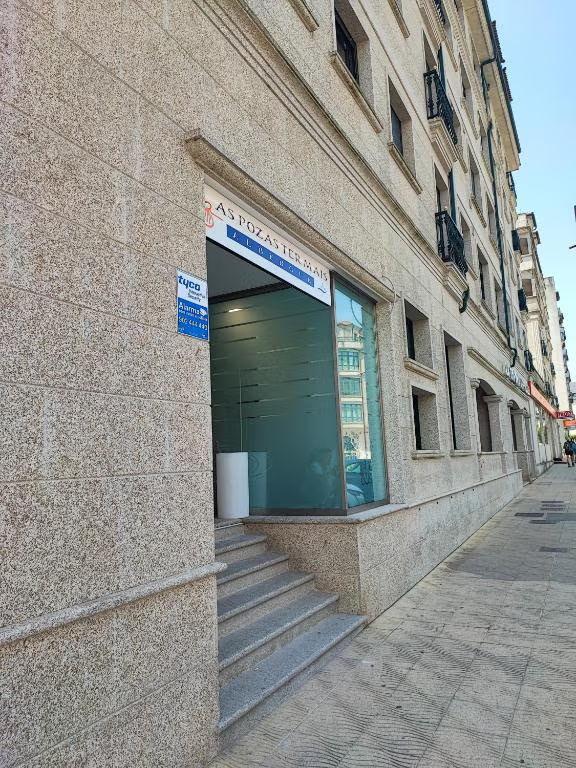
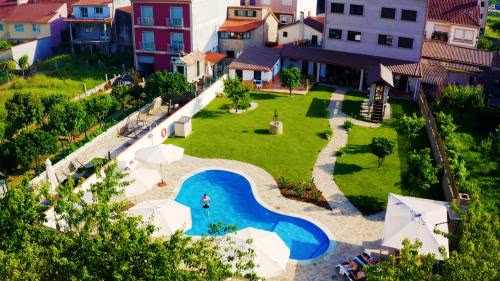
Albergue As Pozas Termais
- Top #2
 OpenReservations accepted
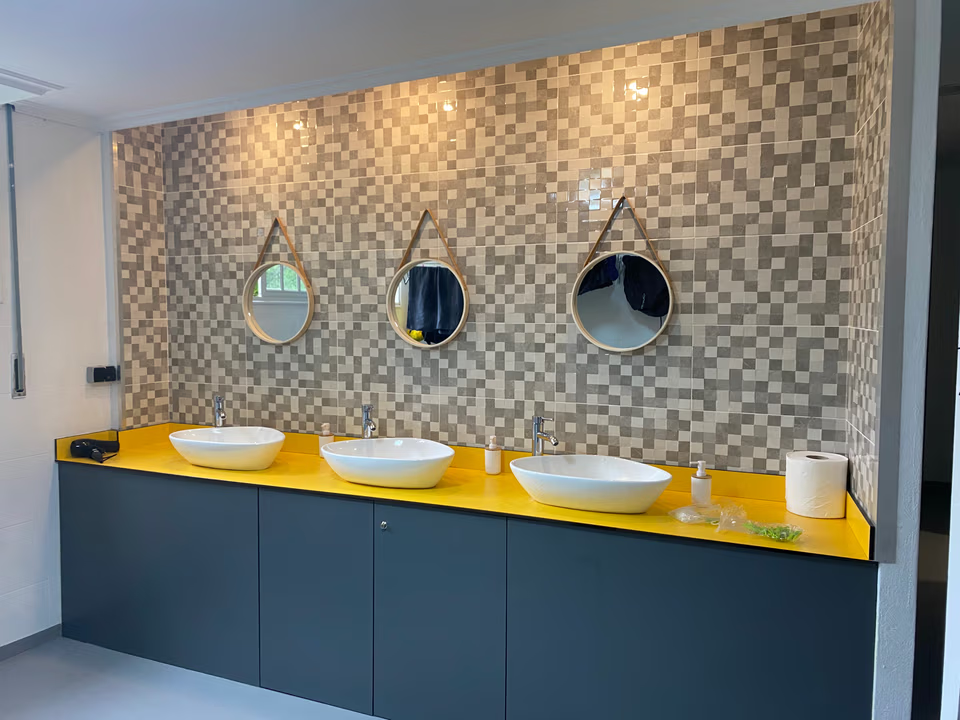
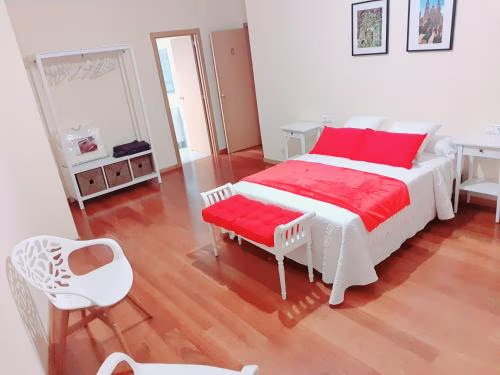
Albergue Urraca
- Top #3
 OpenReservations accepted
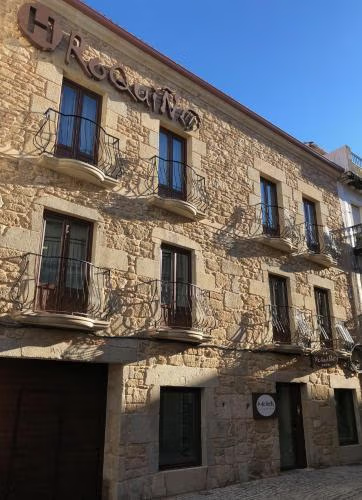
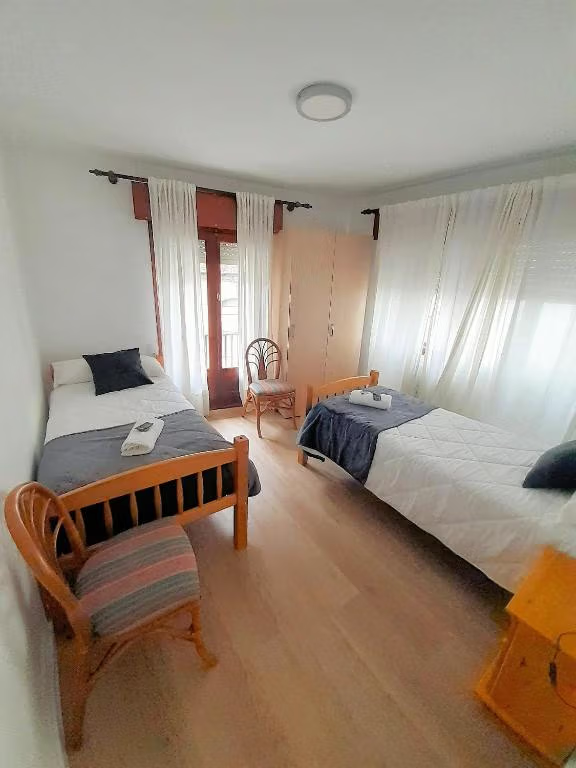
Hotel Pousada Real


Services in Caldas de Reis
What you can find in town before the next stage.
- ATM
- Café
- Shop
- Pharmacy
- Fountain
- Post office
- Train station
- Restaurant
Source: © OpenStreetMap contributors · updated April 2026
Town 26 of 31