

Stage town on the Camino
Pontevedra
Pontevedra, Galicia, Spain
- places to stay
- 38
- Caminos
- 5
- Elevation
- 20 m
Pontevedra is the last big city on the Camino Portugués before Santiago, and it has won walking back: the old town belongs to pedestrians. At its heart stands the church of the Pilgrim Virgin, built in the shape of a scallop shell. Here you choose between the main route and the Variante Espiritual. A rest day is worth it.
Right now in Pontevedra (as of October 2026)
- Santuario da Peregrina: The restoration of the outer facade has been finished since the end of July 2026, and the 1896 clock on the north tower is running again too.
- Museo de Pontevedra: The famous Caldas gold treasure has been temporarily off display since 15 October 2026. The Castro Monteagudo and García Flórez buildings are closed for renovation; the Castelao and Sarmiento buildings are open.
- Ruinas de San Domingos: closed to individual visitors from 1 November to 14 March.
- Public albergue: no reservations, beds are given out on arrival. In summer 2026 it was often full by the afternoon.
- Pontedetapas: The city's tapas route is expected to run from 5 to 23 November 2026.
How long to stay?
Worth a rest day, just not on a Monday. An afternoon is enough for the Peregrina and a walk through the old town. But Pontevedra has more: a free museum with two prophets from the Pórtico da Gloria, the roofless Gothic ruin of San Domingos, arcaded squares, tapas evenings on the Praza da Verdura and an old town you can stroll through without cars. And here you face a decision that needs some calm: carry on along the main route to Caldas, or cross over to the Variante Espiritual with its boat trip on the Ulla. A free day gives you time to sort out the boat and your accommodation. Don't plan it for a Monday, because then the museum and the ruins are closed.
Pontevedra in Ninja numbers
- 64,500 meters to the cathedral of Santiago. That is what an installation in the Rúa Virxe do Camiño says, which you pass as you arrive.
- Around 230,000 pilgrims a year now reach Santiago on the Portuguese routes. Almost all of them walk through Pontevedra.
- About one in five turns onto the Variante Espiritual beyond the city (an estimate by the Friends of the Camino Portugués for 2024).
Arriving: through the valley of the lepers
Coming from Redondela and Ponte Sampaio, you follow the Camino Portugués over the old cobbled Brea Vella da Canicouva, slippery when wet, and past the Capela de Santa Marta from 1617. A good 300 meters further on, the path forks. Since 2018 the official route has gone left onto the Senda Fluvial do Río dos Gafos, a shady path along the stream. “Gafos” is the Galician word for lepers. For the last kilometers before a city, that is a rather honest name.
The public albergue sits on the southern edge next to the railway and bus stations, about one and a half kilometers before the old town. From there you go along the Rúa Gorgullón and the Rúa Virxe do Camiño, where an installation shows the distance to Santiago: 64,500 meters. Then you turn into the pedestrian zone of the Rúa da Peregrina, and at the end it stands there: the curved Baroque facade of the Virxe Peregrina. Until 1852 the city gate Porta de Trabancas stood here. The square is still the threshold to the old town.
In brief: a city of bridge and harbor
Legend says Teucer, a hero of the Trojan War, founded the city. On the Peregrina fountain he tears open a lion's jaws. A humbler origin is more likely: a Roman station on the Via XIX and an old bridge over the Lérez, Latin pons vetera. From that came Pontevedra, and the Camino Portugués still follows the Roman road here in broad strokes.
In the fifteenth and sixteenth centuries Pontevedra was the largest city and the most important port of Galicia. The city held the monopoly on sardine oil and a tax-free fair, and the mariners' guild was so rich that it built its own church. Then the Lérez silted up the harbor, and the glory faded. In 1833 Pontevedra became a provincial capital and yet always remained in the shadow of the larger Vigo. Until in 1999 a mayor dared something from which every pilgrim benefits.
A city that took walking back
In 1999 Miguel Anxo Fernández Lores became mayor and took the old town away from the cars. The center followed. Car traffic in the old town fell by 92 percent, and around 80 percent of the former car space now belongs to pedestrians. In 2010 Pontevedra became the first provincial capital in Spain to introduce a 30 km/h limit across the whole city. Since 2007 there were twelve years without a single traffic death. The city has won United Nations and EU awards for it. Fernández Lores is still in office today.
For you as a pilgrim this is more than a statistic. For days you have been walking along national roads, pressing yourself against guardrails and waiting at crossings. Pontevedra is the first city on your way that is built for people on foot. The city even has a map in the style of a metro map, the “Metrominuto”, which shows the walking minutes between squares instead of stations. Notice how that feels. Pontevedra makes walking the most normal thing in the world again, and that is exactly what you have been doing for weeks.
On foot through the old town: what to see
Everything listed here is only a few minutes' walk from the Praza da Peregrina. The city has even measured it: its pedestrian map Metrominuto shows the routes from there in minutes instead of stops. So in Pontevedra you need no bus and no taxi, only the legs that brought you here in the first place.
- Santuario da Virxe Peregrina: Built from 1778, the Peregrina is the only church in Spain with a floor plan in the shape of a scallop shell. The curved facade sweeps toward you like an open shell. Inside, the holy water basin is a real giant clam from the Pacific, a gift from Admiral Méndez Núñez. The Madonna on the altar wears what you wear: pilgrim staff, gourd, hat and cloak. The Virxe Peregrina is the patron saint of the province and of the Camino Portugués. Legend says she led pilgrims safely to Santiago. Here you get your stamp, and in the evening there is a Mass (according to the pilgrim portal Gronze Monday to Saturday at 19:30, Sundays and public holidays at 13:00, check the times on site). Since July 2026 the facade has gleamed freshly restored. By the way, at the southwest corner of the square sits a bronze parrot. His name is Ravachol, he belonged to a pharmacist and around 1900 he was more famous than some mayors. When he died in 1913 he was given a public wake, which Pontevedra still re-enacts at the end of every carnival.
- Real Basílica de Santa María a Maior: The mariners' guild church was built in the sixteenth century. Its west facade of 1541 is designed like a stone altarpiece, with scallop medallions and, right next to the rose window, the busts of Christopher Columbus and Hernán Cortés. That the city's fishermen and sailors put an explorer on their church is no coincidence. More on that in the deep dive below. For pilgrims, one small figure matters. To the left of the south portal stands the Cristo del Buen Viaje, the Christ of the Good Journey. Sailors asked him for protection before setting out, and pilgrims do the same today before the last three stages. You can climb the tower for a small fee.
- Igrexa de San Francisco: The Gothic Franciscan church on the Praza da Ferrería lies right on the Camino and was built from around 1310. At about 100 meters long, it is said to be the tallest Franciscan church in Galicia. Tradition has it that Francis of Assisi himself founded the monastery when he made his pilgrimage to Santiago. The Franciscans are documented here only from 1274, but the legend is lovely all the same. Inside, Payo Gómez Chariño lies in stone on his tomb, with sword and knight's armor. He was an admiral and a troubadour, wrote love songs about the sea, and his heirs helped pay for the church. A knight who wrote poems, under the roof of a saint who is said to have walked to Santiago: for a pilgrim that is good company for a quarter of an hour of silence.
- Ruinas de San Domingos: Of the Dominican church, built from 1383, only the chevet with five polygonal apses remains. That is unusually splendid for Galician Gothic. The nave has vanished, and you stand under open sky in a church without a roof. In between lie gravestones, coats of arms and inscriptions from the museum. After weeks full of churches, this is the most impressive of them, precisely because it is incomplete. It is open from mid-March to the end of October, and admission is free. In winter you have to make do with a look over the fence.
- Museo de Pontevedra: The museum is spread across several buildings in the old town, admission is free, and from Tuesday to Saturday it is open until 21:00. That makes it ideal for a rainy day. It shows painting from Castelao to Sorolla, ceramics from Sargadelos and, when it is back on display, the Caldas gold treasure, one of the largest collections of prehistoric gold in Europe. The reason for pilgrims to go in: two prophets from the Pórtico da Gloria stand here, a good 60 kilometers before the cathedral. Master Mateo carved them for Santiago, and by winding paths they came to Pontevedra. So you see them before you see the Pórtico itself. There are also jet and silver works from Compostela, the kind pilgrims have taken home as souvenirs for centuries.
- Praza da Leña and the squares of the old town: The old town of Pontevedra consists of small squares, each named after what was once sold there. On the Praza da Leña it was firewood, on the Praza da Verdura vegetables, and on the Praza da Ferrería the tax-free fair took place from 1467. On the Leña stands a stone wayside cross that the artist Castelao had brought here from Caldas de Reis in 1941. Around the squares there are arcades, Baroque town palaces and terraces. This is where the evening life happens. Once you have showered at the albergue and hung up your laundry, sit down on the Verdura or the Leña, order a glass of Albariño and watch the locals who have reclaimed their city on foot.
Food and drink
Pontevedra lies in the Rías Baixas, and you can taste it: seafood from the rías, pulpo, pimientos de Padrón, empanada. On the tapas menus of the old town you will also find hearty Galician cooking: raxo (fried pork), zorza (seasoned minced meat), orella (pig's ear), lacón (boiled ham) and in spring dishes with lamprey, the lamprea. With it you get Albariño, the region's fresh white wine, which grows on pergolas held up by granite posts. According to tradition, Cistercian monks from Armenteira brought it here, and you pass that monastery if you take the Variante Espiritual.
The tapas zones in the evening are the Praza da Verdura and the Praza da Leña, plus the lanes around the Praza das Cinco Rúas. The Mercado de Abastos by the Lérez is open on weekday and Saturday mornings. Upstairs there is a gourmet market with a view of the river. In November it is worth asking about the tapas route Pontedetapas.
Honestly
- The way into the city is its weakest part. After the shady path along the stream come suburbs, the station district and an underpass beneath the tracks. Pontevedra only becomes beautiful from the Rúa da Peregrina on. Don't let that fool you.
- The public albergue is at the wrong end of the city. It is well run and cheap, but it lies a kilometer and a half before the old town. If you sit on the Praza da Verdura in the evening, you then walk another twenty minutes back to the station.
- In winter part of the city is missing. From November to mid-March the Ruinas de San Domingos are closed, and the gold treasure in the museum has been off display since October 2026. A rest day is still worth it, but it will be quieter.
- The Variante Espiritual is no stroll. On the first day you climb steeply from the coast, around 400 meters of ascent to Armenteira, accommodation along the way is scarce, and the boat costs around €30 and in late autumn runs only on request (as of 2026). If your feet are already protesting, the main route is the wiser choice.
- The stage to Caldas gets long toward the end. The second half runs over open tracks with little shade. In the heat, set off early and carry enough water.
Where pilgrims sleep
The only classic pilgrim albergue in the city is the public Albergue de peregrinos Virxe Peregrina on the southern edge, right by the station. Since 1999 it has been run by the Friends of the Camino Portugués, an association from Pontevedra, and volunteer hospitaleros from all over the world sit at reception. It has 56 beds, up to 86 in high season, costs €10 a night and takes no reservations: first come, first served (as of October 2026). Pilgrims in the app praise the large kitchen and the common room, and the supermarkets are around the corner.
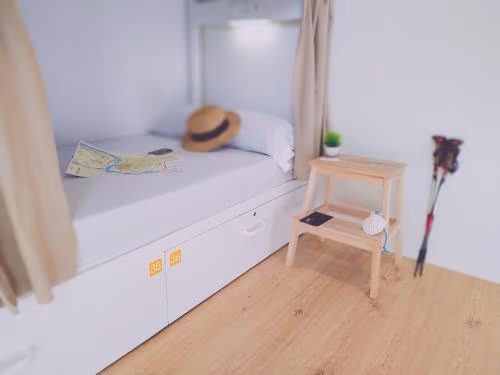
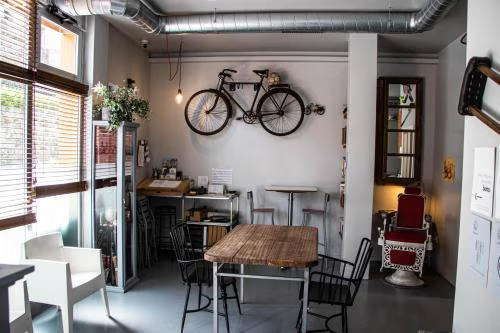
Besides that, there are several private hostels with dormitories in the old town and along the way. They mostly cost around €20 a night, are more central and can be reserved. For a rest day they are the better choice, because you can also stay two nights there.
Ninja tips
- Up for €1: You can climb the dome of the Peregrina for one euro, and from above you see that the church really is a shell. The tower of Santa María costs the same.
- Google Maps doesn't know the stream: Google Maps does not show the official route along the Río dos Gafos and sends you onto the sunny country road. Follow the yellow arrows or the Camino Ninja map, not the navigation app.
- Read the fountain: On the Praza da Ferrería the fountain carries the saying the city tells about itself: “Pontevedra é boa vila, dá de beber a quen pasa”, Pontevedra is a good town, it gives a drink to everyone who passes by. For pilgrims that is a lovely welcome.
- Plan in walking minutes: Photograph the Metrominuto. The map in the style of a metro map hangs on boards around the city and shows how many minutes it takes you to reach each destination from the Peregrina. Build your rest day around it, not around a list of sights.
- In high season, be there in the morning: A pilgrim in the app advises queuing for the public albergue by 11:00 at the latest. In summer 2026 it was often full by the afternoon. If you arrive later, book a private place beforehand.
- Cooking for yourself pays off here: Several Camino Ninja pilgrims praise the large kitchen of the public albergue and the supermarkets right around the corner. Cook your dinner there and save the tapas for a stroll through the old town.
- A farewell with a blessing: Before setting off, make the small detour to Santa María a Maior and the Cristo del Buen Viaje. The sailors took their blessing here before heading out. Three stages before Santiago, that suits you just as well.
When it rains
And it often does here: in October and November Pontevedra gets more than 200 millimeters of rain each, on around 14 days a month. A rainy rest day doesn't have to be a lost one.
- Into the museum, until evening: The Museo de Pontevedra costs nothing to enter and is open until 21:00 from Tuesday to Saturday, and on Sunday mornings (as of October 2026). The Castelao and Sarmiento buildings are in the middle of the old town, so you only get briefly wet going from one to the other.
- To the market, in the morning: In the Mercado de Abastos by the Lérez you are under a roof, and upstairs you can eat at the gourmet stalls with a view of the river. It is open Monday to Saturday until early afternoon.
- Under the arcades: Around the Praza da Leña and in the lanes of the old town there are arcades. Here you can go from café to café without opening your umbrella.
- Into the churches: The Peregrina, San Francisco and Santa María a Maior are all only a few minutes' walk apart. In the rain they are quiet and almost empty, and that is often the loveliest way to see them.
- In the evening, into the tapas bars: On the Praza da Verdura people simply move from outside to inside when it rains. You should follow their example.
Practical tips for pilgrims
- Water and provisions for the stage in: Between Ponte Sampaio and the albergue lie a good eleven kilometers with just one bar, in Ganderón. Pack enough in the morning.
- Albergue or old town: The public albergue is at the station, a kilometer and a half from the center, and takes no reservations. For a rest day you will usually need private accommodation. It is better located in the old town, so you don't walk back to the outskirts in the evening.
- Avoid Monday: On Mondays the museum and the ruins are closed, on Sundays they are open only in the morning, and the market is closed on Sundays.
- Stamp: You get the loveliest stamp at the Peregrina. From here on you need two a day, so pick up a second one in a bar or church in the evening.
- Plan the Variante Espiritual: The boat across the Ría de Arousa and up the Ulla runs daily in season, depending on the tides. In late autumn it often runs only on request. Book or ask in Vilanova de Arousa before you set off. The variant also shifts your following stages.
- Luggage: The postal backpack transport (Correos Paq Mochila) has served the Camino Portugués between Tui and Santiago since November 2025. You can book until 20:00 the evening before.
- Shopping for tomorrow: On the way to Caldas, after a good three and a half kilometers there is a small shop in Santa María de Alba, after that only bars. Buy supplies in the city if you want to picnic on the way.
- Train and bus: The railway station and bus station are next to each other on the southern edge, right by the albergue. If you want to make a side trip to Combarro or to the sea, this is your starting point.
Onward: over the bridge, then left or straight on?
You leave the city over the Ponte do Burgo, successor to the Roman bridge, first mentioned in 1165. Stone scallop shells decorate the piers, and at night small blue lights in the paving show you the Camino. Just beyond it, in the Rúa da Santiña, is a house where a family keeps a small figure of Saint James. Legend says the apostle once found shelter there.
The main route leads through the Marismas de Alba and through forest and villages in a good 20 kilometers to Caldas de Reis, the thermal town. About three kilometers beyond the bridge the Variante Espiritual branches off, which roughly one in five pilgrims chooses. It leads over Poio and the hórreo village of Combarro steeply up to the monastery of Armenteira. Its founder Ero, according to legend, listened to a bird and returned only after 300 years. Then it goes along the Ruta da Pedra e da Auga with its mills to Vilanova de Arousa and from there by boat up the Ulla, past 17 stone crosses, on the route the body of the apostle is said to have taken as well. Both routes meet again in Padrón.
What awaits you tomorrow
Most Camino Ninja pilgrims spend their next night in Caldas de Reis, and something waits there that you will have earned after a good 20 kilometers: hot water. In the middle of the town it has flowed since 1881 from the two lion heads of a public fountain, almost 50 degrees warm. The Romans already named the place after its springs. Right next to it is an old wash house with warm water, where pilgrims dip their feet and get talking. There is hardly a nicer way to end a stage.
If you take the Variante Espiritual, Combarro awaits you instead, with its hórreos right on the water, and then the steep climb to the monastery of Armenteira, where the legend of Ero and the bird is set.
Deep dive: bridge, harbor and a Madonna in a pilgrim's cloak
A long read, in case you want to learn more about Pontevedra. About twenty minutes' reading.
A city on the river
When you stand on the Ponte do Burgo in Pontevedra and look at the Lérez, you stand at the point that brought this city into being. A river that flows broad and calm into the ría, a spot where it could be crossed, and a sheltered arm of the sea behind it that let ships come almost up to the city. Bridge and harbor are the two things around which the history of Pontevedra turns. The bridge led pilgrims here, the harbor made the city rich, and when it disappeared, Pontevedra went quiet for centuries.
The city itself prefers to tell its beginning differently. Teucer is said to have founded it, an archer from Homer's Iliad who, after the fall of Troy, wandered across the sea and came ashore here. The inhabitants still like to call themselves “teucrinos”. On the Peregrina fountain Teucer stands in granite, tearing open a lion's jaws. None of this is documented. But the myth says something true about the people here: they were always convinced that their city deserved an important past.
The Romans and the old bridge
The sober history begins with a road. The Romans built the Via XIX, which connected Bracara Augusta, today's Braga, with Lucus Augusti, today's Lugo. On the south bank of the Lérez lay a rest station that the sources call Turoqua. Here the road crossed the river, roughly where the Ponte do Burgo stands today. In 1988 a milestone bearing the name of Emperor Hadrian was found near the bridge. It dates from the 130s after Christ.
When you walk the Camino Portugués, you walk for long stretches in the footsteps of this road. The Romans looked for the most direct, safest way north, and the pilgrims of the Middle Ages did the same. The name of the city recalls it. A charter of 1141 calls the place Pontus Veteri, the old bridge. So even nine hundred years ago it was already old.
A stream with a harsh name
Before you arrive in Pontevedra, you walk along a stream whose name is worth knowing. It is called Río dos Gafos, and gafos is the Galician word for lepers. Where exactly the name comes from is not documented. Probably there was a house for people with leprosy here, as outside many medieval cities.
In the Middle Ages leprosy was an illness that shut people out of the community. Those who had it were not allowed to live in the city. Separate houses were built for the sick outside the walls, often on the great roads, because there they could ask travelers for alms. Many of these houses were dedicated to Saint Lazarus. When you reach Santiago on the Camino Francés, shortly before the city you walk through the San Lázaro district, which takes its name from such a house. On many pilgrim routes the leper houses lined the approaches to the cities.
For the pilgrims of that time this was a familiar sight: before entering the city, you saw those who were not allowed in. Many pilgrims were ill themselves and hoped for healing through the apostle. So the road led past those for whom there was no healing left. Today the stream is a shady path, since 2018 the official route. It does no harm to think, on these last kilometers before the city, of those who had to stay out here.
Sardines, salt and privileges
In the Middle Ages the bridge settlement became a port city. In 1169 King Fernando the Second of León granted it city rights. What followed reads like the success story of a trading city. In 1229 Pontevedra received the monopoly on sardine oil in all of Galicia. Salted fish went to Portugal, Castile and the Mediterranean ports. In 1452 the harbor became the loading and unloading place for the whole of Galicia. In 1467 King Henry the Fourth granted the city a tax-free fair of thirty days, held on the Praza da Ferrería, right in front of the Franciscan church that you walk past today. Every year in September the Feira Franca recalls it, when the whole old town throws itself into medieval costume.
The backbone of this wealth was the sailors. At the end of the fifteenth century they founded their guild, the Gremio de Mareantes. It is considered the oldest seafarers' association in Spain. The Mareantes controlled maritime trade and wanted to show what they had. So they built themselves a church, Santa María a Maior, with a facade that is still the most magnificent in the city. The names of the guilds are still in the streets of the old town. When you walk through the lanes, you walk through the organization chart of a medieval port city.
In the fifteenth century Pontevedra was the most important urban center of Galicia, in the sixteenth the largest port and the city with the most inhabitants. In 1557 it was even, briefly, the capital of the Kingdom of Galicia. Santiago was the city of the apostle, A Coruña the city of the crown. Pontevedra was the city of money.
An admiral who wrote poems
One of the men who rose to greatness in this period lies buried today in San Francisco: Payo Gómez Chariño. He lived in the thirteenth century, became Admiral of Castile and was at the same time a troubadour. About twenty-eight poems by him survive, written in Galician-Portuguese, the language of lyric poetry of that age. Many are about the sea, about parting and waiting. On his tomb he lies in full armor, with a sword. The inscription calls him Payo Guomez Charino. His heirs paid for part of the church in which he lies.
The Franciscans, who owned the church, liked to tell how Francis of Assisi himself founded their monastery when he made his pilgrimage to Santiago. That Francis went to Compostela around 1214 is an old tradition. That he founded a monastery in Pontevedra on the way cannot be proven. But the story shows how naturally the Camino belonged to this city's image of itself. Whoever wanted to claim importance linked themselves to a famous pilgrim.
A language across the border
If you set out from Porto or Tui, you may have noticed something odd. When you crossed the Minho into Galicia, the language on the signs and in the bars sounded hardly different from before in Portugal. That is no coincidence. In the Middle Ages the same language was spoken north and south of the Minho, Galician-Portuguese. In the thirteenth century it was the language of poetry across the whole Iberian Peninsula. Even a Castilian king like Alfonso the Wise wrote his songs to Mary in it.
Payo Gómez Chariño, the admiral who lies buried in San Francisco, wrote poetry in this language. Only later did the paths part. Portugal became a kingdom of its own with its own written language, Galicia became part of Castile, and Galician became for centuries the language of peasants and fishermen, while Spanish was used in churches, offices and schools. Only in the nineteenth century did poets like Rosalía de Castro begin to write in Galician again. The book regarded as the first work of this rebirth appeared in 1853 here in Pontevedra.
For you as a pilgrim on the Camino Portugués this means: you walk through a language area that is older than the border dividing it. The words for bread, water, road and church hardly change when you go from Valença to Tui. Listen for a moment when the old people in the villages beyond Pontevedra talk to each other. You may hear how Portugal and Galicia were once one country.
Queens, kings and a Medici
Over the centuries pilgrims from all walks of life came through Pontevedra, among them crowned heads. In 1325 Queen Isabel of Portugal made the pilgrimage to Santiago, later canonized as the Rainha Santa. She gave money for pilgrim hospitals along the way and laid down her crown in Santiago. In 1502 came King Manuel the First of Portugal, the ruler of the Age of Discovery. In 1669 the young Cosimo de' Medici, later Grand Duke of Tuscany, traveled this route with a large retinue and had his journey documented by an artist.
Most pilgrims, however, were not kings. They were farmers from the Minho, fishermen, merchants, monks, the sick and penitents, who came on foot and stayed the night in the city's hospitals. Little is known about them, except that the city looked after them, because they contributed to its prosperity and because it was a Christian duty.
Where the pilgrims slept
As in every city along the way, Pontevedra had hospitals where pilgrims could stay the night, eat and be cared for. In the Middle Ages the word hospital meant more than a place for the sick. It was a shelter for strangers, the poor and the sick all at once, usually run by a brotherhood, a monastery or a wealthy foundation. Pilgrims stayed a night, sometimes two, were given bread, a soup and a place on straw, and moved on.
One of these houses, the Hospital San Juan de Dios, was pulled down long ago. A piece of it has survived, though: its bells and its clock hang today in the towers of the Peregrina. When the clock on the north tower strikes, which in 2026 was set running again after months of standstill, you hear the voice of an old hospital.
The line from back then reaches to today. Since 1999 the association of the Friends of the Camino Portugués has run the city's public albergue. Volunteer hospitaleros receive pilgrims from all over the world there every evening. In October 2026 around seventy of them met in Pontevedra for their international annual gathering. A canon from Santiago recalled something that probably always belonged to the Way: in every age there were false pilgrims who claimed a bed without having walked the road. Hospitality was never made conditional all the same.
The admiral from Pontevedra?
No chapter of the city's history is argued over as passionately as the one about Christopher Columbus. Two claims persist stubbornly. The first: the flagship of his first voyage, the Santa María, was built in Pontevedra and was originally called La Gallega, the Galician woman. The Galician name is well documented. That the ship was launched in Pontevedra rests mainly on a book from 1897, and there is no shipyard record.
The second claim is bolder still: Columbus himself was a son of Pontevedra. The local historian Celso García de la Riega presented this thesis in Madrid in 1898. He relied on documents from the fifteenth century in which people named Colón appear in Pontevedra. After his death he was accused of forgery. Only in 2013 did the Spanish Institute of Cultural Heritage examine the documents and reach a remarkable result: the documents are genuine and from the period. But someone had later gone over the names in ink, presumably so that they would be more legible in photographs, and probably without any intention to deceive.
That is a very Galician end to a story. The documents are genuine, the names too, and yet they only prove that there were people named Colón in Pontevedra, not that the admiral was one of them. The majority of historians stay with Genoa. The city has put Columbus on the facade of its mariners' church all the same, and a square on the Camino bears the name of García de la Riega. You walk across it before you come down to the bridge.
When the river took the harbor
Toward the end of the sixteenth century the decline began, earlier than in the rest of Galicia. The Lérez washed sand and mud into the ría, and the harbor silted up bit by bit. Larger ships could no longer get in. At the same time the crown lost interest, wars disrupted trade, and the Atlantic ports further south drew the business away. In the seventeenth and eighteenth centuries the population halved. In 1646 a flood almost tore down the bridge. In 1719 English troops occupied the city for fifteen days, set fires and destroyed the towers of the bridge.
It is a peculiar irony that the same river that had brought the city into being took its harbor away. To this day the city plans to dredge the Lérez. The port city had become a city on a river.
A Madonna in pilgrim dress
In the middle of these quiet centuries falls the building that stands for the city today. In the eighteenth century a brotherhood in Pontevedra venerated a Madonna in pilgrim dress, with hat, staff and gourd. According to legend she had accompanied and protected pilgrims on the way from Baiona to Santiago. For her they began to build a new church in 1778, at the spot where pilgrims came through the city gate into the old town.
The architects, the Portuguese Antonio de Souto and Bernardo José de Mier, gave it a floor plan that exists nowhere else in Spain: the shape of a scallop shell with a cross inscribed in it. The convex facade bulges out toward the square. On it stand Mary, Joseph and James as pilgrims. The message is hard to miss: here the Mother of God herself is one of you, a pilgrim walking with you.
To this day the Virxe Peregrina is the patron of the province and of the Camino Portugués. Every year in August the city celebrates her feast with a procession. And when in 2026 the scaffolding came down from the restored facade, the clock on the north tower, the oldest in the city, ran again too, after months of standstill. It was restored by the clockmaker who also looks after the clocks of the cathedral of Santiago.
Provincial capital, poets and a parrot
In 1833 Pontevedra became the capital of the new province, and in 1835 it received the title of city. It was a city of civil servants, lawyers and schoolboys, no longer of sailors. But in exactly this middle-class city something new grew. In 1853 Xoán Manuel Pintos's “A gaita gallega” appeared here, a book regarded as the first work of modern Galician. Ramón María del Valle-Inclán, one of the great writers of Spain, attended school here and published his first book in Pontevedra in 1895. He was born in Vilanova de Arousa, where the pilgrims of the Variante Espiritual board the boat.
In the 1920s and 30s the Café Moderno was the meeting place of the Galicianists, the men who fought for the language and self-government of Galicia. Their most famous mind was Castelao: painter, draftsman, writer, politician. He wanted to be an adopted son of this city, and today a museum building bears his name. In front of the café the Galicianists now sit in bronze at a table, with empty chairs for you.
And then there is Ravachol. In 1891 the pharmacist Perfecto Feijoo, whose pharmacy stood on the Praza da Peregrina, was given a parrot by a friend. He named it after a French anarchist, because the bird was so unruly. Ravachol announced the customers and was soon known all over town. When he died in January 1913, the craftsmen's society set up a funeral chapel for him in the pharmacy, and half the city came to the mourning ceremony. Since 1985 the carnival in Pontevedra has ended every year with Ravachol's wake and burial. A city that honors a parrot like that does not take itself too seriously. That makes it likable.
Castelao: always in Galicia
One of the men from the Café Moderno deserves a section of his own. Alfonso Daniel Rodríguez Castelao was born in 1886 in Rianxo, a fishing town on the Ría de Arousa, not far from the boat route of the Variante Espiritual. He was a doctor but gave up the profession and became a draftsman, painter, writer and politician. His drawings show the rural Galicia of his time: farmers, emigrants, old women at the hearth, children with big eyes. They are tender and bitter at once and tell of a poor land that sends its sons to America.
In the 1930s Castelao lived in Pontevedra and fought for a statute of autonomy for Galicia. After the Civil War he had to go into exile, first to the United States, then to Buenos Aires. There he wrote his main political work, titled Sempre en Galiza, always in Galicia. In 1950 he died in Buenos Aires without having seen his homeland again. Only in 1984 were his remains brought to Galicia. Today he lies in the Pantheon of Illustrious Galicians in the monastery of Santo Domingo de Bonaval in Santiago, right next to the Porta do Camiño.
For pilgrims this is a lovely connection. In the museum of Pontevedra you see his pictures, in the old town he sits in bronze at the table of the Café Moderno, and in Santiago you walk past his tomb if you arrive on the Camino Francés or visit Bonaval. Castelao wanted Galicia not to be forgotten. The pilgrims who walk through his country by the hundreds of thousands every year contribute to that in their own way.
The city that took the street from the cars
The twentieth century was no golden age for Pontevedra. Under Franco neighboring Vigo got the free port and industry, and Pontevedra remained the smaller sister. In the 1960s factories came to the ría, with environmental problems that occupied the city for a long time. At the end of the nineties the old town was considered neglected and was full of parked cars.
In 1999 Miguel Anxo Fernández Lores became mayor, a doctor, and began something that many then considered madness. He closed the old town to cars, then the center, moved parking to the edge, built sidewalks across whole streets and lowered speeds. Car traffic in the old town fell by more than ninety percent. The number of seriously injured people in road traffic dropped from 129 in 1999 to a handful per year, and for twelve years there was not a single traffic death. Two thirds of all trips in the city are now made on foot. The old town lives again, and Pontevedra is growing while many cities in Galicia shrink.
That of all places a city on the Way of Saint James rediscovered walking is a lovely coincidence. The Camino is a movement of people who have decided not to drive for a while. Pontevedra has decided the same, only permanently.
The sea on the doorstep
Pontevedra lies at the end of a ría, one of those deep arms of the sea that reach far inland along the coast of Galicia. The Rías Baixas, the lower rías, are among the most fertile sea areas in Europe. Here fresh water from the rivers mixes with the cool, nutrient-rich Atlantic, and fish, crabs and shellfish live on it in great numbers. If you see wooden platforms in the water of the ría, those are bateas, floating mussel farms. Galicia is among the largest mussel producers in the world.
For a pilgrim this has a special charm. The shell you carry on your backpack is here no symbol but dinner. The scallop, in Galician vieira, lives off this coast, and in the restaurants of the old town you can order it baked. The medieval pilgrims bought their shells in Santiago and fastened them to hat and cloak. The shell gatherers who supplied them came from exactly these coasts.
The fishermen and sailors of Pontevedra knew how dangerous the sea is. That is why they asked the Christ of the Good Journey for protection before setting out, why they endowed churches and made vows. The sea has made the city rich and poor, depending on whether the harbor was open or silted up. To this day it determines what comes to the table here and what many families live on.
Two cities, one rivalry
About thirty kilometers south of Pontevedra lies Vigo, today the largest city in Galicia, with one of the most important fishing ports in Europe. For a long time it was the other way round. When Pontevedra was the largest city in Galicia in the sixteenth century, Vigo was a fishing village. Then the harbor of Pontevedra silted up, while Vigo lay on a deep, open ría that the big ships could enter. In the twentieth century Vigo got a free trade zone, shipyards and car factories. Pontevedra remained the provincial capital, but the smaller of the two cities.
The rivalry is still felt today, in politics, in football and in many small digs. People from Vigo like to call Pontevedra a little town of civil servants, people from Pontevedra think Vigo is loud and ugly. Neither is quite true, and both cities know it.
For pilgrims the rivalry is interesting for a particular reason. Whoever walks the Portuguese coastal route comes through Vigo and then meets the Camino Central in Redondela. From there everyone goes on together to Pontevedra. So here in Pontevedra the pilgrims of both routes come together, those from the coast and those from the interior. In the evening on the Praza da Verdura they sit next to each other and tell each other whether the sea or the vineyards were lovelier. Among the pilgrims, the rivalry between the cities has turned into a friendly conversation.
The Way today
By the end of September 2026 almost 200,000 pilgrims had reached Santiago on the two Portuguese routes, more than ever before, and almost three out of four came from abroad. Most of them walked through Pontevedra. The public albergue at the station, run by the Friends of the Camino Portugués, has 86 beds and is full by the afternoon in summer. On some days there was no free bed left in the whole city, and pilgrims slept in the open. Celestino Lores, the president of the association, said in summer 2026 that so much growth frightened him. At a meeting of the hospitaleros in October the mayor jokingly suggested calling a book about him “O Códice Celestino”, an allusion to the Codex Calixtinus, the first pilgrim guide in history.
For you this means two things. First: Pontevedra is no longer an insider tip, so plan your night here. Second: you are part of a movement that is changing this city, just as the pilgrims of the Middle Ages changed it.
A monk, a bird and three hundred years
Whoever chooses the Variante Espiritual in Pontevedra walks into a landscape full of stories. The best known is set in the monastery of Armenteira, which you reach at the end of the first day, after a steep climb from the coast.
In the twelfth century a knight named Ero lived here with his wife. They remained childless, and it was said that their descendants would be of a spiritual kind. So they founded monasteries. Bernard of Clairvaux, the great Cistercian, sent four monks to Armenteira, and Ero himself became a monk and later abbot. One day, so the legend goes, he asked the Mother of God to grant him a glimpse of Paradise. He went into the forest, sat down by a spring and listened to a bird that sang so beautifully that he forgot everything around him. When he returned to the monastery after what seemed a few minutes, nobody knew him anymore. Three hundred years had passed.
King Alfonso the Tenth of Castile, the Wise, took the story into his songs to Mary in the thirteenth century, the Cantigas de Santa María. It is song number 103. Similar stories exist in many Celtic traditions, and in Galicia, which likes to invoke its Celtic roots, it is popular to this day. The monastery itself fell into ruin in the nineteenth century after the Spanish state expropriated the monasteries. Only toward the end of the twentieth century was it rebuilt, and today Cistercian nuns live there again. According to tradition it was also the Cistercians who brought Albariño to this region, the wine you drink in the evening in Pontevedra.
The next day the Ruta da Pedra e da Auga, the route of stone and water, leads along a stream through a forest full of old mills down to the sea. From Vilanova de Arousa the boat then travels across the ría and up the Ulla. The trip recalls the legend that the body of the apostle came to Galicia on this water. On the bank stand seventeen stone crosses, advertised as the only Way of the Cross on water in the world. The route itself, by the way, is a modern idea. It was proposed in 1963 by a man named José Luis Sánchez-Agustino and became a pilgrim route only decades later. That takes nothing away from it. Many pilgrims say the hour on the boat, silent between mussel beds and crosses, was one of the quietest moments of their whole Way.
Perhaps that is the real message of the legend of Ero. Whoever gives themselves completely to a moment loses the sense of time. On the Camino many know this experience: days that feel like weeks, and weeks that pass like a day. Whether you take the detour or not, you will carry the question of time with you.
The bridge you cross tomorrow
Finally, back once more to the bridge with which this story began. The Ponte do Burgo, as it is called today, stands at the spot where the Roman road already crossed the Lérez. In 1165 it is mentioned in a charter as an old bridge. Originally it had fifteen arches and was a good 150 meters long. Floods, wars and rebuilding have changed it again and again. In 1646 the flood almost tore it down, in 1719 the English destroyed its towers, in the nineteenth and twentieth centuries it was widened so that carriages and cars could pass over it.
In the 1950s stone shells were set between the arches, as a sign that the Way of Saint James runs here. In 2019 and 2020 the bridge was rebuilt and has belonged ever since to pedestrians and cyclists. At night small blue lights glow in the joints of the paving and mark the Camino. For a bridge that for two thousand years carried mostly carts, horses and trucks, this is a late return to its oldest task: bringing people on foot across the river.
On the other bank there used to be a small chapel, Santiaguiño do Burgo, the little James of the bridge. In the Rúa da Santiña, through which you leave the city tomorrow morning, a family still keeps a figure of the saint. According to tradition the apostle himself once found shelter in this house. Every year the family brings him the first grapes and the first maize of the year. It is a small, private piety at the edge of the great pilgrimage, and yet it says much about this land: here the apostle is not just a saint in a distant cathedral but a neighbor to whom you give a share of the harvest.
When you cross the bridge tomorrow morning, perhaps still in the dark, you follow the blue lights. Beneath you flows the river that first gave this city its harbor and then took it away again. Ahead of you lie three more days to Santiago. Behind you lies a city that has learned that you can grow great again on foot.
What Pontevedra gives you
For many pilgrims Pontevedra is a turning point, even if they only notice it later. It is the last big city before Santiago. About 65 kilometers remain, three daily stages. Here you notice that the goal is near, and perhaps also that you don't want to arrive yet.
And here you have to decide. The main route leads straight ahead over Caldas and Padrón to Santiago. The Variante Espiritual leads in an arc over the sea, to Ero's monastery and then up the river by boat. There is no wrong choice. But it is worth taking the question seriously: do you want to arrive, or do you want to be on the way a little longer?
When you sit on the Praza da Leña in the evening, the glass of Albariño in front of you, watching the people who walk through their city on foot, think of the sailors who asked the Christ of the Good Journey for protection before setting out. And of the Madonna with the pilgrim hat, who for over two hundred years has stood at the city gate and welcomes everyone who arrives. Tomorrow you cross the old bridge, following the blue lights. It has carried many before you.
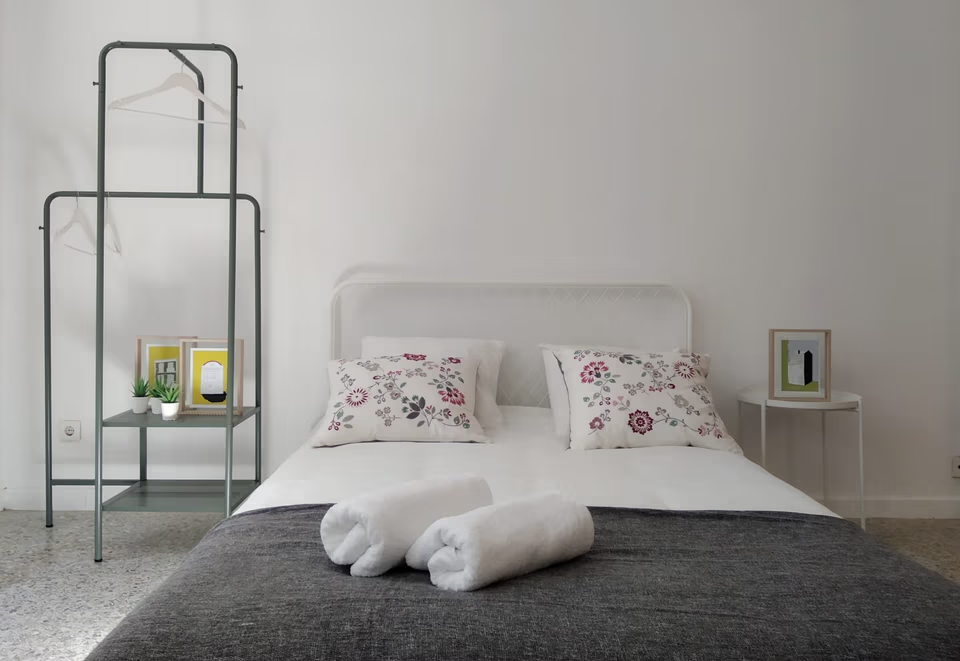
Where to stay in Pontevedra
The places pilgrims rate highest in Pontevedra come first.
- Top #1
 OpenReservations accepted
Hostel Charino
- Top #2
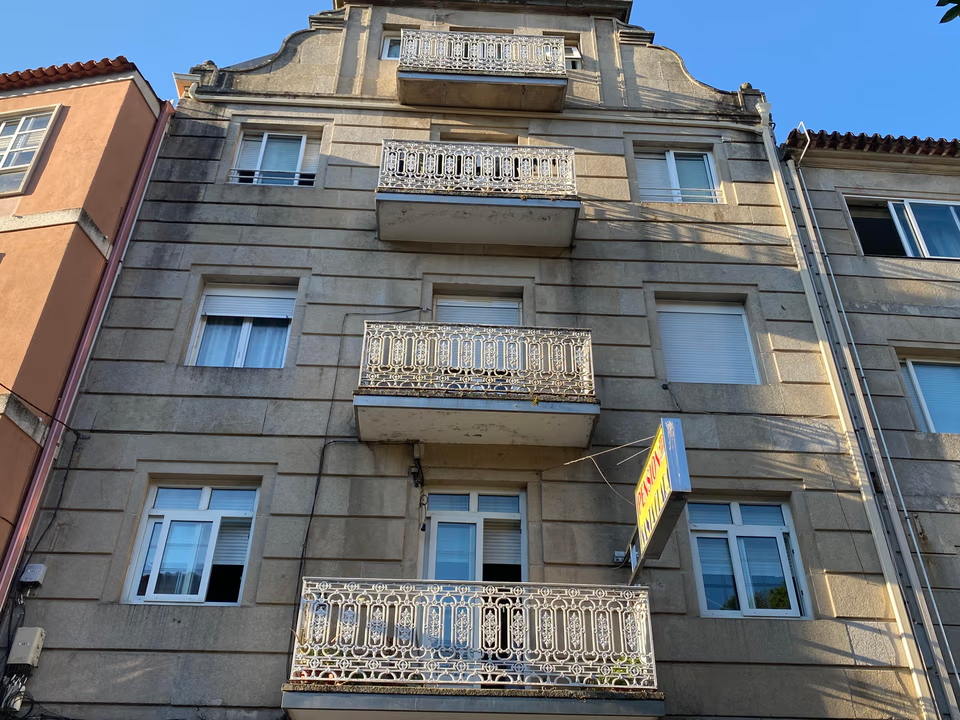 OpenReservations accepted
Pensión Santa Clara
- Top #3
 ClosedReservations accepted
Bulezen Urban Hostel



Services in Pontevedra
What you can find in town before the next stage.
- ATM
- Café
- Shop
- Tobacco
- Medical clinic
- Pharmacy
- Fountain
- Post office
- Train station
- Bus station
- Restaurant
Source: © OpenStreetMap contributors · updated April 2026
Town 25 of 31