

Town on the Camino
Castelo Branco
Portugal
- places to stay
- 14
- Camino
- 1
- Elevation
- 417 m
In Castelo Branco you have three quarters of the Via Nascente behind you: 494.9 kilometres since Tavira, with 166.3 still to go to Trancoso. The city of the Templars has a bishop's garden where the kings stand on a staircase and the Spanish ones have deliberately been made smaller. An afternoon is enough for the garden, the castle hill and the embroidery.
How long to stay?
An afternoon is enough, but really take it. You arrive after 31.5 kilometres from Vila Velha de Ródão, and tomorrow brings 34.1 kilometres to Castelo Novo. You rarely have the energy for more than an afternoon, but for less the bishop's garden is too good to rush. The garden, the castle hill and the embroidery centre are close together. According to the city's leaflet the municipal museums are closed on Mondays; if you arrive on a Monday, you mainly have the garden and the castle hill.
Castelo Branco in Ninja numbers
- 494.9 kilometres is how far you have walked since Tavira according to Camino Ninja. That is three quarters of the Via Nascente.
- 166.3 kilometres remain to Trancoso, the end of the way. From there it continues towards Santiago.
- 34.1 kilometres to Castelo Novo, the next popular place. According to one pilgrim guide, there is no restaurant, shop or cash machine on the way until Soalheira, after 26.6 kilometres.
- 1721 is when Bishop João de Mendonça laid out the garden that is now the best-known image of the city.
- 1771 is when Castelo Branco became a city and a bishop's seat. Just 110 years later, in 1881, the diocese had been dissolved again and went to Portalegre.
Arriving: the long asphalt before the garden
The stage from Vila Velha de Ródão is 31.5 kilometres long, and its end is not its prettiest part: according to one pilgrim guide you walk the last eight kilometres or so on asphalt, through commercial and industrial areas, before you reach the centre. After that it gets better. Castelo Branco is a district capital with a good 34,000 people in the urban area (2021 census) and everything a pilgrim needs: according to one pilgrim guide, all services, supermarkets, restaurants and good transport connections.
The city lies on the border between two landscapes: here granite and schist meet. Up on the hill stood the Templar castle, and below on the slope lies the old town with the bishop's palace and its garden. The place may have borne its name since Roman times: Castra Leuca was the name of a fortified settlement on the hill, the white camp.
In brief: a city of the Templars
In 1182 a nobleman named Fernandes Sanches gave the Templars an area called Vila Franca da Cardosa. Pedro Alvito, master of the order, gave the place its first town charter in 1213, and in it the name Castel-Branco appears for the first time. In 1215 Pope Innocent III confirmed the name. The Templars built the castle, probably between 1214 and 1230, above the upper Tagus. King Dinis had the walls extended, and parts of them still stand.
For a long time Castelo Branco belonged to the diocese of Guarda. Its bishops had had their winter residence here since the late 16th century, built under Bishop Nuno de Noronha. In 1771 the place became a city and a bishop's seat of its own, and in 1881 Rome dissolved the diocese again. What remains are the palace, which is now a museum, and the garden that made the city famous.
Who has to be small: the staircase of the kings
In the garden of the bishop's palace stands a staircase on which the kings of Portugal are lined up, from Afonso Henriques, the first, to José. All of granite, all in line. Only at the very bottom stand a few who do not want to belong: the three Filipes, who as kings of Spain from 1580 to 1640 also ruled Portugal, and the Cardinal-King Henrique, the last before them. They are made distinctly smaller and turn away. The city itself calls this "irónico" in its tourism brochure.
For a pilgrim who has just walked three quarters of a way, this is a nice thought: here, scale is a question of attitude. Whoever stayed true to the country stands tall on the staircase, whoever ruled it from outside stays small at the foot. You get to choose where you see yourself after 494.9 kilometres. The apostles, by the way, have their own staircase, at the Lago das Coroas, the pool of the crowns.
Scale in granite: what to see
The most important sights lie between the bishop's palace and the castle hill. The opening times come from an undated leaflet of the Câmara Municipal; check them on the spot.
- Jardim do Paço Episcopal: The garden is a national monument and is considered one of the most distinctive Baroque gardens in Portugal. Bishop João de Mendonça founded it in 1721 and dedicated it to John the Baptist; his successor Vicente Ferrer da Rocha, the second bishop of Castelo Branco, had the granite statues set between the box-hedge paths. The garden lies on three levels. At the top the Cascata de Moisés feeds a large basin, and from there the water flows without a pump into the lower basins as far as the Jardim Alagado, the "flooded garden". For you it is the place to sit after the asphalt, with the staircase of the kings, the staircase of the apostles and water. The tour begins in the Centro de Interpretação with finds from the restoration. Open from April to September 9am to 7pm, from October to March 9am to 5pm; we did not find the admission price.
- Museu Francisco Tavares Proença Júnior: The museum sits in the old bishop's palace next to the garden. It shows archaeology, sacred art and above all old colchas, the embroidered bedspreads of Castelo Branco. Here also lies a stone with a Hebrew inscription from 1297, which comes from the synagogue of Belmonte. Belmonte lies further north on the Via Nascente, and you will get there in a few days. Tuesday to Sunday 10am to 1pm and 2pm to 6pm.
- Museu de Arte Sacra: In the church of the Convento da Graça, the museum of sacred art shows a figure of the apostle James the Greater from the 16th century. For a pilgrim on the way to Santiago, this is the city's St James. The museum opened on 11 November 1984. We did not find opening times; the telephone number according to the pilgrim guide of the Centro region is +351 272 348 420.
- Sé Concatedral de São Miguel: A church of Saint Michael is already mentioned on this site in 1289, on Templar ground. What you see today is mostly Baroque, with gilded carving in the main chapel, a Last Supper by Pedro Alexandrino in the Sacrament Chapel and a painting by Bento Coelho in the sacristy. Since the diocese was dissolved in 1881 it has been a co-cathedral. We did not find Mass times.
- Castle hill: Little remains of the Templar castle, though parts of Dom Dinis' walls still stand. It is worth going up for the view over the city and the country you have come through.
- Centro de Interpretação do Bordado: In the old town hall on the Praça Camões, the centre tells the story of the embroidery of Castelo Branco, from linen through the silkworm to the stitches and their symbols. Attached is a workshop school where embroiderers work. Tuesday to Sunday 10am to 1pm and 2pm to 6pm.
- Casa da Memória da Presença Judaica: The house commemorates the Jewish community that lived in the city from at least the 14th century until the Inquisition came. After that Castelo Branco became a centre of Jews who secretly kept their faith. In the old town, according to a Jewish travel guide, a menorah in the Rua d'Ega recalls that time. Tuesday to Sunday 10am to 1pm and 2pm to 6pm.
Honestly
- The way in is ugly. Eight kilometres of asphalt through commercial areas at the end of 31.5 kilometres: that is the toughest part of the day. Head down, fill up your water, think of the garden.
- There is no real pilgrim hostel. No donativo, no parish hostel, no municipal hostel. The Pousada de Juventude is the pilgrim solution (see below).
- Hardly anything is left of the castle. If you expect a fortress, you will be disappointed. Go up for the view, not for the stones.
- The museums are closed on Mondays. According to the city's leaflet, museums and the embroidery centre only open Tuesday to Sunday. For the garden, the leaflet names no closing day.
- Tomorrow will be long. 34.1 kilometres to Castelo Novo, and only in Soalheira after 26.6 kilometres is there, according to one pilgrim guide, a restaurant, shops and a cash machine. Shop today.
Where pilgrims sleep
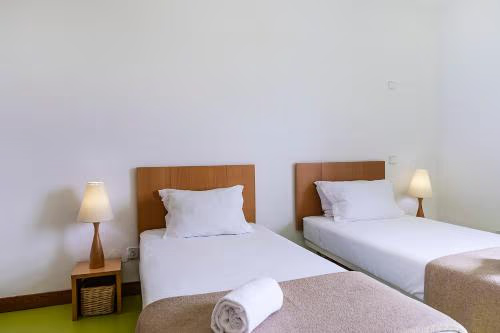
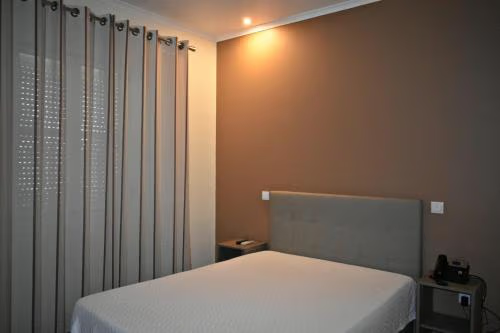
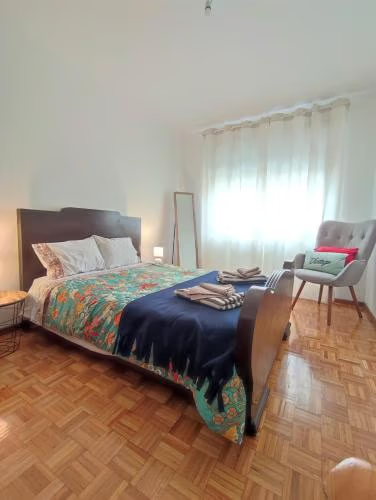
The hostel for pilgrims is the youth hostel: HI Castelo Branco - Pousada de Juventude. It belongs to the Hostelling International network, has according to our listing a kitchen, breakfast and lockers, and can be booked. The city also has guest rooms and holiday homes in several price ranges. There is no donativo or parish hostel in Castelo Branco.
Ninja tips
- Sit in the garden before you do anything else. After the asphalt, the bishop's garden is the best recovery in the city, and in summer it is open until 7pm.
- Look for the little kings. At the very bottom of the staircase of the kings stand the Filipes and the Cardinal-King, smaller and turned away. If you know, you see it at once.
- Visit St James in the museum. The 16th-century figure of James in the Museu de Arte Sacra is your saint in this city. Call ahead, as we have no opening times.
- Remember the stone from Belmonte. In the Museu Francisco Tavares Proença Júnior lies the Hebrew inscription of 1297 from the synagogue of Belmonte. When you arrive there a few days later, the circle closes.
- Look at the St James bridge tomorrow. In Cafede, 10.8 kilometres after Castelo Branco, a bridge from the 18th century leads over the Ocreza, the Ponte de Santiago, with a chapel for the saint. According to another pilgrim guide there is a Roman bridge with two arches about 600 metres off the way: behind the blue-and-white fountain, on the left. In Cafede there is a bar.
Practical tips for pilgrims
- Supplies: Castelo Branco has all services, supermarkets and restaurants. Shop here for the whole next stage.
- Stamp: We did not find an official stamp point. Ask at the Pousada de Juventude, in the co-cathedral or in the museums.
- Closing day: The museums close on Mondays; for the garden the leaflet names no closing day.
- Getting there and away: The city has good transport connections, also for starting or leaving the way.
Onward: north into the Beira Baixa
On the Via Nascente you leave Castelo Branco to the north. After 10.8 kilometres you come to Cafede, after 14.3 kilometres to Póvoa de Rio de Moinhos, where according to the pilgrim guide there is hardly anything for pilgrims. After 26.6 kilometres you reach Soalheira with a restaurant, shops and a cash machine, after 34.1 kilometres Castelo Novo. Carry water for the whole day.
What awaits you tomorrow
Tomorrow evening you sleep in Castelo Novo, a village of granite on the slope of the Serra da Gardunha. The Templars were there too, there is a castle there too, and not much of it is left either. What the village has instead is fountains: one with the coat of arms of Dom João V and one with three spouts from the time of King Manuel. After 34.1 kilometres you will appreciate them.
Deep dive: A garden that takes measure
A short read, in case you want to learn more about Castelo Branco. About four minutes' reading.
Where you stand
When you stand in the bishop's garden of Castelo Branco, between box and granite, you stand in one of the strangest gardens in Portugal. It is not big, and it is not wild. It is ordered, in levels, basins and staircases. And it has an opinion. Whoever reads its statues reads the history of a country that once very nearly ceased to be one.
The white camp and the knights
The name of the city may reach back to the Romans. Castra Leuca was the name of a fortified settlement on the hill, the white camp. In the year 1182 a nobleman named Fernandes Sanches gave the Knights Templar land on this spot. The knights were to secure and settle the land. In 1213 their master Pedro Alvito gave them a town charter, and in this document the name Castel-Branco appears for the first time. Soon afterwards the Templars built their castle above the valley of the Tagus. Little of it remains.
The bishops arrive
For centuries Castelo Branco belonged to the diocese of Guarda, further north. Bishop Nuno de Noronha had a winter residence built for himself in Castelo Branco in the late sixteenth century. In 1721 Bishop João de Mendonça laid out a garden next to it and dedicated it to John the Baptist. Fifty years later, in 1771, Castelo Branco itself became a bishop's city. The second bishop of the new diocese, Vicente Ferrer da Rocha, gave the garden what made it famous: the figures of granite.
A staircase full of kings
On a staircase they stand in line, the kings of Portugal, from the first, Afonso Henriques, to José. Yet between 1580 and 1640 Portugal had kings who were at the same time kings of Spain, three men named Filipe. They do not stand on the steps. They stand below, made smaller, turned away, together with the Cardinal-King Henrique, whose childless death had put them on the throne in the first place. The city itself now calls this ironic. One can also put it differently: the garden takes measure. Whoever belongs to Portugal stands tall. Whoever came from outside stays small.
A doctor who left
Castelo Branco also produced people who had to find their place elsewhere. In 1511 a Jewish boy was born here who later became known as Amatus Lusitanus. He studied medicine in Salamanca, worked in Antwerp, taught anatomy and medicinal plants in Ferrara and lived in Ancona until persecution drove him on. He died in 1568 in Salonica, where he could at last live his faith openly. His case histories in seven volumes appeared in many editions. Today there is a statue of him in his home town, and a house recalls the Jewish community that lived here from at least the fourteenth century. In the museum next to the garden lies a stone with Hebrew writing from the year 1297. It came from the synagogue of Belmonte, a place you will still pass on the Via Nascente.
Thread and silk
What the embroiderers of Castelo Branco made was quieter than castles and bishops. On linen, with silk, the colchas came into being, large embroidered bedspreads. The road to them began in the field with the flax and with the silkworms. The museum in the old bishop's palace shows old pieces, and in the old town hall there is a workshop school where this art is still passed on today.
St James in the city
Castelo Branco does not tell a great pilgrim story. But the apostle is there. In the museum of sacred art, in the church of the old Convento da Graça, stands a figure of James from the sixteenth century. The museum opened on 11 November 1984. And the next morning, a few hours after setting off, in Cafede you come to a bridge over the Ocreza that bears his name: the Ponte de Santiago from the eighteenth century, with a chapel for him beside it. By the eighteenth century at the latest, then, the apostle had his place along the way.
What Castelo Branco gives you to take along
Three quarters of your way lie behind you when you arrive here. The garden does not ask how fast you were. But it shows you that here greatness does not depend on rank, but on what one belongs to. Tomorrow you walk on north, into the mountains. Take along the measure that suits you.
Where to stay in Castelo Branco
Places to stay in Castelo Branco.
 OpenReservations accepted
HI Castelo Branco - Pousada de Juventude
 OpenReservations accepted
Horta D'Alva
 OpenReservations accepted
Casa da Olívia




Town 19 of 25