

Town on the Camino
Santiago do Cacém
Portugal
- places to stay
- 14
- Caminos
- 2
- Elevation
- 205 m
Santiago do Cacém carries your patron saint in its name: in 1186 the castle passed to the Order of Santiago, and in the church by its wall James has been fighting in stone since the 14th century. Outside the town lies Roman Miróbriga. At 227.1 kilometres from Faro, you are halfway along the way here.
How long to stay?
An afternoon is enough, as long as it doesn't fall on a Monday. Behind you lie 24.1 kilometres from São Domingos, almost 21 of them without any services at all, and you will arrive tired. The afternoon is still worth it: Miróbriga, castle and church lie close together, and all three carry the history that brought you here. Only the calendar can spoil your plan. Miróbriga is closed on Mondays, the church with the museum of sacred art on Mondays and Tuesdays. If you arrive on one of those days and want to see the James relief, you need a rest day.
Santiago do Cacém in Ninja numbers
- 227.1 kilometres lie behind you since Faro, according to Camino Ninja, with 225.7 still ahead of you to Benfica do Ribatejo. So you are standing 700 metres past the middle. Halfway, with James on the town sign.
- Nine towers of the castle still stand. A tenth fell in 1796, when the church was rebuilt.
- 359 metres was the length of the Roman racetrack at Miróbriga, one of only three such structures in present-day Portugal. You're not allowed to walk on it, but then the horses have long gone anyway.
- €3 is the entry to Miróbriga, children up to twelve go free (as of November 2026).
- 25 July is the town's holiday. On St James's Day, of all days, Miróbriga is closed.
Arriving: a name after the silence
The stage from São Domingos is one of the loneliest on the way. First you walk about four kilometres on a sandy track beside an irrigation canal, then through hills of cork and holm oak. The region's official guide warns that for almost 21 kilometres there is nowhere to resupply, until Aldeia dos Chãos, 3.9 kilometres before the finish. So water for the whole day belongs in your rucksack.
Shortly before the town you pass the ruins of Miróbriga, then the town climbs up to the castle hill. Santiago do Cacém lies on the Caminho Português Central do Sul and at the same time on the Caminho Central Via Atlântico, which comes in from Cercal and is waymarked only digitally. The town is twinned with Santiago de Compostela, and in 2019 the Caminhos de Santiago Alentejo Ribatejo were formally presented here, in the presence of the bishops of Beja, Évora and Portalegre.
In brief: a castle for the order
The castle on the hill is Moorish in origin. Afonso Henriques conquered it in 1158 with the help of the Templars, but at the end of the 12th century it fell back to the Almohads. In 1186 King Sancho I gave the place to the Order of Santiago; for the knights of the order it was then the first outpost in the south. It became definitively Portuguese in 1217, after the conquest of Alcácer do Sal. The town gets its name from this order and its patron.
In 1310 Santiago do Cacém passed to an unusual lady: Vataça Lascaris, a princess from the Byzantine imperial house and a confidante of Queen Isabel of Aragon. She lived here from 1317 to 1332 and kept a small court. In the lower town there was also a hospital of the Holy Spirit that took in travellers and pilgrims.
James on horseback
What makes Santiago do Cacém special is that your patron saint is not only in the name but hangs on the wall, carved in stone. In the main church a Gothic high relief from the 14th century shows Santiago fighting the Moors. The region's guide dates the commission to around 1330 and calls the relief one of the oldest depictions of its kind in Portuguese art.
If you look more closely, you'll find a second, quieter James in the church: a human figure that seems to show the apostle with a staff, and a bust drinking from a gourd, the drinking vessel of the pilgrims to Santiago. The warrior and the thirsty man under one roof. After 21 kilometres without a well, you know which of the two is closer to you.
On the castle hill: what to see
Castle, church and museum lie close together up top, and Miróbriga lies about a kilometre south-east of the centre at the entrance to town. You can reach everything on foot.
- Ruínas Romanas de Miróbriga: People lived here from the Iron Age; under the Flavian emperors in the late 1st century the place became a Roman municipium, and it flourished until the 4th century. At its best the town measured 10 to 12 hectares. Most impressive is the forum with the temple of the imperial cult, of which columns still stand. There are also two bath complexes, houses and shops. The 2nd-century racetrack, 650 metres to the south, can't be visited. At the entrance a visitor centre explains the site. Open Tuesday to Saturday 9am to 12.30pm and 2pm to 5.30pm, Sunday 9am to 12pm and 2pm to 5pm, last entry half an hour before closing, closed on Mondays and on 25 July. Entry €3 (as of November 2026). For a pilgrim it is a rare moment: you see the town that was already old when there was no Way of St James.
- Castelo de Santiago do Cacém: The castle has been a national monument since 1910. Nine towers survive, and the only surviving gate bears the cross of the Order of Santiago. Inside stand the ruins of the commandery house from the 13th and 14th centuries. Since 1838 the interior has served as the town's cemetery, so behave like a guest. The castle owes its present form to a major restoration in the 1930s. We didn't find any opening hours.
- Igreja Matriz de Santiago and museum of sacred art: The main church adjoins the castle and has also been a national monument since 1910. The order built it in the 13th century, it was extended in the first half of the 14th century, heavily altered between 1796 and 1830 after the earthquake of 1755, and fires struck in 1895 and 1912. Outside there is a Gothic portal, the Porta do Sol; inside, Manueline vaults, 17th-century azulejos and the relief of the fighting James. Since 25 July 2002 the treasury of the collegiate church has formed the museum of sacred art. From October to March it is open 10am to 12.30pm and 2pm to 5pm, from April to September 10am to 12.30pm and 2.30pm to 6pm, closed on Mondays and Tuesdays (as of November 2026). We don't know the entry price.
- Moinho da Quintinha: The stone-built windmill on the Cumeadas, the town's ridge, has been run by the town since 1982. If the weather allows, you can watch grain being ground. From November to March it is open 8.30am to 12.30pm and 2pm to 5pm, closed on Sundays, Mondays and public holidays; visits by telephone 964 174 982 (as of November 2026).
- Igreja da Misericórdia: The church probably dates from the late 15th or early 16th century and was rebuilt in 1678 and after 1755. Striking are the long flight of steps, three flying buttresses and a small Manueline portal. It is classified as a monument of public interest. We didn't find any opening hours.
Food and drink
- Bolo de Santiago and Santiaguinhos: The cake and its little siblings are regarded here as sweets from the Galician monastic tradition. A piece of Compostela, 225.7 kilometres before the end of your way.
- Supplies for tomorrow: After a day without services, Santiago do Cacém is the first place in a long time where you can shop properly. Buy for the next stage straight away, because after this there is only São Bartolomeu da Serra until Roncão.
Honestly
- No pilgrim hostel. You sleep privately or in guesthouses, and the prices are higher than what you know from hostels. Book in good time.
- Monday and Tuesday are bad days. The church with the relief is shut on both days, Miróbriga on Monday. If you arrive on a Monday and move on on Tuesday, all you see of Santiago do Cacém is the walls.
- The next stage has no stage town. It is 45.8 kilometres to Grândola, and in between, after 22.2 kilometres, Roncão is only a hamlet with a few rural lodgings. Book beforehand, or it becomes a very long day.
- The way is lonely, and sometimes it is wrong. A pilgrim reported in 2021 fences and gates that landowners had put across the way, and two big detours. A GPS track on your phone is not an optional extra on this section.
Where pilgrims sleep
There is no pilgrim hostel in Santiago do Cacém. Our data lists only private accommodation: guesthouses, rooms and holiday apartments in town, plus rural houses in the surrounding area, for example at the Chãos Salgados near Miróbriga. You'll find a single room from about €55 (as of November 2026). Booking is advisable, because on this way there are hardly any pilgrims for anyone to plan around.
Ninja tips
- Take in Miróbriga on your way in. The ruins lie at the entrance to town. If you're there before 5pm, go straight in; last entry is half an hour before closing.
- Look for the thirsty pilgrim. In the main church a bust drinks from the gourd. Next to the famous equestrian relief almost everyone overlooks him.
- Reckon with the calendar. Church and museum only reopen on Wednesday, Miróbriga on Tuesday. If you're flexible, plan your arrival for Wednesday to Saturday.
- Ask for the stamp in the old town. The Junta's tourist office (Turismo) is in the Rua Condes de Avillez in the historic centre, that is, up by the church. We haven't reliably found out whether there is a pilgrim stamp there, but it's worth a try.
- Fill your bottles for tomorrow. After 11.8 kilometres you come through São Bartolomeu da Serra; after that, according to the guide, there is nowhere to resupply until Roncão.
- If the wind is blowing, go to the mill. At the Moinho da Quintinha the town still grinds grain, and from the ridge you look out over the hills you'll walk through tomorrow.
Practical tips for pilgrims
- Turismo: The municipal tourist office on the Praça do Mercado is open Monday to Friday 8.30am to 4.30pm and Saturday 9am to 3pm, telephone 269 826 696. The Junta's tourist office in the old town, Rua Condes de Avillez, opens in winter Tuesday to Saturday 9am to 1pm and 2pm to 5pm, telephone 269 825 382 (as of November 2026).
- Post, money, pharmacy: There is a CTT post office, a bank with a cash machine and a pharmacy in town.
- Sunday: The municipal tourist office and the mill are closed, Miróbriga is open morning and afternoon.
- Navigation: Download the GPS track for the next stage beforehand. On the Via Atlântico there is only digital waymarking anyway.
Onward: via São Bartolomeu da Serra into the Serra de Grândola
The next stage is long and quiet. After 11.8 kilometres you reach São Bartolomeu da Serra. According to the guide there are two grocery shops and two cafés there, a 14th-century church with a Gothic figure of St Bartholomew and a station with azulejos. Then comes Roncão after 22.2 kilometres, and shortly beyond it the Cruz de João Mendes, a cross with a scallop shell. After 33.6 kilometres you pass through Santa Margarida da Serra, and after 45.8 kilometres Grândola lies ahead of you. The region's official guide splits the route at Roncão.
What awaits you tomorrow
Grândola is the town from the song. After a concert there Zeca Afonso wrote "Grândola, Vila Morena" in 1964, and on the night of 25 April 1974 it was played on the radio as the signal for the Carnation Revolution. The beat of that song is made of footsteps on gravel. You bring your own.
Deep dive: A name, a castle, a princess from Byzantium
A short read, in case you want to learn more about Santiago do Cacém. About five to six minutes' reading.
The town before the town
When you arrive in Santiago do Cacém, you walk past a town that is much older than the one you are walking into. On the hill of the Chãos Salgados people were already living in the Iron Age. Under the Flavian emperors, in the second half of the first century AD, the place became a Roman municipium called Miróbriga. Its best years lasted into the first half of the fourth century. Then decline set in, and between the late fifth and early sixth centuries life there faded away.
At its peak the town measured ten to twelve hectares. In the north lay the forum with a temple for the imperial cult, lined with colonnades, a basilica and a meeting house. There were two bathhouses, many shops and a large residential quarter. Six hundred and fifty metres further south a structure three hundred and fifty-nine metres long was built in the second century, a racetrack or circus. In present-day Portugal only three such structures are known: in Lisbon, in ancient Balsa near Tavira, and here. The humanist André de Resende mentioned the ruins in the sixteenth century. In the early nineteenth century the Bishop of Beja, Frei Manuel do Cenáculo, had the first excavations started. Since then archaeologists from Portugal and America have worked here.
A castle between the fronts
The castle on the hill above today's town was built by the Muslims. Until 1158 the area belonged to their sphere of rule, then Afonso Henriques, the first king of Portugal, conquered the castle with the help of the Templars. That didn't make it safe. At the end of the twelfth century the Almohads took it back. In 1186 King Sancho the First had already given the place to the Order of Santiago, which had its first outpost in the south here. Santiago do Cacém only stayed Portuguese for good when Alcácer do Sal fell as well in 1217.
The order, which united knights and monks under one rule, gave the place its patron and with him its name. On the castle's only surviving gate you can still see the order's cross today. Inside stood the house of the commanders, built in the thirteenth or fourteenth century and altered later. During the great crisis of 1383 to 1385 Castilian troops occupied the castle until Nuno Álvares Pereira drove them out of the Alentejo. After that the fortress lost its purpose. In 1605 it was abandoned, by about 1700 it was a ruin, and in 1838 the town laid out its cemetery inside the walls. Whoever walks through the gate today stands among graves in the walls of a border castle.
The princess from Byzantium
Perhaps the most beautiful story of the town is about a woman from a distant imperial house. Vataça Lascaris was the daughter of a Byzantine princess of the Laskarid dynasty and a count of Ventimiglia. She was a close friend of Isabel of Aragon and accompanied her to Portugal in 1288, when Isabel married King Dinis. Isabel was later venerated as the holy queen, and Vataça stayed at her side all her life.
In 1310 Vataça received Santiago do Cacém. From 1317 she lived here and kept a small court, and until 1332 she managed her estates, then she followed the queen to Coimbra. She died there in 1336, and there she lies to this day, in the Old Cathedral. Her tomb is surrounded by double-headed eagles, the emblem of the Laskarids and of the Byzantine Empire. Here in Santiago do Cacém her time coincided with the extension of the main church in the first half of the fourteenth century. The region's guide even credits her with building it herself, other sources the order a century earlier. What is certain is that the relief that pilgrims go into the church to see today was made in her time.
The knight and the thirsty man
This relief shows Santiago on horseback fighting the Moors. It is Gothic, from the fourteenth century, and is among the oldest depictions of its kind in Portugal. It has to be said honestly: the image of the Moor-slayer is hard for many people to look at today. It comes from a time when the apostle was venerated as a helper in battle against Islam, and the order that built this church had been founded for exactly that. In Spain there has long been argument over whether such figures should stay in churches. In Santiago do Cacém the relief hangs as what it is: a witness from a frontier age, when this castle was now in Christian, now in Muslim hands.
And yet the same church has a second answer ready. Beside the warrior there is a figure that seems to show the apostle with a staff, and a bust drinking from a gourd, the vessel of the pilgrims to Santiago. The church also keeps a relic of the Holy Cross. Down in the town stood, in the Middle Ages, a hospital of the Holy Spirit that took in travellers and pilgrims.
The church has been through a lot. After the earthquake of 1755 it was heavily rebuilt between 1796 and 1830, and fires struck in 1895 and 1912. Without regular services it was threatened with decay in the twentieth century, until the Diocese of Beja saved it between 1993 and 1996. On 25 July 2002, St James's Day, the museum of sacred art opened in it.
A name that obliges
To this day the town takes its name seriously. Its holiday is 25 July, the apostle's day, and on that day even the ruins of Miróbriga stay closed. Santiago do Cacém is twinned with Santiago de Compostela. And when the Alentejo and Ribatejo tourism region presented its Ways of St James to the public in September 2019, it did so here, with the Secretary of State for Tourism and the bishops of Beja, Évora and Portalegre. Since then two Ways of St James have run through the town, one from Faro, the other via Cercal. The order, the princess and the apostle have left behind a place that knows whom it owes its name to.
What Santiago do Cacém gives you
When this text was written, in autumn 2026, only a few pilgrims were walking through Santiago do Cacém. Most of those who come here come for the ruins or for the coast. For you the town is something else: the middle of your way, and the first place since Faro that carries your patron in its name. Here you have two images of James to choose from, the rider with the sword and the walker with the gourd. Which of the two accompanies you to Benfica do Ribatejo is for you to decide.
Where to stay in Santiago do Cacém
Places to stay in Santiago do Cacém.
 OpenReservations accepted
Residencial Gabriel
55€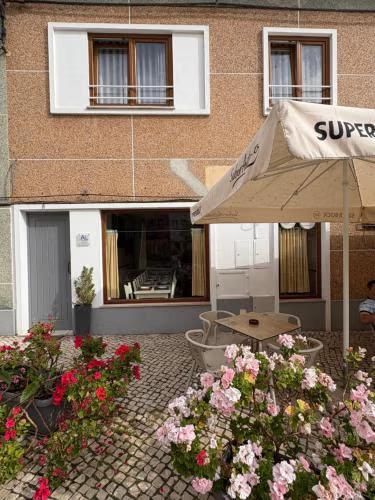 OpenReservations accepted
Alojamento Local - Covas
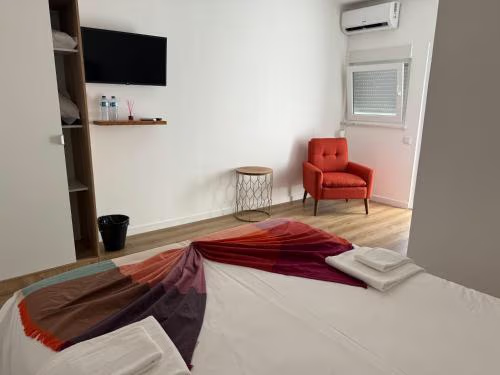 OpenReservations accepted
5Melros


Town 12 of 24