

Town on the Camino
Fischingen
Switzerland
- places to stay
- 2
- Camino
- 1
- Elevation
- 613 m
Fischingen is a monastery for tired feet: it was founded in 1138 to shelter pilgrims between Konstanz and Einsiedeln, and the altar of Saint Idda has an opening for aching pilgrim feet. From 3 to 8 November 2026 the monastery marks the 800th anniversary of Idda's death. Tomorrow morning there is the pilgrim blessing, then it's up the Hörnli.
Right now in Fischingen (as of October 2026)
- 800th anniversary of Saint Idda's death, 3 to 8 November: festive service on Tuesday, 3 November, at 10:00, talks in the monastery library on Friday, 6 November, from 14:00, festive service with Bishop Beat Grögli on Sunday, 8 November, at 10:00. If you come that week, ask for a bed early.
- Berggasthaus Hörnli on winter hours from 1 November: Wednesday and Thursday 9:00 to 16:00, Friday and Saturday 9:00 to 18:00, Sunday 9:00 to 17:00. No hours are given for Monday and Tuesday, so expect it to be closed.
How long to stay?
An afternoon is enough, but take the morning too. The village itself is quickly seen. What makes Fischingen is the monastery's daily rhythm: vespers in the evening, compline before bed, lauds and the pilgrim blessing in the morning. If you arrive in the early afternoon, you can fit in the church, the Idda Chapel and the monastery brewery, and be at choir prayer in the evening. We would only take a rest day here if you are looking for monastery and silence, because there is little else in the village.
Fischingen in Ninja numbers
- 1138 is when the monastery was founded, explicitly as lodging for pilgrims on the way to Einsiedeln. So you are not here by accident.
- 42.8 kilometers from Konstanz lies Fischingen, almost exactly halfway to Einsiedeln.
- 800 years have passed in 2026 since Saint Idda is said to have died, on 3 November 1226.
- 7:30 is the pilgrim blessing in the Idda Chapel, on four days of the week.
- 10.3 kilometers to Steg, with the Hörnli at over 1,100 meters in between.
Arriving: through the forest to the monastery
After Sirnach the path rolls gently up and down, past Oberwangen with its chapel. The last two kilometers or so lead through forest, and then you stand in the narrow Murg valley in front of a monastery that looks far too big for a village this size. Fischingen is the southernmost municipality in Thurgau. The monastery sits on a terrace above the linear village and dominates everything.
In brief: built for pilgrims
Bishop Ulrich II of Konstanz founded the monastery around 1138 as a hostel for pilgrims between Konstanz and Einsiedeln. Benedictines from Petershausen settled it. Its great age was the Baroque: the present monastery church was built from 1685 to 1687, the Idda Chapel from 1705 to 1708, the Psallierchor in 1753. In 1848 the canton of Thurgau dissolved the monastery, the buildings were sold to a textile factory, and later a children's home moved in. Benedictines only returned in 1977. Today the monks live in the south wing, and the rest of the house is a hotel, seminar house, brewery and pilgrim hostel.
Idda and the foot in the altar
Saint Idda is the reason pilgrims have stopped here for centuries. The legend says that a raven stole her wedding ring. Her jealous husband, a count of Toggenburg, believed it was adultery and threw her out of the castle window. She survived, lived as a hermit, and a stag with lights in its antlers is said to have shown her the way to Mass in Fischingen. She is said to have died on 3 November 1226.
Historically this is hard to sustain. Before the 15th century no Idda cult is documented in Fischingen, and the Swiss National Museum considers the legend an invention meant to make the monastery better known. For you as a pilgrim, something else counts: since 1496 Idda has had a large tomb, and in her tomb altar there is an opening where pilgrims put their aching feet. The pain is said to fade. One pilgrim once wrote that his blisters stayed, but the calm of the room gave him new courage.
From the altar to the brewery: what to see
Everything is in the monastery or right next to it, so you don't have to walk far.
- Monastery church: Built 1685 to 1687, with a colorful choir screen and four organs. For pilgrims it is the goal of the day: the monks celebrate Mass here on Sundays at 10:30 and on Mondays and Saturdays at 7:30. It is open in summer from 7:00 to 20:30, in winter until 19:00, and admission is free.
- Idda Chapel: A white central-plan building with pink pilasters and a high dome, built 1705 to 1708 and one of the most beautiful central-plan buildings around Lake Constance. Here lies Idda's tomb with the opening for the feet, and here the pilgrim blessing takes place on Tuesdays, Wednesdays, Thursdays and Sundays at 7:30.
- Katharinakapelle: The small chapel from 1635 is the place of choir prayer. The monks pray in public, and you can simply sit down with them: lauds at 7:00, sext at 11:45, vespers at 17:45 (Saturdays 16:00), compline at 19:30. Whoever ends the day in Fischingen with compline sleeps differently.
- Pilgrim brewery: The only monastery brewery in Switzerland, with around 15 beers. From October to March the shop is open Tuesday to Friday from 13:00 to 17:00 and Saturday from 10:00 to 16:00, and from April to September also on Sundays from 12:00 to 16:30. Closed on Mondays. Guided tours with tasting take place every first Saturday of the month.
- St. Anna church in Au: A good two kilometers further along the way, first mentioned in 1275, with a Baroque side altar showing Idda. If you set off in the morning, this is the first thing you pass.
Food and drink
The monastery restaurant is open daily from 9:00 to 23:00, with warm à la carte food until 21:00 in the evening (as of October 2026). It can get full with large groups and seminars, so a reservation makes sense. The monastery shop is open daily from 7:00 to 20:00. We did not find a grocery store in the village. Think of provisions for the climb to the Hörnli.
Honestly
- The pilgrim price is a secret. Neither the price nor the number of beds in the pilgrim hostel is public anywhere. Call ahead.
- The monastery is also a seminar business. Hotel rooms from CHF 142 (approx. €152), banquets, game evenings. On some days the groups are louder than the monks.
- No village shop. You are better off buying tomorrow's provisions along the way.
- The children's home is part of the history. In the children's home St. Iddazell, children were beaten, humiliated and abused until the 1970s. The monastery and the association apologized in 2014. You won't see much of it in the house, but it belongs to the story.
Where pilgrims sleep
The pilgrim hostel is in the Kloster Fischingen itself, in the multi-bed room "Jakobus". The Benedictine community looks after the pilgrims: arrival, bed, food, prayer and blessing. The monastery calls the overnight stay "inexpensive" without giving a price. Pilgrims are welcome with or without a pilgrim passport. Register beforehand: +41 71 978 72 20. The reception is staffed from 6:30 to 20:30.
The Schwendi Stübli in the hamlet of Schwendi near Au used to have a mattress dormitory, open from May to October. The only information on it dates from around 2007, and we could not confirm whether it still takes pilgrims today.
Ninja tips
- Compline in the evening, blessing in the morning: At 19:30 the monks' day ends with compline, and at 7:30 (Tuesdays, Wednesdays, Thursdays and Sundays) there is the pilgrim blessing. After that you reach the Hörnli around noon.
- Foot in the altar: The opening in Idda's tomb is not a museum piece, and pilgrims use it to this day. Give it a try.
- No brewery visit on Monday: The shop is closed on Mondays, and in winter on Sundays too.
- Tuesday is a bad day for the Hörnli: No opening hours are given for the Berggasthaus on Mondays and Tuesdays, and in Steg the Landgasthof has its rest day from Tuesday to Thursday. Bring food.
- Wednesday evening zazen: In the upper choir of the monastery church, silent meditation takes place on Wednesdays from 19:50 to 21:00, free of charge and without registration.
When it rains
In October it rains on about ten days in the area (MeteoSwiss norm values 1991–2020 for Zurich and St. Gallen). The monastery is then a good place to arrive wet.
- Monastery church and Idda Chapel: in winter 7:00 to 19:00, in summer until 20:30.
- Choir prayer in the Katharinakapelle: vespers at 17:45, compline at 19:30.
- Pilgrim brewery shop: from October to March Tuesday to Friday 13:00 to 17:00, Saturday 10:00 to 16:00.
- Monastery restaurant: daily 9:00 to 23:00.
Practical tips for pilgrims
- Bus: Postbus 734 runs about hourly from Wil to the terminus "Fischingen Kloster".
- Stamp: Ask for it at the reception.
- Monastery for a time: Men can live with the monks for three to eight days, usually for CHF 90 (approx. €96) a day. This is not a tourist offer but a sharing of life.
Onward: over the Hörnli to Steg
It is 10.3 kilometers to Steg, but it is the first real mountain of the Via Jacobi. From the monastery you cross the Murg and follow the Aubach to Au with St. Anna church. Then it gets steep: a long staircase, meadows, an alpine road into the forest and the steep Eggholz up to the hamlet of Allenwinden at a good 900 meters. At the Dreiländerstein of 1640, where Zurich, St. Gallen and Thurgau meet, you leave Thurgau. Soon after you reach the Hörnli with a 360-degree view of the Säntis and the Alps and with a Berggasthaus. Then it is a good hour down over the Tanzplatz to Steg.
What awaits you tomorrow
Steg im Tösstal is the village where the mountain ends and the railway begins. Here you are in the canton of Zurich for the first time, and the S-Bahn runs every half hour. If you want to keep going, from Steg there is a flat path via the towns of Wald and Rüti to Rapperswil.
Deep dive: A monastery built for the way
A short read, in case you want to learn more about Fischingen. About four minutes' reading.
A hostel between lake and Madonna
Around the year 1138, Bishop Ulrich the Second of Konstanz founded a monastery in a narrow valley at the foot of the Hörnli. The purpose was fixed from the start: pilgrims on the way from Lake Constance to Einsiedeln were to find a roof, a meal and a prayer here. Monks from the Konstanz monastery of Petershausen came to the Murg valley. So Fischingen is not a monastery that a pilgrim path happens to pass, but one that was built for this path.
Idda, the woman from the window
Fischingen became famous through a woman nobody knows ever existed. The legend tells of Idda, a countess from the Toggenburg. A raven carried off her wedding ring, and a hunter found it. Her jealous husband had the hunter killed and threw his wife out of the castle window. She fell and survived. Afterwards she lived as a hermit, and when she went to Mass in Fischingen, a stag with burning lights in its antlers is said to have walked ahead of her. Her death is dated to 3 November 1226.
The Swiss National Museum is sober about it: before the fifteenth century there is no trace of an Idda cult in Fischingen, and the legend was probably invented to make the monastery more attractive. In 1496 Idda received a large tomb. In 1724 Pope Benedict the Thirteenth confirmed the veneration for the diocese of Konstanz.
Baroque and bankruptcy
In the seventeenth and eighteenth centuries the monastery did well. The abbots built a new church, then the Idda Chapel with its high dome, half Italian, half southern German. Part of the plans remained unfinished because the money ran out. On 27 June 1848 the Grand Council of the canton of Thurgau dissolved the monastery. The buildings were sold to a textile factory, then a trade school moved in, and in 1879 a Catholic association bought the complex for an orphanage.
The dark chapter
The orphanage became the children's home St. Iddazell, run from 1943 by Benedictines from Engelberg. An investigation report from 2014 confirmed that children were beaten, humiliated and sexually abused there until the 1970s. The home closed in 1976. The monasteries of Engelberg and Fischingen and the association Kloster Fischingen apologized and made money available for those affected. Whoever asks for a blessing here stands in a house where wrong was also done.
The monks come back
In 1973 Switzerland struck the ban on monasteries from its constitution. In 1977 Benedictines moved to Fischingen again, a small community in the south wing. They pray several times a day, in public, and they have taken up again the task for which the house was founded: to receive pilgrims, give them a bed, pray with them and bless them in the morning.
What Fischingen gives you
You arrive with tired feet at a place that was built almost nine hundred years ago for exactly that. Whether Idda existed, nobody knows. But that pilgrims put their feet into an altar here is true. And tomorrow morning, after the blessing, the mountain awaits.
Where to stay in Fischingen
Places to stay in Fischingen.
 OpenReservations accepted
Schwendi Stübli
 OpenReservations accepted
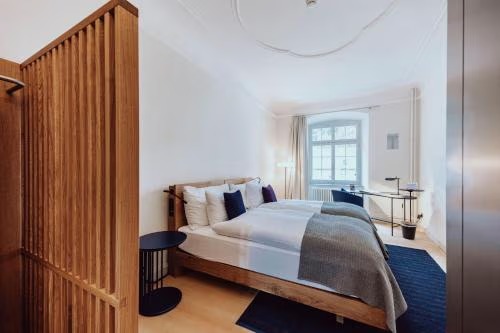
Hotel Kloster Fischingen