

Stage town on the Camino
Foncebadón
León, Castilla y León, Spain
- places to stay
- 8
- Camino
- 1
- Elevation
- 1,440 m
Foncebadón sits at 1,440 metres, 1.8 kilometres below the Cruz de Ferro, where pilgrims have laid down a stone for centuries. In the 1990s only two people still lived here; today the village is full of albergues again. One evening is enough, and tomorrow morning the cross is the first thing on your path.
Right now in Foncebadón (as of October 2026)
- Construction work at the Cruz de Ferro: Since mid-October 2026 the mound of stones beneath the cross has been undergoing repairs costing almost €90,000. The stones are being restacked by hand, the mound is getting a wooden fence, road access for cars is being closed off, and a barrier-free path will in future lead to its foot. How long the work will last and whether you can lay your stone on the mound in the meantime has not been announced.
How long to stay?
One evening is enough. Foncebadón is a village on a single street, with a church, monastery ruins and albergues. You stay here to be among the first at the Cruz de Ferro tomorrow morning and to start the long descent into the Bierzo with fresh legs. There is nothing more to see, and nothing more is needed.
Foncebadón in Ninja numbers
- 1,440 metres: You will hardly sleep higher anywhere on the whole Camino Francés. Since Astorga you have climbed 25.4 kilometres and 623 metres of elevation.
- 1.8 kilometres and 65 metres of elevation separate you from the Cruz de Ferro at 1,499 metres.
- 5.5 kilometres beyond the cross lies the truly highest point of the Camino Francés, 1,512 metres, just past Manjarín. The cross is the most famous point, not the highest.
- Two people still lived in the village in the 1990s, a mother and her son, among collapsed houses. Today there are 18 residents again, and every evening pilgrims sleep in the albergues.
- 239.3 kilometres remain from here to Santiago.
Arriving: the last climb
From Rabanal del Camino it is 5.6 kilometres and almost 300 metres of elevation, nearly half of the whole day's climb from Astorga. Then you stand on the Calle Real, the village's only street. Quite different from ten or fifteen years ago: where pilgrims in 2014 still walked along a stony path between ruins, carefully built stone houses now stand almost everywhere again. At the edges you can still see how it was.
In brief: abandoned and returned
Foncebadón is a village that the Camino made. As early as the 10th century, at the wish of King Ramiro II, the bishops of the Kingdom of León met here for a council, among other things against the robbers at the pass. In the 11th century the hermit Gaucelmo founded a hospice and a church for pilgrims, which later became a monastery. In 1093 King Alfonso VI exempted the village from taxes in thanks for its care of pilgrims. According to tradition, the inhabitants had to set 800 posts in return, to mark the way in the snow.
Then it went downhill. In 1764 the new road over the Manzanal Pass opened, bypassing the village, the War of Independence at the beginning of the 19th century destroyed it, and it was rebuilt a little further east. At the end of the 1960s the inhabitants left to work in the cities, and within a few years about a hundred people became two. Houses were plundered and collapsed. That Foncebadón lives today, it owes solely to the pilgrims who came back in the 1990s.
Laying down the burden
Beyond the village, on the pass of the Monte Irago, a wooden pole about five metres high with an iron cross stands on a mound of stones, the Cruz de Ferro. How old the mound of stones is, nobody knows. It may be a pre-Roman waymark pile onto which travellers laid stones for the gods of the roads; some suspect a Roman altar to Mercury. According to tradition, Gaucelmo set the cross on it in the 11th century. Today's cross is a replica, the original lies in the Museo de los Caminos in Astorga. The small chapel next to it, the Ermita de Santiago, dates from 1982.
The custom is simple: you bring a stone from home or pick one up along the way and lay it down at the cross, as a sign of what you do not want to carry any further. One legend says the stones were once collected for the building of the cathedral of Santiago; this is not documented. For Foncebadón the image fits twice over: a village that itself was almost laid down, and every morning pilgrims who let go of something here.
At the pass: what to see
Everything lies on the Calle Real or on the way west.
- Cruz de Ferro: 1.8 kilometres beyond the village at 1,499 metres, right on the path. Go early, then you will not stand in a queue; during the day cars have so far stopped here too, and access is due to be closed off with the ongoing work. On 25 July the feast of the Apostle is celebrated at the Ermita de Santiago.
- Church: The small village church with its freshly restored bell gable stands on the Calle Real. We did not find opening hours; in the parish albergue opposite there is prayer every evening, open to all.
- Monastery ruins: On the edge of the village stand the remains of the monastery that grew out of Gaucelmo's hospice. They are freely accessible and seen in ten minutes.
Food and drink
Several albergues have a restaurant, and there is a bar. Pilgrims especially praise the game stew in one of the albergues. The village has no shop of its own, but there is a small shop in an albergue and El Trasgu with bread, sausage and even bicycle spare parts. For the long descent tomorrow, buy enough provisions here: until El Acebo, 11.2 kilometres further on, there is hardly anything.
Honestly
- No cash machine, no pharmacy, no doctor. Bring cash from Astorga.
- It is not always quiet at the cross. Until now you could drive right up to the mound; if you want the Cruz de Ferro to yourself, you have to set out very early. Whether the construction work will temporarily restrict the custom is open.
- Many albergues close in winter. Convento, Posada del Druida and Monte Irago are only open from March or April to November.
- The old, rough Foncebadón is gone. If you are looking for the derelict ghost village from older accounts, you will find a neatly rebuilt albergue village today.
Where pilgrims sleep
The Albergue parroquial Domus Dei belongs to the parish, its upkeep is borne by the Asociación de Amigos del Camino del Bierzo, and volunteer hospitaleros run it. 18 places, donation instead of a price, no reservation, only with a credencial. In the evening there is a shared meal, cooked together, then a prayer that nobody is obliged to attend. It has heating and is open all year, as long as hospitaleros can be found; in winter it may close for a few weeks.
Alongside it there are private albergues for about €14 to €25 in a dorm (as of October 2026): La Cruz de Fierro and Chelo all year, El Convento de Foncebadón, La Posada del Druida and Monte Irago in season. Several also have rooms.
Ninja tips
- Don't lay your stone down along the way, only at the cross. If you have carried it since home, you won't want to lose it 1.8 kilometres too early: tuck it in the top of your backpack this evening, within easy reach.
- Set off before sunrise. You walk the 1.8 kilometres to the cross with a headlamp, and you are there before the cars and groups arrive.
- Get cash beforehand. The nearest cash machine is behind you in Astorga or ahead of you in Molinaseca.
- Buy provisions for the descent. It is 11.2 kilometres over the pass to El Acebo, and there is little on the way.
- Spare your knees for tomorrow. From the high point beyond Manjarín it drops about 950 metres over just under 12 kilometres down to Molinaseca. Poles help.
Practical tips for pilgrims
- Stamp: in the albergues.
- Cash: no cash machine in the village.
- Shopping: small shop in an albergue, bread and sausage at El Trasgu.
- Laundry: In the parish albergue the washing machine costs €3.
- Festivals: 23 July Santa María Magdalena, 25 July Santiago at the Cruz de Ferro.
Onward: over the pass into the Bierzo
The path climbs another 1.8 kilometres to the Cruz de Ferro (km 538.6), then continues undulating over Manjarín (km 540.9) to the highest point of the Camino Francés at 1,512 metres (km 544.1). After that comes the long descent: 369 metres of elevation over 3.9 kilometres to El Acebo (km 548.0), a further 584 over 7.8 kilometres via Riego de Ambrós to Molinaseca (km 555.8). To there it is 19.0 kilometres with 1,061 metres of descent, to Ponferrada 26.6 kilometres. The descent follows slate paths that are slippery when wet.
What awaits you tomorrow
Molinaseca, a village on the river Meruelo, which you enter over a medieval pilgrim bridge. The doors of its sanctuary are clad in iron, because earlier pilgrims sawed out splinters as relics. If you still have strength, walk on 7.6 kilometres to Ponferrada.
Deep dive: A village on the pass
A short read, in case you want to learn more about Foncebadón. About three minutes' reading.
The pass that everyone feared
The Monte Irago is the pass between the plain of León and the valley of the Bierzo. Anyone walking to Santiago in the Middle Ages had to cross here, in summer through dust, in winter through snow and fog. Robbers knew the pass as well as the pilgrims did. In the tenth century King Ramiro the Second summoned the bishops of his kingdom to a council right here, and one of the questions was how to make the roads safer.
Gaucelmo
In the eleventh century a hermit named Gaucelmo came. He built a hospice and a church in which pilgrims found bread and a roof. It became a monastery, and in 1093 King Alfonso the Sixth freed the village from taxes because it cared for the pilgrims. According to tradition, the inhabitants had to set eight hundred posts into the ground in return, so that the way could be found even in snow. Gaucelmo is also said to have set the first cross on the heap of stones at the pass, which may have lain there long before him.
The disappearance
Then the village became superfluous. In 1764 a road was built over the Manzanal Pass, further north, and the traffic moved there. The war against Napoleon destroyed Foncebadón, and the inhabitants rebuilt a little further east. At the end of the 1960s they went to work in the cities. About a hundred people became two within a few years, a mother and her son. The empty houses were plundered, the roofs fell in.
The return
In the 1990s the pilgrims came back, at first a few, then more and more. With them came people who bought houses and built albergues. When this text was written, in autumn 2026, Foncebadón was a village of rebuilt stone houses, and at the Cruz de Ferro work was beginning to restack the mound of stones as it once looked.
What Foncebadón gives you
This village was once almost gone and has come back, because people like you pass through. Tomorrow morning you carry a stone up the last metres and leave it lying. What it means to you, you do not have to tell anyone.
Where to stay in Foncebadón
The places pilgrims rate highest in Foncebadón come first.
- Top #1
 ClosedReservations accepted
Albergue Monte Irago
- Top #2
 ClosedReservations accepted
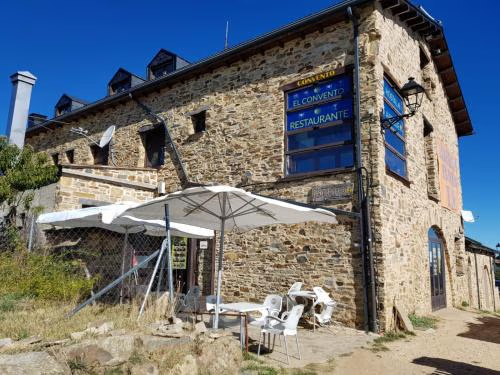
Albergue & Hostal "El Convento de Foncebadón"
- Top #3
 Open
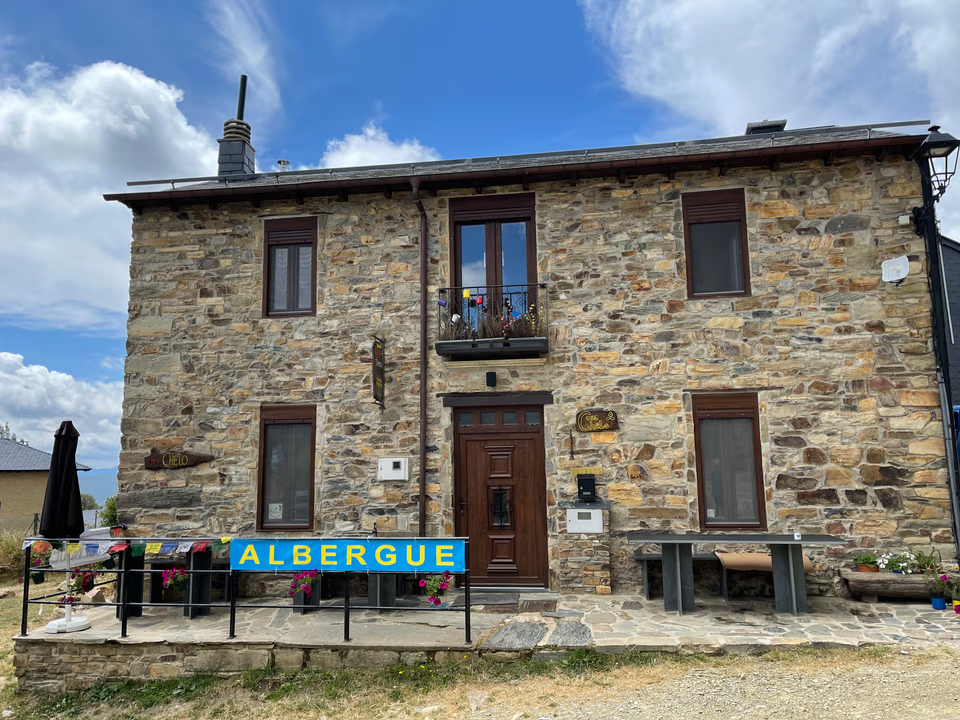
Albergue Chelo


Services in Foncebadón
What you can find in town before the next stage.
- Café
- Shop
- Fountain
- Restaurant
Source: © OpenStreetMap contributors · updated November 2025
Town 32 of 49