

Town on the Camino
Larrasoaña
Navarra, Spain
- places to stay
- 4
- Camino
- 1
- Elevation
- 497 m
Larrasoaña is a one-street village of just over 130 people on the Río Arga, 51.1 kilometres from Saint-Jean and 5.3 past Zubiri. You cross the medieval Bandits' Bridge into a place that once had three pilgrim hospitals and hosted the Cortes of Navarre. A quiet evening before Pamplona.
How long to stay?
An afternoon is enough. Larrasoaña is a single street you can walk end to end in a quarter of an hour: bridge, church, the old hospital, a few houses with coats of arms. People sleep here to stretch the stage from Roncesvalles or to reach Pamplona rested the next morning. The village does not fill more than one evening.
Larrasoaña in Ninja numbers
- 51.1 kilometres lie behind you since Saint-Jean-Pied-de-Port on the Camino Francés, 725.0 are still ahead to Santiago.
- 5.3 kilometres separate you from Zubiri, with 133 metres of ascent.
- 15.0 kilometres are left to Pamplona.
- Three pilgrim hospitals stood here in the Middle Ages: the Augustinians', the confraternity of Saint James's and Saint Blaise's.
- Just over 130 people live here today.
Arriving: over the Bandits' Bridge
From Zubiri the way follows the Arga past Ilárraz and Urdániz. You enter the village over the medieval bridge; behind it begins the main street, where everything is.
In brief: a village for traders and pilgrims
It probably began with an Augustinian monastery, founded most likely in the 10th century. In the 12th century Franks settled here, craftsmen and traders from the north drawn by the privileges granted to new towns; Sancho VI gave them the charter of Pamplona. That is how the typical street village on the Camino came about, built to serve trade and pilgrim traffic. The Augustinians' pilgrim hospital belonged to the collegiate church of Roncesvalles. In 1329 the Cortes of Navarre met here. Until 1928 Larrasoaña was a municipality of its own; today it belongs to the valley of Esteribar.
A street full of history: what to see
Everything is at the bridge or along the main street.
- Puente de los Bandidos: The medieval stone bridge over the Arga is called the Bandits' Bridge because, according to legend, robbers disguised as pilgrims attacked travellers here. For you it is the way into the village.
- Antiguo hospital: A rectangular medieval building with four buttresses on one long side. It belonged to Roncesvalles, later served as a granary and is now a private house; you can only see it from outside.
- Iglesia de San Nicolás de Bari: The parish church goes back to the 13th century and was remodelled in the Baroque period. We have not found opening hours.
- The houses on the main street: Large round-arched doorways, carved eaves and coats of arms show that wealthy people once lived here.
Food and drink
There is a bar with a restaurant, a small shop and a bakery. The municipal albergue does not serve dinner; pilgrims recommend bringing food or buying it at the shop. A Navarrese speciality with a dark history is the "tortilla maldita", a potato omelette fried in lard instead of oil, whose name is linked to the Agotes, a group excluded from society in the Middle Ages.
Honestly
- It is not much more than one street. If you want a lively stage town, walk on to Pamplona.
- There is no cash machine and no pharmacy. You will find both in Zubiri, 5.3 kilometres back, or in Pamplona.
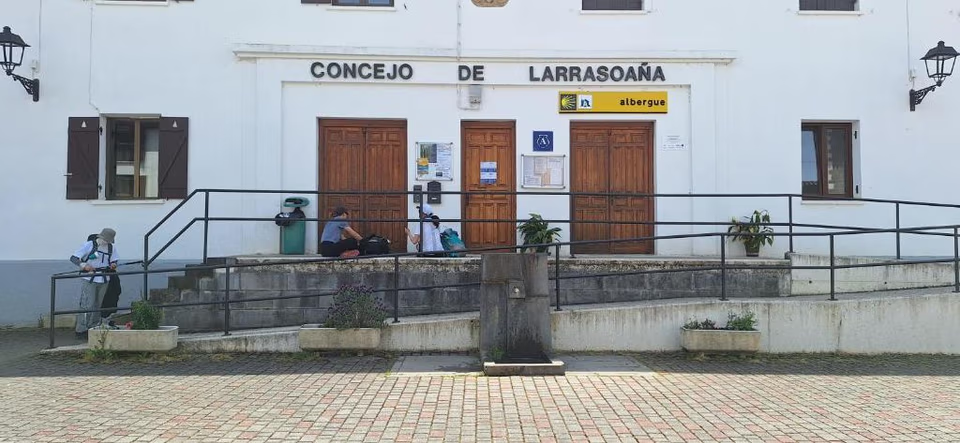
- The municipal albergue is basic. It is clean and well organised, but it does not serve dinner.
Where pilgrims sleep
The Albergue Municipal de Larrasoaña has 32 places and costs €15 (as of October 2026). It is open from spring until mid-October; washing machine and dryer cost extra. There is also the private Albergue San Nicolás, plus two guesthouses with rooms. There is no donativo albergue in the village.
Ninja tips
- Use the cash machine in Zubiri. There is none in Larrasoaña.
- Bring food. The municipal albergue does not cook, and the shop is small.
Practical tips for pilgrims
- Bus: From Monday to Saturday a bus between Pamplona and Roncesvalles runs through the village on the N-135.
- Doctor: The village surgery is open at midday (according to alberguescaminosantiago 12:00 to 14:30).
- Festival: 8 September, the Nativity of Mary; beds can fill up then.
- Emergency: 112.
Onward: along the Arga to Pamplona
Back over the bridge and on along the river: via Akerreta, Zuriáin, Irotz and Zabaldika you reach the edge of the city at Villava and, via Burlada, Pamplona. It is 15.0 kilometres with 322 metres of ascent and 373 metres of descent.
What awaits you tomorrow
Pamplona, the first big city on the Camino Francés. After 15 kilometres you are there by late morning and have the whole afternoon for the city.
Deep dive: The village of strangers
A short read, in case you want to learn more about Larrasoaña. About three minutes' reading.
Monks by the river
The story of Larrasoaña probably begins with Augustinian monks who founded a monastery here in the tenth century. In the eleventh century it passed to the monastery of Leire, and the monks ran a pilgrim hospital. Later it belonged to the collegiate church of Roncesvalles, the great pilgrim station at the pass that you walked past.
Franks on the main street
In the twelfth century strangers arrived. Craftsmen and traders from the north, called Franks in Navarre, settled beside the monastery because the kings granted privileges to new settlements on the pilgrim road. Sancho the Sixth gave them the charter of Pamplona. That is how a village came about that consists of nothing but one street, because it existed only for the road: for trade and for the people travelling west on it. At times there were three hospitals, the Augustinians', one run by the confraternity of Saint James and one dedicated to Saint Blaise.
Robbers on the bridge
Not everyone here in pilgrim's clothes was a pilgrim. The bridge over the Arga is still called the Bandits' Bridge, because according to tradition thieves disguised themselves as pilgrims here and robbed travellers. It is a legend, but it tells something true about the medieval road: anyone on the move was vulnerable, and the hospitals were not only shelters but also protection.
What Larrasoaña gives you
Just over a hundred and thirty people live here today, and most strangers stay only one night. It has always been that way. A village built for people passing through takes you in without fuss and lets you go again in the morning.
Where to stay in Larrasoaña
Places to stay in Larrasoaña.
 ClosedReservations accepted
Albergue San Nicolás
 OpenReservations accepted
Pensión Tau
 ClosedReservations accepted
Albergue Municipal de Larrasoaña

Services in Larrasoaña
What you can find in town before the next stage.
- Café
- Shop
- Pharmacy
- Fountain
- Restaurant
Source: © OpenStreetMap contributors · updated November 2025
Town 4 of 49