

Stage town on the Camino
Lugo
Lugo, Galicia, Spain
- places to stay
- 24
- Camino
- 1
- Elevation
- 460 m
Lugo is the city inside a ring of stone: a 3rd-century Roman wall still encloses the whole old town, and you can walk all the way round on top of it. In the cathedral the Blessed Sacrament has been exposed day and night for centuries. From here it is 100.0 kilometres to Santiago, and a rest day is worth it.
How long to stay?
Worth a rest day, especially after the mountains of the Primitivo. You have more than 200 kilometres behind you, and the highest point of the whole route. Lugo gives you the opposite: a compact old town where everything is within walking distance, a circuit on the wall with no real climbing, a cathedral, Roman remains beneath the city and taverns where a tapa comes with your drink. If you only stay one night, an afternoon is enough for the wall and the cathedral. For the Roman city, the museum and an unhurried dinner, you need a second day.
Lugo in Ninja numbers
- 100.0 kilometres from here to the cathedral of Santiago de Compostela. A number on the Camino doesn't get any rounder.
- 208.7 kilometres lie behind you since Oviedo, on the Camino Primitivo. The highest point was at 1,216 metres; Lugo sits at 460.
- Just over two kilometres is the length of the wall, with ten gates and more than 70 towers. It was built between 263 and 276 AD.
- Since 1669 the old capitals of Galicia have brought an offering to the Sacrament in the cathedral every year. It was cancelled only once, in 1809, when French troops occupied the city.
- 47.3 kilometres further on, in Melide, your route joins the Camino Francés. Until then, Primitivo pilgrims keep to themselves.
Arriving: into the ring
The last stage from Castroverde is 22.0 kilometres long and takes you down from its highest point at 612 metres to Lugo. Then the wall stands in front of you, and behind it lies the old town, which has stood on the same spot for more than two thousand years. The pilgrim hostel is inside the wall, on Rúa San Pedro. The gate of that street, the Porta de San Pedro, was called Puerta Toledana in the Middle Ages, because the merchants from Toledo came through it. It stayed open an hour longer in the evening than the other gates, until ten o'clock.
In brief: a Roman camp that stayed a city
The Romans founded Lucus Augusti between 15 and 13 BC. In the 3rd century the city got its wall, and it is still standing. UNESCO added it to the World Heritage list in 2000, calling it the finest example of late Roman fortifications in western Europe. Of the ten gates, five are Roman; five were added after 1853.
The Cathedral of Santa María was built from 1129 onwards. Romanesque, Gothic and Baroque stand side by side in it, and the main façade is Neoclassical. Pilgrims traditionally entered the church through the north portal. Today the cathedral is part of the World Heritage listing of the northern routes to Santiago.
The light that never goes out
On the high altar of the cathedral the Blessed Sacrament is permanently exposed, day after day. Nobody knows for certain since when; it is documented from the 15th century, and the cathedral holds a papal privilege for it. A second privilege goes with it: anyone who goes to confession and communion here, prays for the Pope's intentions and visits the Sacrament can receive a plenary indulgence on any day of the year. The custom goes back to the 19th century and was renewed by decree on 10 October 2016.
In 1669 the cathedral was short of money. The cities of the old Kingdom of Galicia vowed to provide for the light on the high altar every year. This became the Ofrenda do Antigo Reino de Galicia: on the Sunday after Corpus Christi, the mayors of A Coruña, Lugo, Ourense, Santiago, Mondoñedo, Betanzos and Tui bring their offering and walk in procession through the city. Since June 2025 the ceremony has been protected as cultural heritage at Galicia's highest level.
Once round in a circle: what to see
Lugo is the place on the Camino where you walk in a circle instead of straight ahead. Everything important lies inside the wall or right next to it.
- The wall: Just over two kilometres of walkway, with no real climbing, looking into the old town on one side and the newer city on the other. For pilgrims the circuit is what the Camino never is: a walk that ends where it began. You need neither a backpack nor a ticket.
- Cathedral of Santa María: The building of 1129 with the Sacrament exposed on the high altar. Look at the Baroque chapels of San Froilán, the city's patron saint, and of the Virxe dos Ollos Grandes, the Madonna with the big eyes. San Froilán and San Cápito stand on the Romanesque west façade. We have not found reliable opening hours.
- Porta Miñá: One of the two best-preserved Roman gates, with its original arch between two towers. In the Middle Ages this was the gate most pilgrims passed through on their way to Santiago, and the waymarks still lead you through it today.
- Domus do Mitreo: A Roman house with a temple to the god Mithras, covering about 700 square metres, with finds from Roman times to the 20th century. It is open Tuesday to Sunday; we have not found the hours.
- Museo Provincial: Housed in the former Franciscan convent, it shows the city's oldest finds and Roman mosaics. We have not found opening hours.
- Roman baths: They are inside the Hotel Balneario on the Miño, near the bridge. According to one source they can only be visited on Wednesday mornings with a guided tour; ask at the tourist office first.
Eating and drinking
In the taverns you get a tapa with every drink, at no extra cost. People eat and drink around the Praza do Campo, on Rúa Nova and on the Praza Maior. On the menus you'll find Galician beef, porco celta, the old Galician breed of pig, and capon from Vilalba. Since the pilgrim hostel has no kitchen, this is not a side issue here.
Honestly
- The hostel has no kitchen. There is a microwave, but no crockery and no fridge. Buy ready-made food or eat in town.
- Once it closes, you can't go out again. The hostel takes in pilgrims from 13:00 to 22:00, then it is shut. Plan your evening so that you are back in time.
- You can't book at the pilgrim hostel. Beds go in order of arrival. If you want certainty, take one of the private hostels.
- The Roman baths are hard to get into. If the tour really only runs on Wednesdays, you will miss it on most days.
- The next stage has few supplies. After Lugo there is little to buy and few water points for a long time. Stock up here.
Where pilgrims sleep
- Albergue de peregrinos de Lugo: The Xunta de Galicia hostel is inside the wall and open all year. It costs €10 including disposable bedding (as of August 2026); you need a credencial, and you can't book. There is a washing machine and dryer for a fee. Sources disagree on the number of beds.
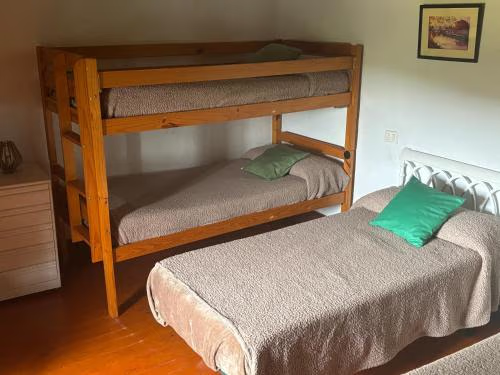
- Albergue juvenil Lug2: The youth hostel is owned by the Xunta, privately run and takes pilgrims with a credencial, about 150 metres from the wall. A dormitory bed costs €15 to €19 with breakfast (as of August 2026). Here you can book.
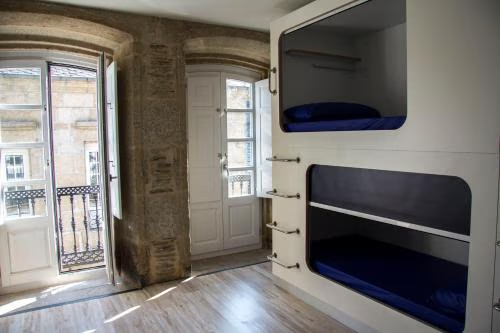
- We have not found a donativo or parish hostel in Lugo. There are also several private albergues and hostels in and around the old town, with dormitory beds from about €14 (as of October 2026).
Ninja tips
- Walk once all the way round the wall. Just over two kilometres without a backpack, without climbing, with the city on both sides. For your legs it's a rest day; for your head it's a panorama of everything you don't have to walk today.
- Order another drink rather than a second meal. In the taverns the tapa comes with it anyway.
- If the indulgence matters to you: here it is possible on any day of the year, not only in a Holy Year.
- Take water and food for the whole stage tomorrow. After the bridge there is nothing for a long time.
- Note for 2027: In the Holy Year, volunteers from the Canadian Company of Pilgrims will welcome arrivals at the pilgrim hostel from May to October. They help with anything practical and listen if you want to talk.
Practical tips for pilgrims
- Credencial: Without one the pilgrim hostel won't take you; the Lug2 youth hostel also requires it.
- Festivals: In mid-June Lugo celebrates its Roman past with Arde Lucus; 5 October is the day of the city's patron saint, San Froilán. The Ofrenda takes place on the Sunday after Corpus Christi.
- Laundry: At the pilgrim hostel the washing machine costs €3, the dryer €1.50 (as of August 2026).
- Tourist office: on the Praza do Campo. Opening hours are given differently; ask locally.
Onward: over the Roman bridge to the Miño
The route leaves the old town from the Praza Maior via the Praza de Santa María. There you have two options: the waymarks lead you down through the Porta Miñá; the second variant passes the cathedral, goes through the Porta de Santiago and down Rúa Santiago. Both meet again and cross the old stone bridge to the other bank of the Miño. Then the route continues upstream; after 2.1 kilometres you are in San Lázaro. After 18.5 kilometres you reach San Romao da Retorta, after 27.1 kilometres Ferreira.
What awaits you tomorrow
Tomorrow you start on a bridge the Romans already walked across: it lies on the line of the old Via XIX and is still in use today. The stage to San Romao da Retorta is 18.5 kilometres long, with 450 metres of ascent and hardly anywhere to buy food. If you go on to Ferreira, you have 27.1 kilometres ahead of you.
Deep dive: The ring and the light
A short read, in case you want to learn more about Lugo. About two minutes' reading.
A city in a grove
The name Lucus Augusti means something like the grove of Augustus. The Romans founded the city between 15 and 13 BC. Down by the river they built a bridge for their road, Via nineteen, and above the river a city. For a long time it had no wall. Only in the third century, between 263 and 276, did the ring of stone rise around its houses.
A wall that was not allowed to fall
The wall is just over two kilometres long and originally had five gates. Five more were added only after 1853. More than seventy towers still stand. Lugo kept its wall, and in 2000 UNESCO added it to the World Heritage list as the finest example of late Roman fortifications in western Europe. Whoever walks on top today can go round the whole city without once coming down.
Pilgrims at the gate
Then came the pilgrims. In the Middle Ages they crossed the bridge over the Miño and passed through the Porta Miñá on their way to Santiago. Another gate, the Porta de San Pedro, was then called Puerta Toledana, because the merchants from Toledo came through it. In the evening it stayed open an hour longer than the others.
The light on the altar
From 1129 the people of Lugo built their cathedral. At some point in the Middle Ages they began to expose the Sacrament permanently on the high altar. Nobody knows exactly when; it is documented from the fifteenth century. It has not been taken away since. In 1669 the cathedral lacked the money to pay for the light on the altar. The cities of the old Kingdom of Galicia vowed to provide for it, and they keep that vow to this day. Every year, on the Sunday after Corpus Christi, the mayors of A Coruña, Lugo, Ourense, Santiago, Mondoñedo, Betanzos and Tui come to the cathedral and bring their offering. Only once was the ceremony cancelled, in 1809, when French troops were quartered in the city.
What Lugo gives you
The Camino is a line. You walk on every day, and what lies behind you does not come back. In Lugo you can do something different for an afternoon: walk once in a circle, on a wall that has stood for almost eighteen hundred years, and end up back where you started. And in the cathedral a light is burning that people have not let go out for centuries. You don't have to believe to understand what that means. From here it is one hundred kilometres more. Tomorrow you walk straight ahead again.
Where to stay in Lugo
The places pilgrims rate highest in Lugo come first.
- Top #1
 OpenReservations not accepted
Albergue de peregrinos de Lugo
- Top #2
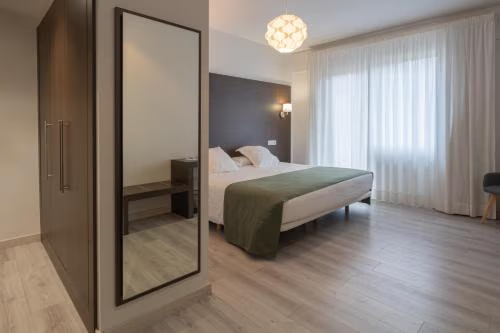 OpenReservations accepted
Hotel Méndez Núñez
- Top #3
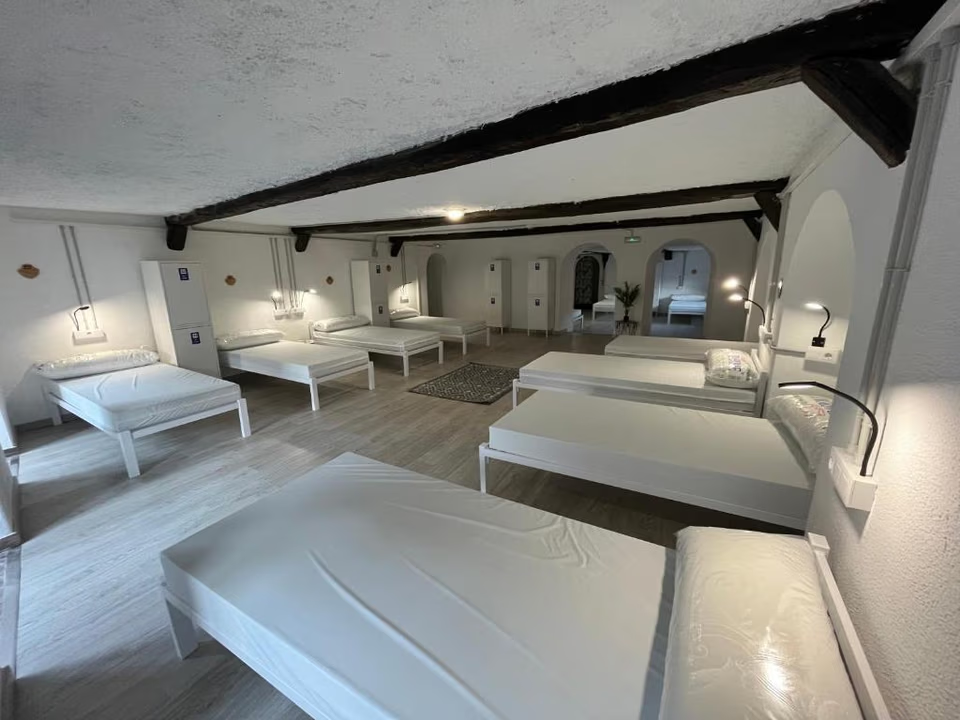 OpenReservations accepted
Hostel Porton


Services in Lugo
What you can find in town before the next stage.
- ATM
- Café
- Shop
- Tobacco
- Medical clinic
- Pharmacy
- Fountain
- Post office
- Train station
- Restaurant
Source: © OpenStreetMap contributors · updated November 2025
Town 11 of 17