

Town on the Camino
Melide
A Coruña, Galicia, Spain
- places to stay
- 24
- Caminos
- 2
- Elevation
- 456 m
Two Caminos merge in Melide: here the Camino Primitivo from Oviedo meets the Camino Francés, and from here you walk the last 52.6 kilometers to Santiago together. Add a 14th-century wayside cross, a pilgrim hospital that is now a museum, and the octopus the town is famous for. One afternoon is enough.
How long to stay?
One afternoon is enough. What makes Melide special lies close together: the wayside cross and the San Roque chapel on the Camino, the old pilgrim hospital with its museum, the squares of the old town and, at the edge of town, the Romanesque church of Santa María. Add a long meal in a pulpería. Melide is too small for a rest day, and Santiago is only two to three days away.
Melide in Ninja numbers
- 52.6 kilometers are left from here to Santiago. Behind you lie 723.5 kilometers on the Camino Francés since Saint-Jean-Pied-de-Port.
- 256.0 kilometers are in the legs of the pilgrims on the Camino Primitivo when they meet you in Melide. They come from Oviedo via Lugo and have left the mountains of Asturias behind them.
- 1185 is the year the bridge of Furelos, which you cross shortly before Melide, is first mentioned.
- Around 1375 the pilgrim hospital was built, which now houses the town museum. Admission: nothing.
- 0 euros is what the best hour in Melide costs, if you come between May and December.
Arriving: over Furelos into town
From Palas de Rei it is 14.9 kilometers with 298 meters of ascent and 407 meters of descent, through a chain of small villages. The last highlight before the town is the bridge of Furelos: four uneven round arches, 50 meters long, documented since 1185 and, until the 19th century, the only crossing for carts and riders. After that you climb the last one and a half kilometers up to Melide. Opposite the church on the Camino is a private clinic that specializes in pilgrims. At the Plaza do Convento, the pilgrims from the Primitivo and the Francés come together.
In brief: a town for pilgrims
In the Middle Ages, Melide was a town on the Camino and for the Camino. In the 14th century it received a wall and a castle meant to protect town and pilgrims; both fell in the Irmandiño uprisings of the 15th century. Around 1375, Fernán López and Aldara González founded a pilgrim hospital, which the Count of Monterrey had renewed in the early 16th century; his coat of arms still hangs on the façade. The convent of Sancti Spiritus was also founded as early as the 14th century. Today Melide is a small town of just over 7,500 inhabitants, and for most pilgrims it is above all one thing: the place where you get pulpo.
Where two Caminos become one
Until Melide, the pilgrims from the Primitivo walk a path of their own, over the mountains of Asturias and through Lugo. From here they walk with you, and in conversation places come up that you do not know. For you, Melide is one stage town among many; for them it is the end of a Camino of their own, over 250 kilometers long. Ask them how it was.
Confluence: what to see
Everything lies on the Camino or a few steps from it.
- Cruceiro and Capilla de San Roque: The Gothic wayside cross from the 14th century is considered one of the oldest in Galicia. It stands at the San Roque chapel next to the N-547 road, right on the Camino. The chapel itself is younger than it looks: it was built around 1949 from stones of the medieval churches of San Pedro and San Roque, hence the Gothic-looking portal.
- Museo da Terra de Melide: Since 2001 the museum has been housed in the old Sancti Spíritus pilgrim hospital. The first hall tells of the Caminos and the hospital, with medieval capitals, wall painting and a 15th-century sarcophagus; further halls cover the castros of the Iron Age, Roman times and life in the countryside. Tuesday to Saturday 10:30–13:30 and 17:00–20:00, Sunday 11:00–14:00, closed on public holidays, admission free (as of October 2026). From January 1 to May 1 it stays closed.
- Santa María de Melide: The Romanesque church from the second half of the 12th century, a national monument, with a single nave and a semicircular apse, stands at the edge of town. Gothic wall paintings survive in the choir. We did not find opening hours; you walk past it tomorrow anyway.
- Capilla del Carmen: The chapel of 1741 stands on the hill of a pre-Roman castro, where the castle was in the Middle Ages. Its altar dates from 1755.
Food and drink
Melide is the capital of pulpo á feira: octopus with paprika, olive oil and salt, served on wooden plates, with bread and a glass of Ribeiro. The two best-known pulperías, Ezequiel and A Garnacha, each have their loyal followers. For dessert there are melindres, glazed rings with sugar icing, along with ricos and almendrados. On the second Sunday in May, the town celebrates its own Melindre festival.
Honestly
- The Xunta albergue has a kitchen without dishes. Microwave and fridge yes; pots, plates and cutlery no. Pilgrims complained about this several times in 2026.
- Cramped and full. The public albergue is large, but between the bunk beds there is hardly any room for your backpack, and some showers have no doors.
- Winter gets thin. Many private albergues are open only from March or April to October or November.
- The museum is closed in spring. It stays shut until May 1, just in the season when the first pilgrims arrive.
Where pilgrims sleep
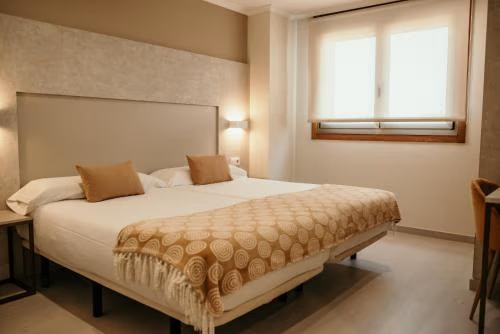
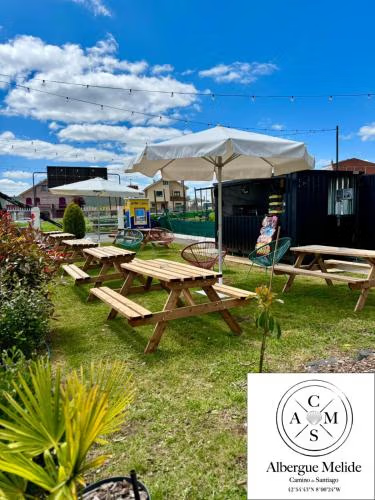
The Xunta's Albergue de peregrinos de Melide is on Rúa San Antonio at the edge of town, right on the Camino. It costs €10 with disposable bed linen, opens at 13:00, closes at 22:00, is open all year and takes no reservations; you need a credencial (as of October 2026). In addition there are a good dozen private albergues, mostly for €13 to 17, many of them closing for the late autumn, and pensions in the center.
Ninja tips
- Bring a cup and cutlery to the Xunta albergue. The kitchen has no dishes.
- Blisters? The pilgrim clinic opposite the church on the Camino is private, but exactly geared to this.
- Look at the wayside cross before you sit down. It stands right on the Camino by the San Roque chapel, and in the evening it is quieter there than at noon.
- Talk to the Primitivo pilgrims. From Melide you are on one Camino; they know which stages are still to come, and you know where it gets crowded tomorrow.
- The museum is free. Tuesday to Sunday, from May: an hour of pilgrim history in the building where pilgrims already slept in 1375.
Practical tips for pilgrims
- Stamps: On the last 100 kilometers you need two stamps a day for the Compostela. Albergues, churches and bars stamp.
- Bus: Freire goes about ten times a day to Santiago and Lugo, Arriva a few times a day to A Coruña.
- Tourist information: in the town hall, Monday to Friday 9:00 to 15:00, tel. 981 505 003.
Onward: via Ribadiso to Arzúa
At the edge of town you pass Santa María, then up and down over Boente and A Castañeda into the valley of the Iso. In Ribadiso (km 734.6) you cross the river on a stone bridge; next to it stands a medieval pilgrim hospital that has been a Xunta albergue again since 1993. At 305 meters, this is the lowest point of the day. After that it climbs up to Arzúa (km 737.7): 14.2 kilometers, 323 meters of ascent, 392 meters of descent. From Arzúa it is another 38.4 kilometers to Santiago.
What awaits you tomorrow
Arzúa, the town of cheese. Here the third Camino joins in: the Camino del Norte from the coast meets you, and in the Xunta albergue pilgrims from Irún, Oviedo and Saint-Jean-Pied-de-Port then sleep under one roof.
Deep dive: Melide, the town of meeting
A short read, in case you want to learn more about Melide. About three minutes' reading.
Two Caminos, one square
When you stand at the Plaza do Convento, you stand at the point where two of the great Caminos become one. One comes from the Pyrenees, over more than seven hundred kilometers through Navarra, Castile and León. The other comes from Oviedo, over the mountains of Asturias and through Lugo. The Camino from Oviedo bears the name Primitivo, the original, because according to tradition it is the oldest, the one a king of Asturias is said to have walked as early as the ninth century. Whether that is true cannot be proven. What is certain: from here on, everyone walks the same Camino.
A bridge, a hospital, a wall
Melide lived from the Camino early on. The bridge of Furelos is documented since 1185. For seven hundred years it was the only crossing for carts and riders. Around 1375, Fernán López and Aldara González founded a hospital for pilgrims in the town. At the start of the sixteenth century the Count of Monterrey had it renewed, and his coat of arms still hangs over the door today. In the fourteenth century Melide also received a wall and a castle. They were meant to protect the town and the pilgrims. In the fifteenth century, when the peasants of Galicia rose against their lords, both were destroyed. The castle stood where the chapel of Carmen now stands on the hill, and beneath it there had been a settlement as early as the Iron Age.
A wayside cross that stays
Much in Melide has been rebuilt, moved, put together anew. The San Roque chapel, which looks so medieval, was built around 1949 from the stones of two old churches. The wayside cross beside it, however, is from the fourteenth century and is considered one of the oldest in Galicia. It has seen generations of pilgrims pass by, from both directions, who came together here.
What Melide gives you
When this text was written, in autumn 2026, the old pilgrim hospital housed a museum that costs nothing, and in the pulperías pilgrims from two Caminos sat at the same wooden tables. Melide is not a town you stay for. It is a town where you meet. Whoever has walked alone until here is rarely alone from here on.
Where to stay in Melide
The places pilgrims rate highest in Melide come first.
- Top #1
 ClosedReservations accepted
Albergue Alfonso II El Casto
- Top #2
 ClosedReservations accepted
Albergue San Anton
- Top #3
 ClosedReservations accepted
Albergue O Candil



Services in Melide
What you can find in town before the next stage.
- ATM
- Café
- Shop
- Tobacco
- Medical clinic
- Pharmacy
- Fountain
- Post office
- Restaurant
Source: © OpenStreetMap contributors · updated January 2025
Town 44 of 49