

Stage town on the Camino
Oviedo
Asturias, Spain
- places to stay
- 37
- Caminos
- 5
- Elevation
- 242 m
Oviedo is where it all began: King Alfonso II is said to have set out from here as the first pilgrim to the Apostle's tomb, and the Camino Primitivo starts here, 308.7 kilometres to Santiago. First you visit the Salvador, to whom the cathedral belongs. The cathedral, the Cámara Santa and the pre-Romanesque churches are worth a rest day.
How long to stay?
Worth a rest day, especially if this is where you start. Oviedo is both a starting point and a finish: the Camino Primitivo begins at the cathedral, the Camino San Salvador ends there. One day is enough for the cathedral with the Cámara Santa, a walk through the old town and a detour to the pre-Romanesque churches on Monte Naranco. If you come from León, you have some 120 kilometres over the mountains behind you and will be glad of a day without your pack. Mind Sunday: the cathedral's pilgrim office is closed.
Oviedo in Ninja numbers
- 308.7 kilometres separate the cathedral from Santiago on the Camino Primitivo. In Melide, after 256.0 kilometres, you join the Camino Francés.
- 834 is the year tradition gives for King Alfonso II's departure. Historians argue about the date; the city calls him the first pilgrim all the same.
- 120.8 kilometres is the length of the Camino San Salvador from León to here. If you are on the Camino del Norte, you can turn off at Villaviciosa: it is 40.3 kilometres on the Norte via Oviedo.
- 7,110 overnight stays were counted by the El Salvador pilgrim hostel in 2025, more than ever before. In 2024 there were 6,581. More than eight in ten guests were heading for the Primitivo.
- 184 steps lead up the cathedral's Gothic tower, only on a guided tour with a separate ticket.
Arriving: to the Salvador
If you start here, you usually arrive by train or bus and head straight for the Plaza de la Catedral. Alfonso II stands there as a statue, with the Gothic tower rising behind him. If you arrive on foot, on the Camino San Salvador from León or on the Norte via Villaviciosa, you reach the city through Colloto, and that approach is long and tedious, through industrial estates and suburbs. The reward is the old town, with the cathedral at its end.
In brief: a capital and its relics
In the 9th century Oviedo was the capital of the small Christian kingdom of Asturias. When the tomb of the Apostle James was found in Galicia, King Alfonso II is said to have set out for it from here. His route became the Camino Primitivo, the "original way", part of the UNESCO World Heritage since 2015.
The cathedral is dedicated to the Salvador, Christ the Saviour. Its origins go back to the 8th century; the present Gothic building was mostly built in the 14th and 15th centuries, the façade and tower in the 16th. Under Alfonso II the Cámara Santa was built, a treasure chamber for the relics. In the Middle Ages many pilgrims on their way to Santiago came to Oviedo specifically for them. Hence the saying people here like to quote: "Quien va a Santiago y no al Salvador, visita al criado y no al Señor". Whoever goes to Santiago and not to the Salvador visits the servant and not the Lord.
The first way: what to see
The essentials lie close together in the old town; you reach the pre-Romanesque churches on the Naranco by bus.
- San Salvador Cathedral: The Primitivo starts here, and here you get your first stamp. The audio-guided tour covers the church, the Cámara Santa, the museum and the cloister. Pilgrims with a credencial pay less; we have not found a reliable current price. You can only visit the tower with its 184 steps on a guided tour with a separate ticket.
- Cámara Santa: The chapel from the time of Alfonso II holds the treasures medieval pilgrims came for: the Cross of the Angels, the city's emblem, the Cross of Victory and the Arca Santa, the reliquary chest. In 1934 the chamber was blown up; it was reconsecrated in the 1940s. The cathedral shows the shroud, the Santo Sudario, openly on only three days: Good Friday, 14 and 21 September.
- Statue of Alfonso II: On the square in front of the cathedral stands the king Oviedo calls the first pilgrim. A good spot for your starting photo.
- Fuente de la Foncalada: A pre-Romanesque fountain, also World Heritage. Since 2026 two bronze pilgrim figures by the sculptor Sara Iglesias have stood beside it.
- San Julián de los Prados: The pre-Romanesque church is about ten minutes' walk from the centre.
- Santa María del Naranco and San Miguel de Lillo: The two most famous buildings of Asturian pre-Romanesque architecture stand on Monte Naranco above the city. You reach them on bus A2 from Calle Uría.
Food and drink
Asturias drinks cider, and since 2024 Asturian cider culture has been intangible cultural heritage. The cider is poured into the glass from a great height so that it foams, and drunk in small sips. On the evening before you set off, a sidrería is the right place, and tomorrow you have 26.4 kilometres to walk it off again.
Honestly
- The approach from Colloto is a slog. If you arrive via the San Salvador or the Norte, you walk a long way through industry and suburbs. That is no reason to cut the stage short, but don't expect beauty before the old town.
- The hostel is not in the old town. It is housed in the seminary, about 800 metres from the cathedral, and only opens at 16:00.
- The cathedral charges admission. The stamp is normally available at the entrance even without a ticket. Pilgrims have reported days in August, though, when they were asked to pay for it.
- On Sundays the pilgrim office is closed. If you want to collect the Salvadorana, do it on Saturday.
Where pilgrims sleep
The El Salvador pilgrim hostel belongs to the city and is run by volunteers from the Astur-Leonese Camino association. It is in the seminary near Prao Picón, open all year, and lets you in from 16:00 to 21:00 in winter, until 22:00 in summer. The price is small; sources give different amounts. We don't give bed numbers, as the figures contradict each other.
There are also private hostels in the old town, such as La Hospedería next to the cathedral and La Peregrina on Calle Gascona. A dorm bed there costs roughly €15 to just over €30, depending on the house and the season (as of October 2026). There is no donativo hostel in Oviedo.
Ninja tips
- Get the Salvadorana if you come from León. If you have walked the Camino San Salvador, the cathedral's pilgrim office gives you the certificate free of charge, and with it free entry to the cathedral, the Cámara Santa, the museum and the cloister.
- You can get a credencial in four places: at the cathedral, the tourist office, the church of San Juan el Real and the hostel.
- Turn left at the cathedral. The Primitivo runs through Calle Schultz, the Camino del Norte in the opposite direction. Take the wrong turn here and you end up on the way to Avilés.
- Take the bus to the Naranco. Line A2 leaves from Calle Uría. That way you see both churches without spending energy before the first stage.
- Stamp in Llampaxuga. Shortly after the city you can stamp your credencial in the small chapel of the Virgen del Carmen.
- Shop in Oviedo. There are few supplies on the first stage.
Practical tips for pilgrims
- Arrival: The railway and bus stations are about a kilometre from the cathedral.
- Hostel: Entry from 16:00, until 21:00 in winter and 22:00 in summer.
- Sudario: If you want to see the shroud, plan for Good Friday, 14 or 21 September.
- Cathedral: We have not found reliable opening hours and prices. Check them on site.
Onward: onto the Primitivo
From the cathedral the way leads through Calle Schultz, across the Plaza de La Losa and through the La Argañosa district, over the railway line and out into the Parque del Camino de Santiago. After 4.5 kilometres you reach San Lázaro de Paniceres, where a large leper hospital stood in the 14th century, and at kilometre 5.7 the highest point of the day at 257 metres. Passing below Monte Naranco you come to Escamplero at kilometre 12.0. After the Molino de Quintos a climb awaits that tests many pilgrims. At kilometre 22.8 you cross the Nalón on the Peñaflor bridge, and after 26.4 kilometres, 707 metres of ascent and 872 metres of descent you are in Grado.
What awaits you tomorrow
Grado, the first stage town of the Primitivo. Just before it you cross the Peñaflor bridge, where a pilgrim hospital already stood under King Alfonso VII. The first day tells you what you are letting yourself in for: a lot of up and down, few supplies, and in the evening the feeling of being on the oldest of all the ways.
Deep dive: The Lord and the servant
A short read, in case you want to learn more about Oviedo. About four minutes' reading.
A king sets out
In the beginning there is a tomb at the end of the world. In the early ninth century, so tradition tells, the tomb of the Apostle James was found in Galicia. The king who heard of it sat in Oviedo. Asturias was then a small Christian kingdom in the north of the peninsula, squeezed between the sea and the Muslim south. Alfonso the Second, known as the Chaste, is said to have set off with his court over the mountains to the west. Tradition usually gives the year 834; historians dispute it. What is certain is that Oviedo claims him as the first pilgrim, and his route today bears the name Camino Primitivo, the original way. The king's statue stands in front of the cathedral, and that is where you begin.
Why pilgrims came to Oviedo
In the Middle Ages Oviedo was not only a beginning but also a detour. Many pilgrims passing through León on the way to Santiago turned north and climbed over the mountains to Oviedo to see the relics of the Cámara Santa. The small chapel from the time of Alfonso the Second still holds the Cross of the Angels, the Cross of Victory and the Arca Santa, a silver-clad chest full of relics. Then there is the Sudario, a linen cloth that, according to tradition, covered the face of Christ in the tomb. It is shown openly on only three days a year. From this time comes the saying that whoever goes to Santiago and not to the Salvador visits the servant and not the Lord. The Lord is Christ, to whom the cathedral is dedicated. The servant is the Apostle. The way from León to Oviedo is still called the Camino San Salvador.
Blown up and rebuilt
The cathedral grew over centuries. Its origins go back to the eighth century; the Gothic house you see today was mostly built in the fourteenth and fifteenth centuries, the façade and tower in the sixteenth. In 1934, during the uprisings in Asturias, the Cámara Santa was blown up. It was rebuilt and reconsecrated in the 1940s. The treasures pilgrims once came for are back in their place.
What Oviedo gives you
Oviedo reminds you that the way to Santiago once had a first step. Before there were stages, arrows and hostels, a king set out from here without knowing what awaited him. When this text was written, in autumn 2026, more people every year were staying at the pilgrim hostel to take the same way. Perhaps that is what you take with you from here: you are not the first to walk, but you walk the oldest way. And before the servant, you have visited the Lord.
Where to stay in Oviedo
The places pilgrims rate highest in Oviedo come first.
- Top #1
 OpenReservations not accepted
Albergue de Peregrinos El Salvador
- Top #2
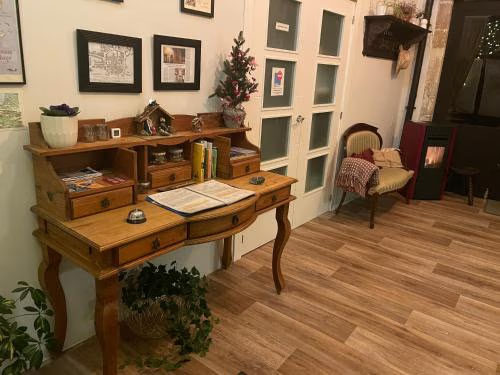 OpenReservations accepted
La Hospedería Oviedo
- Top #3
 OpenReservations accepted
AC Hotel Oviedo Fórum by Marriott


Services in Oviedo
What you can find in town before the next stage.
- ATM
- Café
- Shop
- Tobacco
- Medical clinic
- Pharmacy
- Fountain
- Post office
- Train station
- Bus station
- Airport
- Restaurant
Source: © OpenStreetMap contributors · updated November 2025
Town 1 of 17