

Stage town on the Camino
O Cádavo
Lugo, Galicia, Spain
- places to stay
- 6
- Camino
- 1
- Elevation
- 726 m
O Cádavo is where you arrive after the "leg-breaker": 24.3 hard kilometres beyond A Fonsagrada, at the edge of the Campo da Matanza, where King Alfonso II is said to have defeated a Muslim army in 813. An unassuming farming village with everything you need and 130.5 kilometres to Santiago. An afternoon is enough.
Right now in O Cádavo (as of October 2026)
- Winter season: The private Albergue San Mateo is only open from 1 April to 31 October. From November, the Xunta hostel and the Albergue-Pensión Porta Santa remain.
How long to stay?
An afternoon is enough. O Cádavo is the main village of the small municipality of Baleira, a village of dairy and beef farmers where you mostly meet milk tankers. There are hardly any sights in the strict sense. You arrive exhausted from one of the hardest stages of the Primitivo, wash, eat and sleep. That is exactly what the place is good for.
O Cádavo in Ninja numbers
- 24.3 kilometres lie behind you since A Fonsagrada, with 896 metres of ascent and 1,133 metres of descent.
- 130.5 kilometres are left to Santiago de Compostela on the Camino Primitivo.
- 813 is the year Alfonso II, the first pilgrim to Santiago, is said to have defeated a Muslim army here. That is how the legend tells it.
- 30.5 kilometres separate you from Lugo, with 612 metres of ascent. That is why many split the distance.
Arriving: across the battlefield
After Montouto and the descent to Paradavella come the climbs this stage is feared for: first A Lastra, then the long way up to A Fontaneira. At the end of Fontaneira you leave the road, climb briefly once more and then cross a small plateau down into the village. This plateau is the Campo da Matanza, the "field of slaughter". The Xunta hostel is right at the village entrance, on the path.
In brief: a king and a battlefield
Written traces of this place go back no further than the 9th century, and the first story is about a battle. Christians and Muslims are said to have fought on the Campo da Matanza. The legend links this to Alfonso II, King of Asturias, who is considered the first pilgrim to the newly discovered tomb of the Apostle: he defeated a Muslim army here in 813, and a sanctuary was later built on the spot. None of this is documented. But the coat of arms in the old town hall still shows a knight fighting Moorish soldiers. Later the area belonged to noble families, the best known being the Count of Amarante.
A village after the battle: what to see
The village itself is simple. The main places are on the path.
- The Campo da Matanza: The plateau you cross from Fontaneira down into the village is the setting of the legend. There is nothing to see but pasture, but you are walking through the story O Cádavo introduces itself with.
- The old town hall with the coat of arms: This is where the shield hangs with the knight fighting the Moors. It is the only visible testimony of the battle.
- The church of the Inmaculada Concepción: The village's parish church. We have not found opening or Mass times.
- Santiago in A Fontaneira: Five kilometres before O Cádavo stands the 18th-century church of St James in Fontaneira, on the site of the chapel of a medieval pilgrim hospital. In 1809 Napoleonic troops burned the village down; the villagers drove them out.
Food and drink
People here eat what the mountains provide, above all pork: butelo, botillo, chorizo and lacón. Every February there is a market dedicated to them, with produce from the area. In the village you will find a grocery, a butcher, a bakery and a bar-restaurant.
Honestly
- The village is no beauty. O Cádavo is a working village, considered "unremarkable but functional". If you are looking for an old town, you will find one in Lugo.
- The stage before is harder than you think. 24.3 kilometres sounds short, but the constant climbs make it one of the toughest of the whole route.
- The stage after is long. It is 30.5 kilometres to Lugo. If you don't want to go that far, you have to stop in Castroverde or at one of the small hostels beyond it.
- In winter it gets tight. From November the largest private hostel is closed, and in winter more snow falls here than in the surrounding area.
Where pilgrims sleep
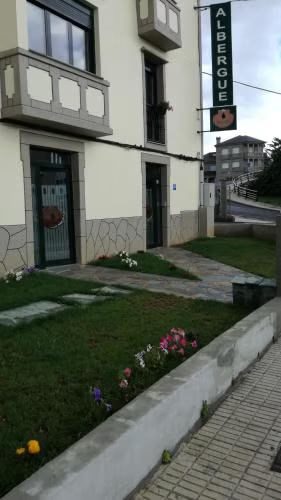
The Xunta pilgrim hostel stands at the village entrance on Rúa da Feira, right on the path. It has 22 places and costs €10, disposable sheets and blankets included (as of August 2026). It is open all year, check-in from 13:00, closing at 23:00 in summer and 22:00 in winter. You cannot book; there is a washing machine, a dryer and heating, but no fridge and no crockery. There are also two private hostels with rooms: Albergue San Mateo on the same street, open from April to October, and the year-round Albergue-Pensión Porta Santa, both around €17 in the dormitory; Porta Santa can be booked via Booking. There is no parish or donativo hostel.
Ninja tips
- Shop here for tomorrow. O Cádavo has an ATM, a pharmacy, a bakery and groceries. On the way to Lugo supplies are thin.
- Split the walk to Lugo. Castroverde is only 8.5 kilometres further on. If you sleep there or at the small hostels beyond Castroverde, you arrive in Lugo the next day well rested.
- Turn around in Pradeda. Shortly after the village the path climbs to Pradeda, from where you have a fine view back over O Cádavo.
- Bad weather? Take your time. After rain the tracks before O Cádavo are muddy, and the stage takes much longer.
Practical tips for pilgrims
- Supplies: ATM, medical centre, pharmacy, groceries, butcher, bakery, bar-restaurant.
- Bus: Several times a day a bus runs to Lugo and to A Fonsagrada.
- Festivals: Around 12 August the municipality celebrates its patron saint, San Cristovo.
Onward: towards Lugo
The path avoids the steep main road and climbs on a farm track to Pradeda. It continues up to the Alto da Vacariza, at kilometre 180.7 and 849 metres the last high point before Lugo. Then the path drops to Vilalle and on to Castroverde, 8.5 kilometres with 169 metres of ascent and 299 metres of descent. In total it is 30.5 kilometres to Lugo.
What awaits you tomorrow
Lugo, the only city in the world with a completely preserved Roman town wall. You walk in through a gate and in the evening you can walk all the way round the old town on top of the wall.
Deep dive: The king who walked first
A short read, in case you want to learn more about O Cádavo. About three minutes' reading.
A field with a harsh name
Shortly before you arrive in O Cádavo, you cross a small plateau. It is called Campo da Matanza, the field of slaughter. People here say that Christians and Muslims fought each other on this spot in the ninth century. It is the oldest story known about this place. There are no older written traces, only finds that show people already lived here in prehistoric times.
Alfonso the Chaste
The legend gives the battle a name and a date. King Alfonso the Second of Asturias, known as the Chaste, is said to have defeated a Muslim army here in the year 813. For pilgrims Alfonso is no ordinary figure. He is considered the first pilgrim to Santiago, because he is said to have travelled from Oviedo to the newly found tomb of the Apostle. You are walking roughly that route now. Whether he ever stood on this field, no one knows. The legend says that a sanctuary was later built here in thanks.
What remains
What you see today is a farming village. In the old town hall hangs a coat of arms showing a knight fighting Moorish soldiers. Five kilometres back, in Fontaneira, stands a church of St James where a hospital cared for pilgrims in the Middle Ages. And in 1809 soldiers came again, this time from France. They burned Fontaneira down, and the villagers chased them away. These mountains have seen many armies, but above all many pilgrims.
What O Cádavo gives you
When this text was written, in autumn 2026, pilgrims crossed this field every day, tired from the climbs beyond Paradavella. None of them fought an army, but each of them fought their own legs. O Cádavo is not a place you admire. It is a place where you arrive. Sometimes that is enough.
Where to stay in O Cádavo
The places pilgrims rate highest in O Cádavo come first.
- Top #1
 OpenReservations accepted
Albergue-Pensión Porta Santa
- Top #2
 ClosedReservations accepted
Albergue San Mateo
- Top #3
 OpenReservations accepted
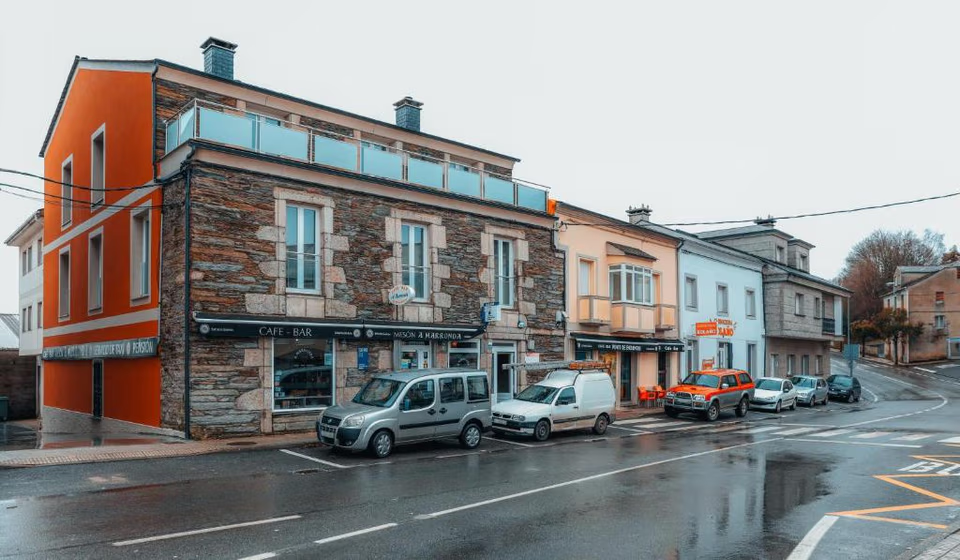
Pensión A Marronda


Services in O Cádavo
What you can find in town before the next stage.
- ATM
- Café
- Shop
- Pharmacy
- Fountain
- Restaurant
Source: © OpenStreetMap contributors · updated November 2025
Town 9 of 17