

Stage town on the Camino
A Fonsagrada
Lugo, Galicia, Spain
- places to stay
- 6
- Camino
- 1
- Elevation
- 960 m
A Fonsagrada is the first Galician town on the Camino Primitivo and exactly its halfway point: 153.9 kilometres from Oviedo, 154.8 to Santiago. The town sits at almost 1,000 metres and takes its name from a sacred spring that rises below the church. An afternoon is enough; tomorrow brings one of the hardest stages of the route.
How long to stay?
An afternoon is enough. You arrive after a long climb out of Asturias, and you are tired. What A Fonsagrada has to show lies close together: the spring, the church above it, a small folk museum. You can see it all in an hour or two. You need the rest of the evening for food and sleep, because the next stage to O Cádavo is a tough one.
A Fonsagrada in Ninja numbers
- 153.9 kilometres lie behind you since Oviedo, 154.8 are left to Santiago de Compostela. You are standing almost exactly in the middle of the Camino Primitivo.
- 956 metres is how much you have climbed today since Grandas de Salime, over 25.6 kilometres. At kilometre 141.5 you reach the highest point of the stage, at 1,113 metres.
- 960 metres is the town's altitude according to our data. A Fonsagrada is said to be the highest municipal seat in Galicia, and in winter there is often snow.
- 1984 is the year residents founded the folk museum; today the municipality runs it.
Arriving: across the border into Galicia
Beyond Peñafuente the path keeps climbing, and at the Alto do Acevo you cross from Asturias into Galicia. From here the Galician waymarker stones line the path. Via Barbeitos and Paradanova you continue along the ridge, then climb up into the town. A Fonsagrada is the first place of real size after the border, with shops, bars and several hostels.
In brief: the town at the sacred spring
The name comes from the Latin "fons sacrata", sacred spring. It rises at the foot of the parish church of Santa María, and travellers probably drank here long before there was a town. Several legends surround the spring. The best known says it gave a poor widow and her children milk instead of water. In another version, the spring was the reward for the family taking in a pilgrim in need. Both are legends, but they explain why a town grew up right here on the heights. The municipality is today the largest in Galicia by area, and thinly populated.
The sacred spring: what to see
The main places are only a few steps apart.
- The Fonte Sagrada: The spring that gave the town its name lies on Rúa da Fonte below the church, and a monument commemorates it. For pilgrims it is the real heart of A Fonsagrada: water for travellers, and in the legend even milk for those who took pilgrims in. It is accessible at any time.
- Igrexa de Santa María: The parish church is Baroque, from the 16th or 17th century, with three naves, a slate roof and a bell tower of granite blocks. We have not found Mass times.
- Museo Etnográfico: Founded in 1984 by residents, it shows mountain life on three floors: old crafts, prehistory and Roman finds. Entry was last €1.50, and it is closed on Mondays; opening hours change with the season, so call ahead (982 340 507).
- Casa Pasarín: This 19th-century house bears the name of a family that once owned it. Since 2017 it has been the public pilgrim hostel, so you sleep in one of the old houses of the town centre.
Food and drink
The cooking here is mountain cooking: game, Galician beef, meat from the Porco celta, an old pig breed being brought back, and above all butelo, a smoked sausage similar to the botillo of León. It has its own festival at the end of January or the beginning of February. You can also get pulpo a feira in town. For the road, the bakery has empanadas, plus an almond-and-cream cake that counts as a local speciality.
Honestly
- It is cold up here. At almost 1,000 metres even summer nights are fresh, and in winter there is often snow.
- The Xunta hostel gives out no blankets. There are disposable sheets but no blankets, and the kitchen has no crockery. A sleeping bag is not optional here, it is essential.
- The town itself is rather plain. Away from the spring and the church, A Fonsagrada is a functional small town, not a postcard village.
- The next stage is hard. Between O Padrón and O Cádavo the path goes constantly up and down, and after rain the tracks are muddy. Allow more time than the kilometres suggest.
Where pilgrims sleep
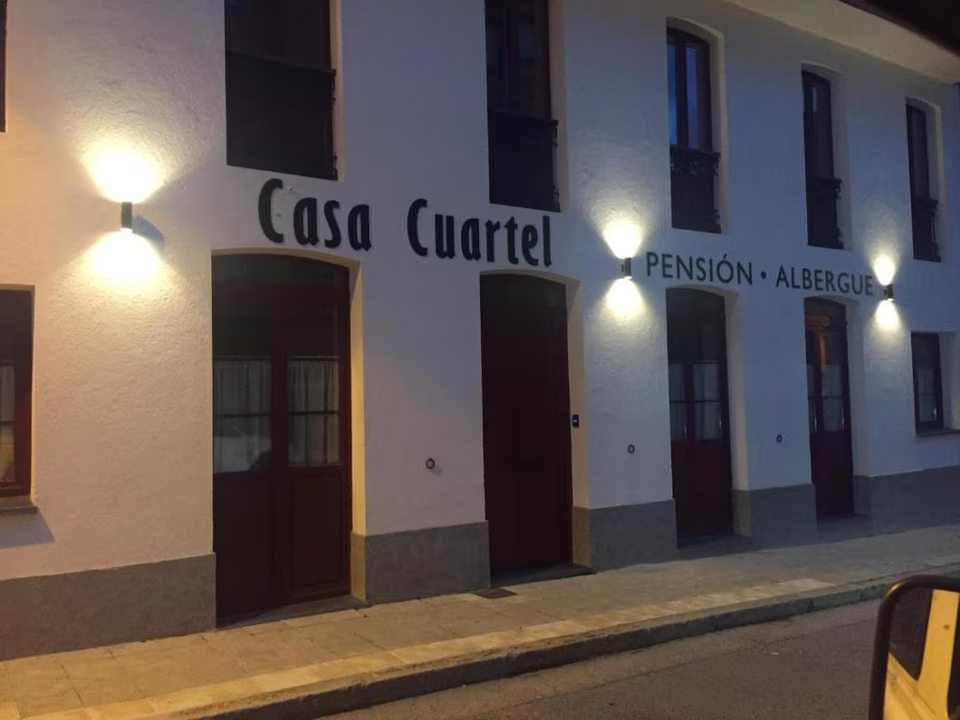
The public Xunta pilgrim hostel in Casa Pasarín is in the old town centre, on Rúa San Roque. It has 42 places in five dormitories, costs €10 and is open all year, check-in from 13:00, closing at 22:00 (as of August 2026). You cannot book, and the credencial is required. There are also two private hostels with guesthouse rooms, both open all year with dormitory beds around €15: Albergue Casa Cuartel, which opened in 2020 and can be booked via Booking, and Albergue-Pensión Cantábrico in the town centre. On top of that there are a few guesthouses and a campsite about 900 metres outside town. There is no parish or donativo hostel.
Ninja tips
- Drink at the spring. It lies right below the church and is the reason this town exists.
- Stop at Montouto tomorrow. A good seven kilometres beyond town, at around 1,000 metres, stand the remains of a 14th-century pilgrim hospital, with a dolmen beside it. It is the most atmospheric stop of the stage.
- Don't judge the stage to O Cádavo by its kilometres. 24.3 kilometres sounds harmless, but you climb almost 900 metres and descend more than 1,100. Pilgrims call the stretch beyond Paradavella the "leg-breaker".
- Monday is closing day. The museum and the tourist office are closed on Mondays.
Practical tips for pilgrims
- Tourist office: Rúa Rosalía de Castro, from July to December Tuesday to Saturday 10:00–14:00 and 16:00–19:00, Sundays 11:00–14:00 (as of 2026).
- Post office: Avenida de Galicia 66, Monday to Friday 08:30–14:30.
- Festivals: The Apostle is celebrated on 25 July, the patron saint Santa María from 5 to 13 September.
- Bus: A bus runs to Lugo every day, in case you need to stop or skip ahead.
Onward: into the mountains of Lugo
The path leaves town alongside the road and reaches O Padrón after 1.3 kilometres. After that, forest tracks lead away from the road and up to Montouto; at kilometre 162.3 you reach the day's highest point, at 1,026 metres. Down to Paradavella, then come the climbs of A Lastra and A Fontaneira, before you descend across the plain of the Campo da Matanza to O Cádavo: 24.3 kilometres with 896 metres of ascent and 1,133 metres of descent.
What awaits you tomorrow
O Cádavo, the village on the edge of a battlefield. This is where King Alfonso II, the first pilgrim to Santiago, is said to have defeated a Muslim army in 813. The coat of arms in the old town hall still shows the scene.
Deep dive: Water for those who walk on
A short read, in case you want to learn more about A Fonsagrada. About three minutes' reading.
A spring on the mountain
Anyone who came over the mountains from the east found water up here. From it grew a town, and from the water a name: fons sacrata, the sacred spring. It still rises today at the foot of the parish church. No one knows exactly how old the veneration is. It is probably older than Christianity in these mountains, because springs here were always seen as places of life. The church was built over it later, not the other way round.
Milk instead of water
The legend people tell is about hospitality. A poor widow lived here with her children. In one version the spring gave her milk instead of water, so that the children would not go hungry. In another, the family had taken in a pilgrim, although they had almost nothing themselves, and the spring was the thanks for it. None of this is historically documented. But the story says what this place was for pilgrims: somewhere you were looked after.
A hospital on the mountain
The hospital of Montouto, which you reach tomorrow, had the same task. It was founded in the fourteenth century, on a ridge at around a thousand metres. The building whose remains you see dates from the end of the seventeenth century. It took in pilgrims until the beginning of the twentieth century. Today only one house still stands, with a small chapel beside it to which the people of the area go on pilgrimage, and a dolmen from the Neolithic. So people have seen something sacred on this mountain for a very long time.
What A Fonsagrada gives you
You are in the middle of the route, and the mountains of Asturias lie behind you. When this text was written, in autumn 2026, pilgrims crossed the border every day and drank at the same spring. It is a reminder that no one walks this route entirely alone. Somewhere, someone gives you water. And one day, perhaps, you will be the one who passes it on.
Where to stay in A Fonsagrada
The places pilgrims rate highest in A Fonsagrada come first.
- Top #1
 OpenReservations accepted
Albergue Casa Cuartel
- Top #2
 OpenReservations accepted
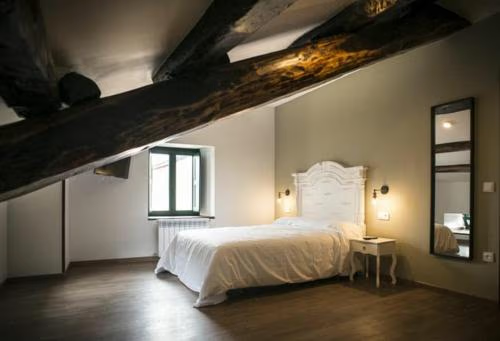
Hotel Pórtico
- Top #3
 OpenReservations accepted
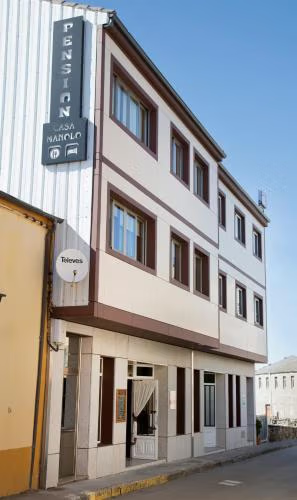
Pensión Casa Manolo


Services in A Fonsagrada
What you can find in town before the next stage.
- ATM
- Café
- Shop
- Pharmacy
- Fountain
- Post office
- Bus station
- Restaurant
Source: © OpenStreetMap contributors · updated November 2025
Town 8 of 17