

Town on the Camino
O Milladoiro
A Coruña, Galicia, Spain
- places to stay
- 11
- Caminos
- 4
- Elevation
- 245 m
O Milladoiro is the last stop before the finish: a suburb of tower blocks, 7.7 kilometres from the cathedral. Its name tells of pilgrims who saw the towers here for the first time and knelt down. A Romanesque chapel, a hostel with a social mission, and tomorrow morning you are in Santiago.
How long to stay?
An afternoon is enough. Most pilgrims walk straight through O Milladoiro because Santiago is so close. Those who sleep here do it on purpose: to arrive in Santiago rested rather than tired, in the morning, with time for the Pilgrim's Mass. The town is not pretty, but the chapel on the Way and the first view of the towers are worth the stop.
O Milladoiro in Ninja numbers
- 7.7 kilometres are left from here to the cathedral of Santiago on the Camino Portugués Central. You walk the same stretch if you came along the Coastal Way or the Senda Litoral.
- 17.6 kilometres is the stage from Padrón, with 303 metres of ascent. The last 5.9 kilometres from Rúa de Francos are almost all uphill.
- 242 metres is the altitude of O Milladoiro, barely lower than Santiago itself.
- More than 13,000 people live here, about half of the whole municipality of Ames.
- 2017 is when the town's pilgrim hostel opened, run by an association and the parish.
Arriving: up into the suburb
After Rúa de Francos the Way climbs steadily through woods and hamlets. The entry into O Milladoiro is not pretty: a sawmill near A Grela and a shopping area greet you. The Camino avoids the busy main road with its large apartment blocks and runs along side streets through the town. On Rúa Estivada de Castelao you pass the small chapel of Santa María Madalena.
In brief: from pilgrim halt to commuter town
O Milladoiro belongs to the parish of Viduido in the municipality of Ames and is today its largest settlement. For a long time there was little more here than the chapel and the Way. Then O Milladoiro grew as a place to live just outside Santiago, and with it the tower blocks you see today. The name is older than all of that. Most often it is said that pilgrims saw the cathedral here for the first time and knelt down. Others derive it from „miradoiro“, viewpoint. And in Galicia, „milladoiro“ is also the word for the cairn that pilgrims built up stone by stone on their way to a shrine.
The last chapel: what to see
- Capela de Santa María Madalena: The chapel stands right on the Way. Some traditions name the 10th or 11th century; the surviving medieval building is more cautiously dated to the 12th century. You can see Romanesque masonry mainly on the apse and the north wall; today's appearance largely dates from the restoration of 1863, the bell gable from the 19th century. Pilgrims once found rest, shelter and prayer here before the last kilometres. We did not find opening hours.
- The first view of Santiago: Beyond the residential area the Way climbs through woods to the Agro dos Mosteiros. From there you can see the cathedral and its towers. Take the minute.
Honestly
- A suburb, not a village. Tower blocks, roundabouts, shopping centres. If you are looking for one last Galician village, you won't find it here.
- The arrival is unattractive. A sawmill and commercial buildings accompany you into town.
- The way to Santiago zigzags. Because of the motorways and expressways you cross them several times, often on bridges and through underpasses.
- The hostel is seasonal. According to Gronze it is open from 1 March to Christmas. In winter you have to fall back on guesthouses or walk on to Santiago.
Where pilgrims sleep
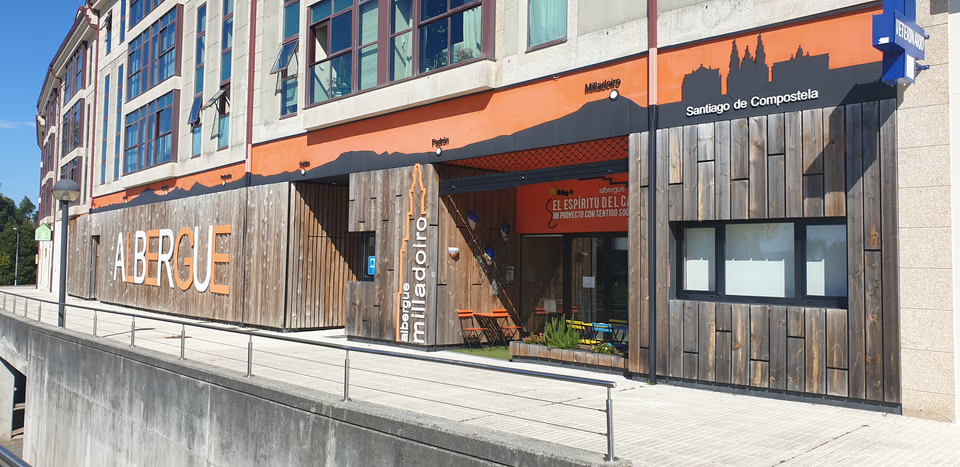
The Albergue Milladoiro is at the edge of town, about 300 metres from the Camino. It was inaugurated on 11 March 2017 and is run by the Asociación de Amigos do Camiño Portugués en Ames e Teo, supported by the parish of San Xosé do Milladoiro. It is a social project: people with disabilities and the long-term unemployed are meant to find work and experience here. Pilgrims praise the new beds, the good showers, the kitchen and the common room with its fireplace. A bed in the dormitory costs 17 to 19 € according to pilgrim portals (as of October 2026); it is open from 1 March to Christmas, and you can book via Booking. The town also has guesthouses and apartments.
Ninja tips
- Sleep here if you want to make the Pilgrim's Mass. From O Milladoiro it is just under eight kilometres. You reach the cathedral in the morning without setting off in the dark.
- Plan ahead in winter. Between Christmas and March the hostel is closed. Then you are left with a guesthouse in town or the walk to Santiago.
- Don't walk the main road. Follow the arrows through the side streets, even if they take detours.
Practical tips for pilgrims
- Pilgrim info in season: in the Casa da Cultura Monday to Friday 10:00–13:30 and in a hut between the Camino and the hostel, by the motorhome parking, Monday to Saturday 16:00–19:30 (according to Gronze).
- Supplies: ATM, bars, grocery shop, pharmacy and bus stop are in town.
- Bus to Santiago: If you are at the end of your strength, take the bus. The city is only a few kilometres away.
Onward: the last 7.7 kilometres
Beyond the Agro dos Mosteiros the Way goes down, through A Rocha Vella (km 614.2) and over the motorways. You have a choice of two approaches: via Santa Marta, the most direct according to Wise Pilgrim, or via Conxo, where the church of Santa María now stands in the grounds of a psychiatric hospital. You reach the lowest point at 164 metres at the Ponte Vella over the Sar. After that the Way climbs via the Alameda and the Porta Faxeira into the old town. In total it is 112 metres of ascent and 97 metres of descent.
What awaits you tomorrow
Santiago de Compostela. The cathedral, the Apostle's tomb, the Pilgrim's Office and the Compostela. You have arrived.
Deep dive: The place where people knelt
A short read, in case you want to learn more about O Milladoiro. About three minutes' reading.
Three explanations for a name
No one knows for certain how O Milladoiro got its name. There are three explanations. The first is the most beautiful: here, on the last hill of the Portuguese Way, pilgrims saw the cathedral for the first time, and they knelt down. The second is more sober: „Milladoiro“ could come from „miradoiro“, the Galician word for viewpoint. The third tells of an old custom. In Galicia, „milladoiro“ is the name for a pile of stones that pilgrims built up on the way to a shrine. Each one added a stone, and over the years the pile grew.
A chapel on the edge of the city
All three explanations mean the same thing: this is where people stopped, just before the goal. The chapel of Saint Mary Magdalene tells of it. Its oldest stones go back to the Middle Ages, and it was once a resting place, shelter and place of prayer for those who came from the south. Today it stands between apartment blocks. It was restored in the nineteenth century and got its bell gable then. Volunteers from the hostel project look after it.
What O Milladoiro gives you
You do not arrive in a village, you arrive in a commuter town. People live here who travel to Santiago every day; for them the city is everyday life. For you, tomorrow, it is the end of a long road. Perhaps you add a stone to the pile in your thoughts before you leave. And when you see the towers from the edge of the woods, you do not have to kneel. But you are allowed to stop.
Where to stay in O Milladoiro
Places to stay in O Milladoiro.
 OpenReservations accepted
Albergue Milladoiro
 OpenReservations accepted
B&B HOTEL Santiago Milladoiro
 OpenReservations accepted
Hotel PAYRO


Services in O Milladoiro
What you can find in town before the next stage.
- ATM
- Café
- Shop
- Tobacco
- Pharmacy
- Fountain
- Post office
- Train station
- Restaurant
Source: © OpenStreetMap contributors · updated April 2026
Town 30 of 31