

Stage town on the Camino
Roncesvalles
Navarra, Spain
- places to stay
- 5
- Caminos
- 2
- Elevation
- 945 m
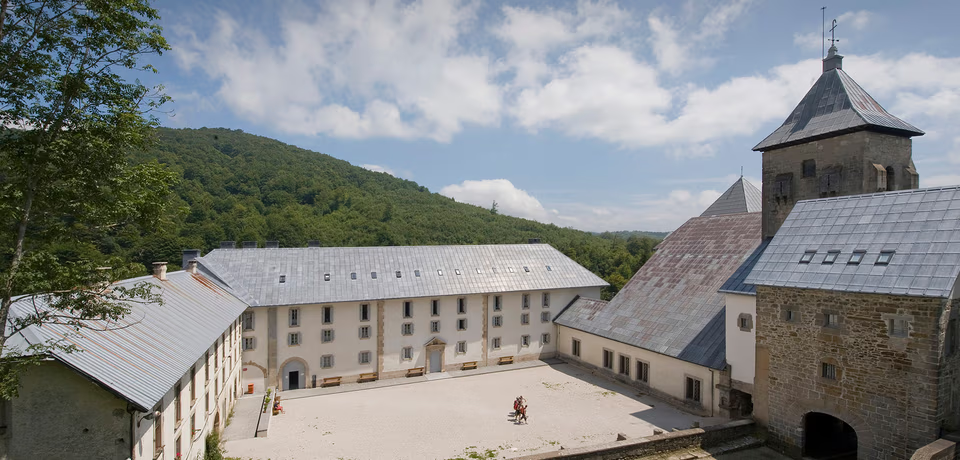
Roncesvalles is your first stop in Spain, 24.3 kilometres and almost 1,500 metres of climbing from Saint-Jean-Pied-de-Port. Since the 12th century this monastery at the pass has taken in pilgrims, today in an albergue with 183 beds and an evening pilgrim Mass. One evening is enough, because apart from the church, chapels and albergue there is almost nothing here.
Right now in Roncesvalles (as of October 2026)
- Napoleon route closed from 1 November: From 1 November to 31 March the route over the pass is closed, even under a clear sky. Then you come via Valcarlos, a good 23 kilometres. If you go up there anyway and need rescuing, you may have to bear the costs.
- Registration with personal data: Albergues must record the personal data of every pilgrim. The Colegiata albergue uses an app with a QR code for this; during the rush in spring 2025, pilgrims waited 40 to 50 minutes.
How long to stay?
One evening is enough. Roncesvalles is not a village but a monastery precinct with a church, chapels, an albergue and a few guesthouses. Everything lies within a few hundred metres. After the Pyrenean stage you want to shower, eat and go to Mass anyway. The next morning you have to be out of the albergue by 8:00.
Roncesvalles in Ninja numbers
- 1,493 metres of climbing you have done since Saint-Jean-Pied-de-Port, on the Napoleon route with the highest point at 1,427 metres, four kilometres before the finish.
- 751.8 kilometres is what the Camino Ninja map measures from here to Santiago. The famous sign at the edge of the village says 790. So you already save almost 40 kilometres on the first morning.
- 183 beds in three dormitories has the pilgrim albergue. Nobody is alone here.
- 2,304 pilgrims came through the Colegiata in the 1 to 12 April 2025 period alone, 86.7 percent of them from abroad.
- 1212 is when King Sancho the Strong took the chains at the Battle of Las Navas de Tolosa that now hang in the coat of arms of Navarre. He is buried here.
Arriving: from the forest straight into the monastery
After the pass the path leads down and arrives directly at the monastery buildings. The albergue lies in the precinct of the Real Colegiata, so you do not have to look for anything. If you come over Valcarlos in winter, your day ends at the same place. Before you join the queue: the albergue opens at 14:00, and without a reservation it gets tight between May and September.
In brief: a hospital at the pass
Here, in the hollow beneath the pass, Basques defeated Charlemagne's rearguard in 778. The Middle Ages turned this defeat into the Song of Roland, and Roncesvalles became the place of a legend. In the first half of the 12th century Bishop Sancho de Larrosa of Pamplona, supported by King Alfonso the Battler, founded a hospital for pilgrims here. The pilgrim guide of the Codex Calixtinus, written around 1135 to 1140, describes the Cize passes, where three of the four great routes from France converge. At the start of the 13th century Sancho the Strong of Navarre had the church built and chose it as his burial place.
Nine centuries of welcome
What you experience today is at heart the same as in the 12th century: you arrive exhausted from the pass, and you get a bed, a meal and a blessing. The hospital had its own chapel for those who could go no further: from about 1200 the Sancti Spiritus, the oldest building in Roncesvalles, became the burial place for pilgrims. Today the Colegiata runs the albergue with volunteer hospitaleros, many of them from the Dutch Confraternity of St James. And every evening a priest in the church blesses the pilgrims who have arrived, in several languages. You are one of many. That is exactly what this place has always been about.
Nine centuries of welcome: what to see
Everything lies within the monastery precinct. We did not find opening times and admission for the museum and cloister; ask at the albergue reception.
- Real Colegiata de Santa María: The Gothic church in the French style from the early 13th century is the place of the pilgrim Mass. On the altar stands the silver-clad Virgin of Roncesvalles from the 14th century. The church was later remodelled and heavily restored in the 20th century. What matters for you is the evening: here you receive the pilgrim blessing, often in several languages.
- Sala capitular with the tomb of Sancho the Strong: In the chapter house lies the king who had the church built, with a tomb effigy from the 13th century. Next to it are the chains he took from the emir's tent at Las Navas de Tolosa in 1212. They are still in the coat of arms of Navarre today.
- Capilla Sancti Spiritus, the "Silo de Carlomagno": The oldest building in Roncesvalles, from the 12th century. Legend would have Charlemagne's fallen buried here; what is documented is that from about 1200 pilgrims who never left the hospital were buried here.
- Capilla de Santiago: The small chapel of St James from the 13th century next to the Sancti Spiritus. The first James of your Spanish route.
- Museum in the Casa Prioral: Here lies "Charlemagne's chessboard", in truth a reliquary, and a Flemish triptych of the Crucifixion from the 16th century. The library next door has more than 15,000 volumes.
- Cruz de los peregrinos: The pilgrims' cross from the 14th century at the edge of the village, your first photo the next morning.
Eating and drinking
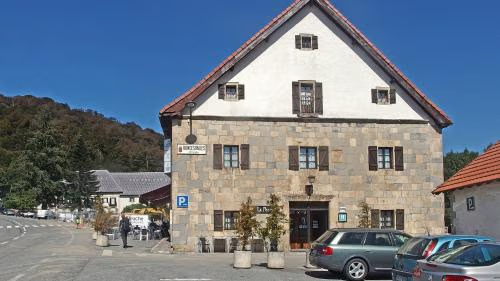
The albergue has no kitchen, only a microwave. You eat in the guesthouses with a pilgrim menu; the meal vouchers are available at the albergue reception, dinner costs €14, breakfast €6 (as of September 2026). About 700 metres from the albergue lies the ASPACE cheese dairy, where people with disabilities work; it also sells its cheese at the Colegiata.
Honestly
- You are not alone. 183 beds, and in April 2025 almost 200 pilgrims a day on average. The stillness of the pass is over here.
- Registration takes time. Since albergues have had to record all data, there are queues; if you cannot use the app, you wait longer.
- No shop, no pharmacy. The nearest are in Burguete, about three kilometres further on. Whether there is a cash machine, the sources disagree; do not count on it.
- Early start. Between 6:00 and 8:00 you have to leave the albergue.
Where pilgrims sleep
The Albergue de Roncesvalles belongs to the Real Colegiata and is run by volunteer hospitaleros. It is open all year, from 14:00 to 22:00; at night the door stays shut. The bed costs €15, with breakfast €21, with dinner and breakfast €35 (as of September 2026). You need a credencial and a sleeping bag. You can reserve online; from May to September that is practically compulsory. In winter the old albergue with 34 places opens instead. There are also private guesthouses with rooms.
Ninja tips
- Reserve before you set off from Saint-Jean. If you arrive without a reservation after a long pass stage, you risk having to go on to Burguete.
- Download the app for the QR code beforehand. It saves you the queue at registration.
- Shop in Saint-Jean. There is no shop in Roncesvalles; the nearest is in Burguete.
- Check the Mass time on the spot. Depending on season and weekday, the sources give 18:00, 19:00 or 20:00. On Saturdays, Sundays and public holidays it is at 18:00.
- Take the winter route seriously. From 1 November the only permitted route goes via Valcarlos, even when the sun is shining.
Practical tips for pilgrims
- Credencial and stamp: at the Colegiata albergue; no credencial, no bed.
- Laundry: washing and drying €4 (as of September 2026).
- Getting here: buses from Pamplona to Roncesvalles, as well as taxis that pilgrims often share.
- Festivals: 8 September is the feast of the Virgin of Roncesvalles; on Sundays in May and June pilgrimages come from the valleys.
Onward: over the Erro to Zubiri
At the edge of the village stand the pilgrims' cross and the sign with the 790 kilometres. Then the path goes through forest to Burguete (km 27.3), where there is a shop and pharmacy, and to Espinal (km 30.9). Over the Alto de Mezkiritz you reach Bizkarreta (km 36.0), the last shopping before the finish, and Lintzoain with a fountain. Then comes the Alto de Erro and the descent to Zubiri, about four kilometres over rock, very slippery when wet. To Zubiri (km 45.8) it is 21.5 kilometres with 400 metres of ascent and 812 metres of descent. If you came over Valcarlos in winter, you are back on the Camino Francés here; we call the winter variant Camino Francés Winter Route via Valcarlos.
What awaits you tomorrow
Zubiri, the bridge village on the Arga. Its bridge is called Puente de la Rabia, the Rabies Bridge: people used to lead animals around its central pillar so that they stayed healthy. After the descent from the Erro you will understand why pilgrims first put their knees in the water there.
Deep dive: The hospital under the pass
A short read, in case you want to learn more about Roncesvalles. About three minutes' reading.
A defeat becomes a legend
In the year 778 the army of Charlemagne was returning over the Pyrenees after a campaign in Spain. In the mountains around Roncesvalles, Basques fell on the rearguard and destroyed it. Among the dead is said to have been the margrave Roland. Three centuries later poets made the Song of Roland out of this skirmish, one of the great epics of the Middle Ages, and the Basques became Saracens in it. What is in the song is poetry. What remained is the name of the place, which soon all of Europe knew.
A bishop builds a hospital
In the first half of the twelfth century Sancho de Larrosa, Bishop of Pamplona, with the support of King Alfonso the Battler, founded a hospital in the hollow beneath the pass. There had been shelters before, up at Ibañeta and down in Burguete, but this house became the great one. Around 1135 to 1140 the author of the pilgrim guide in the Codex Calixtinus wrote about these passes, where three of the four great routes from France come together. Whoever arrived here had the hardest part behind them. And whoever did not make it was buried in the Chapel of the Holy Spirit, which served as a burial ground from about 1200.
The king with the chains
At the start of the thirteenth century King Sancho the Seventh of Navarre, called the Strong, had the Gothic church built. In 1212 he fought at Las Navas de Tolosa, the battle that tipped the balance of power on the peninsula. Tradition says he broke through the chains that protected the emir's tent. Navarre still carries these chains in its coat of arms today, and they hang in the chapter house next to his tomb.
Snow, rebuilding, the present
In the fourteenth century the monastery received a cloister, which collapsed around 1600 under the weight of snow. In modern times the church was rebuilt, and in the twentieth century it was restored with a lot of good will and too much zeal. When this text was written, in the autumn of 2026, up to 183 pilgrims slept in Roncesvalles every night, and in twelve April days of the previous year more than two thousand came through.
What Roncesvalles gives you
You have the pass behind you, the border, the first big day. For nine hundred years this house has taken in people who arrive in exactly this state: tired, proud, a little overwhelmed. You do not have to achieve anything here. You get a bed, a meal and, if you want, a blessing. Tomorrow you walk on, and from here on it is Spain.
Where to stay in Roncesvalles
The places pilgrims rate highest in Roncesvalles come first.
- Top #1
 Open
Albergue de Roncesvalles - Orreagako Aterpea
- Top #2
 ClosedReservations accepted
Hotel Roncesvalles
- Top #3
 OpenReservations accepted
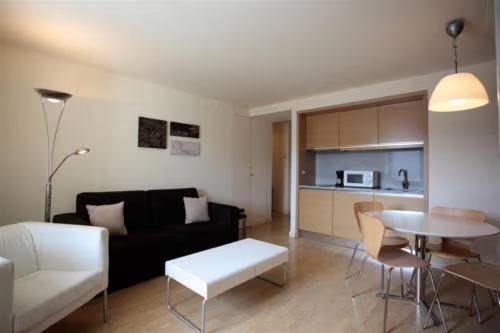
Apartamentos Casa de los Beneficiados

Services in Roncesvalles
What you can find in town before the next stage.
- Café
- Shop
- Fountain
- Restaurant
Source: © OpenStreetMap contributors · updated January 2025
Town 2 of 49