

Town on the Camino
Santo André de Teixido
Spain
- place to stay
- 1
- Camino
- 1
- Elevation
- 143 m
After Santiago, Santo André de Teixido is the best-known pilgrimage site in Galicia: a white village in a gorge above the Atlantic, the church of the apostle Andrew, the spring with three spouts. Whoever does not come alive comes dead, says the proverb. You come on foot, after the ridge of the Capelada.
How long to stay?
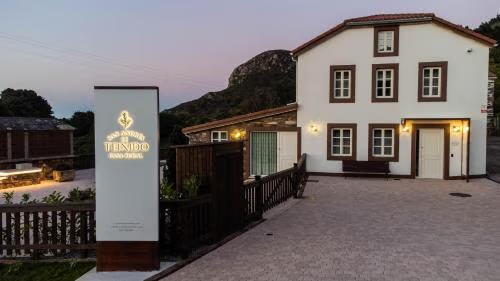
A break is enough, but take a long one. Teixido is not a stage town for pilgrims, there are hardly any beds, and it is still 16.4 kilometres to Cedeira. Even so, the village is the highlight of this stage: church, spring, stone heaps and the shops with the bread figures want to be looked at in peace. You should plan one to two hours. If you get the only country house in the village, a night here is a special experience.
Santo André de Teixido in Ninja numbers
- 185.4 kilometres lie between Ribadeo and Teixido, according to Camino Ninja, and there are still 86.6 kilometres to Ferrol.
- 20.4 kilometres is the distance from Cariño to here, according to Camino Ninja, and 16.4 kilometres to Cedeira.
- Over 600 metres high are the cliffs of Vixía Herbeira, which you pass about five kilometres before the village.
- 17 people died on 1 June 1943 when Flight 777 was shot down off this coast; its memorial stands, according to Camino Ninja, 1.6 kilometres before the village on the way.
Arriving: from the ridge down into the village
You come from above. On the ridge of the Serra da Capelada you pass the Garita da Herbeira, a stone lookout hut from the early 19th century above the highest cliffs of the tour. Then, at the Mirador do Cruceiro, follows the memorial to Leslie Howard, a propeller with the names of all the victims. The actor from "Gone with the Wind" was on board the DC-3 "Ibis" that German warplanes shot down over the Bay of Biscay in 1943. After that it goes down into the gorge where the white houses of Teixido lie. On the way you see by the wayside the Milladoiros, stone heaps on which pilgrims have always laid a stone.
In brief: whoever does not come alive comes dead
The sanctuary has existed since at least the 12th century and then belonged to the Order of Saint John. The oldest written mention dates from 1391: a noblewoman from Viveiro promised the altar a candle in her will. The legend says Andrew capsized with his boat on the cliffs, and the boat turned to stone. When he complained that all the world made pilgrimage to Santiago and no one to him, God promised him: every person will visit his sanctuary, in life or after death. Hence the saying "Vai de morto quen non foi de vivo". Whoever misses it comes back as a frog, snake or lizard. So watch what runs over your feet on the way.
Andrew at the end of the world: what to see
The village is small, and everything important lies within a few steps of each other, right on the way.
- Santuario de Santo André de Teixido: The white pilgrimage church was built from the 16th century; in 1781 the bell tower and a new façade were added, and the main chapel dates from 1789. From the earlier building the portal in the north wall and the Gothic chancel arch remain. Inside, the wall paintings showing the martyrdom of Andrew, rediscovered only in 1970, are worth a look, as are the Baroque high altar and a reliquary said to contain a bone fragment of the apostle. Around the altar hang the votive offerings of visitors. For you as a pilgrim it is a rare moment: here one honours a different apostle from the one you are walking to.
- Fonte dos Tres Canos: The saint's spring with three spouts is part of the ritual. Drink from all three without leaning on the fountain with your hands, make a wish and throw a breadcrumb into the water. If it floats, the wish comes true; if it sinks, you have to come back. The water is not marked as drinking water, so better just wet your lips and fill your bottle elsewhere.
- Sanandresiños and Herba de namorar: In the shops by the sanctuary there are small painted figures made of bread dough that count as amulets: the ladder for work, the boat for travel, the flower for love. Also the Herba de namorar, thrift from the cliffs, for matters of love. A Sanandresiño weighs almost nothing and is the most honest souvenir of this tour.
- Milladoiros: The stone heaps on the old pilgrim path are the oldest ritual here. Pick up a stone on the way and add it. It costs nothing and connects you with everyone who came before you, alive or not.
Honestly
- No pilgrim bed. There is no hostel, only a single country house in the village. Otherwise you sleep 20.4 kilometres back in Cariño or 16.4 kilometres further on in Cedeira.
- Teixido is also an excursion destination. In summer and on pilgrimage days many come by car and bus. If you want stillness, come early or out of season.
- The shops live from souvenirs. Between genuine folk piety and souvenir kitsch it is sometimes a fine line. That is part of it.
- The weather can turn. In a north-east wind a dense cloud often lies over the Capelada, even on sunny days. Then you see little from the cliffs.
Ninja tips
- Lay a stone on a Milladoiro. Best already up on the ridge, then you arrive as a pilgrim, not as a visitor.
- Bring bread. For the ritual at the spring you need a crumb. If you have none, buy a Sanandresiño at the sanctuary.
- Stop at the Garita da Herbeira. It lies only about 140 metres off the way, and the view down the cliffs is the strongest picture of the whole tour. Stay behind the wall.
- Read the names on the propeller. The memorial to Flight 777 is a quiet place, not a photo spot.
- Don't fill your water at the saint's spring. Plan your supplies so that they last to Cedeira.
Practical tips for pilgrims
- Pilgrimage goes on all year. It is especially full at Pentecost, on 24 June, from 16 August to 9 September and at the feast of Saint Andrew at the end of November.
- Cows and horses roam free on the plateau. On the narrow road cars also come towards them, so walk attentively.
Onward: via Corveiro to Cedeira
From Teixido it is 16.4 kilometres to Cedeira, according to Camino Ninja, on the Camino del Mar. Shortly before the town you pass the chapel of Santo Antón do Corveiro, one of the finest viewpoints over the Ría de Cedeira, and right after it the Castelo da Concepción, the small fortress of 1747 at the mouth of the ría. From Ferrol the Camino Inglés then leads on to Santiago.
Deep dive: To Andrew, while you live
A short read, in case you want to learn more about Santo André de Teixido. About two minutes' reading.
An apostle who came up short
Galicia has two great pilgrimage sites. One is Santiago, where the apostle James lies buried. The other lies in a gorge above the sea, at the end of a road winding over a windy mountain ridge. Here Andrew is venerated, the brother of Peter. The legend says he capsized with his boat on the cliffs. The boat turned to stone, and Andrew was sad because all the world made pilgrimage to James and no one to him. Then God promised him that every person would one day come to him, in life or after death.
Whoever does not come alive
From this came the best-known saying of Galicia: to Teixido goes as a dead person whoever did not go as a living one. According to tradition, whoever misses it returns as a small animal, as a frog, snake or lizard.
An old sanctuary
For at least eight hundred years a sanctuary has stood here. At first it belonged to a knightly order, the Order of Saint John. In 1391 a noblewoman from Viveiro wrote in her will that she wished to donate a candle to the altar. That is the oldest written trace of the pilgrimage. The church you see today was built from the sixteenth century, and in the eighteenth it got its tower. Under the plaster old wall paintings showing the martyrdom of Andrew were found only in 1970.
The rituals
Whoever comes to Teixido follows a series of small gestures. On the way one lays a stone on one of the stone heaps by the path. At the spring one drinks from three spouts without leaning on one's hands, and throws a piece of bread into the water. If it floats, the wish is granted. One buys small figures of bread dough, painted in bright colours, and a bunch of the herb that grows on the cliffs and is said to help in love.
A pilgrim at another apostle's
For you, on your way to Santiago, Teixido is an encounter with another way. Andrew and James were both fishermen on the Sea of Galilee, both among the first whom Jesus called. Up here, above the Atlantic, one found his place, and the other waits for you in Santiago. When you walk on, you have done your duty by Andrew. At any rate you no longer have to come as a frog.
Where to stay in Santo André de Teixido
Places to stay in Santo André de Teixido.
 OpenReservations accepted
Casa Rural San Andrés de Teixido
Town 14 of 17