

Stage town on the Camino
Tomar
Distrito de Santarém, Região do Centro, Portugal
- places to stay
- 23
- Caminos
- 3
- Elevation
- 59 m
Tomar is the city of the Knights Templar on the Camino Portugués, 155 kilometres out of Lisbon: above it rises the Convento de Cristo with its round Charola, modelled on the Church of the Holy Sepulchre in Jerusalem. Here the order that once protected pilgrims became the seafarers' Order of Christ. A rest day pays off.
Right now in Tomar (as of October 2026)
- Festa dos Tabuleiros 2027: On 18 April 2026 the townspeople decided to hold the festival, which only takes place every four years, again in 2027. The exact days have not been set yet; the last edition was in June and July 2023.
- Works at the convent: In June 2026 the castle was only partly accessible because of a major renovation; the Charola was open. The town's website also carries a notice of a temporary closure for restoration, without a date. Call before your visit: +351 249 313 434.
- Chapter window: The famous Manueline window has been under restoration since mid-2022 and may be covered. There is no end date.
How long to stay?
Worth a rest day. You arrive in the afternoon after 30.5 kilometres from Golegã, and the Convento de Cristo needs a good three hours, ideally right from opening at 9:00, before the coach groups arrive. Then there is the Templar church of Santa Maria do Olival, the medieval synagogue and the old town around Praça da República. And tomorrow a stage of 31.8 kilometres with almost 500 metres of climbing awaits. A day off here is not a luxury, it is good planning.
Tomar in Ninja numbers
- 155 kilometres lie behind you since Lisbon, and 464.3 kilometres are still ahead to Santiago de Compostela on the Camino Portugués Central. So you have only just done a quarter.
- 1160 is the year the Templar master Gualdim Pais laid the foundation stone of castle and convent. The town still celebrates its birthday on 1 March.
- 16 sides form the ambulatory of the Charola, the Templars' round church. A church to walk around, built on the model of the Church of the Holy Sepulchre in Jerusalem.
- 180 arches carry the Pegões aqueduct, which from 1614 brought water some six kilometres to the convent.
- 320 metres is the height of the highest point on tomorrow's stage. In Tomar you are standing at 57 metres.
Arriving: up the Calçada de Santiago
The day from Golegã is long at 30.5 kilometres, but flat: never higher than 137 metres, just under 290 metres of climbing in total. Via Asseiceira and the chapel of São Lourenço you reach the Nabão from the south. The town routes the Way of St James past the convent and through the old town, well marked with yellow arrows. The old road up to the castle is not called Calçada de Santiago by chance. The climb to the convent is steep, so do it without your backpack.
In brief: knights who protected pilgrims
In 1159 the Knights Templar were given the land on the Nabão, and a year later their master Gualdim Pais had castle and convent built. Tomar was a frontier fortress against the Moors: in the 1190s the castle withstood a six-day assault by the Almohads, when the Templar master was over seventy. The Templars had originally been founded to protect pilgrims on their way to Jerusalem. Here, on the edge of young Portugal, they built themselves a piece of Jerusalem: the Charola.
When the Pope dissolved the Templar order in 1312, King Dinis saved its Portuguese possessions by passing them to a new order, the Order of Christ. In the mid-14th century it moved to Tomar. Its most famous administrator was Henry the Navigator, who was already at the head of the order in 1417. The order's money sent the caravels out to sea, and for centuries Tomar became the spiritual centre of the churches Portugal founded overseas.
The cross of the Order of Christ
In Tomar you keep meeting the same sign: the red cross with the white core, the cross of the Order of Christ. It stands on the walls of the convent, it is the sign under which Henry's ships sailed, and to this day it crowns the tabuleiros, the towers of bread carried at the town's great festival. For you as a pilgrim this is a strange twist: an order founded to keep the way safe for pilgrims opened up half the world from here. And now you walk quietly, a shell on your backpack, beneath this cross and on to the north.
Beneath the cross of the order: what to see
The convent takes a morning, the rest an afternoon.
- Convento de Cristo and Charola: The heart of the town and a UNESCO World Heritage Site since 1983. The Charola was built at the end of the 12th century: an octagonal building with an ambulatory of 16 sides, meant as a reminder of the Church of the Holy Sepulchre in Jerusalem. For a pilgrim this is the key to the whole place: knights whose task was to protect pilgrims prayed here. Around the Charola the convent grew over centuries, with cloisters built by Henry the Navigator, the Manueline chapter window by Diogo de Arruda (1510 to 1513) and the great Renaissance cloister designed by Diogo de Torralva. It is open October to March 9:00 to 17:30 and April to September 9:00 to 18:30, last entry half an hour earlier; closed on 1 January, 1 May and 25 December (as of October 2026). We have not found a reliable current admission price. Allow three hours.
- Santa Maria do Olival: The Templar church is the quieter counterpart to the convent. It was the order's burial church, and Gualdim Pais, the founder of the town, lies here. One historian calls it the mother church of all the churches Portugal built overseas. The bell tower beside it was built under King Manuel I. A travel portal gives 10:00 to 18:00 as opening hours, closed on Mondays, though without a date.
- Igreja de São João Baptista: The main church on the big square dates from the 15th and 16th centuries; its panel paintings were made by Gregório Lopes in the 1530s. In the church's parish office, Rua de São João 135, you can get a credential and stamps. If Mass is on, sit down and join in rather than taking photos.
- Synagogue and Museu Luso-Hebraico Abraão Zacuto: A plain room from the late Middle Ages, considered the best-preserved medieval synagogue in Portugal. In 1496 the Jews were expelled from Portugal, and the room lost its purpose. It has been a museum since 1939; excavations in 1985 uncovered a ritual bath. Admission is free; we have not found opening hours.
- Ermida de Nossa Senhora da Conceição: A small chapel in pure Renaissance style, built between 1532 and 1540 and intended as the burial chapel of King João III. He was never buried here.
- Pegões aqueduct: For your rest day: around six kilometres long, up to 30 metres high, completed in 1614 to supply the convent with water. It was in use for more than 330 years.
Food and drink
Tomar has two sweet specialities: the fatias de Tomar, a dessert of egg yolk and sugar said to have been a favourite of the convent's monks, and the estrelas de Tomar. The estrelas are sold by a pastry shop of the same name in the centre.
Honestly
- There is no pilgrim hostel in town. Dormitory beds are only offered by private hostels. The nearest pilgrim hostels are 11 kilometres before in Asseiceira and 11 kilometres after in Calvinos.
- The convent is a coach-tour destination. The coaches arrive during the morning. If you are there at opening at 9:00, you are ahead of them.
- Not everything can be seen. The castle and the chapter window are being restored, and parts are closed or covered. That is annoying, but the Charola alone is worth the climb.
- Tomorrow is tough. 31.8 kilometres to Alvaiázere with just under 500 metres of climbing, and few beds in between. If you don't want that, split the stage at Calvinos.
Where pilgrims sleep
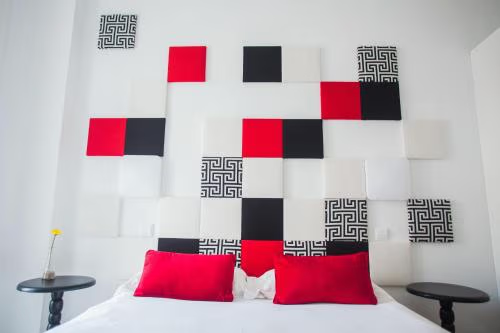
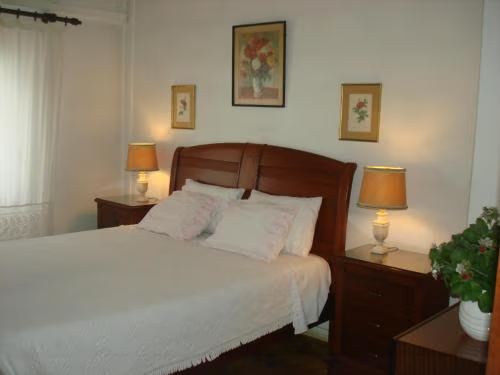
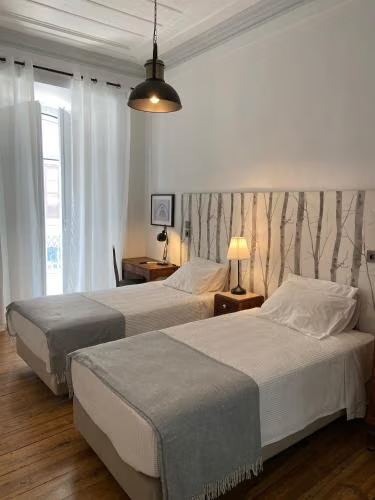
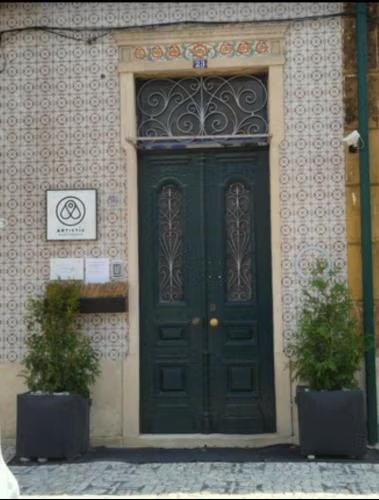
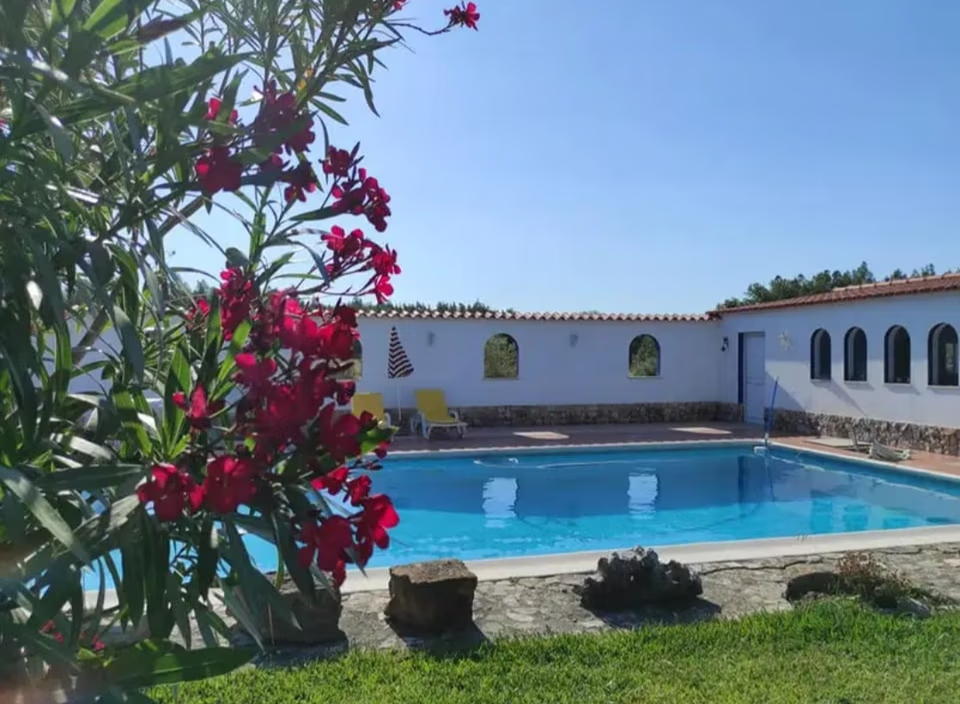
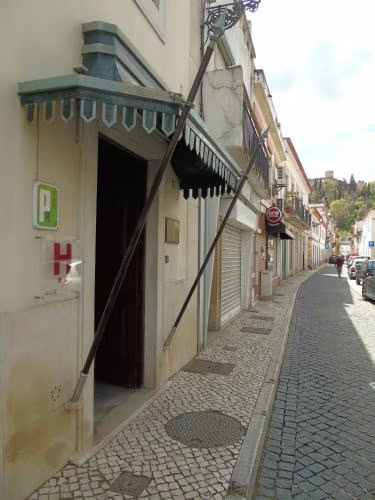
Tomar has no municipal or church-run pilgrim hostel. Pilgrims sleep in private hostels and guesthouses in the old town, many of them on Rua Serpa Pinto. Dormitory beds are available at Hostel 2300 Thomar with 32 places, at Residencial Avenida Hostel for 22.50 euros without breakfast and at Residencial Luz for 20 euros, though there only from two people and not in August (as listed by the town's tourist office, retrieved October 2026). Single and double rooms in simple guesthouses start at around 30 euros.
If you would rather sleep in a real pilgrim hostel: the Albergue D. Dinis in Asseiceira, 11 kilometres before Tomar, has 5 places for 10 euros. The Albergue de Calvinos, 10.9 kilometres after Tomar, has 10 places for 7.50 euros, without towels and without breakfast; you can book the day before or on the same day.
Ninja tips
- Be at the convent at 9:00. The Charola is quiet then; the coaches come later. Allow three hours.
- Go up without your backpack. The way to the convent is steep. Leave your luggage at your accommodation and visit on your rest day or in the morning before you set off.
- Get your stamp at the parish office of São João Baptista. You can also get a credential there if you only need one now.
- Call Calvinos if you want to split the next stage. The hostel only has 10 places.
- Santa Maria do Olival in the afternoon. After the bustle up on the hill, the Templars' burial church is the right place to quieten down again. It is probably closed on Mondays.
Practical tips for pilgrims
- Credential and stamps: Parish office of the Igreja de São João Baptista, Rua de São João 135, tel. +351 249 312 264.
- Convent: Opening hours see above; call beforehand to check whether parts are closed because of the works: +351 249 313 434 or +351 249 315 089.
- Public holiday: On 1 March the town celebrates its founding.
- Supplies: Tomar is a small town of around 20,000 people. Buy provisions here, because the next stage only passes small villages.
Onward: into the hills to Alvaiázere
Beyond the old town the way leaves Tomar over a Gothic bridge and then starts to climb. After 7.6 kilometres you are in Casais, after 10.9 in Calvinos with its small hostel. Then it continues uphill via Areias, Vila Verde and Cortiça until at kilometre 30.5 you reach the highest point at 320 metres. To Alvaiázere it is 31.8 kilometres in all, with just under 500 metres of ascent and 240 metres of descent.
Deep dive: A piece of Jerusalem on the Nabão
A short read, in case you want to learn more about Tomar. About three minutes' reading.
Knights for pilgrims
This town begins with a pilgrimage, just not yours. In the early twelfth century a few knights in Jerusalem founded a community meant to protect pilgrims on the dangerous roads of the Holy Land. They lived on the Temple Mount, which is why they were called Templars. The order grew quickly and was given land all over Europe, including in the young kingdom of Portugal, which was just expanding southwards. In 1159 the Templars received the land on the river Nabão. A year later their master Gualdim Pais had a castle built on the hill, and inside it a church.
A round church
That church is the Charola. It is round, or more precisely octagonal, with an ambulatory of sixteen sides, and in the middle stands a core you can walk around. Its model was the Church of the Holy Sepulchre in Jerusalem, built over the tomb of Christ. So on the frontier with the Moors, the Templars built themselves an image of the very place they were meant to protect. Whoever stepped inside was in Jerusalem in spirit. Gualdim Pais was over seventy when the Almohads besieged the castle in the years around 1190. It held. Today he lies buried in the church of Santa Maria do Olival.
From Templar to seafarer
At the beginning of the fourteenth century the Templar order fell. The French king wanted its money, and the Pope dissolved the order. In Portugal King Dinis found a clever way out: he founded a new order, the Order of Christ, and gave it the Templars' possessions. In the middle of the century the order moved back to Tomar. And then came Henry, a son of the king, later known as the Navigator. By 1417 at the latest he was at the head of the order. He added cloisters to the Charola and used the order's wealth for the voyages along the African coast. The cross of the Order of Christ became the sign of the Portuguese voyages of discovery.
A window of ropes and chains
The kings after Henry kept building. Under Manuel the First the Charola was opened with a great arch and a nave was added. On the new building, between 1510 and 1513, Diogo de Arruda created the chapter window, covered all over with ropes, anchor chains and sea plants carved in stone. UNESCO describes it as the first synthesis of European and Oriental art. Under João the Third great Renaissance cloisters were added. So today the convent tells in stone what happened here: a place built for the way to Jerusalem ended up looking out at the open sea.
The festival of bread
Every four years Tomar carries its memory through the streets. At the Festa dos Tabuleiros young women carry towers of thirty loaves on their heads, decorated with paper flowers. On top of the crown sits a white dove or the cross of the Order of Christ. All eleven parishes take part. When this text was written, in autumn 2026, the townspeople had decided in the spring to hold the festival again in 2027.
What Tomar gives you
You have walked a quarter of your way, and here you meet people who, almost nine hundred years ago, wanted to make the way safe for other pilgrims. Perhaps that is the thought you take with you from Tomar: every way rests on those who made it passable before you. And sometimes it leads where nobody expected.
Where to stay in Tomar
The places pilgrims rate highest in Tomar come first.
- Top #1
 OpenReservations accepted
Hostel 2300 Thomar
- Top #2
 OpenReservations accepted
Thomar Story
- Top #3
 OpenReservations accepted
Pensão Residencial Luanda


Services in Tomar
What you can find in town before the next stage.
- ATM
- Café
- Shop
- Tobacco
- Medical clinic
- Pharmacy
- Fountain
- Train station
- Bus station
- Airport
- Restaurant
Source: © OpenStreetMap contributors · updated January 2026
Town 7 of 43