

Town on the Camino
Bernkastel-Kues
Germany
- places to stay
- 13
- Camino
- 1
- Elevation
- 109 m
Bernkastel-Kues is the town to which a cardinal sent his heart home: Nicholas of Cusa is buried in Rome, but his heart lies in the chapel of the hospital he founded in 1458 for 33 people in need. Across the bridge is Bernkastel with its market square and Burg Landshut. The apostle's tomb in Trier is still 66.6 kilometres away.
Right now in Bernkastel-Kues (as of October 2026)
- Cusanusstift: According to the tourist office, the series of public guided tours runs until 30 October 2026. From 13 November 2026 to 30 April 2027 the foundation presents "Schätze der Cusanus-Bibliothek", treasures of the Cusanus library, on seven evenings at 19:00. Whether the Tuesday and Friday tours continue in winter is best checked in advance on 06531 2260.
- Christmas market: From 20 November to 20 December 2026 on the market square and in the old town, for the fiftieth time. If you come during these weeks, book your room early.
How long to stay?
An afternoon is enough, ideally a Tuesday or Friday. According to Camino Ninja it is only 6.9 kilometres from Traben-Trarbach, so you arrive early. You can only see the library of Nicholas of Cusa on a guided tour, and those run on Tuesdays at 10:30 and Fridays at 15:00. Add the chapel with his heart, his birthplace, the market square in Bernkastel and, if your legs are willing, the climb to Burg Landshut. If you arrive on another day, you can still see the chapel and the cloister and walk on towards Monzel.
Bernkastel-Kues in Ninja numbers
- 66.6 kilometres from here to Trier, according to Camino Ninja. A good 90 kilometres of the Mosel-Camino are behind you.
- 33 places were endowed by Nicholas of Cusa in 1458 for needy men aged 50 and over, as many as the years of Jesus' life: six for clergy, six for nobles, 21 for everyone else. Since 1465 the house has been a home for the elderly without interruption.
- More than 300 manuscripts from the ninth to the fifteenth century are kept in the hospital library (as of October 2026), most of them from the cardinal's own collection.
- 100 gold marks per vine is what Julius Wegeler paid in 1900 for a piece of the Bernkasteler Doctor vineyard. The whole vineyard measures 3.25 hectares.
- 1416 is the year the Spitzhäuschen was built, the narrow half-timbered house with the pointed roof on Karlstraße.
Arriving: from the hills to the bridge
On the Mosel-Camino you come from Traben-Trarbach up through vineyard and forest paths to the Hochmoselübergang. There you can make a detour to the Graacher Schanzen, the viewpoint above Bernkastel. Then the path passes the Waldschenke "Zur eisernen Hand" and drops into the Moselle valley, and you are standing in Bernkastel at the foot of Burg Landshut.
Bernkastel lies on the right bank, Kues on the left. They have been one town since 1905, and the Moselle bridge is their hinge. You cross it to Kues, to the Cusanusstift and to the cardinal's birthplace. The birthplace stands at the edge of Kues towards Lieser, so it lies in your walking direction.
In brief: a bishop's castle and a boatmen's village
From 1017 Bernkastel belonged to the archbishops of Trier. Around 1280 their castle rose above the town, later called Landshut, and on 29 May 1291 Bernkastel was granted town rights. Below the castle grew a market town that lived from the wine trade and from river shipping. On 8 January 1692 the castle burned out and remained a ruin.
Kues on the other bank was a winegrowing village. Nicholas was born here in 1401, the son of a ship owner. He became a cardinal, one of the great thinkers of his century, and endowed his birthplace with a hospital. On 1 April 1905 Bernkastel and Kues became one town.
A heart that came back
Nicholas of Cusa died on 11 August 1464 in Todi in Umbria. His body lies in Rome, in his titular church of San Pietro in Vincoli. But his heart came to Kues, as he had wished. It rests in a lead capsule under a brass plate in the chancel of his hospital chapel.
This hospital is the heart of the town. The cardinal had it built in the 1450s and endowed it on 3 December 1458 for 33 men in need. The first residents moved in only after his death, and it has been a home for the elderly ever since, and for women too since the late 1960s. If you walk a Camino, you usually know hospitals only as the names of old hostels. Here stands one that has never stopped taking people in.
Between chapel and castle: what to see
The most important things are in Kues, near the Moselle bridge. For Bernkastel a walk round is enough; for the castle you need time and breath.
- Cusanusstift (St.-Nikolaus-Hospital): A late Gothic cloister runs round an inner courtyard, and each of its four sides has a different vault. In the chapel stands a winged altarpiece from around 1460 showing the Passion of Christ. Beneath the cross kneels the founder, one of the oldest depictions of Nicholas of Cusa, with his brother Johann beside him. The cardinal's heart lies under a brass plate in the chancel. Look out too for the mural of the Last Judgement and the tomb slab of his sister. The house and chapel are open Sunday to Friday from 9:00 to 18:00 and Saturday from 9:00 to 15:00; the chapel is free. The library with the cardinal's books, instruments and sermons in his own hand can only be seen on the guided tour, Tuesdays at 10:30 and Fridays at 15:00, €10 in cash (as of May 2025).
- Birthplace of Nicholas of Cusa: On the Nikolausufer stands the house of his father, a Moselle boatman. Here, on 12 February 1440, Nicholas finished his main work, "De docta ignorantia", on learned ignorance. On the upper floor a permanent exhibition shows his life, including his legation journey through Germany in 1451 and 1452. Open Tuesday to Sunday from 12:00 to 17:00, closed on Mondays, €4 (as of May 2025). The exhibition is in German only.
- St. Brictius in Kues: The parish church is first mentioned in 1258. Nicholas and his siblings were baptised here.
- Market square, Bernkastel: Half-timbered houses with gables and oriel windows stand round the Michaelsbrunnen fountain of 1606, together with the town hall of 1608, whose ground floor was once an open market hall. On Karlstraße stands the Spitzhäuschen of 1416 with its overhanging upper floor.
- St. Michael: The 56-metre tower of rubble stone was part of the town fortifications before it was incorporated into the church. In the chancel stands a Crucifixion group from 1496. Johann, the cardinal's brother, was parish priest here from 1450 to 1456 and was buried here, but his grave has not survived.
- Burg Landshut: The archbishops of Trier built it around 1280 on the site of a late Roman fort, whose walls were found in 2012. You can climb the round keep and look out over the Moselle valley as far as the Eifel. There is food and drink at the top. In summer a bus, the Burg-Landshut-Express, takes about 20 minutes to get up, leaving from opposite the Doctorbrunnen on the Gestade.
- Graacher Tor: The gate from around 1300 is the last of eight town gates. Since 1985 it has housed the local history museum.
Food and drink
We have not found reliable pilgrim tips for individual restaurants, and we don't do advertising. Bernkastel-Kues is a tourist town, and prices reflect it. You can taste the hospital's wine where it comes from: the vinothek in the vaulted cellar of the Cusanusstift has around 150 Moselle wines for tasting. Since 1990 the foundation's winery has been run by the DRK-Sozialwerk, with people with and without disabilities. The cardinal endowed his hospital with vineyards from the very start.
Honestly
- There is no pilgrim hostel. The whole Mosel-Camino has only two, in Traben-Trarbach and in Klausen. Here you sleep in a guesthouse, a pension or a hotel and pay tourist prices.
- You can see the library only twice a week. Without the Tuesday or Friday tour it stays closed. If it matters to you, plan your stage around it.
- It gets busy in season. Bernkastel-Kues is a stop for river cruises, and the grape harvest and wine festivals fill the Moselle towns. The Weinfest der Mittelmosel is on the first weekend of September.
- There is no railway station. The line to Wittlich is closed and is now a cycle path. If you need to stop, take the bus to Wittlich.
Where pilgrims sleep
There is no pilgrim hostel in Bernkastel-Kues. On the Mosel-Camino the normal choice is a guesthouse or a room at a winegrower's, and you book it in advance. The route's two pilgrim hostels lie behind you and ahead of you:
- Pilgerherberge Mosel "Alte Lateinschule" in Traben-Trarbach, 6.9 kilometres back according to Camino Ninja. It wants to see your pilgrim passport.
- Pilgerherberge Eberhardsklause in Klausen, 18.8 kilometres ahead according to Camino Ninja, at the pilgrimage site. It also asks for your pilgrim passport.
Ninja tips
- Friday, 15:00: If you come from Traben-Trarbach on a Friday, you can comfortably make the afternoon library tour. Bring €10 in cash.
- Look for the two brothers: On the chapel altar, Nicholas and Johann kneel beneath the cross. In the chancel in front of it lies the heart of one of them.
- Follow the crayfish: The family name was Krebs, crayfish, and crayfish are set into the pavement. They mark the Cusanus walk, 3.5 kilometres through both parts of town, past the birthplace, the baptismal church and the hospital.
- Look at the bridge: On a small balcony of the Moselle bridge there is a sundial. From there you can see St. Michael, the castle and the boats on the Moselle.
- The Doctor at the fountain: The Doctorbrunnen on the Gestade tells the legend of the sick prince-elector who was cured by a cup of wine. The vineyard lies above the old town.
- Ask for a stamp: None of the sources we found names a fixed stamp point. Ask at the tourist office at Gestade 6 or at the Cusanusstift.
Practical tips for pilgrims
- Pilgrim passport: The official pilgrim passport is issued by the St. Jakobusbruderschaft Trier, by post or in person. The two hostels on the route require it.
- Tourist office: At Gestade 6 in Bernkastel, in a neo-Gothic school building from 1880. There is a cash machine next to it, and another on Römerstraße 50.
- Cusanusstift: Cusanusstraße 2, phone 06531 2260, for tours in English and group tours by arrangement.
- Closing day: The birthplace is closed on Mondays.
- Getting here and away: The nearest railway station is Wittlich, from where bus 300 runs to Bernkastel-Kues.
Onward: through the vines to Monzel
From Kues you walk through the vines via Lieser, 4.4 kilometres according to Camino Ninja, and Mülheim, past the Brauneberg to Osann-Monzel, 10.9 kilometres. That is where the stage from Traben-Trarbach ends. After that the route goes quiet: between Monzel and Klüsserath there are long stretches with nowhere to stop, so carry two litres of water. According to Camino Ninja it is 66.6 kilometres to Trier.
What awaits you tomorrow
Klausen, 18.8 kilometres from here according to Camino Ninja, the second-largest pilgrimage site in the diocese of Trier. In 1440 a winegrower called Eberhard set up an image of the Sorrowful Mother there, in the same year that Nicholas finished his main work in Kues. A canon named Wilhelm von Bernkastel later recorded 753 miracles said to have happened there. At the foot of the church the Eifel-Camino joins, and the Eberhardsklause is the route's second pilgrim hostel.
If you want to take it more slowly, stop after 10.9 kilometres in Osann-Monzel, where the stage ends, and walk on the next day via Klausen to Klüsserath.
Deep dive: The cardinal's heart
A long read, in case you want to learn more about Bernkastel-Kues. About twenty minutes' reading.
Two banks and a bridge
As you come down from the heights, you first see the town from above. On the right bank of the Moselle lies Bernkastel beneath its castle hill, with the church of Saint Michael on the riverbank. On the left lies Kues, with the hospital near the bridge. Two places that have only been one town since 1 April 1905, and that are still told apart by where they lie: Bernkastel belongs to the Hunsrück, Kues to the Eifel. People here pronounce the second name Kuus, by the way, not Küs.
For a long time there was no fixed bridge between them. When the English painter William Turner travelled along the Moselle in 1839, he drew Bernkastel and Burg Landshut in pencil in his sketchbook and wrote beside it: Flying Bridge. That was the name for a ferry that swung across the river on a cable. The first road bridge was not built until between 1872 and 1874.
This text is about both banks. About a castle that archbishops built, and a wine that, according to legend, cured one of them. But above all about a boy from the boatmen's village on the other bank who became one of the cleverest minds of his century, travelled across half of Europe, curbed a pilgrimage that was compared with Santiago, and in the end sent his heart home.
A fort on the hill
People lived here as early as around 3000 before Christ; archaeologists have found traces in Kues. Around 370 the Roman poet Ausonius wrote his poem Mosella, a song of praise to this river and its vineyards. Around the year 700 a geographer names a place called Princastellum. From this it was long concluded that the Romans had a fortification on the castle hill. In 2012 it was actually found: during maintenance work on the castle, walls of a late Roman fort came to light, about 60 by 30 metres, with quartzite walls almost two metres thick.
In the eleventh century Bernkastel appears in the records. An Adalbero of the House of Luxembourg was lord of the place at the time, and in the twelfth century scholars turned this into a Latin name: Beronis castellum. From 1017 the place belonged to the archbishops of Trier. In 1280 Archbishop Heinrich von Finstingen acquired the Count of Salm's rights and property in Bernkastel and had a new castle built on the hill, on the site of the Roman one.
On 29 May 1291 King Rudolf the First granted the place town rights, and in 1332 Emperor Louis the Bavarian confirmed them. The archbishop surrounded the town with walls and towers. One of these towers still stands, and you know it: it is the tower of Saint Michael, 56 metres high, of unplastered rubble stone. It was part of the fortifications before the church was built onto it. Of the eight town gates, one remains, the Graacher Tor from around 1300.
The prince-elector and the Doctor
In the fourteenth and fifteenth centuries the castle above Bernkastel was a favourite residence of the archbishops of Trier. One of them was Boemund the Second, who ruled from 1354 to 1362. His time saw a rise in rank: in 1356 Emperor Charles the Fourth laid down in the Golden Bull who was entitled to elect the king, and the Archbishop of Trier was among them. Boemund was now a prince-elector.
And Boemund is the hero of the town's best-known story. It is a legend, and it goes like this. The prince-elector lay gravely ill with fever in his castle. Doctors came and went, he drank tea and bitter medicines, nothing helped. So he had it proclaimed throughout the archdiocese that whoever cured him would be rewarded. An old knight from Hunolstein Castle in the Hunsrück, a man of property in Bernkastel, came forward. He brought a small cask of his best old wine. Boemund expected the next bitter medicine. But the knight poured him a cup of golden wine. The sick man sat up, emptied the cup and felt better. And he gave the wine the name it still bears today: Doctor.
Whether it ever happened like that, nobody knows. The name Doctor for the vineyard above the old town is first documented only in 1736. But the site has become as famous as a good legend deserves. It is only 3.25 hectares in size and in places 60 percent steep. In 1900 Julius Wegeler, then president of the German winegrowers' association, bought part of it and paid 100 gold marks for every single vine. Konrad Adenauer took Doctor wine with him when he travelled to Washington in 1953. During the Second World War bottles were walled up in the cellars, and they were only found again in the early 1970s.
The Doctorbrunnen fountain on the Gestade is decorated with scenes from the legend. When you stand there, remember that in this town healing was linked with wine from early on. A few hundred metres further on, across the bridge, it will be linked with something else: with a house for people who have no one left.
The boatman's son
In 1401 a boy named Nicholas was born in Kues. His father, whom the sources call Henne or Johan Cryfftz, was a wealthy man. He owned Moselle boats, had vineyards, sat as a lay judge in the court and dealt in land. The family name means crayfish, and a red crayfish on a gold field became the family's coat of arms. Later Nicholas bore it on his arms as a cardinal. His mother was called Katharina. Nicholas had a brother, Johann, who became a priest, and a sister, whose tomb slab now lies in the hospital chapel. The children were baptised in the parish church of Saint Brictius in Kues.
As the eldest son, Nicholas was supposed to take over the business. But he wanted to become a priest and is said to have pushed this through against his father's will. Perhaps around 1413 he went to the Brothers of the Common Life in Deventer in Holland; that is not certain. What is certain is that he enrolled in Heidelberg in 1416. His name still stands in the university register: Nycolaus Cancer de Coeße, Nicholas Crayfish from Kues.
A year later he went to Padua and studied canon law. There he made friends with two young men who would later become popes, Nicholas the Fifth and Pius the Second. In 1423 he was a doctor of canon law.
A lawyer exposes a forgery
Back in the north he became secretary and legal adviser to the Archbishop of Trier. In Cologne he continued his studies, theology and philosophy, and searched through the cathedral library. There he found old legal sources that no one had paid attention to any more, and he came upon a question that made him famous. The so-called Donation of Constantine, a document according to which the Emperor Constantine was supposed to have handed the pope rule over the western part of the empire, was one of the foundations of papal power. Nicholas examined it and in 1433 declared it a forgery.
In 1432 he went to the council in Basel. There he represented Ulrich von Manderscheid, who was in a dispute over the archdiocese of Trier. He lost the case, but the council had noticed him. There he wrote a major work on the order of the Church, De concordantia catholica, in which he placed the assembly above the pope. He negotiated with the Hussites, the followers of the Prague preacher Jan Hus, who had been burned in Konstanz in 1415. And he worked on a reform of the calendar.
Then, on 5 December 1436, he changed sides. He went over to the pope, against the council whose primacy he himself had argued for. His old friends in Basel saw this as betrayal.
At sea a thought came to him
In 1437 the pope sent him to Constantinople. He was to prepare a union of the Greek Church with the Roman Church. On the voyage back the thought came to him that would shape his thinking: in God all opposites coincide. He called it coincidentia oppositorum, the coincidence of opposites.
At home in Kues, in his father's house on the riverbank, he wrote it down. On 12 February 1440 he finished his main work there: De docta ignorantia, On Learned Ignorance. The title sounds like a contradiction, and it is meant that way. The finite mind, Nicholas wrote, can never fully grasp God. But it can recognise that it cannot, and he called this knowledge of one's own limit learned ignorance. In the same book there is a thought far ahead of its time: the Earth is not the centre of the world.
So when you stand in the birthplace, you are standing in the place where this sentence was first written to its end. That can be a comfort to a pilgrim. Whoever walks for a long time often notices how little they know, and that this is not a bad thing.
A cardinal on the road
On 20 December 1448 his old fellow student, by now Pope Nicholas the Fifth, made him a cardinal. As his titular church he received San Pietro in Vincoli in Rome, the church in which the chains of the apostle Peter are venerated. 1450 was a Holy Year. Whoever went on pilgrimage to Rome could gain a special indulgence, the jubilee indulgence.
On Christmas Eve 1450 the pope appointed Nicholas as his legate. He was to bring the jubilee indulgence into the empire and at the same time renew church life. The journey took him through the empire in 1451 and 1452, among other places to Salzburg, Vienna, Bamberg, Magdeburg, Mainz and Utrecht. In Erfurt he preached publicly three times at the beginning of June 1451. Only in 2021 did researchers there discover two letters of indulgence he issued at the time, for people who visited their church on high feast days and gave money for its upkeep.
He inspected monasteries, priests and account books, settled feuds and took action against the trade in relics. He wanted fewer saints' days and more weight on Sunday. In the churches he had boards put up with the most important prayers so that people could learn them. His concern was that faith should be lived from within and not exhaust itself in outward things. His sermons were festive occasions. But his strictness put many people off.
The contested question: when a reformer banned a pilgrimage
On this journey Nicholas made a decision that concerns you as a pilgrim. In the north, in Wilsnack in the Mark of Brandenburg, there was one of the largest pilgrimages in Europe. In 1383 a knight, in a feud with the Bishop of Havelberg, had burned down the village and its church. In the rubble, so the story went, three consecrated hosts were found, unharmed and with red stains that were taken for blood. The holy blood of Wilsnack drew pilgrims whose numbers were compared with those going to Santiago. They carried small badges of tin and lead home with them, three hosts joined in a triangle. Such badges have been found in many parts of Europe.
There were doubts early on. In 1405 a synod in Prague banned the pilgrimage, and Jan Hus wrote against it. In 1412 a synod in Magdeburg accused the clergy in Wilsnack of fraud. In 1451 Nicholas came as legate. At a synod he forbade the display of the supposedly bloody hosts and of the lead copies. That deterred many pilgrims. Years of conflict with the Bishop of Havelberg followed, with excommunication and armed bands. In 1453 the pope settled the dispute, and in the end Havelberg was essentially proved right. The pilgrimage continued until 1552, when a Protestant preacher burned the hosts.
Was Nicholas an enemy of pilgrims? That would be too simple. On the same journey the same man proclaimed the indulgence of the Holy Year throughout the empire and promoted churchgoing and prayer. He took action against the trade in relics and wanted a faith lived from within. In Wilsnack, however, the Church earned money from the offerings and from the lead badges, and Hus had already spoken of a deception by greedy people. Those who believed in the miracle saw it differently, and it is true that the legate's strictness went too far for many. You do not have to decide. But the question of what really carries a pilgrimage, the goal or the way, the miracle or what happens inside you, is the same on every Camino.
Captive in the mountains
In 1450 the pope had also given Nicholas the diocese of Brixen in Tyrol. In April 1452 he took up office there, as bishop and territorial ruler. He wanted to reform the Church there and came up against the ruler of Tyrol, Duke Sigmund of Austria, and against resistance in the convents. His most stubborn opponent was the abbess Verena von Stuben.
The conflict escalated. In July 1457 Nicholas fled to Buchenstein Castle. In 1460 Sigmund besieged him in Bruneck and took him prisoner. Nicholas had to make concessions, which he revoked after his release, and he never returned to his diocese. The man who had written about the coincidence of opposites was defeated by very earthly opposites: by the rights and power of a territorial ruler.
Peace among religions
In May 1453 the Ottomans conquered Constantinople, the city Nicholas had visited sixteen years earlier. Nicholas responded in the same year with a work that still surprises today. It is called De pace fidei, On the Peace of Faith. In it he imagines a conversation in heaven about peace between the religions.
Eleven years later the same man died on a journey on which he was helping to prepare a crusade. Both belong to him, the conversation and the sword, and there is no need to smooth that over. When you see the stained-glass window in the chapel in Kues that shows him beside the Hagia Sophia, think of that journey and of that book.
A house for thirty-three
In the middle of these years of journeys and struggles, Nicholas built a house in his birthplace. It was built in the 1450s and cost 10,000 Rhenish gold guilders. On 3 December 1458 he issued the deed of foundation. He dedicated the house to his patron saint, Saint Nicholas of Myra, the bishop who, according to legend, secretly helped the poor.
The hospital was intended for 33 needy men who were at least 50 years old. Six places were reserved for clergy, six for nobles and 21 for everyone else. The number 33 stood for the years of Christ's life. So that the house could survive, it was given vineyards on the Moselle, around nine hectares in good sites. So Moselle wine now quite literally supported the poor.
The first residents moved in only when the founder was already dead. Since 1465 it has been a home for the elderly without interruption, for more than five and a half centuries. Since the late 1960s it has also taken in women. War, plague and revolution have passed through the Moselle valley; the hospital has remained what it was meant to be.
It is easy to idealise a house like this. At a lecture evening in October 2025 the hospital in Kues was set alongside the famous hospital in Beaune in Burgundy, under the question of how much of it was mercy and how much self-presentation. That is an honest question. A cardinal who has himself painted beneath the cross on the altar of his almshouse also wants to be remembered. But the people who found a roof and a bed here over five hundred years were none the worse off for it.
What you see in the hospital
The hospital is built like a small monastery, a late Gothic complex round an inner courtyard. Go into the cloister first. Each of its four sides has a different vault, and the windows onto the courtyard have different tracery. People like to read into this the founder's idea of unity in diversity. Whether he planned it that way, the sources do not say.
Then the chapel, consecrated around 1465. Its vault is a late Gothic star vault. In the space for the faithful a column stands in the middle, from which twelve arches spring. This is understood as an image of the Church resting on Christ and the twelve apostles. In the chancel stands the winged altarpiece from around 1460 with the Passion of Christ. On the central panel the founder, Nicholas of Cusa, kneels beneath the cross, and beside him his brother Johann. It is one of the oldest images we have of Nicholas. On the wall the Last Judgement is painted, and set into the floor is the tomb slab of his sister.
And in the chancel, in front of the altar, lies a brass plate. Beneath it, in a capsule of lead, rests his heart.
In the eighteenth century a Baroque hall was added, the convent hall, with a stucco ceiling counted among the most valuable in the Trier region, and five paintings by Johannes Leutzgen from Graach.
The cardinal's books
A spiral staircase takes you up to the library, above the chapel sacristy. It is the greatest treasure of the house. Nicholas left his books to his hospital, around 270 manuscripts, and with what was added later there are now more than 300 manuscripts from the ninth to the fifteenth century. It is considered one of the most important surviving private libraries of the Middle Ages.
What it holds shows how widely this man thought. Theology and law, of course, but also medicine, a work by the Greek physician Galen, geography, astronomy and a Koran. One manuscript contains the only complete collection of Greek proverbs, the Proverbia Grecorum. Beside them lie his astronomical instruments, exercise books from his time in Padua and sermons written in his own hand.
In 1496 a travelling group of humanists came to Kues to see these books, among them Johannes Reuchlin and Johann von Dalberg. In May 2025 three of the manuscripts were digitised together with an institute in Texas.
One sentence of his shows how he thought about himself. In a dispute about the right method he wrote: I do not know whether I am a Pythagorean or something else. A man with more than three hundred books who admits that he cannot be pigeonholed. That fits learned ignorance.
A heart comes home
Nicholas did not return to Brixen. His friend from Padua was by now Pope Pius the Second, and he made him his vicar general in Rome. Nicholas drew up a plan to reform the whole Church, which was even to place the pope under supervision. It was never put into practice.
In 1464 Pius the Second was preparing a crusade against the Ottomans. Nicholas was on the road to help prepare it when he fell seriously ill in Todi in Umbria. He died there on 11 August 1464. His body was taken to Rome and buried in San Pietro in Vincoli, his titular church, where it still lies. But his heart, as he had wished, was brought to Kues, into the chapel of his hospital.
His brother Johann had gone before him. He was parish priest of Saint Michael in Bernkastel from 1450 to 1456, on the other side of the river, and was buried there. His grave is lost. But on the altar in Kues the two brothers still kneel side by side.
The abbot Johannes Trithemius, a contemporary, wrote a simple sentence about Nicholas: from his learning one can therefore learn true wisdom. For almost four hundred years after that he was little read; only in the nineteenth century was he rediscovered. Today his works appear in a great edition whose first volume came out in Heidelberg in 1932, and researchers have collected more than 5,700 records of his activity.
Pilgrims on the way to Trier
In the same year that Nicholas finished his main work in Kues, 1440, a winegrower called Eberhard, just under 19 kilometres further along your route, placed an image of the Sorrowful Mother in a wayside shrine. Two years later he built a tiny hermitage beside it, three paces long and two wide. His name became the name of the place, Eberhardsklausen, today Klausen. In 1449 the archbishop consecrated a church there, and pilgrims came.
One of the canons who lived in Klausen from 1459 was called Wilhelm von Bernkastel. Between 1485 and 1536 he wrote down what pilgrims claimed to have experienced there: 753 miracles, healings of the blind, the deaf and the lame. A man who bore the name of this town thus became the chronicler of the great pilgrimage next door. Today more than 100,000 pilgrims a year come to Klausen. You will pass through tomorrow.
The goal of your journey is still 66.6 kilometres away: the abbey of Saint Matthias in Trier with the only apostle's tomb north of the Alps. The Mosel-Camino you are walking is young. Two private individuals, Karl-Josef Schäfer and Wolfgang Welter, opened it in the summer of 2008, and volunteers look after its waymarks. Bernkastel-Kues still has no pilgrim hostel. The house Nicholas built was never meant for people passing through, but for people who stay, to the end.
Fire, plague and a shared name
The centuries after Nicholas were hard for both banks. In 1627 the plague came to Bernkastel, in 1641 to Kues. In 1689 soldiers of Louis the Fourteenth put an end to the town fortifications, and the Graacher Tor was partly torn down too. On 8 January 1692 Burg Landshut burned out. It was never rebuilt. In 1920 the ruin passed to the town.
From 1794 to 1814 Bernkastel belonged to France, then to Prussia, and in 1821 it became a district town. The nineteenth century brought the bridge, the railway and the wine wealth you can see in the large houses along the riverbank. On 1 April 1905 Bernkastel and Kues merged into one town. The dark side is not missing here either: on 9 November 1938 the synagogue was destroyed.
The little Moselle valley railway, which people here called the Saufbähnchen, ran until the last day of 1962. The line to Wittlich is closed too, and a cycle path now runs along it. In 1997 a tunnel opened under the castle hill, taking traffic out of Bernkastel.
Bernkastel-Kues today
Today around 7,200 people live in the town. It is a health resort, a stop for river cruises and, at the end of summer, the stage for the Weinfest der Mittelmosel. From 20 November to 20 December 2026 the Christmas market takes place on the market square for the fiftieth time. When this text was written, in the autumn of 2026, the hospital was preparing evenings with treasures from the cardinal's library.
And old people still live in the hospital. When you walk through the cloister, you are walking through their home. Be quiet, as you would be in a hostel where others are already asleep.
What Bernkastel-Kues gives you
Bernkastel-Kues is a town of two banks. On one side the castle of the powerful and the wine that, according to legend, cures fever. On the other a house that a rich and powerful man built for those who have nothing left. In between, a bridge that you walk across.
Nicholas of Cusa was on the move all his life, to Padua, Basel, Constantinople, through half the empire and into the mountains of Tyrol. He examined certainties and declared them false, he curbed a pilgrimage and proclaimed an indulgence, he changed sides and was called a traitor for it. He wrote that the mind reaches a limit, and that simply knowing about this limit is itself a kind of knowledge.
In the end he left his body where he had held office and sent his heart to where he came from, to the old and the poor of his village. Perhaps it is the quietest story you will meet on this route. You can go far and become a great deal and still know where your heart belongs.
Tomorrow you walk on, through the vines to Klausen and then to Trier. The apostle's tomb is still 66.6 kilometres away.
Where to stay in Bernkastel-Kues
Places to stay in Bernkastel-Kues.
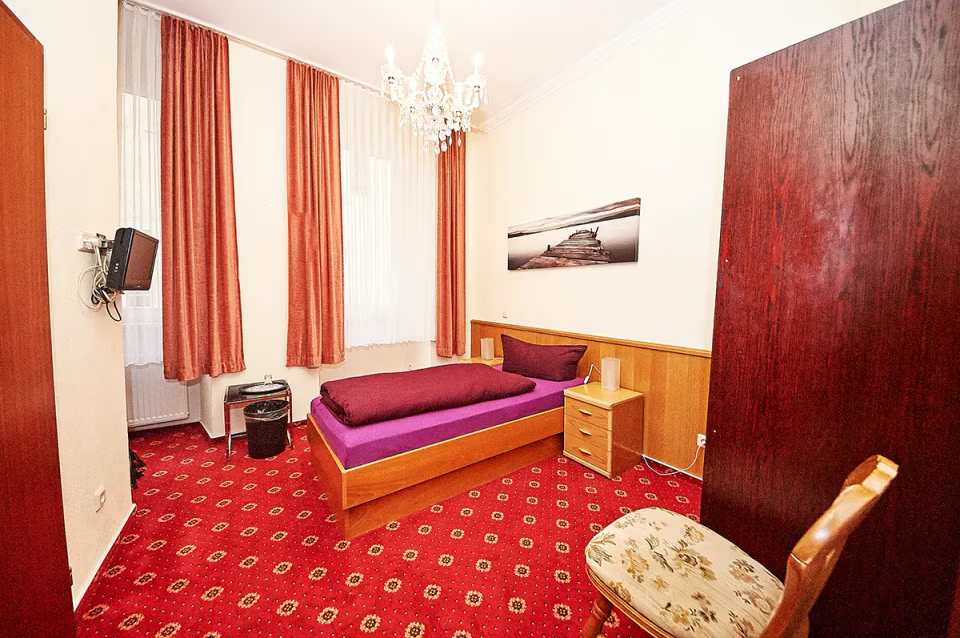 Open
Hotel Bernkasteler Hof
50€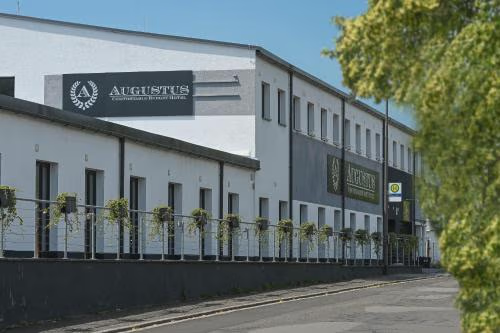 OpenReservations accepted
Augustus Hotel Bernkastel - Comfortable Budget Hotel
 OpenReservations accepted
Hotel Dolce Vita


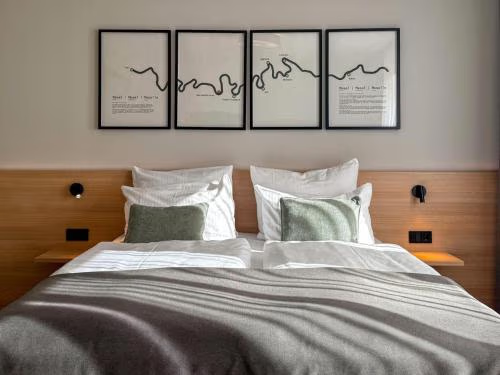


Services in Bernkastel-Kues
What you can find in town before the next stage.
- ATM
- Café
- Shop
- Medical clinic
- Pharmacy
- Fountain
- Post office
- Train station
- Restaurant
Source: © OpenStreetMap contributors · updated April 2026