

Town on the Camino
Zell (Mosel)
Germany
- places to stay
- 11
- Camino
- 1
- Elevation
- 99 m
Zell sits in the middle of the Zeller Hamm, a Moselle loop almost 14 kilometres long that the Mosel-Camino cuts short over the Marienburg. On this stretch the parish walked ahead of you: from the Petersberg to Kaimt, where a chapel of St James is recorded in 1143, and around 1200 to Zell. Trier is still 89.3 kilometres away.
How long to stay?
An afternoon is enough. Zell lies in the middle of the stage from Bullay to Traben-Trarbach, and for most pilgrims it is a long lunch break: the fountain with the Schwarze Katz, the palace, St. Peter and the pedestrian zone sit close together in the small old town. Outside services both churches are usually closed, and you can only see the Marienburg from the outside. If you walk the nine-stage version of the St. Jakobusbruderschaft Trier, you sleep here anyway and have the evening for wine and the riverbank.
Zell in Ninja numbers
- Almost 14 kilometres is the length of the Moselle loop called the Zeller Hamm. The Camino cuts it short: from Bullay over the Marienburg it is only 5.4 kilometres to Zell, according to Camino Ninja.
- 1143 is when the chapel of St James in Kaimt first appears in a papal document. Since 1781 the high altar has held relics attributed to the apostle.
- 152 buildings were destroyed by the town fire of 1848, and 900 people lost their homes.
- 11.30 metres was the reading on the Trier gauge in the 1993 flood. From 8.70 metres, Zell is under water.
Arriving: over the hill and across the bridge
From Bullay the Mosel-Camino climbs in switchbacks up to the Marienburg, 3.8 kilometres before Zell according to Camino Ninja. From up there you see the whole loop you are cutting off. Then a road takes you towards Barl, past the ruin of the Marienthaler Hof and down to Kaimt on the left bank, to the parish church of St. Jakobus.
The footbridge takes you over to the right bank of the Moselle. Then left and straight away right again, and you are in Zell's pedestrian zone, where you can stop for food and drink.
In brief: Romans, Prince-Electors and a great fire
Zell grew up after the year 70, probably from a Roman road station on the Zeller Bach. In 1978 the remains of a bath were found in Oberstraße. In 1222 the Archbishop of Trier, Theoderich von Wied, allowed a town wall; from 1332 Zell belonged to the Electorate of Trier and until 1794 it was the seat of an Oberamt. When Franz von Sickingen attacked Trier in 1522, around a hundred men from Zell helped defend it. Afterwards, from 1530, the Elector had the palace built.
In 1794 the French arrived, and in 1816 the Prussians made Zell a district town. In 1848 a large part of the old town burned down, and of the town wall only the Round Tower and the Square Tower survived. In 1969 Zell lost its district seat to Cochem. Today a little over 4,000 people live here, and Zell is one of the largest wine-growing communities on the Moselle.
A parish goes round the loop
What you walk on the nearly four kilometres from the Marienburg to Zell is the order in which Christianity moved house here. The first church of the Zeller Hamm stood on the Petersberg, named as early as 690 in the will of a Frankish king's daughter. When a convent for women was founded up there around 1145, the parish moved down to Kaimt. A chapel of St James is recorded there in 1143. Between 1193 and 1220 it moved on across the river to Zell and took its patron with it: Peter, after whom the hill was once named.
The Mosel-Camino has only been waymarked since 2008, and no source knows of a medieval Way of St James through the Hamm. But it leads you over exactly these three stations: the hill, James, Peter. You don't walk the loop, but you take its story with you all the same.
From the Marienburg to St. Peter: what to see
The Marienburg and Kaimt lie on the Way before Zell; everything else is in the small old town on the right bank.
- The Marienburg: A castle and a church of St Peter stood on the Petersberg before Abbot Richard of Springiersbach founded a convent for Augustinian nuns here around 1145. Their church of St Mary was consecrated in 1157, then the parish church for Zell, Kaimt, Merl and Pünderich. In 1515 Pope Leo X dissolved the convent because the Elector of Trier wanted the hill as a fortress. In 1650 the fortress was destroyed. Today it is a youth education centre of the Diocese of Trier, and you can only see it from the outside. For pilgrims, the view is what counts: from up here you look out over the Zeller Hamm. For us it is the best view on the whole Mosel-Camino.
- St. Jakobus in Kaimt: The chapel of St James is named in 1143 in a document of Pope Innocent II. When a new building was consecrated on 13 March 1781, relics attributed to St James were placed in the high altar. Today's church was built from 1968 to 1970 to plans by Karl Peter Böhr; only the old tower was kept. Inside hangs a Romanesque stone tablet from around 1220: it names the donors Sifrid and Friderun, who gave two vineyards for a Mass every Wednesday, and it is considered the oldest medieval depiction of a Moselle winegrower. The tabernacle is shaped like a vine. The church is only open for services.
- St. Peter: The red sandstone parish church was built from 1786 to 1793 in front of the old lower town gate. The high altar of 1787 is the work of Matthias Höpp from Trier, with a baldachin on four columns of a kind otherwise known from cathedrals: a sign that the Elector of Trier was lord here. The font bears the date 1461 and comes from the earlier church, and the Madonna on the left side altar dates from the middle of the fifteenth century. The greatest treasure you only see on the feast of Saints Peter and Paul: a reliquary from Limoges holding a foot bone attributed to the apostle Peter. Outside services the church stays closed.
- The Schwarze Katz fountain: Since 1936 a cat of Eifel basalt with an arched back has sat on a wine barrel in the market square. It stands for the famous vineyard site, and the inscription recalls the men of Zell who defended Trier in 1522. There are several legends about where the name comes from, but no certain answer (more on this in the long read below).
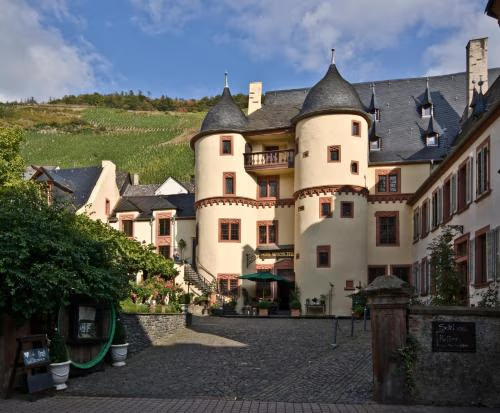
- The Electoral Palace: Elector Richard von Greiffenklau had it built from 1530, according to tradition as thanks for Zell's help against Sickingen. The late Gothic wing with its two towers dates from 1542. Today it is a hotel, and you can only see it from the outside. In 1849 the Jewish community set up its synagogue in one of the outbuildings; today it is a memorial, open from May to October on Saturdays from 15:00 to 17:00.
Food and drink
You can stop for food and drink in the pedestrian zone just past the bridge; we don't recommend individual places. And since you are in one of the largest wine-growing communities on the Moselle, a glass of Riesling from the site the cat on the fountain is named after is worth it. From May to October the Vinothek „Zeller Schwarze Katz“ opens in the vaulted cellar of the town hall. Come in summer and you'll find wine festivals: Schwarze Katz on the last weekend of June, and the St.-Jakobus-Weinkirmes in Kaimt on the last weekend of July.
Honestly
- Zell has no pilgrim hostel. You sleep in guest rooms, wineries or holiday flats and have to book ahead. The nearest pilgrim hostel is in Traben-Trarbach.
- The churches are usually closed. According to the tourist office, you can only see St. Peter and St. Jakobus from the outside or during services.
- After Zell it gets steep. After your break you climb out of the valley to around 420 metres, and three hard climbs wait before Traben-Trarbach. Plan your break so that you have enough day left for the rest.
- No railway station. The nearest station is Bullay, about seven kilometres away.
Where pilgrims sleep
There is no pilgrim hostel in Zell. In the app you'll find guest rooms, holiday flats and wineries with rooms, from about €45 according to Camino Ninja (as of October 2026). There are hardly any spare beds for walk-ins on the Mosel-Camino, so phone ahead.
The nearest pilgrim hostel is 15.8 kilometres further on in Traben-Trarbach: Pilgerherberge Mosel „Alte Lateinschule“, one of only two pilgrim hostels on the entire Mosel-Camino.
Ninja tips
- James before Peter: Don't walk past Kaimt without looking. The church of St James is on the Way before you cross the bridge to Zell. If it is open, look for the stone tablet with the winegrower on the left wall.
- On the feast of Peter and Paul: If you come through on 29 June, you have a chance to see the Peter reliquary from Limoges. On other days it is not on display.
- Shopping in Barl: From the Marienburg the Way follows a road towards Barl, the district up on the heights. There is a large supermarket there. After Zell you walk through forest for a long time, so buy your supplies beforehand.
- Looking for the cat: The Schwarze-Katz-Rundweg is about three kilometres long and explains steep-slope winegrowing on information boards. For a rest day or a long evening it is the short alternative to walking on.
- Museum in the afternoon: The Wein- und Heimatmuseum in the town hall shows remains of a Roman bath with underfloor heating and the story of the Schwarze Katz. In season it opens in the afternoon from 14:00 to 17:00, closed on Mondays. We didn't find winter hours.
Practical tips for pilgrims
- Stamp: We didn't find a fixed stamp point in Zell. Ask at the tourist information in the town hall, Balduinstraße 44, or at the parish office. You can be sure of getting one in Traben-Trarbach at the tourist information by the station.
- Parish office: Pfarreiengemeinschaft Zeller Hamm, Schlossstraße 16, phone +49 6542 4536. Open Monday, Wednesday and Friday 8:00 to 11:00, Thursday 15:00 to 18:00, closed on Tuesdays. This is where you ask about Mass times.
- Getting here and away: Zell has no station of its own. Bullay is on the Koblenz–Trier line and is also served by Intercity trains.
Onward: up into the Hunsrück
You leave Zell along Hauptstraße to the roundabout, turn towards the Hunsrück and climb the first 100 metres or so from Brandenburgstraße. At the former water-treading pool the long climb begins, over a hilltop with the remains of a Roman cult building to the Schöne Aussicht and the Bummkopfhöhe. Then it is through the forest to the Fünftälerblick and down to Enkirch, 9.5 kilometres from Zell according to Camino Ninja. Past the castle ruin of Starkenburg at kilometre 13.2 you reach Traben-Trarbach after 15.8 kilometres. It is 22.8 kilometres to Bernkastel-Kues and 89.3 to Trier.
What awaits you tomorrow
Traben-Trarbach has what Zell lacks: with the „Alte Lateinschule“ a real pilgrim hostel, one of only two on the Mosel-Camino. And just before it you pass the Starkenburg, where in the summer of 1328 Loretta von Sponheim held the Archbishop of Trier, Balduin of Luxembourg, captive for a month. She was excommunicated and got her demands met all the same.
Deep dive: A cat, an apostle's bone and a wandering parish
A long read, in case you want to learn more about Zell. About fifteen minutes' reading.
At the bridge in Kaimt
When you come down from the Marienburg, you are not in Zell at first but in Kaimt, on the left bank of the Moselle. In front of you is the footbridge, the town is on the other side, and the river makes a loop here that is almost 14 kilometres long. People here call this loop the Zeller Hamm. The Mosel-Camino goes round the top, over the hill. The river takes the long way.
Zell is a small place with a little over 4,000 inhabitants, and at first glance it is above all a wine town. A cat on a barrel sits in the market square, and a cat holding a wine glass is the town's logo. But beneath the wine lies an older story. It is about a church on a hill, about a parish that moved twice, about an apostle whose bone is kept in a shrine from Limoges, about a Prince-Elector who thanked his townspeople, and about a court case that was about nothing other than the name of a cat.
A road station by the stream
People lived on this spot as early as the late Stone Age. Stone axes and an axe head were found in Kaimt. Later the Celts of the Treveri tribe lived here, after whom the city of Trier is named. Between 58 and 51 before Christ, Caesar conquered the land west of the Rhine, and for almost half a millennium the Moselle remained Roman.
Zell itself probably grew out of a Roman road station on the Zeller Bach, some time after the year 70. In 1912 a stone ash chest with three urns came to light, and in 1978 the remains of a bath complex and a road were found in Oberstraße. Parts of this bath with its underfloor heating can be seen today in the museum in the town hall. At least seven Roman farmsteads stood around the town.
And the Romans brought wine. Winegrowing began on the Moselle in the first century after Christ. In Zell the evidence is a wine-press stone in the Corray district, pruning knives from Merl and from the hill above the town, and a drinking beaker from the early fourth century bearing the words Vinum nobis, wine for us. That really says everything Zell will do for the next sixteen centuries.
Around 400 the Franks reached the Moselle, and in the middle of the fifth century the land finally fell to them. Kaimt is first named in a document in 732 or 733, Merl in 782. In the early Middle Ages both villages were more important than Zell.
The church on the hill
The story of Christianity in the Zeller Hamm begins up on the hill you have just walked over. In the year 690 the will of a woman named Adela, a daughter of the Frankish king Dagobert the Second, mentions a church in the Zeller Hamm. It stood on the Sankt Petersberg, where the Marienburg stands today, and was the mother church of a large district. Its patron was Peter. Remember that name, it is going to move.
There was also a castle on the hill. It was strategically valuable because of the Moselle. In 1140 Archbishop Albero of Trier took the castle back after Count Palatine Wilhelm von Ballenstedt had died without heirs. And then he handed church and parish over to the Augustinian canons of Springiersbach Abbey. Two popes and King Conrad the Third confirmed this between 1142 and 1144.
The abbot of Springiersbach, Richard, founded a convent for Augustinian nuns on the hill. He had the old, dilapidated church of Saint Peter torn down and a church for Mary built in its place. In 1145 the name castrum Mariae, Mary's castle, appears in the sources for the first time. The Petersberg became the Marienburg. In 1157 the new church was consecrated as the parish church for Pünderich, Merl, Zell and Kaimt.
It did not happen without a quarrel. The Count Palatine was not willing to give up the castle so easily. In 1161 Emperor Frederick Barbarossa settled the dispute, and the Count Palatine received another castle, the Ehrenburg, in exchange.
The parish moves down
Soon after the nuns had moved onto the hill, the parish church was moved down, to the left bank, to Kaimt. A chapel of Saint Clement already stood there. And in a bull of Pope Innocent the Second from the year 1143, a chapel of Saint James in Kaimt is named. It is the oldest mention of the apostle James you will meet on this part of the Mosel-Camino.
From this period comes a piece you can still see in the church in Kaimt today, if it is open. On the left inner wall hangs a Romanesque tablet of calcareous sandstone, a Trier work from around 1220. It shows a bearded man and carries an inscription. It names two people, Sifrid and Friderun. They renewed the church and gave two vineyards to the church of Saint Peter in Zell so that a Mass would be said there every Wednesday. The wine historian Karl-Josef Gilles considers the relief the oldest medieval depiction of a Moselle winegrower. It is also one of the oldest records of Zell's church of Saint Peter.
Because by then the parish had already moved on. Between 1193 and 1220, nobody knows exactly when, Archbishop John the First moved the seat of the parish and the high court across the river to Zell. And with the seat went the name of the old patron: the parish church of Zell became Saint Peter. In 1259 a priest of this church is named in a document for the first time.
So when you walk today from the Marienburg via Kaimt to Zell, you walk exactly the route the parish took over a few decades. From the hill to James, from James to Peter. It takes you just under four kilometres.
James on the left bank
Kaimt stayed true to its James, even when the parish had long since been in Zell. The old church there was the chapel of the Electorate of Trier's estate in Kaimt. Between 1770 and 1781 it was rebuilt, and it was consecrated on 13 March 1781. Bones regarded as relics of Saint James were placed in the high altar at that time. Where they came from, no source we found says. They are best taken the way most relics of that period have to be taken: as a sign of whom this church was meant to belong to.
In 1802 Kaimt became a parish of its own. In 1968, under parish priest Walter Benz, the church was demolished except for the tower, and a new building went up to plans by the Trier architect Karl Peter Böhr, according to the parish the fifth church built in Kaimt. The furnishings stayed. The tabernacle is shaped like a vine, and the stages of church history are depicted in it.
James is more than a name on the church door in Kaimt to this day. On the last weekend in July the village celebrates the Sankt-Jakobus-Weinkirmes. The apostle's feast day is 25 July. Celebrating him on the Moselle with wine is perhaps the most honest way of letting him be at home here.
A town with a wall
Zell grew. In 1222 Archbishop Theoderich von Wied of Trier allowed the people of Zell to fortify their settlement, and by around 1229 the wall stood. 1222 counts as the year Zell became a town. People lived from wine, from farming, from livestock and from trade. From 1332 Zell was a town of the Electorate of Trier, and until 1794 an Oberamt of the Electorate had its seat here.
The Church and the lords owned much of what the people of Zell grew. When the vineyards were surveyed between 1719 and 1721, around a quarter of the vines belonged to clerical lords. The Trier cathedral chapter alone owned 66,000 vines. The Electors also cared about quality. In 1750 Franz Georg von Schönborn banned blending and adulterating wine, and in 1787 Clemens Wenzeslaus banned an inferior grape variety known as the Rhenish. It was never enforced, because in 1794 the French arrived.
An emperor, a knight and a thank-you
In March 1512 Emperor Maximilian the First spent a night in the Electoral cellar house in Zell. A tapestry in today's town hall commemorates the visit. It was a great year for the archbishopric. Archbishop Richard von Greiffenklau had just taken office and had the Holy Robe shown in Trier, the garment held to be the seamless tunic of Christ. Maximilian was present.
Ten years later a knight marched against the same archbishop. Franz von Sickingen declared war on Greiffenklau in 1522 and marched on Trier. The city stayed loyal to its archbishop, and Sickingen had to withdraw. In May 1523 he died at his castle above Landstuhl, mortally wounded during a siege. Among the defenders of Trier were around a hundred citizens of Zell.
The Elector did not forget it. From 1530 Richard von Greiffenklau had a palace built in Zell, according to tradition as thanks for the courage and steadfastness of the people of Zell. Greiffenklau died as early as 1531. The late Gothic wing with its two towers dates from 1542. The official of the Electoral district of Zell at this time, from 1535 to 1574, was Konrad von Metzenhausen, a cousin of Archbishop John the Third of Metzenhausen.
And once more, four hundred years later, Zell remembered 1522. When the town had the fountain with the black cat of Eifel basalt set up in the market square in 1936, it carved on it a sentence in the Zell dialect that means roughly: he stands firm like a man of Zell from the Hamm. It refers to the men who defended Trier. The cat hissing above it has arched its back as if it were about to defend a town wall itself.
The nuns leave, the soldiers come
Up on the Marienburg, the Augustinian nuns fared badly in the late Middle Ages. Failed harvests, famines, epidemics and a cold period now called the Little Ice Age made their income shrink. And the hill was too valuable militarily. Archbishop Richard von Greiffenklau, the same man who built the palace, asked the pope to dissolve the convent. Leo the Tenth agreed, and in 1515 the nuns had to leave. They received a pension and moved to the Mulay estate near Bengel. A fortress was built on the hill.
In the Thirty Years' War, Bavarian and Swedish mercenaries quartered themselves on the Marienburg and plagued the people in the valley until 1650. In 1650 French auxiliary troops destroyed the fortress. In the War of the Palatine Succession at the end of the seventeenth century came further destruction. Of Zell's town fortifications, only some towers survived 1689.
The church on the hill, however, was rebuilt in Baroque style and remained a place of pilgrimage until 1797. Then French revolutionary troops plundered the site and destroyed the tower and roof. The French state auctioned off the whole estate for 1,075 francs to a surgeon from Zell named Jodokus Crossius. After that it changed hands several times and fell into ruin.
A new altar for the old patron
In Zell, the church of Saint Peter stood for around five hundred years on the site of today's cemetery. In 1781 it was declared unsafe, and at the beginning of 1785 it was demolished. Between 1786 and 1793 the new church you see today was built, in the former garden of the Electoral cellar house in front of the lower town gate. Back then it stood at the edge of town; today it stands in the middle.
Its west tower is of red sandstone, with a curved cap and an open lantern. Inside, most of it is Rococo. The high altar of 1787 is the work of the Trier sculptor Matthias Höpp, and it has something special: a baldachin on four columns. Altars like this were otherwise built in cathedrals. In Zell it was meant to show to whom this church was subject, the Archbishop and Elector of Trier.
Two things were brought over from the old church. One is the octagonal sandstone font, a little over 1.20 metres high, with the inscription Anno Domini 1461. The other is a carved Madonna from the middle of the fifteenth century, a crowned Queen of Heaven with the Child. It originally stood in a wayside chapel and is considered the most precious piece in the church.
The greatest treasure, however, is hidden away. It is a copper reliquary with enamel decoration, made in a goldsmith's workshop in Limoges. The sources do not agree on exactly when: some say the late twelfth century, others the middle of the thirteenth. Inside lies a foot bone regarded as a relic of the apostle Peter. The reliquary is shown on only one day a year, for the feast of the apostles Peter and Paul on 29 June. So the patron who moved from the hill via Kaimt to Zell has, according to tradition, not only his name here but also a foot.
The French, the Prussians and the great fire
In 1794 French troops occupied the left bank of the Rhine. Zell became French, and what had belonged to lords, monasteries and churches was confiscated. After the Congress of Vienna the Rhineland passed to Prussia in 1815, and in 1816 Zell became a Prussian district town.
In 1848 disaster struck. A fire destroyed 152 buildings, the harvest and many cultural treasures. 900 people lost their homes. During the rebuilding a new suburb called Brandenburg grew up in front of the south gate, and the town wall was torn down almost entirely. Only the Round Tower survived, fourteen metres high and known as the Powder Tower, and the Square Tower, 22 metres high, which long served as a prison. In 1857 there was another fire.
In the year after the great fire, 1849, the administrator of the palace sold the upper floors of an outbuilding to the Jewish community of Briedel and Zell. They set up their synagogue there. Around 1925 up to 80 people from Zell and the surrounding villages belonged to it: merchants, butchers, watchmakers, wine merchants, tailors. In the mid-1920s a women's gallery was added and a starry sky painted on the ceiling. Today a circle of friends has turned the room into a memorial. It is in Jakobstraße.
In the nineteenth century Zell did not live from wine alone. In 1850 Johann Baptist Gräff founded the town's first cigar factory, and until about 1935 a ropewalk twisted its ropes here.
How the cat got its name
And then there is the cat. If you ask in Zell why the town's most famous vineyard site is called Schwarze Katz, the black cat, you will be told a story. The best-known one goes like this: wine merchants from Aachen came to Zell and tasted their way through the cellars. At the winegrower Mayntzer's, three barrels were left at the end, and the merchants could not decide. Then the winegrower's black house cat jumped onto one of the barrels, arched its back and hissed at anyone who came near with the tasting tube. The merchants took exactly that barrel. The wine was so good that they came back and asked for the wine of the black cat.
There are two other versions. In one, the cat drives off the devil at night, who wants to spoil the wine in the cellar. In the other, a black cat prowls through the Mayntzer family's vineyard, and when people asked where to start the harvest, the answer was: by the black cat.
Is any of it true? The honest answer is: nobody knows. Even the year is disputed. One source gives 1863, another 1836. The Trier archaeologist and wine historian Karl-Josef Gilles, himself the grandson of a Zell winegrower who fought for the name, gathered everything that could be found in 1999. His result is sobering and beautiful precisely for that reason. The legends only appear after the middle of the nineteenth century. The name is not recorded in the land register of 1831, where the sites are called Kapertchen and Petersborn. Witnesses later named the early 1860s, or even only the 1880s, as the beginning. Gilles thinks there may be a true core to the story of the merchants, perhaps a coincidence during a sale. But he finds a sober explanation the most convincing: above the Kapertchen and Petersborn sites there is a group of rocks that looks like a leaping cat. A spa guest photographed it in the early 1920s. The origin, Gilles writes, can no longer be settled for good.
What is more certain is who made the name big. Gilles names Peter Anton Mayntzer, who lived from 1817 to 1878, as the real originator, and his relative Benedikt Mayntzer, 1851 to 1919, as the man who established it. Benedikt filled the wine into bottles and stuck his own labels on them. Around 1885 he was already advertising the Schwarze Katz on his visiting card. At the time that was new. Until then, merchants on the Moselle bought whole tuns, and the wines were simply called Zeller, Merler or Enkircher.
A court case over a cat
With success came the envious. In 1913 a winegrower from Reil offered a Reiler Schwarze Katz. A legal dispute followed, and on 5 May 1926 the district court in Traben-Trarbach ruled that the name was a pure fantasy name. That meant, in effect, anyone could use it. Demand for Zell wine collapsed and prices fell. Gilles writes that the ruling took away from the people of Zell their flourishing wine name.
The people of Zell fought back. A winegrower named Jakob Bohn had made the wine known among officers, writers and artists during the First World War, as cellar master of the army winery in Charleville. For the town's 700th anniversary in 1922 he had bottled a wine of the century. He died in August 1928. Philipp Bohn, the grandfather of Karl-Josef Gilles, ran the Ratsschänke on the market square. From 1928 he sold Original Zeller Schwarze Katz there and accepted a court case for it. In December 1928 he received a penalty order of 50 Reichsmarks.
On 4 July 1929 the district court in Cochem acquitted him. The Schwarze Katz, it ruled, was not a fantasy name but a site name that had grown up in popular usage. The judgment became final, and Gilles calls it the most important one in the whole story. Since then the Schwarze Katz has belonged to Zell, and there may no longer be a Reiler Schwarze Katz. A Zeller Weiße Maus, a white mouse, which a firm put on the market, was also banned at the final instance in 1931. And a winegrower from Merl who had sold Merl wine as Zeller Schwarze Katz had to pay 25 Reichsmarks.
The cat did not have only friends. On the night of 31 October to 1 November 1929, someone tried to knock the head off a basalt cat figure at the Ratsschänke. They failed, and the culprits were never found. Philipp Bohn, the man who had won the case, was to be made an honorary citizen. Political developments got in the way. In 1933 he gave up his seat on the town council, and in 1940 the town turned down the honour. In 1936, three years after his withdrawal, the same town set up the fountain with the cat in the market square.
Water, hill and the present
On 16 March 1945 American troops entered Zell. On the Petersberg, Americans and Germans had fought over the heights. After the war the Moselle was developed into a major shipping route, Kaimt joined Zell in 1950, Merl in 1969. In the same year Zell lost its district seat. Because there was no more building land along the bank, the town grew up onto the heights, into the Barl district.
The river that built the loop sometimes comes into town. From a reading of 8.70 metres on the Trier gauge, Zell is under water. In 1989 a protective wall was built on Fährgasse. In 1993 the gauge rose to 11.30 metres.
And the Marienburg? On 25 February 1950 the Diocese of Trier bought the ruin. In the 1930s the nave had still served as the backdrop for a restaurant. On 8 September 1957 Bishop Matthias Wehr consecrated the church anew. In 1996, for the first time in over two hundred years, a priest moved back onto the hill, and since the year 2000 the Marienburg has been a youth education centre. In 2015 it offered 100 beds.
In the summer of 2008 something new was added. Two private individuals, Karl-Josef Schäfer and Wolfgang Welter, laid out the Mosel-Camino from Koblenz to Trier, and since then yellow shells on a blue background have led over the Marienburg, to Kaimt and across the bridge to Zell. There are not many pilgrims. On the Mosel-Camino you are often the only one with a shell on your rucksack.
What Zell gives you
Zell is a place where you can see how things wander. A parish wanders from the hill to the village and from the village to the town. One apostle gets his chapel on the left bank, another his altar on the right. Nuns move out, soldiers move in, a surgeon buys a ruin, a bishop consecrates it anew. And a cat whose story nobody can prove is declared a piece of home by a court.
Perhaps that is this place's invitation. You don't have to know whether the cat really jumped onto the barrel, whether the bone in Sankt Peter really comes from Peter, or the bones in Kaimt from James. The people of Zell have carried their stories on for centuries because they meant something to them. A Way that did not exist before 2008 now leads you through exactly these stories.
When you climb the hill just past Brandenburgstraße, the loop the river carved, and that you cut short in a morning, stays behind you. Trier is still just under ninety kilometres away.
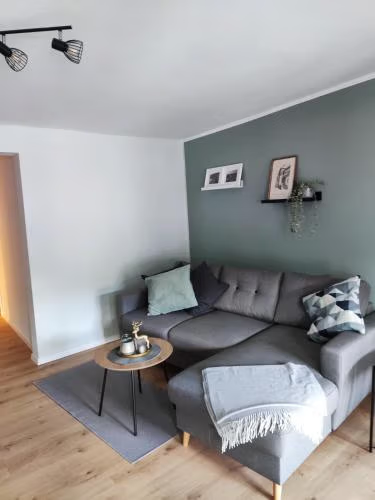
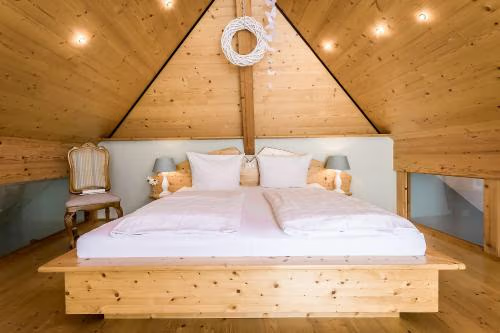
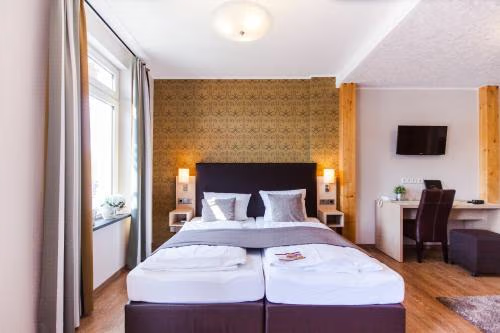
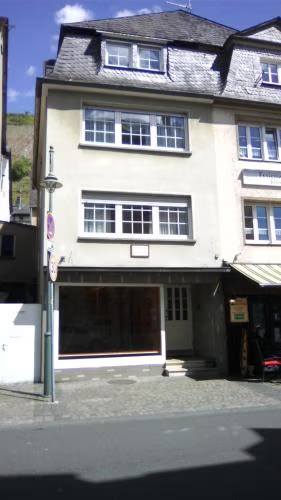
Where to stay in Zell (Mosel)
Places to stay in Zell (Mosel).
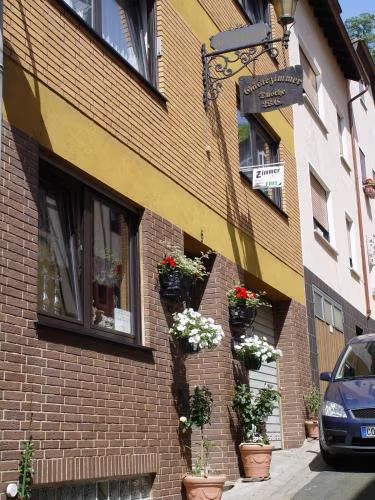 OpenReservations accepted
Gästehaus Am Römerbad
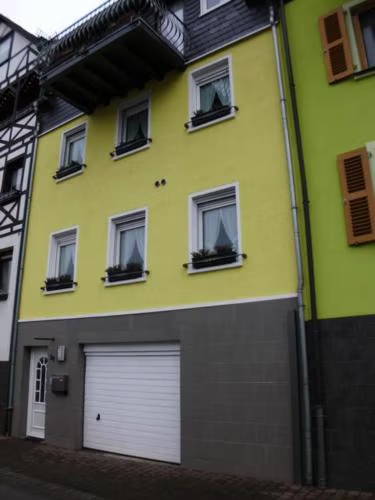 OpenReservations accepted
Gästezimmer Hoffmann
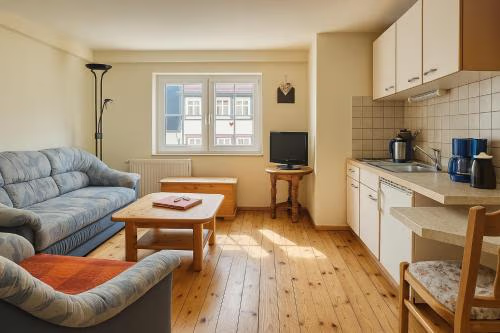 OpenReservations accepted
Moselglocke Urlaub im Herzen von Zell
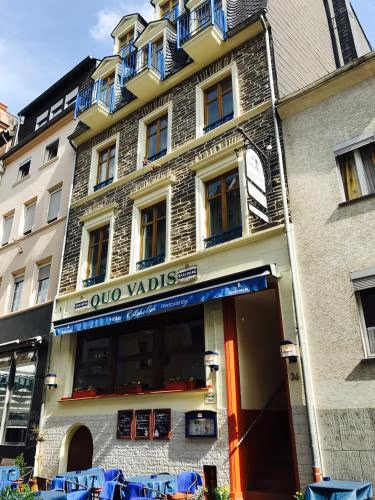
Services in Zell (Mosel)
What you can find in town before the next stage.
- ATM
- Café
- Shop
- Medical clinic
- Pharmacy
- Fountain
- Train station
- Bus station
- Restaurant
Source: © OpenStreetMap contributors · updated April 2026