

Town on the Camino
Beilstein
Germany
- places to stay
- 10
- Camino
- 1
- Elevation
- 115 m
Beilstein is a film set with real stories: below the ruins of Burg Metternich, 132 people live among half-timbered houses and a former synagogue. 108 steps lead up to the Carmelite church, whose Black Madonna came home in 1950. On the Mosel-Camino an afternoon is enough, but book your bed ahead.
Right now in Beilstein (as of October 2026)
- Burg Metternich: The castle ruins are open only until 2 November, 10:00 to 18:00, closed on Mondays according to one source. After that they don't reopen until spring.
- Winter on the Mosel-Camino: From November many businesses along the Mosel close, and the vineyard paths get slippery. Call ahead before you count on a bed or a meal.
How long to stay?
An afternoon is enough. Beilstein is small, and what you should see lies between the riverbank and the castle hill: the monastery church with the Black Madonna, the keep of the castle ruins, the Jewish cemetery and the lanes with the former synagogue. If you follow the Trier Jakobusbruderschaft's version of the route and spend the night here, you have the evening for the Marktplatz. If you walk the long stage from Treis-Karden to Bullay, you stop here for lunch and move on.
Beilstein in Ninja numbers
- 132 inhabitants lived in Beilstein at the end of 2025. Even so, excursion boats tie up here in summer, and the lanes are packed.
- 108 steps make up the Klostertreppe up to the Carmelite church. The castle keep adds more than 120.
- 10 Jewish families were allowed to settle at the foot of the castle under a royal permit of 1309. In the nineteenth century roughly one in four people in Beilstein was Jewish.
- 107.3 kilometres separate you from the apostle's tomb in Trier, the goal of the Mosel-Camino, according to Camino Ninja. For the Trier pilgrim certificate, the last 100 count.
Arriving: from above into the picture book
On the Mosel-Camino you don't arrive along the riverbank but from above. From Treis you climb past the Wildburg into the Flaumbachtal to Kloster Maria Engelport, 6.2 kilometres before Beilstein according to Camino Ninja. A signpost there gives the distance to Santiago, and the sisters invite pilgrims to Mass and choral prayer.
Beyond the monastery the path climbs through the forest to the K 36 road, about 200 metres along the road, then left back into the forest at the "Schafstall" hut. The descent takes you past the monastery church and the castle ruins down into the village. So you meet the two landmarks first and only then drop into the lanes.
In brief: a lord, a king and a war
The castle is first mentioned in 1268, when the Lords of Braunshorn held it. Johann von Braunshorn, steward to King Henry VII, received the right around 1309 and 1310 to found a fortified town on the castle hill, with 40 burghers and ten Jewish families. Later the Winneburgs ruled, and from 1637 the Metternichs. On 2 February 1689 French troops destroyed the castle, and it was never rebuilt.
In 1636 Emmerich von Metternich founded a Carmelite monastery, whose church was begun in 1691 and completed around 1738. In 1794 French revolutionary troops occupied the land, and Metternich rule came to an end. The village's seventeenth- and eighteenth-century townscape has largely survived, and Beilstein is called the Sleeping Beauty of the Mosel.
More than a film set
Beilstein looks as if it were built for the camera, and the camera found it. For Helmut Käutner's "Der Schinderhannes" starring Curd Jürgens, outdoor scenes were shot on the castle ruins in 1958. Heinz Rühmann is said to have been here in 1936 for "Wenn wir alle Engel wären", and Willi Millowitsch went up and down the Klostertreppe for "Der wahre Jakob".
Behind the set, though, lies a place that tells of real people: of Spanish soldiers who left a Madonna behind in the Thirty Years' War, of monks who, as tradition has it, set a large church on the rock for pilgrims, and of a Jewish community that lived here, with interruptions, for six centuries. Its synagogue still stands, its cemetery lies above the castle. As you walk through Beilstein, it pays to look behind the façades.
Up the steps through Sleeping Beauty's village: what to see
Everything is close together, but almost everything is uphill. Expect steps.
- Karmeliterkirche St. Josef: The church of the former Carmelite monastery stands on a rock above the village. A friar named Wynant from Springiersbach Abbey designed the three-aisled hall church; the foundation stone was laid in 1691, and it was finished around 1738. The furnishings date from the time of construction: the walnut high altar with Saint Joseph and the curving organ gallery of 1738. The reason for your visit is the Black Madonna, a statue of Mary from the twelfth or thirteenth century, probably from Spain. Spanish troops left it here after the Thirty Years' War, and according to tradition the Carmelites built their church this large so that the pilgrims would have room. Only in 1950 did the statue return to Beilstein. Service times are on the website of the Pfarreiengemeinschaft Beilstein-Moselkrampen.
- The Klostertreppe: 108 steps lead from the village up to the church, lined with eighteenth-century half-timbered houses. The story goes that the monks built it and levied a stair tax on the residents to finish it. Today walking guides also call it the Rühmann stairs.
- Burgruine Metternich: The castle was first mentioned in 1268; its keep dates from around 1200 and is about 25 metres high. More than 120 steps lead to the top, where you look out over the village and the bend of the Mosel. There is a restaurant with a terrace in the ruins. Adults pay €3 admission, children €1 (as of October 2025). Open until 2 November.
- The Jewish cemetery: On the southern ridge of the castle hill, high above the Mosel, lies the Jewish community's cemetery, laid out in the seventeenth century. Jews from Bruttig and Ediger were buried here too. The surviving gravestones date from about 1818 to 1938, and there are more than a hundred of them. Under the Nazis the cemetery was desecrated and partly cleared; after 1945 the stones were set up again, though not all in their original places. Right next to it stands the Dreikreuzkapelle of 1652.
- The former synagogue: In the Weingasse, in the old Jewish quarter, stands the synagogue, essentially from the eighteenth or nineteenth century. Above the entrance sits a stone imperial double-headed eagle with a Star of David. It was sold in 1925 and used as a barn and wine-press room, which is why it came through November 1938 undamaged. Since its restoration in 1990 it has been a gallery, with the prayer room and the women's gallery restored. We couldn't find opening hours.
- The Marktplatz: Here stand the Zehnthaus of 1537 with its stair tower and the Alte Schule, formerly the church of Sankt Christophorus, a single-nave building of 1732.
Food and drink
In the castle ruins there is a restaurant with a terrace and a view over the Mosel valley, open Tuesday to Sunday from 11:30 to 17:00 according to the operator. In the village many winegrowers sell their wine, and in autumn chanterelles and Federweißer, the new partly fermented wine, appear on the menus. One pilgrim tells of a café in the monastery courtyard where he took a break on the stage. We don't do advertising.
Honestly
- Beilstein has no pilgrim hostel. There are only hotels, inns and holiday flats, and according to Camino Ninja prices start at around €78 (as of October 2026). Elsewhere on the Mosel-Camino a single room with breakfast costs about half that.
- In summer Sleeping Beauty is wide awake. Excursion boats tie up, and the lanes are full. Come early or at lunchtime, when the groups are sitting down to eat.
- The way out is asphalt and climbing. You walk a good stretch on the K 42 road, then climb through the forest onto the Hunsrück heights.
- After that there's nothing for a long time. Between Beilstein and Bullay there is hardly anywhere to stop on the heights. Fill your bottles here; two litres is not too much.
Where pilgrims sleep
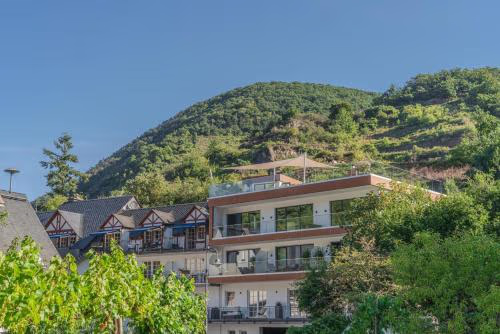
There is no pilgrim hostel in Beilstein, and on the whole Mosel-Camino there are only two, in Traben-Trarbach and in Klausen. In Beilstein you sleep in a hotel, an inn or a holiday flat. Expect prices at the upper end and book ahead, especially during the grape harvest.
The pilgrim-friendly alternative lies before the village:
- Kloster Maria Engelport: the monastery's guesthouse in the Flaumbachtal, 6.2 kilometres before Beilstein according to Camino Ninja. Here you can split the long stage from Treis-Karden to Bullay, and you can join the sisters at Mass.
Ninja tips
- Two places, one walk: The Jewish cemetery and the Dreikreuzkapelle lie side by side above the castle. Give both a few quiet minutes.
- The confraternity stops here: The Trier Jakobusbruderschaft splits the two long days between Treis-Karden and Traben-Trarbach into three shorter ones, with overnight stops in Beilstein and Zell.
- Collect stamps: For the Trier pilgrim certificate you need the last 100 kilometres documented, and according to Camino Ninja Beilstein lies 107.3 kilometres before Trier. We haven't found a fixed stamp point. Ask in the church or at your accommodation.
- The castle from the other bank: The ferry "St. Josef", built in 1949, crosses to Ellenz-Poltersdorf. From there you have the castle in view. We couldn't find current crossing times.
- Don't skip Engelport: At Kloster Maria Engelport there is a signpost with the distance to Santiago. It's worth the photo.
Practical tips for pilgrims
- Pilgrim passport: Get it in advance from the St. Jakobusbruderschaft Trier or from your diocese.
- Services: Times for the Carmelite church are available from the Pfarreiengemeinschaft Beilstein-Moselkrampen.
- Train: Beilstein has no station. The nearest stops on the Mosel line are in Treis-Karden and in Bullay, which the route passes anyway.
- Luggage and quitting: Because the railway follows the Mosel-Camino almost the whole way, you can stop, skip ahead or send luggage on from Bullay.
Onward: over the Hunsrück heights to Bullay
You leave Beilstein on the K 42 road and walk a good stretch on asphalt. Then you climb through the forest onto the Hunsrück heights, cross the L 200 road and walk through a sunken lane and along an open meadow path to the "Alte Schanze". After another road you reach the Kapelle Lindenhäuschen, 4.5 kilometres beyond Beilstein according to Camino Ninja. At the Panoramahütte you turn into the forest, and after about an hour and a half you are back on the Mosel in Bullay, 12.5 kilometres from Beilstein according to Camino Ninja. Across the river stands the Calmont.
If you carry on, you climb in hairpin bends beyond Bullay to the Marienburg in the Zeller Hamm and come via Kaimt to Zell, 18 kilometres from Beilstein according to Camino Ninja.
What awaits you tomorrow
Tomorrow Zell awaits you, and just before it, a Saint James. In Kaimt stands the chapel of Sankt Jakobus der Ältere, first mentioned in 1143. Inside, a Romanesque limestone panel from around 1220 shows the donors Sifrid and Friderun, and the tabernacle is shaped like a grapevine. A few steps further, in Zell, the Schwarze Katz vineyard awaits. It has carried that name since 1863, because a cat called Mori jumped onto a barrel and made the decision for merchants from Aachen.
If you prefer a shorter day, stop in Bullay, where you also have the train.
Deep dive: A Madonna, a community and a sleeping village
A long read, in case you want to learn more about Beilstein. About thirteen minutes' reading.
From above into the picture book
When you come to Beilstein on the Mosel-Camino, you come from above. You have left the forest behind Engelport, and the path leads you down, past a large Baroque church on a rock and past a castle ruin with a slender tower, all the way into the village on the Mosel. It is a picture so perfect that you almost want to distrust it.
Beilstein has 132 inhabitants, according to the statistics at the end of 2025. People call it the Sleeping Beauty of the Mosel, or a miniature Rothenburg ob der Tauber. Filmmakers have used it as a set since the 1930s. But this text wants to show you that behind the set there are real stories: of a knight with a hunting horn in his coat of arms, of a Madonna who came with soldiers, of monks who built for pilgrims, and of a Jewish community whose cemetery still lies above the village.
A horn in the coat of arms
People settled here early. Frankish graves point to inhabitants around the year 800, and in 1129 a Crafto of Beilstein appears in a charter. The castle itself is first mentioned in 1268. At that time it belonged to the Lords of Braunshorn, who held it as a fief of the Archbishop of Cologne.
The Braunshorns bore a coat of arms you can still find in Beilstein today: three silver hunting horns on a red field. The town seal of 1336 shows such a horn, and when the municipality adopted a coat of arms in 1951, it returned to the horn of the old lords.
The most important of them was Johann von Braunshorn. He was steward to King Henry the Seventh, a man at the court of a ruler who was crowned emperor shortly afterwards. That closeness paid off. In April 1310 the king allowed him to found a fortified settlement at the foot of his castle and to settle 40 burghers there. Some sources already give the year 1309 for this. In 1316 King Louis confirmed the town's liberties and granted the little town a weekly market on Tuesdays. A town wall with five gates and towers went up, and two round towers still stand today.
Ten families on the castle hill
As early as December 1309 the king had allowed Johann von Braunshorn something else: the settlement of ten Jewish families. Perhaps, historians suspect, the first of them were survivors of the persecutions that had raged along the Middle Rhine in 1287. They helped to build the new town and its walls.
What is certain is that this first community did not live in peace for long. In 1349, the year of the great plague, the Jews of Beilstein too fell victim to a pogrom. After that their traces vanish for a long time. Only in 1547 are Jewish residents mentioned again. In the sixteenth century the community grew anew, and in the first half of the eighteenth century it reached its peak.
It lived in a quarter of its own around the Weingasse, entered through two gates. Its house of worship stood there, probably already in the Middle Ages on the same spot as today's synagogue, most likely with a ritual bath in the cellar. In the nineteenth century roughly one in four people in Beilstein was Jewish. In 1808 there were 47 Jewish residents, in 1816 there were 73, in 1885 still 49.
A castle for many lords
When the Braunshorns died out in the male line, around 1362, their inheritance passed to the Winneburg family. Cuno von Winneburg had married a daughter of the house, Lise von Braunshorn. The castle now became a Ganerbenburg, a castle shared by several branches of a family, each with its own buildings and its own entrances. They sold parts of it to the Archbishop of Trier, and in 1488, in what became known as the Beilstein Feud, the archbishop fought over his claim to half of the castle.
The Braunshorns left a second trace, though, and if you came from Treis, you walked past it today. Kloster Maria Engelport in the Flaumbachtal was founded around 1220 by a knight from Monreal. The first nuns soon returned to their mother house, because living conditions were too hard. Around 1260 Philipp von Wildenburg and his wife took on the neglected convent, and they are regarded as its true founders. The wife was called Irmgard von Braunshorn. Three of her daughters entered the convent, and one of them, Beatrix, became its first prioress.
Spaniards, plague and a Madonna
During the Reformation Beilstein became Protestant under the Winneburgs. Then came the Thirty Years' War. Swedish and Spanish troops occupied the area, and the castle came through those years largely unharmed. They were not easy times. In the neighbouring village of Ellenz, on the other side of the river, plague broke out in 1624, probably brought in by Spanish soldiers billeted there.
With the Spaniards came the statue that stands in the monastery church today. It is a figure of Mary from the twelfth or thirteenth century, probably from Spain. People call her the Black Madonna of Beilstein. Tradition tells how exactly she came here like this: in 1620 the Protestant town of Beilstein met Spanish troops who carried the statue with them. The townspeople opened the gates, and no one was killed, nothing was stolen or burned. The people credited this to the Madonna and called her the Queen of Peace. When the Spaniards withdrew, they left the statue behind. Whether it really happened this way, we don't know. All that is certain is that the Madonna stayed in Beilstein after the war and that people came to her.
The Carmelites on the rock
In July 1636 the last Winneburg died in exile. Lordship passed to the Metternich family, and with it the Catholic faith returned. Emmerich von Metternich, provost of Trier Cathedral, founded a Carmelite monastery in Beilstein around 1636. The monks came from Cologne and were meant to make the village Catholic again. At first they lived in a simple house down by the Mosel.
In 1686 they were given the rock above the village, and in 1691 they laid the foundation stone for their church. It was designed by a friar from Springiersbach Abbey named Wynant. The sources call him sometimes David, sometimes Franz. In 1692 the monks moved in, and around 1738 the church was finished. The story goes that the monks also built the stairs up from the village and levied a stair tax on the residents to complete them. The story is not documented, but anyone who climbs the 108 steps with a backpack will happily believe it.
Why such a large church for such a small village? Tradition gives an answer that concerns you as a pilgrim: the Carmelites built big because pilgrims came to the Madonna. The Carmelites venerate Mary especially as Our Lady of the Scapular, and on her feast day in summer so many pilgrims are said to have come to Beilstein that tents stood all around the village.
What you see in Sankt Josef
When you enter the church, you stand in a three-aisled hall. Massive columns carry the vault, standing on tall octagonal bases. The furnishings are all of a piece, dating from the time of construction. At the front stands the high altar of walnut wood, erected after 1737 in heavy Baroque forms. It separates off the choir where the monks once prayed. In the middle stands Saint Joseph, the church's patron, and at the top, in the crowning piece, a painting of the Holy Family.
Turn around and look up. The organ gallery of 1738 sweeps through the space in several curves, with a richly carved balustrade. The organ case was built by Balthasar König, and the instrument was restored in 2002. The wall paintings were made in 1753 and renewed in 1923.
And then look for the Madonna. She is small, according to one description only about half a metre tall, made of painted wood. She is the real reason this church stands here. A pilgrim who passed through on the Mosel-Camino in 2013 found a men's choir in the church singing sacred songs. He wrote that it was a moment of reflection. Perhaps you will be lucky.
The 2nd of February 1689
The Metternichs had risen. In May 1652, after a dispute with the Archbishopric of Trier, the brothers Wilhelm and Lothar von Metternich were finally enfeoffed with the castle, and in 1679 the family was raised to the rank of counts. The centre of their power had long been elsewhere, in Bohemia and in their town house in Koblenz. Beilstein was one possession among several.
Then came the war that the French called the War of the League of Augsburg and the Germans the War of the Palatine Succession. The troops of King Louis the Fourteenth moved through the Mosel valley. Before they reached Beilstein, Count Franz Ferdinand von Metternich evacuated the castle. He gave one work of art away beforehand: a Venetian panel painting from the circle of Giovanni Bellini, painted around 1480, which he left to the Saint Sebastian confraternity in neighbouring Ellenz. It is still the most valuable work of art in that village today.
On the 2nd of February 1689 French troops under a Count Montalt destroyed the castle. It was never rebuilt. The chronicle of the Beilstein Carmelites tells vividly of the hardship of those years. When you stand on the keep today, you are standing on the remains of a castle that has been a ruin for more than three hundred years.
The end of the lords
A good hundred years later, Metternich rule ended as well. On the 15th of May 1773 a boy was born in Koblenz whose father, Franz Georg Karl, styled himself Count of Metternich-Winneburg zu Beilstein. The boy was called Klemens. He would become one of the most powerful statesmen in Europe, foreign minister of the Austrian Empire. The family's possessions included, as his biography puts it, a ruined keep in Beilstein.
In October 1794 a French revolutionary army swept into the Rhineland and took from the Metternichs everything except their estate in Bohemia. In 1803 they were compensated with the abbey of Ochsenhausen in Upper Swabia. Franz Georg was the last lord of Beilstein. The castle ruins stayed in the family for a while, then passed through several hands. Since 1962 they have belonged to a family who run a restaurant inside.
The monastery's end came too. At the beginning of the nineteenth century it was dissolved; the sources give 1802, 1803 or 1805. Parts of the complex were destroyed, the property was sold, and the monastery church became the parish church. And the Madonna left Beilstein. Where exactly she went, the stories disagree. According to one, she went to France. According to the other, she ended up in private hands, was given to the bishop and came to a diocesan museum. In 1815 Beilstein passed to Prussia.
The community that left
The Jewish community had its last great period in the nineteenth century and then shrank. Around 1900 there were no longer enough religiously adult men for a full service. In 1925 only seven Jewish men and women still lived in Beilstein. In the same year the synagogue and the adjoining rabbi's house were sold.
The new owner turned the house of worship into a storeroom, a barn and a wine-press room, and used the vaulted cellar as a stable. That sounds like a sad ending, and it was one. But it had a consequence no one had planned: when synagogues burned all over Germany in November 1938, the house in the Weingasse was no longer a synagogue. It was left standing.
The cemetery on the castle hill was less fortunate. Under National Socialism it was desecrated and partly cleared. After 1945 the gravestones were set up again, but not all in their original places. More than a hundred stand there today, and the legible ones date from 1818 to 1938. Not only the Jews of Beilstein were buried here, but also those from Bruttig, from Ediger and from other villages nearby.
From the mid-1960s the old synagogue stood empty. In 1990 a new owner restored the house carefully. He brought back the prayer room, the women's gallery and the wall decoration, and set up a gallery. Above the door the stone double-headed eagle of the empire still sits, with a Star of David.
The film set and the question of Rühmann
In the twentieth century film discovered the sleeping village. The best known is "Der Schinderhannes" from 1958. In it Helmut Käutner adapted Carl Zuckmayer's play about the robber from the Hunsrück, starring Curd Jürgens and Maria Schell. The outdoor scenes on the castle ruins are said to have been shot in Beilstein. "Das Verlegenheitskind" from 1938 is mentioned too, and Willi Millowitsch is said to have climbed up and down the Klostertreppe for "Der wahre Jakob".
The loveliest story belongs to Heinz Rühmann. In 1936 Carl Froelich filmed the comedy "Wenn wir alle Engel wären", based on the novel by Heinrich Spoerl, with Rühmann as a respectable citizen who nearly stumbles into a scandal. In Beilstein people say that Rühmann's character lived in a house that is now a guesthouse, and walking guides call the Klostertreppe the Rühmann stairs.
Here an honest look is worthwhile. According to the film records you can look up, the film was made in Berlin studios, with outdoor scenes around Cologne. Beilstein does not appear there. Local reports and travel sites are sure that Rühmann was here. Who is right, we cannot decide. Perhaps here too Beilstein is above all one thing: a place where a story fits so well that it has come true.
The Madonna returns
In 1948 the Carmelites came back to Beilstein. They resettled the monastery and took over pastoral care in the village. And they asked to have the Madonna back. Two years later, in 1950, she came home.
Tradition tells of this return as a celebration. The statue is said to have come by ship along the Mosel, with church bells ringing along the river. In Beilstein a large, enthusiastic crowd is said to have accompanied her back into her church. Since then she has stood again where the Carmelites built for her and her pilgrims. The Carmelites stayed until after 1995. Today the church belongs to a group of parishes.
Beilstein today
In summer Sleeping Beauty is wide awake. Excursion boats tie up, and the lanes fill. In July and August, during the Beilstein Fairy-Tale Summer, the marionette theatre from Cochem performs fairy tales, and the season opens and closes with Sleeping Beauty. Winegrowers sell their wine, and in autumn chanterelles and Federweißer come to the table. Across the river shuttles the ferry "Sankt Josef", built in 1949.
The Mosel-Camino from Koblenz to Trier opened in 2008, and on it you are often the only one with a scallop shell on your backpack. The Trier Jakobusbruderschaft suggests spending the night in Beilstein if you want to split the two long days between Treis-Karden and Traben-Trarbach. From here it is still 107 kilometres to the tomb of the Apostle Matthias in Trier, the only apostle's tomb north of the Alps.
What Beilstein gives you
Beilstein is a place that looks so beautiful that it is easy to forget to look at it. You take the photo and walk on. But behind the picture there are people: a knight who was allowed to found a town, ten families who helped build it, soldiers who left a Madonna behind, monks who set a church on a rock for pilgrims, and a community whose stones stand above the castle.
Perhaps that is this place's invitation to you. You came on foot, slowly, from above. You have time to look behind the façade. Climb the 108 steps up to the Madonna who went away and came back. Walk on up to the cemetery, where the stones no longer stand in their old places and yet are still there. And then go down into the lanes, where the boats tie up in summer.
Tomorrow you climb back up onto the heights. Beilstein will lie behind you, and perhaps you now know that it is not a Sleeping Beauty who sleeps. It is a place that remembers.
Where to stay in Beilstein
Places to stay in Beilstein.
 OpenReservations accepted
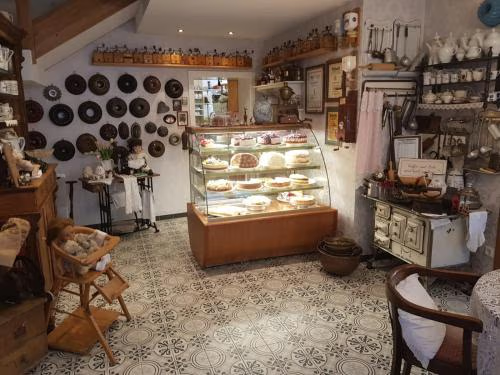
Hotel Klapperburg
 OpenReservations accepted
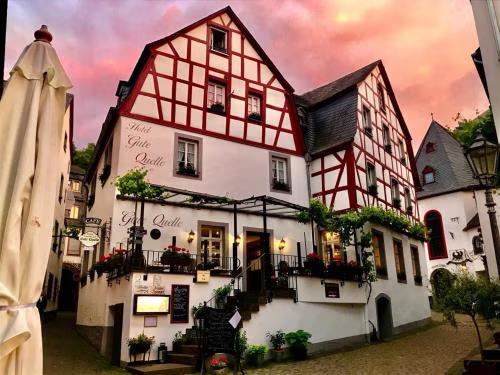
Hotel Gute Quelle
 OpenReservations accepted
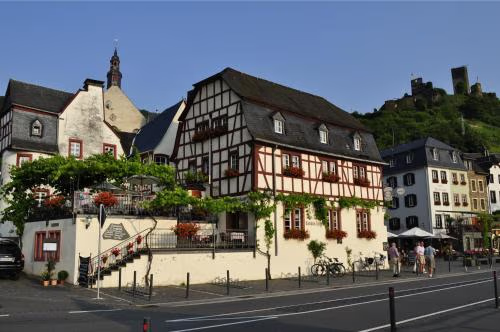
Altes Zollhaus
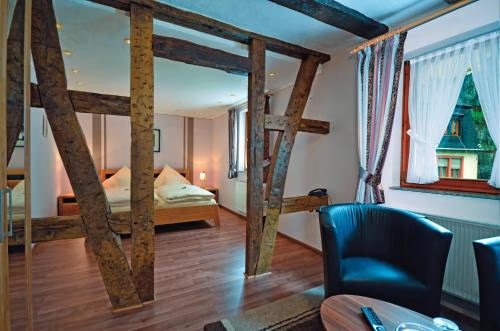



Services in Beilstein
What you can find in town before the next stage.
- Café
- Shop
- Fountain
- Train station
- Bus station
- Restaurant
Source: © OpenStreetMap contributors · updated April 2026