

Senda Litoral
The Senda Litoral is the Camino from Porto that stays closest to the sea: from the cathedral it runs down the Douro to the Atlantic and then follows the coast on boardwalks, promenades and beach paths all the way to Caminha. There you cross the Miño by boat into Galicia and walk the rugged coastline via Oia, Baiona and Vigo to Redondela, where the Senda merges into the Camino Portugués Central. On the Camino Ninja map it measures 283.5 kilometers to Santiago in 13 stages, with 2,011 meters of ascent—and its highest point, of all places, right at the finish.
- 01At a Glance
- 02Overview
- 03Other Names
- 04Who It's Ideal For—and Who It's Not So Ideal For
- 05Route & Landscape
- 06Stages, Terrain, and Difficulty
- 07Everything Arrives by Sea Here—Even the Christ of Matosinhos
- 08Highlights Along the Way
- 09Boardwalks and Siza: What the Coast Has Built
- 10How Pilgrims Find Their Way onto This Path
- 11The Variante Espiritual
- 12Preparation & Practical Information
- 13What the journey will cost you
- 14Getting Here
At a Glance
- Start / Finish: Sé Cathedral in Porto / Cathedral of Santiago de Compostela; the Senda as a route of its own ends in Redondela (km 196.3)
- Length: 283.5 km, of which 113.7 km in Portugal up to Caminha and 82.6 km along the Galician coast to Redondela
- Duration: 13 stages, averaging just under 22 km
- Elevation: ↗ 2,011 m / ↘ 1,816 m
- Highest point: 257 m at km 283.3 – in Santiago de Compostela; in Portugal the route stays below 15 meters almost everywhere
- Landscape: the Douro estuary, beaches and dunes crossed by boardwalks, fishing towns, masseira fields, the rocky coast between A Guarda and Baiona, the Ría de Vigo
- Waymarking: yellow arrows and scallop shells; in Portugal partly local markers, in Galicia the stone markers of the Xunta de Galicia
- Traces of St. James: the Cistercian monastery of Oia on the "ruta monacal", the fishermen's chapels, and in Padrón the pedrón to which the Apostle's boat is said to have been moored
- Accommodation: albergues in every stage town; in Galicia public albergues and plenty of private options; in summer the beach towns get expensive
- Connecting routes: Portuguese Coastal Way (largely parallel from Vila do Conde to Caminha), Camino Portugués Central (shared from Redondela), Variante Espiritual from Pontevedra, Senhora do Norte (ends in Vigo)
- Best time: May to June and September to October; in high summer the beach towns are packed, in winter Atlantic storms and rain
Overview
The name says what the route does. Senda means path, litoral is the seam between land and sea—the Senda Litoral is the shoreline path. Like its siblings it starts at the cathedral in Porto, but instead of heading north into the hinterland it goes down the Douro to Foz do Douro, where the river spills into the Atlantic. From there you have the sea on your left for a good 100 kilometers: on the wooden boardwalks of the passadiços, on promenades, on sand. The highest point of the entire route is Santiago Cathedral, at 257 meters—so you are literally climbing until the very end.
The coast has made this route rich, with stories that all come in from the water: the Christ of Matosinhos, which, legend says, the sea washed ashore in the year 124; the caravel Pinta, which in 1493 reached European soil at Baiona as the first ship carrying the news of America; the monks of Oia, who in 1624 drove off a corsair fleet with their own cannons. And as a pilgrimage route, the Galician half is young: only in 2016 did the Xunta officially recognize the route via A Guarda, Baiona and Vigo; back then about 2,600 pilgrims arrived in Santiago on it, and in 2025 the count was around 90,000. So the Senda is no longer a well-kept secret—but the Atlantic is wide enough for everyone.
Other Names
In Portuguese and Spanish the route is called Senda Litoral, in English the Litoral Way or Coastal Trail; German-speaking pilgrims often just call it the Uferweg ("shore path"). Things get confusing with the word "coastal," because there are three routes out of Porto, and two of them are regularly mixed up:
- Senda Litoral — the shoreline path, from Porto Cathedral along the Douro to the sea and along the beaches, from Caminha by boat into Galicia and along the coast to Redondela – the subject of this page
- Portuguese Coastal Way (Caminho Português da Costa) — first through the hinterland past the airport, from Vila do Conde right next to the Senda, from Caminha along the Minho to Tui
- Camino Portugués Central — the historic main route inland via Barcelos and Ponte de Lima
In Galicia a third reading comes into play: what the Xunta and the Pilgrim's Office in Santiago list as the Camino Portugués de la Costa (Galician: Camiño Portugués pola Costa) is, between A Guarda and Redondela, exactly the route on this page.
Who It's Ideal For—and Who It's Not So Ideal For
Ideal if you want the sea beside you all day: surf, wind, fishing boats, and in the evening the sun going down over the water. Ideal for a first Camino, because the elevation profile is flat as far as Caminha, the towns are close together and you'll find a bed every night.
Honestly, though, it's not for you if you're looking for silence and forest: between Porto and Póvoa de Varzim you walk through suburbs, along promenades and past beach bars, and in July and August straight through the beach crowds. Not for you if sand and hard boardwalks get to your feet—both are more tiring than a forest trail, and there's hardly any shade on the coast. And not for you if you want to rely on a scheduled ferry: the municipal ferry across the Miño hasn't run since 2020; you cross in small water taxis, and they depend on weather and tides.
Route & Landscape
Porto to Caminha (km 0–113.7): From the cathedral you head through the Ribeira along the Douro to Foz do Douro (km 6.3) and along the coast to Matosinhos (km 11.0). Past Leça da Palmeira, whose center lies a good kilometer inland, the boardwalks begin: via Vila Chã (km 26.6) to Vila do Conde (km 33.9), where the Coastal Way rejoins, and on via Póvoa de Varzim (km 39.6) and Fão (km 57.3) to Esposende (km 60.5). Through the Litoral Norte Natural Park, past Castelo do Neiva, a good kilometer off the route, you reach Viana do Castelo (km 86.3) at the mouth of the Lima. After that the mountains crowd toward the coast: via Afife and Âncora (km 103.5) to Caminha (km 113.7) at the mouth of the Miño.
Caminha to Santiago (km 113.7–283.5): A boat takes you across to A Pasaxe (km 116.3) in Galicia. The Senda leaves the center of A Guarda just under a kilometer to the right and follows the rugged rocky coast via Portecelo (km 130.1) to Oia (km 136.0) with its monastery by the water. Over the high ground near Cabo Silleiro (about 100 m) you come to Baiona (km 154.0), then via A Ramallosa (km 158.1) and Panxón to Vigo (km 180.1). Beyond Vigo the route climbs onto the slope above the ría toward Teis and Chapela, about 160 meters, and drops down to Redondela (km 196.3). From here on you're on the Camino Portugués Central via Pontevedra (km 218.4), Caldas de Reis (km 239.9) and Padrón (km 258.6) to Santiago de Compostela.
Stages, Terrain, and Difficulty
We show the route in 13 stages. Kilometers from the Camino Ninja map, calibrated exactly to 283.5 km; the crossing of the Miño is included in stage 6. The town point of Labruge lies just under a kilometer inland; the alternative is Vila Chã (km 26.6).
- Porto → Labruge (24.3 km) — along the Douro to the sea, Matosinhos, Leça, the first boardwalks.
- Labruge → Póvoa de Varzim (15.3 km) — Vila Chã, Vila do Conde with its aqueduct and the Santa Clara convent.
- Póvoa de Varzim → Esposende (20.9 km) — Aguçadoura, the windmills near Apúlia, Fão and the mouth of the Cávado.
- Esposende → Viana do Castelo (25.8 km) — Litoral Norte Natural Park, pine forest, arrival at the mouth of the Lima.
- Viana do Castelo → Caminha (27.4 km) — the longest stage in Portugal, between mountains and sea to the Miño.
- Caminha → Oia (22.3 km) — boat to A Pasaxe, then rocky coast and hardly any villages until the monastery.
- Oia → Baiona (18.0 km) — cliffs, Cabo Silleiro, the bay of Baiona.
- Baiona → Vigo (26.1 km) — A Ramallosa, the beaches of Nigrán, a long walk into the city.
- Vigo → Redondela (16.2 km) — halfway up the slope above the ría, then down beneath the railway viaducts.
- Redondela → Pontevedra (22.1 km) — now on the Central, via Ponte Sampaio.
- Pontevedra → Caldas de Reis (21.5 km) — forest and vine pergolas, or onto the Variante Espiritual.
- Caldas de Reis → Padrón (18.7 km) — hamlets, forest, the Ulla.
- Padrón → Santiago de Compostela (24.9 km) — via O Milladoiro to the highest point of the route: the cathedral.
Technically, nothing is difficult. What wears you out is the surface: boardwalks and cobblestones in Portugal, sand where the route detours onto the beach, and the wind, which nearly always comes from the front or the side. Between A Guarda and Baiona there are long stretches without a bar or a fountain; beyond Vigo come the only climbs worth mentioning.
Everything Arrives by Sea Here—Even the Christ of Matosinhos
On this route, history washes up on the beach. On May 3, 124, so the legend goes, the sea cast a crucifix ashore on the beach of Espinheiro near Matosinhos, said to have been carved by Nicodemus himself—missing one arm. Fifty years later a deaf-mute girl recognized a piece of driftwood as the missing arm; it fit, and she could hear. Art historians date the figure later, and a charter first mentions it in 1342. The Senhor de Matosinhos is still celebrated today on the Tuesday after Pentecost. At the end of the route its Galician counterpart is waiting: the Apostle, too, is said to have arrived by boat, at Padrón.
Then the news from the New World. Around March 1, 1493, the Pinta under Martín Alonso Pinzón sailed into the harbor of Baiona, the first ship of the Columbus expedition back on the Iberian Peninsula—Columbus himself, aboard the Niña, only reached Lisbon and Palos days later. A replica lies in the harbor, and in early March Baiona celebrates the Festa da Arribada.
And finally the monks who fired back. The monastery of Santa María de Oia, begun in the 1140s under Alfonso VII and joined to the Cistercians in 1185, is the only major monastery in Galicia right on the sea—and was armed for that very reason. On April 20, 1624, five corsair ships were chasing two Portuguese ships and a French one off the coast, and the monks opened fire with their guns from the wall. A contemporary print from the same year reports the "Vitoria que los monges del monasterio de Nuestra Señora de Oya de la Orden del Císter, tuvieron contra cinco Navíos de Turcos" (the victory the Cistercian monks of Our Lady of Oya won against five Turkish ships); the cannon was aimed by Fray Pablo de Lezcano, a monk who had once been a soldier. Philip IV rewarded the monastery with the title "Real." After secularization in 1835 it fell into decay in private hands; from 1910 to 1932 Jesuits expelled from Portugal ran a school here, and since 2019 it has been open to visitors again. Honestly, that's the best punchline of the whole route: the only monks on the Camino ever to win a naval battle sit on its quietest stretch.
Highlights Along the Way
- Matosinhos (km 11.0) — fishing harbor, grill restaurants and the church of the Senhor de Matosinhos.
- Vila do Conde (km 33.9) — the Poor Clares' convent of Santa Clara, founded in 1318, above the mouth of the Ave.
- Viana do Castelo (km 86.3) — old town at the mouth of the Lima and Monte de Santa Luzia.
- Baiona (km 154.0) — the Monterreal fortress on its peninsula and the replica of the Pinta in the harbor.
- Vigo and the Cíes Islands — boats leave the harbor for the islands of the Illas Atlánticas National Park; in 2007 the Guardian named Praia de Rodas the most beautiful beach in the world. Visitor numbers are capped, so book early in summer.
- Pontevedra (km 218.4) — a car-free old town and the Peregrina church of 1778, built on the floor plan of a scallop shell.
- Padrón (km 258.6) — the pedrón to which the Apostle's boat is said to have been moored; from here the Camino A Orixe leads to the places where the legend began.
Boardwalks and Siza: What the Coast Has Built
The Senda's trademark are the passadiços, wooden boardwalks that carry you over the dunes. They are at their most impressive in the Litoral Norte Natural Park near Esposende. Near Apúlia the old windmills that once ground grain with the sea wind stand on the dunes, and behind them lie the masseiras: rectangular gardens that farmers dug into the sand as wind-sheltered hollows, with vines on the edges and vegetables in the middle.
Barely out of Porto, the route turns into an architecture trail. In Leça da Palmeira stand the Casa de Chá da Boa Nova tea house, completed in 1963, and the seawater pools of the Piscina das Marés, opened in 1966—both by Álvaro Siza, who received the Pritzker Prize in 1992, both built into the rocks, both national monuments since 2011. In Vila do Conde Baroque engineering keeps you company: from 1714 the aqueduct carried water from Terroso to the Santa Clara convent; built from 1705 over about five kilometers with originally 999 arches, it's the second-longest in Portugal. In Viana do Castelo the country's longest funicular, 650 meters, has been hauling people since 1923 up the hill to the Santa Luzia basilica, begun in 1904.
How Pilgrims Find Their Way onto This Path
Almost everyone starts at Porto Cathedral or right at the airport. From the cathedral, the Senda is the only one of the three routes that goes down the Douro to the sea. From the airport arrivals hall you follow the arrows 6.5 kilometers to the coast and join at Matosinhos or Vila Chã.
Along the way, several routes cross or touch the Senda:
- Portuguese Coastal Way — meets the Senda in Vila do Conde (km 33.9) and runs right alongside it to Caminha; you can switch at any point
- Ave Trail and Aqueduct Trail — links from Azurara and Vila do Conde over to the Central
- Lima Trail — from Viana do Castelo along the river to Ponte de Lima
- Senhora do Norte — from Vila Nova de Cerveira over the mountains, ends in Vigo
- Porto – Braga — also starts in Porto
Officially, the Senda Litoral merges into the Camino Portugués Central in Redondela. For clarity's sake we present it as one complete route to Santiago, because pilgrims simply don't notice the transition along the way; the Camino Ninja planner combines the two automatically, just like the arrows on the ground. The route ends in Santiago; if you're not ready to stop, head back to the sea on the Camiño a Fisterra or the Camiño a Muxía.
The Variante Espiritual
From Pontevedra there's a special option: the Variante Espiritual, an alternative route that follows the legendary sea route of the Apostle James. Instead of heading straight north, it first goes west via Combarro and the monastery of Armenteira into the Salnés wine country to Vilanova de Arousa – and from there a boat takes you across the Ría de Arousa and up the Río Ulla to Pontecesures near Padrón, where the route rejoins the Central. This waterway is said to be the route by which the Apostle's body was once brought to Galicia by ship.
Don't let the numbers fool you: its 79.9 kilometers compare with about 40 direct kilometers between Pontevedra and Padrón – but a good 30 of them you cover by boat. On foot you walk only about 49 kilometers, barely 10 more than on the direct route, and need at most one extra day. Nobody picks it for the kilometers anyway, but for the connection to the legend.
Preparation & Practical Information
Pilgrim passport and app. As on all Portuguese and Spanish Caminos, you need a pilgrim passport (credencial) to stay in the albergues and to receive the Compostela at the end. It's best to order it online in advance so it reaches you in time for the start of your trip. Vigo lies a good 103 kilometers before Santiago; from there you need two stamps a day. Stage planning, including combinations with the Coastal Way or the Central, is easiest right in the Camino Ninja App, where you put your stages together and plan suitable accommodation at the same time.
The crossing into Galicia. The municipal ferry Santa Rita de Cássia, which shuttled between Caminha and A Guarda from 1995, has been out of service since 2020, first because of the border closure, then because of the pier and silting. Caminha announced a new, shallow-draft boat for summer 2026; as of mid-August 2026 none had been bought. Until then, small water taxis take you across in about ten minutes, depending on weather and water level—ask the day before. If nothing is running, take the train to Valença and walk across the bridge to Tui.
Season and gear. The route is at its best in May, June, September and October. In July and August the beach towns are crowded and expensive. Pack sun protection and a windproof jacket, even in summer.
What the journey will cost you
In Portugal, pilgrim albergues usually cost 8 to 15 €, private albergues 15 to 30 €; in Galicia the public albergues cost 10 € and private ones 15 to 25 € (as of October 2026). The water taxi across the Miño costs 6 to 9 € per person, one euro more with a bike. A pilgrim menu costs 8 to 14 €.
Budget 35 to 55 € a day; in Porto, Baiona and Vigo rooms cost considerably more in summer. On stages 6 and 7 between A Guarda and Baiona there are long stretches with nowhere to stop for food—take water and something to eat.
Getting Here
There and back. Porto has direct flights from Germany, Austria and Switzerland. From the airport, Metro line E gets you downtown in about 30 minutes; if you want to set off straight away, follow the arrows 6.5 kilometers on foot to the coast, about two hours. Trains run to Porto Campanhã. Heading home: from Praza de Galicia in Santiago, the Empresa Freire bus takes you to the airport in about 30 minutes for around 3 € (as of October 2026); from there you'll find direct flights to the German-speaking countries.
- Metro Porto: metrodoporto.pt — line E from the airport downtown
- Rail Portugal: cp.pt — Porto Campanhã, regional train Caminha–Valença
- Water taxi across the Miño: xacobeotransfer.com — one of the operators, schedule and booking
- Rail Spain: renfe.com — Santiago, Vigo and Pontevedra
Partners
Partner for Senda Litoral
Camino Ninja is cooperating with official partners. For this camino the partner is:


Get your pilgrim credential and shell
Everything you need for the Senda Litoral, shipped to your door.
Visit Camino Shop
Other Caminos
 Appenzeller Weg
Appenzeller Weg
52.6 km from Rankweil across the Rhine to St. Peterzell: St. James Chapel (1464), 163 Years of the Wedding Trail, connection to the Via Jacobi. Stages, costs, how to get there.
Read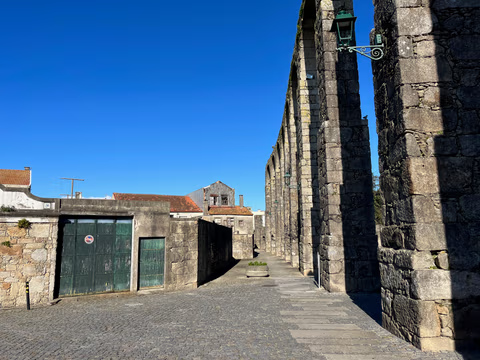
Aqueduct Trail – A path running along the Vila do Conde Aqueduct
From the Coastal Trail to the Camino Central: 12.9 km along the aqueduct from Vila do Conde to São Pedro de Rates. Route, stage, hostels, costs—explained honestly.
Read
Augsburg Way of St. James
The Augsburg Way of St. James runs 231.7 km in 11 stages from Oettingen in the Ries via Donauwörth, Augsburg, Bad Wörishofen and Ottobeuren to Ermengerst in the Allgäu — the Fuggerei, the Jakobervorstadt, a pilgrim of 1446 and Mozart's organ duel. Stages, hostels, costs.
Read

