

Town on the Camino
Trier
Germany
- places to stay
- 46
- Caminos
- 4
- Elevation
- 131 m
Trier is a gateway: four Caminos end here, and at the same church door of St. Matthias, the only apostle's tomb north of the Alps, the routes to Le Puy and Vézelay begin. The cathedral keeps the Holy Robe, and the Porta Nigra has stood since the year 170. Stay at least two nights.
Right now in Trier (as of October 2026)
- Römerbrücke: Since 5 October the footpath and cycle path on the south side have been closed for a longer period, and pedestrians are sent to the other side. The city is preparing the bridge's renovation.
- Trier-Pallien: Bonner Straße has been fully closed since 2 October, probably until the end of March 2027. In early October the steps and lift up to the Kaiser-Wilhelm-Brücke could not yet be used, and a signposted footpath leads through the building site. This is where the Mosel-Camino crosses the Moselle.
- Porta Nigra: The gate is being restored, probably until 2028. In October it is open from 9:00 to 17:00, from November to February until 16:00.
How long to stay?
Stay longer: at least two nights. The routes end at the Abbey of St. Matthias in the south of the city, and if you arrive there in the afternoon you will have little energy left for anything else. Eight structures in Trier are World Heritage sites, and on top of that come the apostle's tomb, the cathedral with the Holy Robe and the Liebfrauenkirche, one of the oldest Gothic churches in Germany. If you are walking on to France, use the extra day for the World Heritage kilometre and your pilgrim passport. The Rheinisches Landesmuseum is closed on Mondays.
Trier in Ninja numbers
- 886 kilometres separate the Abbey of St. Matthias from Le Puy-en-Velay, according to Camino Ninja. And that is only where the Via Podiensis begins.
- Around 180 pilgrimages reach the tomb of the apostle Matthias every year, many on foot, lasting four to nine days (as of October 2026). Some of the confraternities are 800 years old.
- 11,154 pilgrims were counted by Trier's gatekeepers in a single Whitsun week in 1779.
- Around one million people came in seven weeks in 1844 to see the Holy Robe. Other sources speak of half a million in 50 days.
- 7,200 stone blocks make up the Porta Nigra, the largest weighing up to six tonnes.
Arriving: through the Moselle valley to the apostle's tomb
On the Mosel-Camino, the last day from Schweich is longer and steeper than you expect: 20.7 kilometres to St. Matthias, according to Camino Ninja. You walk through woods to Trier-Quint, across the Ehranger Heide to Biewer, then over the Kaiser-Wilhelm-Brücke and past the Alter Kran and the Römerbrücke to the abbey. From Klausen onwards the Eifel-Camino shares this stretch, coming in via Ehrang and Trier-Pallien.
On the Via Coloniensis you come from Welschbillig via Möhn, Butzweiler and Lorich up onto the heights above the Moselle and then descend into the Roman city. The Hunsrücker Jakobsweg from Bingen also ends in Trier.
In brief: city of emperors, city of bishops
The Romans founded Augusta Treverorum by 16 BC at the latest. From 293 emperors resided here, Constantine the Great had the palace hall built, and in the fourth century Trier was the largest city north of the Alps. A bishop of Trier is documented as early as 314, and the diocese is considered the oldest in Germany. Later its archbishops were Electors of the Empire.
In 1127 monks found bones that were held to be those of the apostle Matthias, setting off a pilgrimage that continues to this day. In 1196 the Holy Robe is recorded in the cathedral for the first time. The French came in 1794, the Prussians in 1815. In the Second World War 1,600 houses were completely destroyed.
A gateway to the west
For pilgrims on the way to Santiago, Trier was never the goal but the gateway. Four waymarked routes arrive here: the Mosel-Camino, the Eifel-Camino, the Via Coloniensis and the Hunsrücker Jakobsweg. And at the abbey church of St. Matthias, where they end, the Camino Trier – Le Puy and the route Trier – Vézelay begin. You do not change places, only signs.
That people from Trier walked to Santiago is documented. In 1239 Pope Gregory IX placed the Hospital of St. Jakob under his protection. It existed, in the words of the source, „um arme und kranke Pilgrime auf ihrer Wallfahrt nach Rom oder San Jago de Compostella zu beherbergen und zu pflegen“, to house and care for poor and sick pilgrims on their way to Rome or Santiago. The St. Jakobusbruderschaft Trier, considered the oldest confraternity of St. James in Germany, was dissolved in 1803 and refounded in 2003. Today it issues pilgrim passports at the Dom-Information.
World Heritage on foot: what to see
From the station to St. Matthias is a good half hour's walk. Take the route via the Porta Nigra, the Hauptmarkt and the cathedral, and you will have done the World Heritage kilometre already.
- Abbey of St. Matthias: In the crypt, in a shrine, lies what has been venerated since 1127 as the tomb of the apostle Matthias, the only apostle with a grave north of the Alps. Next to him rest Eucharius and Valerius, the city's first bishops. Pope Eugene III consecrated the church in 1148, with Bernard of Clairvaux present. You reach the crypt by stairs or by lift. This is where you get your stamp and the pilgrim blessing, and one of the monks is specially appointed as pilgrim chaplain. Around 180 pilgrimages come every year, mostly between May and October.
- The cathedral: the mother church of Germany's oldest diocese. Its core, with four granite columns, was built around 340. Behind the east choir, Baroque pilgrim stairs lead up to the Heiltumskapelle, where the Holy Robe lies, the garment of Christ that, according to tradition, Empress Helena brought to Trier. Constantine and Helena stand by the staircase. The chapel is open only during the Heilig-Rock-Tage, which the diocese celebrates for ten days every year. Entry to the cathedral is free, the treasury charges admission. According to the tourism portal the cathedral is open from April to October 6:30 to 18:00 and from November to March until 17:30, with no sightseeing during services.
- The Liebfrauenkirche: Right next to the cathedral and joined to it by a shared porch. Archbishop Theoderich von Wied began building it around 1230 with masters from Champagne and the Île-de-France. Together with the Elisabethkirche in Marburg it is considered the oldest Gothic church in Germany. Twelve columns carry this centrally planned church, standing for the twelve apostles. At the west portal stand Ecclesia with cross and chalice and, opposite her, Synagoga with her eyes bound.
- The Porta Nigra: Begun around 170, never finished, and the best-preserved Roman city gate in Germany. After 1028 the monk Simeon settled here as a hermit, after spending seven years guiding pilgrims in Jerusalem. After his death in 1035 the gate became a double church, and only Napoleon had it taken back in 1804. Open in October 9:00 to 17:00, from November to February 9:00 to 16:00, adults €6 (as of October 2026).
- The Konstantinbasilika: The palace hall was built around 305 to 311 as the great hall of the imperial residence and is considered the largest surviving hall of antiquity. Since 1856 it has been a Protestant church. It burned out in 1944, and inside you now see the bare brick walls.
- Hauptmarkt and Steipe: On the citizens' festival hall of around 1430 stand four patron saints of the city, St. James on the far left, then Helena, Peter and Paul. The Steipe burned out on 21 December 1944 and was rebuilt true to the original by 1970.
- The old Hospital of St. James: The building of the Hospital of St. Jakob in Fleischstraße still stands and now houses an art gallery. You can no longer sleep there, but for centuries people in Trier cared for pilgrims to Santiago in this place.
- The Kaiserthermen: Begun after 294 and never put into use as baths. Same opening hours and prices as the Porta Nigra. With the AntikenCard Basic for €18 you see two Roman sites and the Landesmuseum (as of October 2026).
Food and drink
We have not found reliable pilgrim tips for restaurants in Trier, and we don't advertise. Trier is a wine town: the Vereinigte Hospitien, a foundation set up in 1804 that merged Trier's hospitals, also funded its social work with winemaking. Its wine cellar rests on Roman foundations.
Honestly
- There is no pilgrim albergue in the Spanish sense. In Trier you pay more like €70 to €110 for a guesthouse or inn (as of October 2026). Book ahead, and ask the pilgrim office about private rooms.
- Your goal is on the edge of town. St. Matthias lies two kilometres south of the cathedral, a good half hour's walk from the station. Save the World Heritage kilometre for the next day, not for the day you arrive.
- You will very probably not see the Holy Robe. The Heiltumskapelle is locked outside the Heilig-Rock-Tage, and nobody knows when the robe will next be shown.
- Even the abbey doubts that Matthias lies in the shrine. It writes itself that historical research disputes the presence of relics of Matthias in Trier. That has never harmed the pilgrimage.
- There is building work along the Moselle. The Römerbrücke and Pallien have roadworks, so allow a few extra minutes for detours (see the box above).
Where pilgrims sleep
Trier has no pilgrim albergue, but a few places take in pilgrims:
- Abtei St. Matthias: The app lists the abbey as pilgrim accommodation. We found nothing about this on its website, only the guesthouse with retreat weekends, and the abbey writes that the vast majority of pilgrims stay in guesthouses and hotels. Ask the guest reception beforehand, phone 0651 1709-0.
- Jugendherberge Trier: with dormitories. You need a DJH youth hostel membership.
- Gästeappartement Vereinigte Hospitien: a small apartment on the Krahnenufer, run by the foundation that has carried on Trier's old hospitals since 1804.
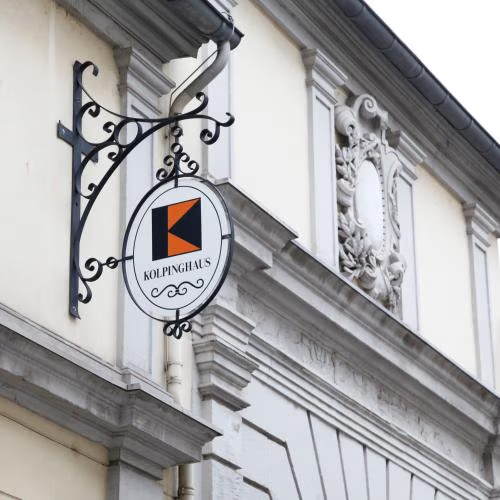
There is also a Kolping hostel in Trier and several church guesthouses. The pilgrim office at the Dom-Information arranges private rooms, but without guarantee.
Ninja tips
- Find St. James on the Hauptmarkt: On the Steipe he stands on the far left among the four patron saints. If you are walking on to France, this is your starting photo.
- Climb the pilgrim stairs in the cathedral: Even when the Heiltumskapelle is closed, at the foot of the stairs you stand before Constantine and Helena, the two with whom almost every story in Trier begins.
- Watch an arrival: Between May and October, especially in the weeks around Whitsun, the Matthias confraternities arrive. The pilgrims from Dedenbach in the Eifel, for instance, enter the church to the ringing of bells and the hymn „Großer Gott, wir loben dich“. Many groups then walk all the way home again.
- Take the lift to the crypt: If you can't face another staircase after the last stage, take the lift down to the tomb.
- Stamps for the last 100 kilometres: For the Trier pilgrim certificate you need stamps covering the last 100 kilometres. On the Mosel-Camino, starting in Traben-Trarbach or Monzel is enough.
- AntikenCard instead of single tickets: The Basic card for €18 gets you into two Roman sites and the Landesmuseum and is valid for a calendar year (as of October 2026).
Practical tips for pilgrims
- Pilgrim passport and pilgrim office: The St. Jakobusbruderschaft Trier issues pilgrim passports at the Dom-Information, Liebfrauenstraße 12, phone 0651 979079-0, or by post. We could not find opening hours.
- Stamp and pilgrim blessing: at the Abbey of St. Matthias, at the apostle's tomb.
- Pilgrim certificate: You get the Trier pilgrim certificate with stamps from the last 100 kilometres. Ask at the abbey or the pilgrim office where it is currently issued.
- Feast of St. Matthias: On 24 February the abbey celebrates its patron.
- Monday: The Rheinisches Landesmuseum is closed on Mondays, otherwise open Tuesday to Sunday 10:00 to 17:00.
- Getting there and away: Trier Hauptbahnhof has connections to Koblenz, Cologne, Saarbrücken and Luxembourg, which is a good 50 minutes away. The Deutschlandticket for €63 a month is valid on regional trains (as of October 2026). The nearest international airport is Luxembourg-Findel.
Onward: to France
Both routes west begin at the abbey church of St. Matthias and follow the Moselle upstream. It is 7.1 kilometres to Konz according to Camino Ninja, then you climb into the Saargau. On the Camino Trier – Le Puy you reach Mannebach after 18 kilometres and Merzkirchen after 26 kilometres. After two days Germany ends near Perl, and the route continues via Sierck-les-Bains to Metz.
The route Trier – Vézelay takes the same line: 26.2 kilometres to Merzkirchen and 45.3 kilometres to Perl, according to Camino Ninja. The two routes share a long first stretch through Lorraine before one turns off to Vézelay and the other heads via Cluny to Le Puy. According to Camino Ninja it is 507.5 kilometres to Vézelay.
Deep dive: An apostle, a robe and a monk in the city gate
A long read, in case you want to learn more about Trier. About thirty minutes' reading.
At the tomb of the replacement
If you reach Trier on the Mosel-Camino, the Eifel-Camino or the Via Coloniensis, you have followed a scallop shell for days. At the end you do not stand before a tomb of St. James, but in the south of the city before a Romanesque basilica, and down in its crypt, in a shrine, lies what has been venerated for almost nine hundred years as the tomb of the apostle Matthias. It is the only apostle's tomb north of the Alps.
Matthias is a special apostle. He was not one of the Twelve whom Jesus called. After Judas's betrayal the remaining Eleven had to choose a replacement, and they did it by drawing lots. The Acts of the Apostles says it briefly: et cecidit sors super Matthiam, and the lot fell upon Matthias. So you walk a Camino of St. James and arrive at the replacement.
The people who have made pilgrimages to him for centuries have never seen this as a detour. Around 180 pilgrimages come to Sankt Matthias every year, many on foot, lasting four to nine days. Some of their confraternities are 200, 500 or even 800 years old. And at the same church door where the German routes end, two others begin their way to France. For pilgrims to Santiago, Trier has always been not a goal but a gateway.
This text tells why this city on the Moselle of all places draws so many routes. It tells of emperors and an empress, leads through the graves of the first bishops, the crypt of Sankt Matthias and the cathedral with its Holy Robe, and tells of a monk who had himself shut away in a Roman city gate after spending half his life guiding pilgrims.
A city of Augustus
Before the Romans came, the Treveri lived here, a Celtic tribe. Julius Caesar subdued them between 58 and 50 before Christ. Around 30 before Christ the Romans set up a military camp on the Petrisberg above the Moselle valley, which they abandoned again after a few months. And around 18 or 17 before Christ, or at the latest 16 before Christ, they founded a city down by the river: Augusta Treverorum, the city of Augustus in the land of the Treveri. From the late antique form Treveris came, later, the name Trier.
The Roman structure you are most likely to use is the bridge. The first bridge over the Moselle was made of wood and, judging by the dating of its piles, was built right in the years of the founding. The stone piers you walk across today were set by the Romans between 144 and 155. Its roadway stayed wooden until Archbishop Balduin of Luxembourg had it vaulted in 1343. If you arrive on the Mosel-Camino, you walk along this bridge.
The people of Trier themselves were never quite satisfied with this founding. In the early twelfth century monks wrote down a much older story in the Gesta Treverorum, the chronicle of the city. According to it, Trebeta, a son of the Assyrian king Ninus, founded Trier 1300 years before Rome. On the Rotes Haus on the Hauptmarkt this claim has stood in an inscription since 1684: Ante Romam Treviris stetit annis mille trecentis, Trier stood thirteen hundred years before Rome. It is a legend, and a beautiful one. It shows how early this city knew it was something special.
Towards the end of the second century a wall 6,418 metres long enclosed an area of 285 hectares. The amphitheatre on the hillside held up to 18,000 people, and the northern gate of this wall still stands today. We will come back to it.
The Rome of the north
Trier grew great through its emperors. From 271 to 274 it was a capital of the Gallic Empire, which had briefly broken away from the rest of the Roman world. Then Emperor Diocletian divided power among four rulers, and in 293 Constantius Chlorus chose Trier as his residence. He set up a mint that became the most important in the western half of the empire. From 293 to 395 Trier was again and again the seat of the Western Roman emperors.
His son is the man whose name you meet on every corner in Trier: Constantine the Great. Between 306 and 324 he stayed in the city time and again and built it up as a residence modelled on the Palatine in Rome. He had his father deified. For himself he had the palace hall built, the hall now called the Konstantinbasilika, constructed around 305 to 311. It is almost 70 metres long, over 26 metres wide and around 30 metres high, without a single column inside, with underfloor heating beneath the marble. It is considered the largest surviving hall of antiquity.
The Kaiserthermen, the imperial baths, were also begun in these years, after 294. They were never put into use as baths. When the court moved east, work probably stopped, and later the complex was rebuilt to a different plan. Constantine himself left Trier and handed the city over to his son Crispus.
Beneath the cathedral, archaeologists have found an elegant Roman house with a state room full of wall and ceiling paintings. It is believed that these paintings belonged to rooms of the young empress Fausta, Constantine's wife, whom he later had killed. That is not certain. What is certain is that in the early fourth century the houses were torn down and churches were built in their place. In 326 parts of the palace were converted into a double basilica, whose remains are now within the cathedral and the Liebfrauenkirche. The city of emperors became the city of bishops, and on exactly the same spot.
Largest city north of the Alps
Nobody knows exactly how many people lived in Trier at that time, and it is worth being honest about it. Some estimates speak of up to 40,000 inhabitants, others of 80,000. Others again think more than 30,000 could hardly have been fed. All agree on one point: in the fourth century Trier was the largest city north of the Alps.
And it was a city of minds. Around 317 Lactantius taught here at the imperial court. From 367 to 388 the poet Ausonius worked in Trier as a tutor at court and wrote the Mosella, a long poem in praise of the river you have just been walking beside. Around 370 the young Jerome came here to study. Around 340 Ambrose was born in Trier, who later became Bishop of Milan and is regarded as the most important son of the late antique city. And in 336 Constantine sent an inconvenient bishop from Alexandria into exile in Trier, Athanasius.
From 367 to 375 Valentinian the First made the city an imperial residence once more, his son Gratian followed him and was murdered in 383. Then a usurper ruled from Trier, Magnus Maximus, and under him something happened that reaches all the way to Santiago.
A verdict that reaches all the way to Santiago
Priscillian was an educated man from the north-west of Hispania, perhaps from Gallaecia, today's Galicia. Around 370 he began an ascetic movement, and in 380 he became Bishop of Ávila. His opponents among the Spanish bishops accused him of spreading false teachings, and they carried the dispute all the way to the emperor. After a synod in Bordeaux the case went before the secular court in Trier. The chief accuser was called Ithacius. The charge was no longer only heresy but sorcery, and that carried the death penalty.
One man tried to prevent it: Martin of Tours. He had obtained the emperor's promise that no one would be put to death. In 385 Priscillian and five of his companions were nevertheless executed by the sword. Priscillian is regarded as the first Christian killed by other Christians for heresy. Afterwards Martin broke off communion with the bishops involved. Pope Siricius rebuked Ithacius and the emperor, and Ambrose, the son of this city, wanted nothing to do with bishops who had sent heretics to their death.
Priscillian's remains were taken from Trier to Hispania and venerated as those of a martyr, especially in Galicia. And here begins a question you can take with you if you walk to Santiago. In the ninth century a tomb was found in Galicia that came to be venerated as the tomb of the apostle James. The English church historian Henry Chadwick suggested that Priscillian might in truth lie there. It cannot be proved, nor disproved. But it is a strange thought: the route that begins in Trier might end at a grave whose story also began in Trier.
Graves outside the city
According to tradition, the first bishops of Trier were called Eucharius, Valerius and Maternus. They probably served in the second half of the third century. The first bishop known for certain is Agritius: he took part in the Synod of Arles in 314. That makes Trier the oldest proven bishop's see on German soil, and the diocese is regarded as the oldest Catholic local church in Germany.
The Romans buried their dead outside the city, along the roads leading out of it. In the south a large burial ground stretched along today's Matthiasstraße, and Christians liked to lay their dead near their bishops. Around these graves the great churches outside the walls grew up, Sankt Maximin, Sankt Paulin and Sankt Eucharius. In the fifth century Bishop Cyrillus had a burial place built over the graves of Eucharius and Valerius. From it grew a monastery that adopted the Rule of Saint Benedict around 977.
For centuries it was named after Eucharius. His remains and those of Valerius still lie in the crypt. When you stand down there, you are standing at the graves of the men with whom Christianity began in this land. Only a discovery in the twelfth century gave the abbey its present name.
How the apostle came to Trier
The legend tells it like this: Matthias died around the year 63 at an unknown place. More than 250 years later Empress Helena, the mother of Constantine, had his remains sought out in Palestine and brought to Trier. The same Helena is said to have found the Cross of Christ, and the same Helena is said to have sent the Holy Robe to Trier. In Trier almost every story begins with Constantine and Helena.
Around 1050 Archbishop Eberhard heard in Rome that Helena had brought the apostle to Trier. He had a search made, and in 1053 monks in the monastery of Eucharius found relics. But the real discovery came in 1127. During demolition work on the old church, monks came upon human bones that were held to be those of the apostle. What happened next the sources describe as an immediate stream of pilgrims from all over Germany.
On 13 January 1148 Pope Eugene the Third consecrated the new church, in the presence of numerous cardinals and of Bernard of Clairvaux, the most famous preacher of his century. A pope and Bernard together in a church on the Moselle: that shows what this discovery meant. From then on the monastery was named after Matthias.
The apostle's head travelled a long road of its own. A knight is said to have brought it back from the crusades, and around 1220 a hexagonal chapel modelled on the Church of the Holy Sepulchre in Jerusalem was built above Kobern on the Moselle to house it. In 1347 the head came to Sayn Castle, in 1381 to the Ehrenbreitstein above Koblenz, around 1420 to Trier Cathedral, and since 1927 it has rested in Sankt Matthias. If you have walked the Mosel-Camino, you have roughly followed this route, in eight days instead of seven centuries.
A basilica that came back
The basilica you are standing in is Romanesque, and it has survived a great deal. In the fifteenth century Abbot Johannes Rode, a former Carthusian, renewed the monastery spiritually and economically, and in 1458 it joined the Bursfelde reform movement. Of the great cycle of choir windows that Wilhelm von der Eifel created between 1510 and 1514, only the Crucifixion group at the top of the middle window has survived.
Then came the decline. In 1783 the last abbot was deposed. In 1794 the French occupied Trier, and in 1802 the monastery was, in the words of the time, placed in the hands of the nation and dissolved. That the buildings were not torn down is thanks to a merchant, Christoph Philipp Nell, who bought the cloister and the adjoining houses. The church remained a parish church, and from 1802 to 1922 the parish priests looked after the pilgrims, who kept coming regardless.
On 22 October 1922 monks moved in again, Benedictines from Seckau Abbey in Styria. In 1920 Pope Benedict the Fifteenth had raised the church to the rank of basilica. In 1941 the National Socialist government dissolved the community, the monks went to Maria Laach, and two of them, Father Marus and Father Martin, were deported to Dachau. Both returned after the war. Today the community is small. In July 2021 it had seventeen monks, eleven in Trier and six at the Huysburg in Saxony-Anhalt, with which Sankt Matthias is linked. One of the brothers is specially appointed as pilgrim chaplain.
Most recently the basilica was redesigned. The crypt was extended by two bays to its original length and given a lift. On 10 December 2007 the shrine with the apostle's remains was carried into the crypt, and on 24 February 2008, the feast of Saint Matthias, the new altar was consecrated. If you cannot face another staircase after the last stage, you take the lift down to the apostle. That is a kindness worth mentioning.
In the northern side tower, in the Chapel of the Cross, lies a staurotheca from the thirteenth century, a goldsmith's work holding a relic of the Cross. You see it only on guided tours. And then there is a story you would not expect in a pilgrimage church. On the cemetery wall of the abbey, a figure of Venus hung on a chain from the Middle Ages onwards. She is first mentioned in 1551, the Mattheiser Venus. In 1811 she was handed over to a learned society, and today she stands in the Rheinisches Landesmuseum.
Eight hundred years on foot to Trier
The Matthias pilgrims still come today, and they come in groups. They are called confraternities, and they come from the Eifel, the Middle Rhine and the Lower Rhine, from the dioceses of Cologne and Aachen and from as far as the Dutch border. Most reach Sankt Matthias in the weeks before or after Whitsun, many between May and October. And many then walk the whole way back home again.
Along their routes they have left traces. In the northern Eifel, between Sötenich, Steinfeld and Urft, stands a wooden pilgrim cross of the Matthias confraternity of Kleinenbroich on the Lower Rhine. It bears the year 1757 and a sign of a crossed walking staff and an axe. In Scheuern in the Volcanic Eifel, on an old Roman road from Trier to Cologne, stands a small Matthias chapel from 1695.
The confraternity from Dedenbach in the Eifel is documented from 1762. When it set out, relatives accompanied the pilgrims as far as a wayside cross from 1729 called the Vaterlandskreuz. There they prayed for those staying at home, and the master of the confraternity blessed the village with his pilgrim cross. In Trier the pilgrims entered the church to the ringing of bells, singing Großer Gott, wir loben dich. On their return they were welcomed at the same cross. In 2006 the Dedenbach pilgrims discovered a stone cross from 1792 on the village street of Meuspath. It records that here Matteis Goerges of Dedenbach died as a pilgrim. A man who died on the way, and two hundred years later his successors walk past his cross. The Dedenbach pilgrimage had lapsed. On 11 May 2002 six men set out to revive it.
Some groups are large. The Matthias confraternity from Mayen walks for three days and, with more than 250 participants, is among the largest pilgrimages in Rhineland-Palatinate. Others are small. For May 2026 the Matthias confraternity of Sankt Aposteln in Cologne invited pilgrims on eight days and around 240 kilometres through the Eifel to Trier, for thirty pilgrims at most, because there were no more beds. It describes its route with a sentence every pilgrim will understand: it leads across the Eifel on the most beautiful way, not the quickest.
How many there once were, Trier's gatekeepers counted. In 1779, in a single Whitsun week, 11,154 pilgrims came through the gates. Five years later, on 19 November 1784, Archbishop Clemens Wenzeslaus banned all pilgrimages lasting longer than an hour. With that, the Archbishop of Trier banned the pilgrimage to his own apostle's tomb. The pilgrims came back anyway.
The cathedral: seventeen centuries under one roof
Two kilometres north of Sankt Matthias stands the cathedral, the mother church of Germany's oldest diocese. It is a book in which almost every century has written a page.
The first page is Roman. Between 310 and 320 a first basilica was built here, where the elegant house with the painted hall had stood before. Under Bishop Maximin, who led the church from 329 to 346, it grew into one of the largest church complexes in Europe, with four basilicas and a baptistery. Around 340 the core of today's cathedral was built, a square structure with four mighty granite columns from the Odenwald. In the fifth century the cathedral burned out after the city was captured, and the granite columns collapsed. In the sixth century Bishop Nicetius restored the building with limestone columns. In 882 the Vikings came, took Trier, burned most of its churches and monasteries and so ended the planned Roman city of Trier.
Then the bishops built again, page by page. Bishop Egbert extended the cathedral to the west. From 1037 Archbishop Poppo, whom you will soon get to know better, had the west front built, which is still regarded as a typical example of Salian architecture. On 1 May 1196 Archbishop John the First consecrated the new altar in the enlarged east choir and enclosed the Holy Robe within it. In the thirteenth century the interior received its vaults and galleries. Around 1350 Balduin of Luxembourg had the east towers raised, and after 1512 Richard von Greiffenklau had the south-west tower built up to 76 metres.
On 17 August 1717 the roof truss burned. The master builder Johann Georg Judas remodelled the cathedral from 1719 to 1723. Shortly before, at the beginning of the eighteenth century, the Baroque Heiltumskapelle had been built behind the east choir, with stairs made especially for pilgrims. The sculptor Johann Wolfgang Frölicher created the structure with these pilgrim stairs and the view through to the chapel. He also made a shell-shaped marble basin in the west choir that now serves as the font.
When you are inside, look out for a few things. At the foot of the stairs to the Heiltumskapelle stand Constantine and his mother Helena. The pulpit from the workshop of Hans Ruprecht Hoffmann shows the seven works of mercy, among them the one every pilgrim knows: to shelter the stranger. The cathedral treasury holds a portable altar of Bishop Egbert, one of the most important works of Ottonian goldsmithing, and the cathedral owns one of the holy nails of the Cross. For centuries the cathedral was the burial church of the archbishops. Balduin of Luxembourg lies here in a marble tomb. On the south wall, at the portal to the Liebfrauenkirche, a relief from around 1180 shows Christ between Mary and Peter. And when you look up at the organ, which hangs on the wall like a swallow's nest, look in its base for a small figure: it is the shepherd god Pan with his pipes.
In the Second World War the cathedral was badly damaged, but its vaults held. The restoration lasted until 1 May 1974. It turned out that the oak piles on which parts of the building stood had rotted, and a system of steel had to stabilise the cathedral. It is 112.5 metres long and the largest church building in the city. On the cathedral clock stands a sentence from the Gospel of Matthew that suits a place where you see so many centuries layered on top of each other: nescitis qua hora dominus veniet, you know not at what hour your Lord will come.
The robe without a seam
The Gospel of John says that after the crucifixion the soldiers divided Jesus's clothes among themselves. Only his undergarment, woven in one piece from top to bottom without a seam, they did not want to cut, and they cast lots for it. This garment, according to tradition, was brought to Trier by Helena.
The tradition itself is younger than you might think. It comes from sources of the twelfth century, from a time when Trier was shoring up its claims to power. Around 1140 to 1150 the Kaiserchronik from Regensburg tells that Helena sent the robe to Trier with other relics. Around 1190 it appears in an epic poem, the Orendel. And on 1 May 1196 it is documented for the first time, when Archbishop John the First enclosed it in the new high altar.
There it remained unseen for more than three centuries. In 1512 Emperor Maximilian the First held an imperial diet in Trier and wanted to see the robe. Archbishop Richard von Greiffenklau had the altar opened, and his secretary Peter Maier recorded what happened. After that the citizens also demanded to see the robe. The cathedral chapter had a loggia built on the west apse, and from 30 June it was shown to the people. Until 1517 pilgrims came every year. Pope Leo the Tenth then set a rhythm of every seven years. In that same year of 1517 Martin Luther published his theses, and in 1546 he wrote of the pilgrimage to Trier as Bescheißerei, a swindle.
From 1628 to 1794 the robe lay, with interruptions, in the fortress of Ehrenbreitstein above Koblenz. In 1810 it came back from exile and was shown for 18 days, and more than 220,000 pilgrims came. And then came 1844. In seven weeks more than a million people are said to have made the pilgrimage to Trier, according to other figures half a million in 50 days. Eighteen miraculous healings were reported. A Silesian priest, Johannes Ronge, publicly called it all deception and idolatry. He was excommunicated, and from his protest the German Catholic movement arose.
In 1891 Bishop Michael Felix Korum called a pilgrimage, and almost two million came. In 1933 there were more than two million, a few weeks after the concordat between the Church and the National Socialist state. In 1959 1.8 million came, in 1996 around 700,000 under the motto Mit Jesus Christus auf dem Weg.
The last pilgrimage was in 2012, for the five hundredth anniversary of the first showing. From 13 April to 13 May around 550,000 people came. The motto was Und führe zusammen, was getrennt ist. Bishop Stephan Ackermann did without an indulgence so that Protestant Christians could take part, and the Protestant Church in the Rhineland joined in. Five hundred years after the first showing, Luther's heirs, too, made the pilgrimage to the same robe.
Since 1996 the diocese has celebrated the Heilig-Rock-Tage for ten days every year. The robe is not shown, but the Heiltumskapelle is open. For the rest of the year it is locked. The robe lies in a shrine, in a climate-controlled glass case, because it can no longer be hung up. Nobody knows when it will next be shown. There is speculation about the year 2033.
The question that remains: what lies in the shrines?
Is this the robe Jesus wore? Does the apostle Matthias really lie in the crypt? The honest answer is remarkable, because part of it comes from the guardians themselves.
About the Holy Robe a great deal is now known, and yet not the decisive thing. In 1890 a church commission thought the fabric was linen or cotton. Before the pilgrimage of 1891 the textile was treated with a plant-based glue that turned brown, and that cannot be undone. An examination in 1973 and 1974 could not determine its origin or age. The textile conservator Mechthild Flury-Lemberg found layers of silk satin, tulle and taffeta onto which old fragments have been glued. The core is probably made of wool. How old it is cannot be said precisely.
With Matthias the situation is even clearer. The abbey itself writes that historical research disputes the presence of relics of Matthias in Trier. The Rhineland regional association considers their authenticity unlikely and points out that the discovery of 1127 came at a time when monasteries and dioceses were competing for power and prestige.
And yet: the pilgrimages have never stopped. The confraternities have been walking for centuries, through bans, wars and dissolutions. Perhaps that is because the walking itself can never be forged. What lies in the shrines nobody knows for certain. The four or nine days it took the pilgrims to get there are real.
You may know this question already. The tomb in Santiago, too, has long been argued over, and one of the theories, as you have read, leads back to Trier. If you believe in relics, you find an apostle here. If you don't, you find a city that people have been walking to for nine hundred years because they are looking for something. Either is a reason to arrive here.
Twelve columns beside the cathedral
Next to the cathedral stands a church whose builders came from far away. Around 1230 Archbishop Theoderich von Wied began a new building on the site of the old Constantinian double church, which had become dilapidated after around a thousand years. His master builders and artists came from Champagne and the Île-de-France, where the first great Gothic cathedrals were being built at that time.
By around 1243 half of it was finished, and then the money ran out. A collection was made in the archdiocese of Cologne, and the Archbishop of Cologne, Konrad von Hochstaden, supported it with a letter of indulgence. The charter calls the church the mother church of the ecclesiastical province of Trier. Around 1260 the Liebfrauenkirche was complete. Together with the Elisabethkirche in Marburg it is considered the oldest Gothic church in Germany.
Its ground plan is based on squares, only the choir projects, and eight chapels surround the building. It is carried by twelve columns, and they stand for the twelve apostles. At the west portal Mary sits enthroned, her feet on a dragon. To the left of the portal stands a female figure with cross and chalice, Ecclesia, the Church. Opposite stands Synagoga with her eyes bound, the tablets of the law and a broken sceptre. This juxtaposition of Church and Synagogue belongs to the visual language of the Middle Ages, and it is worth looking at it consciously as well.
In the Second World War the Liebfrauenkirche was badly destroyed. On 8 March 1945 an American military chaplain, Frederick McDonald, collected shards of glass here. Almost sixty years later, in 2003, the artist Peter Eichhorn made them into a glass picture that now hangs in San Francisco. So a piece of this church has itself gone on a journey.
Between the Liebfrauenkirche and the cathedral lies a shared porch, the Paradies. Until the French period many processions passed through it from one church to the other. In 1803 the two churches were separated and the portal to the cathedral was walled up. Only in 1959 was it opened again. Today you can once more walk from one church into the other.
The monk who guided pilgrims
Now to the man who wrote what may be Trier's most beautiful story for pilgrims. His name was Simeon, and he was born in the late tenth century in Syracuse in Sicily, which was then under Arab rule. His father was Greek and had been a soldier in Byzantine service, his mother came from Calabria. At the age of seven his father sent him to Constantinople to learn to read and write Greek.
As a young man Simeon went to Jerusalem, to the Church of the Holy Sepulchre. And then he stayed seven years and did exactly what volunteers do in pilgrim offices today: he guided pilgrims. Later he served a hermit who lived in a tower on the Jordan and learned from him the life of solitude. For two years he lived in a monastery of the Virgin in Bethlehem, then he went to Saint Catherine's Monastery on Mount Sinai and was ordained a deacon there. For two years he lived alone in a cave by the Red Sea, and every Sunday a monk brought him bread.
In 1026 his abbot sent him on a money matter to Rouen, to the Duke of Normandy, Richard the Second. On the Nile pirates attacked his boat, and Simeon saved himself by swimming. When he finally reached Rouen, the duke was dead. On the way back he joined a group of around 700 pilgrims in Antioch, among them Abbot Eberwin of Tholey. In Belgrade Hungarian officials blocked the way, and the group had to return via Rome. Simeon visited Eberwin in Tholey and so came to Trier.
There he met Archbishop Poppo, a Babenberg, Archbishop of Trier since 1016. Poppo invited him to make a pilgrimage to the Holy Land with him. From 1028 to 1030 the two were on the road, to Jerusalem and back to Trier. An archbishop went on pilgrimage with a monk who had spent seven years guiding pilgrims in Jerusalem.
Shut away in the Black Gate
Back in Trier, Simeon no longer wanted to travel on. He wanted to be enclosed, and Poppo gave him a place for it that could hardly be stranger: the old Roman north gate of the city.
Even then the gate was almost nine hundred years old. The Romans had begun it around 170, which was only established precisely in 2018 from timber remains in the city wall, whose trees had been felled in 169 or 170. Around 7,200 blocks of sandstone from Kordel make up the gate, the largest weighing up to six tonnes. It was never finished. The holes for the door hinges are there, but gates were probably never fitted. In the Middle Ages thieves broke the iron clamps and the lead out of the walls, and you can still see the holes today. Because of the dark weathering of the stone it was called Porta Nigra, the Black Gate.
On 29 November 1030, the feast of the apostle Andrew, Poppo enclosed Simeon in a cell high up in the gate tower. What happened then is told in Trier with the features of a legend. Soon after his enclosure a great flood came over the region, and some took the foreign monk in the tower for a sorcerer. They pelted his cell with stones and broke its window. Simeon prayed and fasted, living on bread, water and beans. He prayed standing upright with his arms outstretched so that he would not fall asleep lying down. Of himself he said that he was dead and buried to the world.
On 1 June 1035 Simeon died and, as he had wished, was buried in his cell. Within the first month miracles were reported at his tomb, and a ladder was set up so that pilgrims could climb to it. The man who had guided pilgrims all his life had himself become a destination. Abbot Eberwin of Tholey, his companion from Antioch, wrote down his life that same year of 1035 at Poppo's request. Poppo sent the account to Rome, and Pope Benedict the Ninth declared Simeon a saint, according to some sources still in 1035, according to others in 1042. It is among the first canonisations by a pope.
Poppo converted the gate into a church, in fact into two, one above the other, the upper one for the monks, the lower one for the people, and founded a house of canons beside it. Part of the canons' buildings dates back to 1040, and today they house the Stadtmuseum Simeonstift. When Poppo died on 16 June 1047 while inspecting the building work on the cathedral, he was buried in his church of Simeon. His tomb was completely destroyed in the Second World War.
The church saved the Roman gate. Other Roman buildings served the people of Trier as quarries, but not the gate, because it was a church. In 1802 Napoleon dissolved church and canons' house, and on his visit in October 1804 he ordered the gate to be returned to its Roman form. A legend says the people of Trier talked him out of tearing everything down. From 1804 to 1809 the medieval building was hollowed out, and the Prussians completed the work in 1816 and 1817. All that remains is the lower part of an apse on the east side. It is the only visible sign that a church once stood here, built around the grave of a monk who had guided pilgrims to Jerusalem.
Sankt Jakob in Fleischstraße
And where is St. James in this city of apostles, emperors and hermits? He is there, you just have to look for him.
On 14 April 1239 Pope Gregory the Ninth wrote to the Hospital of Sankt Jakob in Trier, to its master and its brothers, and placed it under his protection. The Saint James confraternity of Trier, to which it belonged, is regarded as the oldest confraternity of Saint James in Germany. Its hospital in Fleischstraße existed, in the words of the source, um arme und kranke Pilgrime auf ihrer Wallfahrt nach Rom oder San Jago de Compostella zu beherbergen und zu pflegen, to house and care for poor and sick pilgrims on their way to Rome or Santiago. The building still stands. Today it houses an art gallery. So Trier's pilgrim hospice still exists, you just cannot sleep there any more.
In 1803 the confraternity was dissolved. The following year, in 1804, numerous hospitals and institutions for the sick and needy in Trier were merged into a foundation, the Vereinigte Hospitien, which still exists today. In 2003, exactly two hundred years after its dissolution, the confraternity of Saint James was refounded as an association. Today it issues pilgrim passports.
On the Hauptmarkt you find St. James in stone. On the Steipe, the festival hall of Trier's citizens from around 1430, stand four patron saints of the city, and he stands on the far left, next to Helena, Peter and Paul. The Steipe burned out on 21 December 1944 and was rebuilt true to the original by July 1970.
Here honesty is called for. That people from Trier went to Santiago we know from the charter and from the purpose of their hospital. Which route they took we do not know. There is no medieval evidence for a route from Trier via Metz and Langres to the south, and not a single pilgrim known by name is recorded on this line. Hermann Künig von Vach, who wrote a pilgrim guide to Santiago in 1495, described routes further to the west. The routes you walk today are new. In 1987 the Council of Europe declared the Caminos of Saint James the first European Cultural Route and called for uniform waymarks. From 1999 a project reconstructed the routes of the pilgrims to Santiago in the Rhineland, from which the Via Coloniensis emerged. In 2008 two private individuals, Karl-Josef Schäfer and Wolfgang Welter, laid out the line of the Mosel-Camino, and in the same year the Eifel-Camino was waymarked. The routes are young, but they run through very old country, and at their end stands a confraternity that was already caring for pilgrims in 1239.
Decline and return
The history of Trier is not only a history of emperors, saints and pilgrims. Between 1580 and 1596 hundreds of women and men, and some children, were sentenced to death and executed as witches in Trier. In 1589 it even struck one of the judges, the city magistrate and rector of the university, Dietrich Flade. In 1633 the Jesuit Friedrich Spee came to Trier, one of the bravest critics of these trials. In 1652 they were banned for good.
The wars of the seventeenth century took their toll on the city, and in 1698 only 2,500 people still lived here. On 8 August 1794 the troops of the French Republic took Trier. The old Electorate came to an end, the university of 1473 was abolished in 1797, the monasteries and houses of canons in 1802. In 1815 Trier became Prussian, and in 1818 Karl Marx was born here, whose birthplace has been a museum since 1947.
In December 1944 Allied aircraft attacked the city, on 19, 21 and 23 December. At least 420 people died, and over the whole war 1,600 houses were completely destroyed. On 2 March 1945 Trier was captured. The Steipe, where St. James stands, burned out, as did the Konstantinbasilika. The cathedral and the Liebfrauenkirche were badly damaged.
Then came the return. The Liebfrauenkirche was rebuilt by 1951, the cathedral restored in 1974, the Steipe in 1970. In 1984 the city celebrated its two thousandth birthday, and in 1986 UNESCO added the Roman buildings, the cathedral and the Liebfrauenkirche to the World Heritage List. Recent history knows pain as well. On 1 December 2020 a man killed six people when he drove through the city centre. In July 2021 floodwater inundated the district of Ehrang, through which the Mosel-Camino runs.
Today a good 112,000 people live in Trier. The monks of Sankt Matthias go on praying in their basilica, the confraternities come back every year, and the confraternity of Saint James issues pilgrim passports as if it had never been away.
What Trier gives you
Trier is a city of gates. The best known stands in the north and is almost nineteen hundred years old. Another is a church door in the south, through which you may just have come, and through which others are about to leave, heading west, to France.
Before you set off or travel home, think of a few people from this city. The first is an apostle who was not called but took a place that had fallen vacant, because the lot fell on him. Whether he really lies here, nobody knows, but people have walked to him for centuries, and many then walk the whole way back. The second is a monk who spent half his life showing others the way to Jerusalem and in the end stayed in a city gate, at a place everyone had to pass and from which he himself went no further. The third have no names: the brothers of the hospital in Fleischstraße who took in and cared for poor and sick pilgrims on their way to Santiago.
Perhaps you arrive here and you are done. Then you are in good company, with eight hundred years of Matthias pilgrims. Perhaps you set off from here. Then you have more than 2,000 kilometres ahead of you, and the first stretch leads up the Moselle to Konz. Both begin at the same door. That is what makes a gate: you can come in through it, and you can go out through it.
Where to stay in Trier
Places to stay in Trier.
 Open
Jugendherberge Trier
 Open
Abtei St. Matthias
 OpenReservations accepted
Kolping Hostel Trier im Warsberger Hof


.jpg?tr=w-960,c-at_max,f-avif,q-85)
Services in Trier
What you can find in town before the next stage.
- ATM
- Café
- Tobacco
- Medical clinic
- Pharmacy
- Fountain
- Post office
- Train station
- Bus station
- Restaurant
Source: © OpenStreetMap contributors · updated April 2026