

Town on the Camino
Sahagún
León, Castilla y León, Spain
- places to stay
- 13
- Caminos
- 2
- Elevation
- 835 m
Sahagún is considered the midpoint of the Camino Francés: 406.7 kilometers from Saint-Jean, 369.4 still to go to Santiago. Here stood León's mightiest monastery, the "Spanish Cluny", where King Alfonso VI was buried. What remains is an archway, Mudéjar brick churches and a certificate for the halfway point.
How long to stay?
One afternoon is enough, but take all of it. The stage out of the Meseta is flat, so you arrive early. San Tirso, San Lorenzo, the Arco de San Benito and the Plaza Mayor all lie close together, and the Peregrina on the hill at the edge of town costs an extra half hour. In the evening the Benedictine convent where Alfonso VI lies is worth a visit. Sahagún doesn't need a rest day.
Sahagún in Ninja numbers
- 406.7 kilometers lie behind you if you started in Saint-Jean-Pied-de-Port, and 369.4 lie ahead. It isn't exactly the middle, but it's close enough for a certificate.
- 39.3 kilometers from Carrión de los Condes to here; in between lies the Meseta with its long, shadeless straights.
- 1085 is the year Alfonso VI gave Sahagún its town charter, the Fuero, and made the monastery the mightiest in his kingdom.
- Four queens and a dog rest with Alfonso VI in the Benedictine convent, as the newspaper Diario de León reported in 2020 when the tomb was redesigned.
- Two routes meet here: the Camino de Madrid ends in Sahagún and merges into the Camino Francés.
Arriving: into the city of brick
Sahagún is a city of brick. Some of the earliest churches of Mudéjar art were built here, the style that brought Moorish craftsmanship and Christian churches together. The Way leads past the old churches through the old town, the municipal albergue is housed in one of them, and at the far end you leave the city over the stone bridge across the Cea.
In brief: the Spanish Cluny
The name comes from San Fagun, the holy Facundus. The settlement grew up around the monastery of the martyrs Facundo and Primitivo. Its great era came under Alfonso VI, King of León and Castile, who supported the monks from Cluny: Sahagún became the "Spanish Cluny", in 1085 the town received its charter, and in the 14th century the monastery even had a university. The quarrel between townspeople and monks over rights and dues filled whole chronicles in the 12th century. In the 19th century the monastery was dissolved and almost completely torn down; one of its two towers collapsed on 13 May 1835, a few days before the planned reopening after restoration.
The midpoint: what to see
Sahagún is a place to take stock. Half is done, half lies ahead, and the town shows you what is left of a great era.
- Arco de San Benito: The Baroque portal of 1662, designed by Felipe Berrojo, was the south entrance of the monastery church. Today the road runs through it, and it stands there like a gate without a house. Next to it the chapel of San Mancio and a tower with the town clock have survived. That is all that remains of León's largest monastery.
- San Tirso: The church from the 12th and 13th centuries is regarded as one of the first Romanesque-Mudéjar churches in Spain. No services are held here anymore; it is a museum of sacred art with six models of Sahagún's great buildings, including the vanished monastery. Look at the models, and you will understand the archway. We couldn't find opening hours.
- San Lorenzo: The brick church from the 13th century has three apses and a tower with four floors. From the outside it shows how much ornament you can make from plain bricks.
- Santuario de la Peregrina: On the hill at the edge of town, founded in 1257 as part of a Franciscan monastery, named after a statue of Mary in pilgrim dress. Today a restored building with frescoes from the 13th century, stucco from the 17th century and a modern exhibition. Here you get your stamp and, for a fee, the Carta Peregrina, the certificate for the halfway point. Admission €3, reduced €2 (as of October 2026); in the winter half-year daily 9:30–14:00 and 16:00–19:00. Some pilgrims find the exhibition disappointing; for the certificate the walk is still worth it.
- Benedictine convent (Santa Cruz): The remains of Alfonso VI have lain in the church since 1835. An abbot secretly brought them here after the monastery was dissolved, and in 1908 they were found again. Since 2020 the king, his four wives and an infante have rested in two sarcophagi on stone lions. The small museum shows silverwork and the Virgen Peregrina by the sculptor Luisa Roldán from 1688. We couldn't find opening hours.
Food and drink
Sahagún is the town of the leek: puerros are on the menu in many restaurants, gratinéed, in soups, as a side. At the Benedictine convent you can buy Amarguillos, small pastries made of bitter almonds. Under the arcades of the Plaza Mayor, bars and restaurants stand in a row; that is where you sit in the evening.
Honestly
- Almost nothing is left of the monastery. If you expect a second Burgos, you will find an archway and a tower. The models in San Tirso help.
- Opening hours are hard to pin down. For San Tirso, San Lorenzo and the Benedictine convent museum we found no reliable times. Ask at the tourist office next to the albergue.
- The Peregrina charges admission and lies uphill. After a long Meseta stage you have to really want it.
- The way here is long. If you come from Carrión, you have almost 40 kilometers without any larger towns behind you; split the stage if it is hot.
Where pilgrims sleep
The municipal Albergue municipal Cluny is housed in the former Mudéjar church of la Trinidad, in the same building as the tourist office. The beds stand in compartments of eight, and a place costs between €7 and €9 (figures vary, as of October 2026). No reservations, credencial required, open from 11:00 to 23:00, all year except Christmas and New Year. There is a kitchen, a washing machine and a dryer.
The Albergue de la Santa Cruz in the Benedictine convent at the edge of town is run by volunteers and Marists. A dorm bed costs €10, a double room €25 (as of October 2026), open from 15 March to 15 November. You can reserve by phone or WhatsApp, in the morning. In the evening everyone eats together: the hospitaleros cook the starter, the pilgrims bring something along. Pilgrims report a Mass with a pilgrim blessing in the early evening.
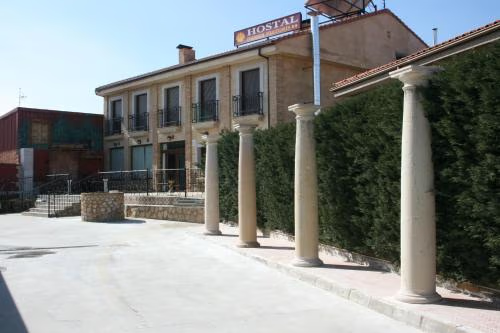
In addition there are private albergues such as El Labriego and the Albergue Dormero with dorms from about €8 to €15, some open only from spring to autumn.
Ninja tips
- Get the Carta Peregrina. The certificate for the halfway point is available at the Peregrina for a fee. It is one of the few certificates along the way, and it shows you in black and white how far you have come.
- Sleep with the Benedictines if you are looking for community. Shared dinner and pilgrim blessing are rare on this stretch.
- Bring something to share. At dinner in the Santa Cruz, it isn't only the house that cooks.
- Buy Amarguillos as provisions. For the long, empty kilometers to El Burgo Ranero they are light and keep well.
- Plan the next days around the albergues. Between Sahagún and Mansilla there are only Bercianos, El Burgo Ranero and Reliegos with beds.
Practical tips for pilgrims
- Stamp and certificate: at the albergue and at the Peregrina, where you also get the Carta Peregrina.
- Camino de Madrid pilgrims: The tourist office next to the Cluny albergue issues a certificate to everyone who has finished the Camino de Madrid.
- Tourist office: in the Iglesia de la Trinidad, Calle del Arco 87, tel. 987 781 015.
- Shopping and food: bars and restaurants around the Plaza Mayor.
Onward: over the Cea into the second half
You leave Sahagún over the stone bridge across the Cea. Via Calzada del Coto (km 412.0) you continue to Bercianos del Real Camino (km 417.0, 10.3 kilometers) and on to El Burgo Ranero (km 424.4, 17.7 kilometers, 114 meters of ascent). Beyond Calzada del Coto there is a second, lonelier track via Calzadilla de los Hermanillos; the Camino Ninja map follows the main route. It is still 55.2 kilometers to León.
What awaits you tomorrow
Bercianos or El Burgo Ranero, depending on your strength, and the day after that Mansilla de las Mulas, the walled town before León.
Deep dive: The monastery that vanished
A short read, in case you want to learn more about Sahagún. About four minutes' reading.
A gate without a church
When you stand beneath the Arco de San Benito, you stand in an entrance with nothing behind it. The portal was built in 1662, when the monastery of Sahagún was still one of the richest in Spain. Two hundred years later the monastery was gone. What you see is the last great sentence of a long text.
The martyrs and the name
The name of the town recalls two men, Facundo and Primitivo, who were venerated here as martyrs. In the speech of the people San Facundo became San Fagun, and from that came Sahagún. Around their grave a monastery arose, and around the monastery a town. The kings of Asturias and León supported it, and under Alfonso the Sixth, who ruled León and Castile at the end of the eleventh century, it experienced its greatest era.
The Spanish Cluny
Alfonso brought in monks from Cluny, the great Burgundian monastery that then shaped the church of Europe. Sahagún became the center of this reform in Spain, and it was called the Spanish Cluny. In 1085 the king gave the town a charter that attracted merchants and craftsmen. The monastery was rich, powerful and quarreled with its townspeople; anonymous chroniclers of the twelfth century wrote these conflicts down in detail. In the fourteenth century there was a university here. When Alfonso died in 1109, he was buried here.
The end
In the nineteenth century Spain lost its monasteries. In 1835 Sahagún was dissolved too. One of the two towers collapsed in May of that year, a few days before it was to be reopened after a restoration. After that the monastery was torn down almost completely, and the stones went into other buildings. An abbot rescued the remains of the king and secretly brought them to the Benedictine nuns of the town. There they were found again in 1908, and since 2020 they rest in a new tomb, together with the remains of four queens.
What Sahagún gives you
When this text was written, in the autumn of 2026, pilgrims arrived every day asking about the halfway point. Sahagún gives you a certificate in answer, and a lesson: even the mightiest does not stay standing. What remains is a gate that people walk through. That is exactly what you will do tomorrow morning.
Where to stay in Sahagún
The places pilgrims rate highest in Sahagún come first.
- Top #1
 OpenReservations accepted
Albergue de peregrinos de la Santa Cruz
- Top #2
 OpenReservations accepted
ALBERGUE MUNICIPAL CLUNY
- Top #3
 OpenReservations accepted
DORMERO Hotel y Albergue Sahagún



Services in Sahagún
What you can find in town before the next stage.
- ATM
- Café
- Shop
- Tobacco
- Medical clinic
- Pharmacy
- Fountain
- Post office
- Train station
- Bus station
- Restaurant
Source: © OpenStreetMap contributors · updated November 2025
Town 24 of 49