

Camino de Madrid
From the capital to the main route: about 325 kilometers from Madrid through the Sierra de Guadarrama and Segovia to Sahagún, where the route joins the Camino Francés.

- 01At a Glance
- 02Overview
- 03Other Names
- 04Who This Route Is Ideal For—and Who It's Not
- 05Route & Landscape
- 06Stages, Terrain & Difficulty
- 07The Sierra de Guadarrama and Segovia—the heart of the trail
- 08Marked in youth, traveled in old age: the history of the Madrid Route
- 09Highlights Along the Way
- 10How Pilgrims Find Their Way onto This Path
- 11Continue the pilgrimage?
- 12Preparation & Practical Information
- 13What the journey will cost you
- 14Getting There
At a Glance
- Start / Finish: Madrid → Sahagún
- Length: 324.9 km
- Elevation gain:↗ 2,935 m / ↘ 2,764 m
- Duration: about 12–15 days on foot
- Other names: Road to Madrid
- Character: a leisurely drive from the capital through the mountains and across the Meseta to the The French Way
Overview
The Camino de Madrid is the direct route from the Spanish capital to the Camino Francés. It begins at the Church of Santiago el Real in the heart of Madrid and soon climbs into the Sierra de Guadarrama, which it crosses via the ancient Roman pass, Puerto de la Fuenfría. From there, the route descends to Segovia, with its famous Roman aqueduct, and continues across the vast plateau of Old Castile to Sahagún, where it joins the Camino Francés.
It’s a quiet route with few pilgrims, crisp mountain air in the first part, and endless grain fields on the Meseta—ideal for starting your journey right in Madrid.
Other Names
- Spanish: Road to Madrid
- English: Madrid Way
- German: The Madrid Way
Unlike many other trails, the Camino de Madrid is not a historic main route, but rather a modern, well-marked connection from the capital to the Camino network.
Who This Route Is Ideal For—and Who It's Not
It's ideal if you're starting in Madrid or looking for a quiet, easily accessible route that begins with an uphill climb and takes you through the Meseta. It's also a popular first leg before the Camino Francés.
Less suitable if you're looking for company and a well-developed infrastructure: On the Meseta, the stages are long, hot in the summer and cold in the winter, and supplies are scarcer than on the main trail.
Route & Landscape
From Madrid, the route leads through Tres Cantos and Manzanares el Real into the mountains. The highlight of the first section is crossing the Sierra de Guadarrama via the Puerto de la Fuenfría.
Segovia lies beyond the mountains. Beyond that, the Meseta opens up: vast fields, pine forests near Coca, small villages in the provinces of Valladolid and León, until the route meets the Camino Francés in Sahagún.
Stages, Terrain & Difficulty
The only real challenge is the Guadarrama Pass right at the start; after that, the trail is mostly flat to gently rolling. The Meseta requires mental stamina and good planning for sun and cold.
Most pilgrims take about 12 to 15 days. The trail is well marked, but be sure to plan ahead for water and lodging on the long Meseta stages.
The Sierra de Guadarrama and Segovia—the heart of the trail
After just a few days, the trail takes you through the Sierra de Guadarrama—along an ancient Roman road over the Puerto de la Fuenfría (about 1,800 m). The ascent through pine forests and the view back toward the Madrid plateau make for a powerful start.
Beyond the mountains lies Segovia, with its massive, nearly 2,000-year-old Roman aqueduct, the Alcázar, and the cathedral—a well-deserved day of rest.
- Plan it Guadarrama Pass in good weather; there may be snow up there in the winter.
- Treat yourself to Segovia a day off (the aqueduct, the Alcázar, the famous suckling pig, “cochinillo”).
- Make sure to fill up on water before the Meseta stages and protect yourself from the sun and heat.
Marked in youth, traveled in old age: the history of the Madrid Route
As a pilgrimage route, the Camino de Madrid is one of Spain’s newest—and at the same time one of its oldest: People were already traveling this route as early as the 12th century, following the resettlement of the lands south of the Duero. It was rediscovered and marked starting in 1996 the Association of Friends of the Ways of St. James in Madrid, together with the associations from Segovia, Valladolid, and Medina de Rioseco.
His greatest sporting achievement is also his greatest historical one: The Fuenfría Pass (1,796 m) is the highest pass on all of Spain’s inland Camino de Santiago routes—and you’ll cross it on a 2,000-year-old Roman calzada, parts of whose paving stones are still original. At the top, you’ll find yourself between Madrid and Old Castile, and from here on, the route is literally all downhill into the Meseta.
Highlights Along the Way
- Madrid – The tour starts at the Santiago el Real Church in the heart of the capital.
- Guadarrama Range – Mountain crossing at the Puerto de la Fuenfría Pass.
- Segovia – Roman aqueduct, Alcázar, and cathedral.
- Coca – an imposing Mudéjar castle built of brick.
- Saint of the day – Where the Camino Francés meets the Camino de Santiago, Mudéjar architecture.
How Pilgrims Find Their Way onto This Path
Madrid is the most accessible starting point in Spain—the airport and AVE train stations will take you there from any direction, and you can begin your journey right at the Church of Santiago y San Juan Bautista near the Royal Palace. There’s no influx of pilgrims here: this route is the very beginning.
The destination is the perfect choice for this: In Sahagún, you'll meet up with the The French Way– with a good 300 kilometers already under your belt and another 360 or so still ahead of you. That’s exactly why so many people from Madrid walk this way: first quietly through their own Sierra, then as part of the great stream of pilgrims heading to Santiago.
Continue the pilgrimage?
The Camino de Madrid does not end in Santiago, but in Sahagún—right in the middle of the The French Way. From here, it's still about 350 kilometers along the The French Way to Santiago de Compostela. Many walk the Camino de Madrid for precisely this reason: as a peaceful, independent start from the capital before joining the main flow of the Camino Francés.
Preparation & Practical Information
The best times to visit are spring and fall; midsummer is very hot on the Meseta, and in winter, the Guadarrama Mountains may be covered in snow. Accommodations are available at albergues and guesthouses. As on all Spanish pilgrimage routes, you’ll need a pilgrim’s passport (Credencial).
What the journey will cost you
Roughly speaking, expect to spend 25–40 € per day. Hostels usually cost 8–15 €, plus meals. If you stay in guesthouses, you’ll pay more.
Getting There
The starting point is Madrid—which is incredibly easy to reach thanks to its international airport and major rail hub.
- Getting to Madrid: Adolfo Suárez Madrid-Barajas International Airport, with rail and metro connections. Spanish national railway company– Spanish railways, routes, and tickets.
- Return trip from Sahagún: Train at The French Way located, with connections via León. Spanish national railway company– Connections from Sahagún.
- Continue the pilgrimage: In Sahagún, the connection to the The French Way Toward León and Santiago.

Get your pilgrim credential and shell
Everything you need for the Camino de Madrid, shipped to your door.
Visit Camino Shop
Other Caminos

Appenzeller Weg
52.6 km from Rankweil across the Rhine to St. Peterzell: St. James Chapel (1464), 163 Years of the Wedding Trail, connection to the Via Jacobi. Stages, costs, how to get there.
Read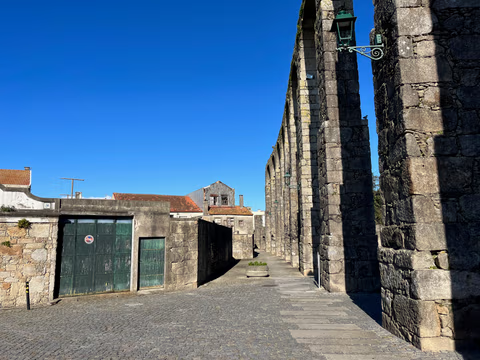
Aqueduct Trail – A path running along the Vila do Conde Aqueduct
From the Coastal Trail to the Camino Central: 12.9 km along the aqueduct from Vila do Conde to São Pedro de Rates. Route, stage, hostels, costs—explained honestly.
Read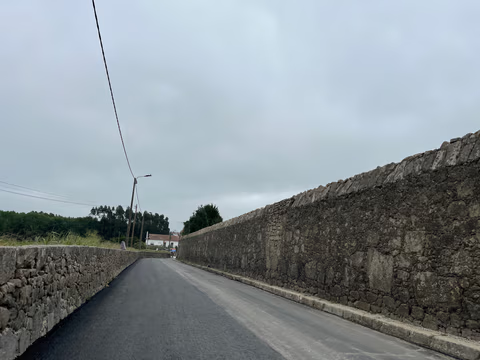
Ave Trail (Costa Station – Central Station)
A 9.2-kilometer route connecting two of Portugal's most popular pilgrimage trails: If you want to switch from the Coastal Route to the Central Route in Vila do Conde after the first day, take this short connecting path to Arcos.
Read


