

Trier – Le Puy
The Way of St. James from Trier to Le Puy-en-Velay takes you on an 886-kilometer journey from the only apostle’s tomb north of the Alps—St. Matthias Abbey Church in Trier—up the Moselle River through Metz, Toul, and Langres, through the vineyards of Burgundy and over the hills of the Forez region to Le Puy-en-Velay, where the Via Podiensis begins. In France, it is called the “Chemin des Allemands,” or “Path of the Germans”—not because of an ancient document, but because French associations have counted how many people walk it today.
- 01At a Glance
- 02Overview
- 03The Apostle's Tomb, Which Sent Its Pilgrims Home
- 04Other Names
- 05Who It's Ideal For—and Who It's Not So Much For
- 06Route & Landscape
- 07Stages, Terrain & Difficulty
- 08Highlights Along the Way
- 09How Pilgrims Find Their Way Here
- 10Continue the pilgrimage?
- 11Preparation & Practical Information
- 12What the journey will cost you
- 13Getting Here
At a Glance
- Start / Finish: Trier, St. Matthias Abbey Church (the only apostle's tomb north of the Alps) → Le Puy-en-Velay, Notre-Dame Cathedral
- Length: 886.0 km — about 47 of them in Germany, about 839 in France; after two days, you'll be across the border
- Elevation gain: ↗ 12,572 m / ↘ 12,033 m — the first half consists of river valleys and plateaus; most of the climbs come after Cluny, in the Beaujolais, the Forez, and the Velay
- Duration: Approx. 6 weeks (41 stages in 4 sections: Moselle & Lorraine, Langres & Burgundy, Cluny & Beaujolais, Forez & Velay — each section begins and ends at a train station)
- Waymarking: The Council of Europe’s blue-and-yellow scallop shell trail from Trier to Le Puy, maintained in stages by four organizations; plus the GR 5F in Lorraine and the GR 765 starting from Cluny — Note: The Council of Europe logo does not indicate the direction; be sure to pack your Camino Ninja app
- Access route: Trier is a crossroads—this is where the Hunsrücker Jakobsweg (from Bingen, linking to the Way of St. James Fulda – Bingen), the Mosel Camino from Koblenz, the Via Coloniensis from Cologne and the Eifel Camino all end.
- Connection: The Via Podiensis begins in Le Puy-en-Velay; at the same time, the Via Gebennensis arrives there from Geneva—two paths end, and one begins
- Best time: April through mid-November (according to the operator) — on the Forez highlands, at elevations above 1,100 m, there is snow at the beginning and end of the season
- Character: “Chemin des Allemands,” the Germans’ Way—a long, quiet long-distance cultural trail with no chain of hostels: the key lodging options (accueils jacquaires) are listed in the association’s guidebooks, not freely available online
Overview
The French call this path“Chemin des Allemands” — The Germans’ Path. There is no medieval document to support this, and that is precisely the best thing about this name: it does not come from an archive, but from a field report. The Lorraine St. James Association soberly notes that these paths are“quasiment exclusivement des Allemands qui transitent” — almost exclusively Germans are out and about. So the path bears neither a royal name nor the name of a saint. It bears the names of its guests — and the Burgundian Confraternité officially lists it in its route guide exactly as follows: Chemin des Allemands, Langres–Dijon–Beaune–Cluny.
You're leaving 886 Kilometers from the Abbey Church in Trier St. Matthias — the only apostle's tomb north of the Alps, discovered in 1127 — up the Moselle to Metz and Toul, across the European watershed at Langres, through the vineyards of Dijon, Aloxe-Corton and Beaune to Cluny, where the largest church in Christendom once stood, and as Via Cluniacensis through the Beaujolais and the Monts du Forez to Le Puy-en-Velay, where the Via Podiensis begins. Trier is a destination; Le Puy is a starting point: This route connects not two places, but two roles — 886 kilometers from the end of one pilgrimage to the beginning of another.
The Apostle's Tomb, Which Sent Its Pilgrims Home
The starting point of this trail is itself a major pilgrimage destination, and its history begins with some research: In order to 1053 Archbishop Eberhard in Trier ordered a search for the relics of St. Matthias, which he had heard about in Rome. 1127 During demolition work, monks came across the remains—and triggered an “sofort einsetzenden Wallfahrerstrom aus ganz Deutschland” On the 13. Januar 1148 Pope consecrates Eugene III the new abbey church, in the presence of Bernard of Clairvaux — A pope and the most famous preacher of his century stand together in the church where your journey begins. The gatekeepers of Trier have counted just how great this event became: 1779 came during a single Pentecost week 11,154 pilgrims. And then the most absurd date in this story: On 19. November 1784 Archbishop Clemens Wenzeslaus has banned all pilgrimages lasting longer than one hour — The Archbishop of Trier has banned pilgrimages to his own apostle's tomb.
A document states that people from Trier also went to Santiago. That St.-Jakobs-Hospital on Fleischstraße — a brotherhood dating back to the 11th century, 1239 placed under the protection of Pope Gregory IX — existed in order to“arme und kranke Pilgrime auf ihrer Wallfahrt nach Rom oder San Jago de Compostella zu beherbergen und zu pflegen”. The building still stands: Today, it houses an art gallery. So Trier’s St. James’s Hostel still exists—but you can no longer stay the night there. And now, the honesty that this route deserves: There is no medieval evidence for a “via Alemannorum,” Hermann Künig von Vach described routes further west in 1495—not this one—and not a single pilgrim known by name is documented as having traveled the Trier–Metz–Langres–Cluny route. We know from a document dating from 1239 that pilgrims from Trier traveled to Santiago. We do not know which route they took. The continuous route is a modern interpretation: 1987 The Council of Europe designated the Routes of St. James as the Déclaration de Saint-Jacques-de-Compostelle for the first European Cultural Trail and called for standardized signage—that’s exactly where the blue-and-yellow scallop shell comes from, which you follow for 886 kilometers, maintained in shifts by four organizations in two countries.
Along the way, the story delivers three punchlines that you'll want to read aloud. First: 775 Charlemagne donated the Corton vineyard to an abbey that had been destroyed by the Saracens in 731—wine has been produced there ever since 696, a parcel is still called“En Charlemagne”, and two out of every three bottles of Grand Cru white wine from the Côte come from this hill; legend has it that Empress Luitgard demanded white wine because the red wine stained the emperor's beard. On this trail, you'll walk through Charlemagne's vineyard — with a backpack. Second: Saint-Jacques-des-Arrêts In the Beaujolais region, it is the only place along an 886-kilometer stretch that is named after the route itself—a stop on the pilgrimage route between the 10th and 12th centuries, according to the municipality„midway between Cluny and the port of Belleville“, halfway between Cluny and the harbor. And third, on the Ance River near Pontempeyrat: That is where the Natura 2000 site is located FR8302040, designated “essentiellement pour la Moule perlière”—for the freshwater pearl mussel, whose population here has declined by 56 percent has plummeted. A clam on a backpack, a clam in the river—only one of the two will die out.
Other Names
On German road signs and in the literature, it is simply called Jakobsweg Trier – Le Puy-en-Velay. In France, it has two names, and both are meaningful: The Burgundian heartland stretching from Langres through Dijon and Beaune to Cluny is officially listed by the Confraternité des Pèlerins de Saint-Jacques de Compostelle en Bourgogne as“Chemin des Allemands” — Weg der Deutschen —, and the last third, from Cluny to Le Puy, is called Via Cluniacensis and is known as GR 765 marked. The origin of the German name is refreshingly unromantic: There is no medieval document mentioning a “via Alemannorum”—there is, however, a report from the Lorraine Confederation stating that virtually only Germans were traveling along this route. The name is based on a census, not a historical document. There are two common misconceptions you should be aware of: The Jakobsweg Trier – Vézelay The route is the same all the way to Grancey-le-Château, where it splits—those heading to Vézelay turn off at the castle. And there’s a completely different “chemin des Allemands” on the Breton coast; it’s named after the Atlantic Wall fortifications and has nothing to do with St. James.
Who It's Ideal For—and Who It's Not So Much For
This route is for you if you want to set out from Germany and arrive in France without flying—and if you like trails that don’t follow you. Over the course of six weeks, you’ll walk from an apostle’s tomb to the starting point of the Via Podiensis, across the European watershed near Langres, and right through the vineyards that Charlemagne gifted in 775. And you’ll have plenty of opportunities to break it down: Trier, Metz, Nancy/Toul, Langres, Dijon, Beaune, Mâcon, and Le Puy All of them have rail access—the four sections of this route are four complete vacations.
To be honest, though, it's not for you if you're looking for the Spanish-style charm of a traditional inn: There are Not part of an albergue chain, in some places there is no pilgrim infrastructure at all, and the key locations—the private accueils jacquaires — aren’t freely available online, but are listed in the club guides, which cost 10 to 12 euros and require a bit of advance planning. It’s also not for you if you’re looking for company: along its 886 kilometers, you’re more likely to encounter cows than fellow pilgrims. And it’s not for you if you want to walk along a well-maintained historic road—the Matthias Pilgrimage to Trier has been documented since 1127, the The route from Trier to Le Puy is a modern route of the clubs. Both are true, and the connection is real. But it’s new, and we’d rather tell you that than make up a certificate for you.
Route & Landscape
The trail does not begin at Trier Cathedral, but two kilometers south of it, at the Abbey Church St. Matthias — and he runs along the Moselle upward, not downhill; the Moselle Camino comes down from Koblenz and ends here, while yours begins. After two days through the Saargau, at Perl/Apach Germany comes to an end, and on to Sierck-les-Bains You can reach it with its ducal castle dating from 1067 and the tranquil Canner Valley Metz, whose cathedral—with its approximately 6,500 square meters of glass—is described as having the largest glass surface area in France—“lanterne du Bon Dieu,” or “lantern of the Good Lord.” Continuing up the Moselle Valley, the route passes right through the arches of the Roman aqueduct near Ars-sur-Moselle and Jouy-aux-Arches according to Toul with its flamboyant façade, then along the western edge of the Vosges—Contrexéville and Vittel, France’s twin mineral-water towns—up to Langres. That is where the most unassuming yet grandest sight of the entire journey unfolds: within the perimeter of the four-kilometer-long city wall, springs Marne, Seine, and Aube — Behind you, everything flows toward the North Sea; ahead of you, everything flows toward the Mediterranean.
Next comes Burgundy, and here Burgundy isn't just a backdrop—it's the main theme: via Auberive and Grancey-le-Château — the junction where the Vézelay Trail branches off — toward Dijon and into the vineyards: Marsannay-la-Côte, Gevrey-Chambertin, Clos de Vougeot, Nuits-Saint-Georges, Aloxe-Corton, Beaune, Meursault, Chagny, then the Côte Chalonnaise via Moroges according to Cluny. That's about 130 kilometers through the world's most expensive vineyards, with a backpack. From Cluny on, the path becomes a mountain trail: As Via Cluniacensis On the GR 765, it enters the green Beaujolais region, skirts Mont Saint-Rigaud (1,009 m), descends toward the Loire, climbs over the Côte Roannaise and the Gorges de la Loire into the Forez and reaches at Montarcher At 1,162 meters, it is the highest municipality in the Loire department. The rest is volcanic terrain: across the Ance River near Pontempeyrat up to the Velay, past Polignac — and on the last morning, there lies Le Puy-en-Velay Before you lies a city where the churches stand atop volcanic vents.
Stages, Terrain & Difficulty
41 stages in four sections — that's how you travel this route, because almost no one travels it all at once: Each section begins and ends in a city with a train connection, and the connecting points are called Langres, Cluny, and Briennon/Roanne. According to our route database, it is 886.0 kilometers with 12,572 meters of ascent and 12,033 meters of descent; the stage distances listed below are taken from the organizing clubs’ lists and are therefore marked “approx.” The elevation gain is distributed extremely unevenly: The first two sections are river and plateau terrain, where the distance is the main challenge—starting at Cluny, the route enters true low mountain terrain with several hundred meters of elevation gain each day. The entire route is marked with the blue-and-yellow Council of Europe shell symbol, but keep in mind what the Lorraine association says: The logo is not indicative — It says, “Here’s the Way of St. James,” not “This is where the trail continues.” Camino Ninja app on your phone, the club guide in your backpack. And the real factor in planning isn’t the trail, but where you’ll sleep: Your destination for the day isn't determined by your fitness level, but by where the lodging is located.
Section 1 — Moselle & Lorraine: Trier → Langres (Stages 1–18, approx. 373 km — Train: Trier, Metz, Nancy/Toul, Langres)
- Trier St. Matthias → Mannebach — approx. 24 km — Start at the Apostle's Tomb, where you can get a pilgrim stamp and a pilgrim's blessing; before that, it's worth taking the "World Heritage Kilometer" walk through Trier.
- Mannebach → Perl-Borg — approx. 23 km — through the Saargau region with views across the Upper Moselle toward Luxembourg; in Borg, the reconstructed Roman villa.
- Perl-Borg → Montenach — approx. 19 km — Border crossing at Perl/Apach; Sierck-les-Bains including the ducal castle dating from 1067, and in Montenach, the pilgrim sculpture carved from Jaumont stone.
- Montenach → Kédange-sur-Canner — approx. 20 km — away from the river into the quiet Canner Valley; sparsely populated, so check for lodging in advance.
- Kédange-sur-Canner → Vigy — approx. 21 km — via Veckring, near the Hackenberg Maginot Fort; the GR 5F trail is marked with a seashell here.
- Vigy → Metz — approx. 20 km — Arrival in the episcopal city: Saint-Étienne Cathedral, then be sure to visit Place Saint-Jacques.
- Metz → Pagny-sur-Moselle — approx. 27 km — the Roman stage: right through the arches of the aqueduct at Ars-sur-Moselle and Jouy-aux-Arches.
- Pagny-sur-Moselle → Pont-à-Mousson — about 15 km — a short day along the river; Prémontré Abbey and the triangular Place Duroc.
- Pont-à-Mousson → Liverdun — approx. 25 km — the Moselle meanders, and the path takes a sharp turn; Liverdun lies on a rocky outcrop above the bend.
- Liverdun → Toul — approx. 21 km — via Villey-Saint-Étienne to the cathedral with its 157-meter cloister.
- Toul → Chalaines — approx. 19 km — out of the Moselle Valley; here, the “Literature” route branches off toward Vézelay.
- Chalaines → Neufchâteau — approx. 25 km — If you have time, take the detour via Domrémy-la-Pucelle, the birthplace of Joan of Arc (approx. +15 km).
- Neufchâteau → Auzainvilliers — approx. 22 km — Plateau and forestland on the western edge of the Vosges; Auzainvilliers is a village; book in advance.
- Auzainvilliers → Aureil-Maison — approx. 24 km — via Contrexéville, with Vittel in sight: France’s twin mineral water towns.
- Aureil-Maison → Les Granges-du-Val — approx. 25 km — Transition into the Haute-Marne; villages are spaced far apart.
- Les Granges-du-Val → Varennes-sur-Amance — about 10 km — a short day, since there’s nothing in between; make the most of it or add it to your itinerary.
- Varennes-sur-Amance → Orbigny-au-Mont — about 23 km — up to the Langres Plateau.
- Orbigny-au-Mont → Langres — approx. 10 km — The river flows through the four-kilometer-long city wall with 12 towers and 7 gates; here, the river changes direction.
Section 2 — Langres & Burgundy: Langres → Cluny (Stages 19–29, approx. 242 km — the section officially known as the “Chemin des Allemands”; train: Langres, Dijon TGV, Beaune, Mâcon-Loché to Cluny)
- Langres → Auberive — approx. 30 km — the longest leg of the trail, through the tall forests of the Parc national de forêts; bring water.
- Auberive → Grancey-le-Château — approx. 18 km — the fork in the road: At the castle, the Le Puy and Vézelay trails split, and you’ll only notice it by the signs.
- Grancey-le-Château → Marcilly-sur-Tille — approx. 27 km — Descent into the Tille Plain, in the peaceful northern Côte-d'Or.
- Marcilly-sur-Tille → Messigny-et-Vantoux — about 19 km — through the wooded slopes of Val Suzon toward Dijon.
- Messigny-et-Vantoux → Dijon — approx. 17 km — Saint-Bénigne, with the Rotonde Crypt (1001–1018); the best place on the route to board the TGV again.
- Dijon → Nuits-Saint-Georges — approx. 26 km — the day the path becomes a vineyard: Marsannay-la-Côte, Fixin, Gevrey-Chambertin, Clos de Vougeot.
- Nuits-Saint-Georges → Beaune — approx. 17 km — the Karls stage via Aloxe-Corton and the Corton hill; destination: Beaune, home to the Hôtel-Dieu, built in 1443. Short and sweet—take your time.
- Beaune → Chagny — approx. 22 km — Meursault, Volnay, Chassagne-Montrachet; if you’re reading the names of the wines, you’ll move slowly here.
- Chagny → Moroges — approx. 24 km — Côte Chalonnaise: the same grape varieties, half the prices, one-tenth the number of visitors.
- Moroges → Saint-Gengoux-le-National — approx. 18 km — limestone hills, dry stone walls, medieval town center.
- Saint-Gengoux-le-National → Cluny — approx. 24 km — Arrival at the abbey, founded in 910; from here, the trail is called the Via Cluniacensis and follows the GR 765.
Section 3 — Cluny & Beaujolais: Cluny → Briennon (Stages 30–33, approx. 91 km — rail access via nearby Roanne)
- Cluny → Saint-Jacques-des-Arrêts — approx. 24 km — the namesake stage: The destination is the only place along the 886-km route that is named after the trail itself.
- Saint-Jacques-des-Arrêts → Propières — approx. 24 km — Beaujolais Ridge, within easy reach of Mont Saint-Rigaud (1,009 m) in the UNESCO Beaujolais Geopark.
- Propières → Arcinges — about 20 km — over the Col des Écharmeaux (712 m), pastures instead of vineyards; Arcinges is a hamlet; check the neighborhood first.
- Arcinges → Briennon — approx. 23 km — Descent to the Loire; a must-see detour: Charlieu, with its tympanum dating from around 1100.
Section 4 — Forez & Velay: Briennon → Le Puy-en-Velay (Stages 34–41, approx. 184 km — this section accounts for most of the 12,572 meters of elevation gain; Train: Le Puy, TER to Saint-Étienne and Lyon)
- Briennon → Saint-Alban-les-Eaux — approx. 24 km — Côte Roannaise via Saint-Haon-le-Châtel; mineral springs, officially recognized in 1878.
- Saint-Alban-les-Eaux → Saint-Jean-Saint-Maurice-sur-Loire — approx. 17 km — a short day, with a spectacular view of the Gorges de la Loire.
- Saint-Jean-Saint-Maurice-sur-Loire → Pommiers-en-Forez — approx. 21 km — to the Priory of Pommiers, a Cluniac monastery since 960, fortified in the 15th century.
- Pommiers-en-Forez → Montbrison — approx. 31 km — via Montverdun and Champdieu (fortified monastery and village); in Montbrison, the Salle héraldique de la Diana. Division into Champdieu is possible.
- Montbrison → Montarcher — approx. 26 km — Ascent into the Monts du Forez; Montarcher (1,162 m) is the highest municipality in the Loire department.
- Montarcher → Pontempeyrat — approx. 21 km — via Usson-en-Forez, down to the Ance River, into the Natura 2000 site for the river pearl mussel.
- Pontempeyrat → Saint-Paulien — approx. 28 km — via Craponne-sur-Arzon Up into the Velay region; Saint-Paulien is the ancient Ruessium, the former capital of the Velay. A stop in Craponne is possible.
- Saint-Paulien → Le Puy-en-Velay — about 16 km — past Polignac into the volcanic town, up the stairs to Notre-Dame Cathedral on Mont Anis. The next morning: a pilgrims’ Mass — and the Via Podiensis.
The total distance of the club’s stages is about 890 kilometers—our track measurement shows 886.0; the difference is due to city crossings and route variations. You can shorten the route at the right spots: Split the Route 31 to Montbrison at Champdieu, and the Route 28 to Saint-Paulien at Craponne-sur-Arzon; the detour via Domrémy after Chalaines adds about 15 extra kilometers but is well worth it. And because each of the four sections begins and ends in a city with a train station, this route is perhaps the best segmented Way of St. James of all: Trier → Langres, Langres → Cluny, Cluny → Briennon/Roanne, Briennon → Le Puy—four vacations, one route. The best single point to rejoin the route is Dijon, with its TGV connection.
Highlights Along the Way
- St. Matthias Abbey Church, Trier — the only apostle’s tomb north of the Alps: sought around 1053, rediscovered in 1127 during demolition work, and consecrated on January 13, 1148, by Pope Eugene III in the presence of Bernard of Clairvaux. To this day, around 160 brotherhood groups visit; a monk from the abbey is assigned specifically as a pilgrim priest. Your kilometer zero.
- Roman Trier — A UNESCO World Heritage Site since 1986, founded in 17 B.C. as Augusta Treverorum: Porta Nigra (c. 170 A.D.), the Imperial Baths, the Amphitheater, the Roman Bridge, the Basilica of St. Constantine, the Cathedral, and the Church of Our Lady. Your first kilometer takes you past nine World Heritage sites.
- St. James Hospital, Trier — A brotherhood founded in the 11th century and placed under the protection of Pope Gregory IX in 1239, established to “arme und kranke Pilgrime auf ihrer Wallfahrt nach Rom oder San Jago de Compostella zu beherbergen und zu pflegen” The building on Fleischstraße still stands—today as an art gallery.
- Château des ducs de Lorraine, Sierck-les-Bains — First mentioned in a document in 1067; the favorite residence of the Dukes of Lorraine, 195 meters above the Moselle; stripped of its fortifications in 1673 on Louvois’s orders; owned by the city since 1866.
- Saint-Étienne Cathedral and Place Saint-Jacques, Metz — The cathedral calls its approximately 6,500 m² of glass the largest glass surface in France: “lanterne du Bon Dieu” featuring windows by Hermann de Münster, Valentin Bousch, and Chagall. A few streets away lies Place Saint-Jacques on the site of the Roman Forum—the Church of St. James has been gone since 1574, but the name has survived two periods of occupation.
- Gorze–Metz Aqueduct, Ars-sur-Moselle / Jouy-aux-Arches — Built in the early 2nd century, 22 km long, originally with 110 to 120 arches up to 30 meters high; in Jouy, 18 piers and 17 arches still stand. The path runs right through the middle.
- Saint-Étienne Cathedral, Toul — Built between 1220 and 1497, with a Flamboyant-style west facade, 65-meter towers, and a cloister measuring 157 running meters—the second-largest of its kind in France. Bruno of Egisheim served as Bishop of Toul from 1026 and became Pope Leo IX in 1049.
- Langres — Roman Andemantunnum, a diocese since the 4th century; its bishops have held the title of duke since 1385; four kilometers of walkable city walls with 12 towers and 7 gates. The Marne, Seine, and Aube rivers have their sources in the surrounding area—the European watershed.
- Grancey-le-Château — The fork in the road: This is where the route to Vézelay and the route to Le Puy split. At a castle, you decide which of the major French pilgrimage destinations you’ll head for.
- Saint-Bénigne Cathedral, Dijon — Crypt of the Rotunda, built between 1001 and 1018 under Guillaume de Volpiano, whom Cluny sent there in 989 to carry out reforms; the Rotunda itself was demolished in 1792, and 86 skeletons lie in the crypt.
- Aloxe-Corton and the Corton Hill — In 775, Charlemagne donated it to the Abbey of Saint-Andoche in Saulieu, which had been destroyed by the Saracens in 731; winemaking here has been documented since 696, and one parcel is still called “En Charlemagne” today. More than two out of every three bottles of Grand Cru white wine from the Côte come from just over 52 hectares of Corton-Charlemagne. Three stages earlier, the vineyard begins in Marsannay-la-Côte, the only appellation in the Côte de Nuits to produce wines in all three colors (AOC since December 8, 1987).
- Hôtel-Dieu, Beaune — Founded in 1443 by Chancellor Nicolas Rolin and Guigone de Salins, in a city ravaged by the plague and the Hundred Years’ War; Rogier van der Weyden’s “The Last Judgment.” Since the first wine offering in 1457, the house has been financed by its own vineyard—today spanning 60 hectares, with an auction held on the third Sunday in November.
- Cluny Abbey — Founded on September 11, 910, for twelve monks, with free election of the abbot and subject only to the Pope; in the 12th century, it had over 1,450 monasteries and approximately 10,000 monks. Cluny III (1088–1225): 187 meters long, the largest church in medieval Christendom—almost completely demolished after the Revolution. You’ll be visiting the largest void in European architectural history.
- Saint-Jacques-des-Arrêts — the only place along the route named after the route itself: between the 10th and 12th centuries, a pilgrimage stop “halfway between Cluny and the port of Belleville”; since 1999, four large canvases by the Lyon painter Jean Fusaro have hung in the church. Part of the municipality of Deux-Grosnes since 2019—the old name still appears on the sign.
- Charlieu Abbey (Side trip on Stage 33) — Founded in 872 by Count Boson and Bishop Ratbert, it became affiliated with Cluny around 930/940; the narthex tympanum, dating from around 1100, is one of the oldest fully sculpted Romanesque tympanums in existence, featuring the twelve apostles on the lintel. The rest of the church was demolished in 1800.
- Montbrison — the Collégiale Notre-Dame d'Espérance, founded in 1223 by Count Guy IV for thirteen canons and constructed over a period of 250 years; next to it, the Salle héraldique de la Diana, dating from around 1296, with 1,728 painted coat-of-arms panels on the wooden ceiling—likely built for a wedding.
- The Ance River near Pontempeyrat — Natura 2000 site FR8302040, designated “essentiellement pour la Moule perlière”: twenty years ago, one of France’s best freshwater pearl mussel populations, numbering several thousand individuals; today, a 56 percent decline over the past eighteen years. On a trail whose symbol is a mussel.
- Notre-Dame du Puy Cathedral — A UNESCO World Heritage Site since 1998, located on the Mont Anis volcano, with two spans built high above the mountainside; the Black Madonna (the original was burned by revolutionaries in 1794), Pierre des Fièvres. From here, Bishop Godescalc set out for Santiago in 950 with 95 companions—the first pilgrim in Europe whose name is known. Your destination is a starting point.
How Pilgrims Find Their Way Here
Trier is one of the few true crossroads in Germany: Four marked routes along the Way of St. James end here, and exactly one continues on—yours. The most important route leading from central Germany is the Hunsrücker Jakobsweg, which joins the Way of St. James Fulda – Bingen at Bingen — together the “German Pilgrimage Route” from Eastern Hesse: It ends in Trier, so you don’t actually change locations—just the sign. In addition, there are three other pilgrims: the Mosel-Camino, which has been fully marked since 2008 and runs about 160 kilometers upstream along the Moselle from Koblenz-Stolzenfels, ending specifically at the Abbey Church of St. Matthias—at your kilometer zero—which Via Coloniensis from Cologne and Bonn, which, according to the brotherhood’s count, actually extends as far as Perl/Schengen and overlaps with your first stages, as well as the Eifel-Camino from Andernach.
If you’re arriving without a prior reservation, take the train: Trier Central Station is connected to the long-distance rail network via Koblenz and Saarbrücken, and the regional train from Luxembourg takes just over 50 minutes. From the station, it’s about half an hour to three-quarters of an hour on foot to St. Matthias — Walk past the Porta Nigra, the Main Market Square, and the cathedral, and you'll have covered the World Heritage sites within the first kilometer. The Pilgrim's Passport You can get it at the Pilgerbüro der St. Jakobusbruderschaft Trier (in cooperation with the Cathedral Parish), which will also issue you a Trier pilgrim certificate at the end; the abbey offers pilgrim stamps and a pilgrim’s blessing.
Continue the pilgrimage?
This route doesn't end in Le Puy-en-Velay; it leads on to the most famous starting point in France. The morning after you arrive, you'll go to the pilgrims' Mass at the cathedral, receive a blessing, and set out on the Via Podiensis Next: via Conques, Cahors, and Moissac to the Pyrenees—exactly the route that the Codex Calixtinus around 1140 as the second of his four major routes, “through Saint Mary of Le Puy, Sainte-Foy de Conques, and Saint-Pierre de Moissac.” At the foot of the Pyrenees, the Camino Francés. From Trier to Santiago, it’s roughly 2,500 kilometers—and starting in Le Puy, you’ll be following in the footsteps of Europe’s first known pilgrim by name: Bishop Godescalc, who set out in 950 with 95 companions.
A second route meets yours at the destination without continuing on: The Via Gebennensis starts in Geneva and also ends in Le Puy—from there, both connecting routes are marked as a single long-distance hiking trail, the GR 65. So when you arrive in Le Puy, you’ll find yourself at a junction where two trails end and one begins. And you can take a detour as early as 500 kilometers before that: Up to Grancey-le-Château is this path identical to the Jakobsweg Trier – Vézelay; there the two routes diverge—southward via Dijon and Cluny to Le Puy, and westward via Flavigny-sur-Ozerain and Semur-en-Auxois to Vézelay, where the Via Lemovicensis takes over. At a castle in a village, you decide which of the major French routes you'll take.
Preparation & Practical Information
The best time is April through mid-November — as the tour operator itself states. Note the elevation profile: The last 275 kilometers run through low mountain ranges, reaching over 1,100 meters near Montarcher — where there’s still snow in April and again in November, and the villages are tiny. In Burgundy, the opposite is true: September and October are the most beautiful months, but on the third weekend in November Beaune is completely booked up because of the Hôtel-Dieu wine auction. You plan around such bottlenecks in advance, not once you're already there.
The trail is marked throughout with the the Council of Europe's blue-and-yellow scallop — but by four organizations in succession: up to the border; then on the GR 5F; from Grancey-le-Château onward, with self-adhesive 6-by-6-cm scallop shell squares, and from Cluny onward, on the GR 765. An important point that is rarely mentioned: The Council of Europe logo is not indicative — It confirms that you're on the Camino de Santiago, but it doesn't tell you where to turn. Download the Camino Ninja app to your phone.
And then there's the point where this approach really works differently from the Spanish one: You'll need the club guides, because the key neighborhoods—the private ones accueils jacquaires, run by volunteer families — are not freely available online. Before you set out, be sure to pick up the Lorraine brochure “Vers Saint-Jacques de Compostelle en passant par la Lorraine” (10 €, available at the tourist offices in Sierck-les-Bains and Schengen, among other places), the three brochures from the Burgundian Confraternité (€12 total, password access after payment), the bilingual Via Cluniacensis guide from the Association Rhône-Alpes, and Martin Simon’s Conrad Stein volume 211 (4th edition, 2024); if you’re comfortable with French, add *Miam Miam Dodo* to the mix. Plan your daily stages in advance, because the lodging options are small, unevenly distributed, and often only open by appointment—the easiest way to do this is directly in the Camino Ninja app, where you can put together your stages and plan suitable accommodations at the same time.
What the journey will cost you
This route passes through two expensive countries, and you'll definitely notice it (all prices as of August 2026). The first two days are Germany: In rural Saargau, you can expect 45 to 75 € for a guesthouse or inn, preferably in Trier itself 70 to 110 € — There is no pilgrim hostel here in the Spanish sense. The remaining approximately 839 kilometers are France, and that's where the pilgrim rates apply, if you can find them: Gîtes d'étape and municipal neighborhoods cost about 17 to 20 € per night; breakfast costs an additional 6 to 9 €; demi-pension It's more expensive, but in small villages it's often the only option for dinner. For food, budget 10 to 15 € per day if you shop at the supermarket and cook for yourself, and 15 to 20 € or more if you eat out—a realistic The daily budget for France ranges from 35 to 55 €.. For the entire 41-day journey, that roughly means 1,600 to 2,600 € Excluding travel to and from the destination: the upper limit is open-ended if you want to sleep well in Dijon and Beaune, but the lower limit is fixed because there aren’t many donation-based hostels in this area. Also factor in A one-time fee of 40 to 60 € for the club leaders one — not an optional feature, but standard equipment (as of August 2026).
Getting Here
To Trier: The main train station is connected to the long-distance rail network via Koblenz (Moselle line) and Saarbrücken; the regional train from Luxembourg takes just over 50 minutes, and Luxembourg-Findel is the nearest international airport. From the train station, it’s a good half hour walk to St. Matthias in the southern part of the city—passing through Porta Nigra, the Main Market Square, and the cathedral, so that the very first kilometer is already part of a World Heritage Site. Those arriving on a pilgrimage will come via the Hunsrücker Jakobsweg (which joins the Way of St. James Fulda – Bingen at Bingen), the Mosel-Camino, the Via Coloniensis or the Eifel-Camino.
Back from Le Puy-en-Velay: Le Puy has a train station with direct TER connections—about 1 hour and 20 minutes to Saint-Étienne and about 2 hours and 20 minutes after Lyon, with frequent service; from Lyon Part-Dieu, you can continue by TGV to Paris, Strasbourg, or Frankfurt, and Lyon Saint-Exupéry is the nearest major airport. But the real trick to getting there this way is the Intermediate Stops: Metz (TGV) for the Lorraine section and, above all, Dijon — Take the TGV from Paris (about 1 hour and 35 minutes), and from there it’s about 480 kilometers to Le Puy—a nice three-week vacation through Burgundy and the Forez.
- Getting to the starting point: Trier Central Station via Koblenz or Saarbrücken; from Luxembourg by regional train (just over 50 minutes); the nearest airport is Luxembourg-Findel. It’s a good half-hour walk from the train station to St. Matthias Abbey Church.
- Return trip: From Le Puy-en-Velay, take the TER to Saint-Étienne (approx. 1 hour 20 minutes) or Lyon (approx. 2 hours 20 minutes); from Lyon Part-Dieu, take the TGV to Paris, Strasbourg, or Frankfurt; Airports: Lyon Saint-Exupéry, Saint-Étienne, Clermont-Ferrand.
- Intermediate entry: Metz (TGV), Nancy/Toul, Langres, Dijon (TGV, best place to rejoin the route), Beaune, Mâcon-Loché (by bus to Cluny), Roanne for the Forez section—the four segments of the route are four complete trips in their own right.
Partners
Partner for Trier – Le Puy
Camino Ninja is cooperating with official partners. For this camino the partner is:


Get your pilgrim credential and shell
Everything you need for the Trier – Le Puy, shipped to your door.
Visit Camino Shop
Other Caminos
 Appenzeller Weg
Appenzeller Weg
52.6 km from Rankweil across the Rhine to St. Peterzell: St. James Chapel (1464), 163 Years of the Wedding Trail, connection to the Via Jacobi. Stages, costs, how to get there.
Read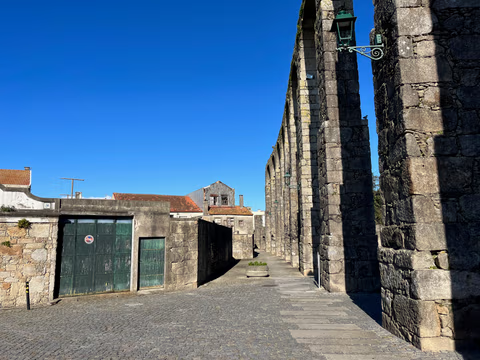
Aqueduct Trail – A path running along the Vila do Conde Aqueduct
From the Coastal Trail to the Camino Central: 12.9 km along the aqueduct from Vila do Conde to São Pedro de Rates. Route, stage, hostels, costs—explained honestly.
Read
Augsburg Way of St. James
The Augsburg Way of St. James runs 231.7 km in 11 stages from Oettingen in the Ries via Donauwörth, Augsburg, Bad Wörishofen and Ottobeuren to Ermengerst in the Allgäu — the Fuggerei, the Jakobervorstadt, a pilgrim of 1446 and Mozart's organ duel. Stages, hostels, costs.
Read

