

Town on the Camino
Viana do Alentejo
Portugal
- places to stay
- 4
- Camino
- 1
- Elevation
- 244 m
The official stage from Cuba ends in Viana do Alentejo, and here you meet a different kind of pilgrim: every year worshippers come to Nossa Senhora d'Aires, some of them after four days in the saddle. The castle, begun in 1313, has a church at its centre. An afternoon is enough, because tomorrow 33.1 kilometres to Évora await.
How long to stay?
An afternoon is enough, but use all of it. It is only 13.3 kilometres from Alvito, 35.7 from Cuba, depending on where you slept. The castle and parish church lie next to each other, and the sanctuary of Nossa Senhora d'Aires is within walking distance. You need no more than that. More important is that you go to bed early: the next stage to Évora is long, and a big part of it runs along a road.
Viana do Alentejo in Ninja numbers
- 231.7 kilometres are behind you since Tavira, according to Camino Ninja. It is another 429.5 to Trancoso.
- 33.1 kilometres to Évora. After 9.3 you pass through Aguiar, and after that, according to Camino Ninja, there is no village until the city.
- Five round towers stand at the corners of the pentagonal castle, each with a masonry spire.
- 7 April 1482: On this day the Cortes ended here, the assembly of estates that King João II had moved from Évora to Viana.
- On the fourth weekend of September Viana celebrates the Romaria de Nossa Senhora d'Aires, with a procession around the sanctuary.
Arriving: on a farm track into the castle town
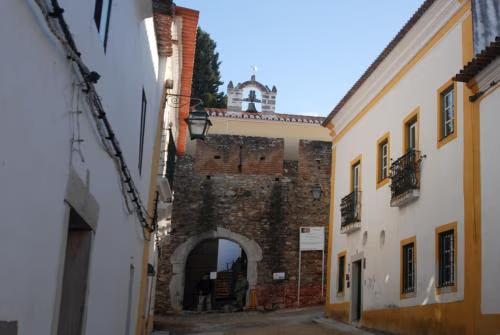
The last 5.1 kilometres from Águas de Peixe are a farm track, according to the Alentejo guide, and then you are standing in front of the castle. Viana grew up on the Roman road between Évora and Beja and used to be called Viana de Foxem and Viana de Alvito. Stage 7 of the official guide ends here. The town has supermarkets, cafés and a pharmacy, and according to a pilgrim portal you get a stamp and information about the route at the castle reception.
In brief: a place for kings and weddings
King Afonso III gave Viana its first town charter. In 1313 King Dinis renewed it, raised the town to a vila and gave 100 pounds for fortification, and that is when construction of the castle and wall began. A year later he gave Viana to his son, the future Afonso IV, on condition that it be passed on only to his wife Beatriz. Afonso did so in 1357, a few days before his death.
At the end of the 15th century Viana was briefly the stage of the royal court. In 1482 João II moved the Cortes here and lived in the castle. In January and February 1491 the wedding of Crown Prince Afonso to Isabel of Castile was celebrated here, and the parish church was renovated for it. Under Manuel I, Martim Lourenço and Diogo and Francisco de Arruda worked on the walls. Later the moats and bridges disappeared. In 1910 the castle became a national monument, and it was restored in the 1940s.
Pilgrims on horseback: the pilgrimage to Aires
You are on your way to Santiago, but in Viana the pilgrims come from the other direction, and they have a different destination. The sanctuary of Nossa Senhora d'Aires is one of the best-known Baroque pilgrimage sites in the Alentejo. What is venerated is a Pietà in Ançã stone: Mary sits holding the dead Jesus in her arms. According to legend the figure has always helped the faithful, and many votive offerings in the sanctuary tell of it. On the fourth weekend of September the procession goes around the church, accompanied by a market, the Feira d'Aires.
The loveliest story is the Romaria a Cavalo. After decades of pause it was revived in 2000: riders set off from Moita on the Tagus and ride for four days along farm tracks to Viana. In 2012 around 300 had signed up, joined by groups from Guimarães and Viseu. At the destination the animals are blessed, because Nossa Senhora d'Aires is the patron saint of animals, and the riders ask for a good harvest. It is the same idea as yours, only with four more legs: go a long way to ask for something at a particular place.
Castle, church, sanctuary: what to see
The castle and the two churches inside it lie close together, and you walk to the sanctuary.
- Castelo de Viana do Alentejo: The Gothic castle has an irregular pentagonal plan. At the corners stand five round towers with battlements and masonry spires, the largest of which became the keep. There are also Manueline and Mudéjar ornaments from different building periods. João II lived here during the Cortes of 1482. You can look at the walls and towers from outside, and going in costs an entrance fee; in 2021 it was €2 according to a pilgrim report. The tourist office is in the castle. We found no current times and prices.
- Igreja Matriz de Nossa Senhora da Anunciação: The parish church stands inside the walls, a Mudéjar-Manueline building that was renovated for the royal wedding of 1491. Its Manueline portal is the reason the castle entrance is worth paying. The south gate of the castle is named after it, Porta da Matriz.
- Igreja da Misericórdia: It too stands inside the castle. The Porta da Misericórdia in the north-west wall opens straight onto its porch, so you walk through a castle gate into a church.
- Santuário de Nossa Senhora d'Aires: The Baroque sanctuary was designed by the priest João Baptista, and the altar is a Rococo carving. For you as a pilgrim it is the real reason to stay an afternoon in Viana: a place where people have been arriving for generations with requests and thanks, as the votive offerings show. In the Holy Year 2025 it was one of the jubilee churches. We found no opening or Mass times.
Food and drink
Viana has its own confectionery tradition. Typical are the Amores de Viana, the Bolo de Mel, the Bolo de Torresmos with pork crackling, the Bolo Real and the Conde de Alcáçovas. On the savoury side are Sardinhas Albardadas, battered sardines. Pottery and cowbells are the craft of the district too; in July there is the Feira do Chocalho.
Honestly
- Tomorrow you walk a long way along the road. A pilgrim portal and a pilgrim forum warn in agreement: about 15 kilometres of the stage to Évora run along the busy N254, partly without a verge. Set off early, wear something light-coloured and walk in single file.
- There is no pilgrim hostel. You sleep privately, so book ahead.
- The stage from Cuba is too long for a summer day. According to Camino Ninja it is 35.7 kilometres, and the Alentejo guide warns in general about heat and sections without supplies. Split it in Alvito.
- We could not find opening times for any church. Ask at the tourist office in the castle.
Where pilgrims sleep
There is no pilgrim hostel in Viana do Alentejo, whether municipal, church-run or donation-based. You sleep in private guesthouses and rooms in town or on farms in the surrounding area. According to Wise Pilgrim, Viana is the sensible stage destination because there are hardly any other beds before Évora. In 2021 the tourist office helped pilgrims look for a room.
Ninja tips
- Get your stamp in the castle. At the reception you get an official stamp and information about the route; the waymarking into town was also looked after from there.
- Ask the tourist office about the bus. If you shy away from the road to Évora, you get timetables and taxi numbers there. In 2021 early buses to Évora ran at 6:00 and 8:15, and there is a bus stop in Aguiar. Check the times on the spot.
- Go to the sanctuary, not just the castle. A pilgrim report recommends the walk to Nossa Senhora d'Aires.
- Shop for tomorrow. There are supermarkets in Viana; after Aguiar, according to Camino Ninja, there is no village until Évora.
Onward: to Évora
The Via Nascente leads from Viana to the north-east. After 9.3 kilometres you are in Aguiar, after 33.1 in Évora. A large part of it runs along the N254. Wise Pilgrim mentions an unofficial alternative via the N257 to the N380, also on asphalt, but on a quieter minor road. Camino Ninja describes the route through the Alentejo together with Turismo do Alentejo e Ribatejo.
What awaits you tomorrow
Évora, one of the great cities of the whole Via Nascente. Its main square is named after Geraldo Geraldes, who is credited with retaking the city in 1165. And there is a church that seems built for you: São Tiago, rebuilt in the 17th century, with frescoes in the vault.
Deep dive: Where the ways cross
A short read, in case you want to learn more about Viana do Alentejo. About 2 minutes' reading.
A place on a Roman road
When you stand in front of the castle of Viana, you stand in a place that arose on a road. Here the Romans connected Évora and Beja, and along this route a village grew that for a long time had no name of its own, only a borrowed one: Viana next to Alvito. In 1313 King Dinis made it a vila, gave money for walls, and a castle came into being that is unlike most in the country. It has five corners and five towers, and in its middle stands no keep, but a church.
The court as guest
For a moment at the end of the fifteenth century Viana mattered. In 1482 King João II brought his assembly of estates here and lived in the castle. Nine years later, in the winter of 1491, the wedding of his son Afonso to Isabel of Castile was celebrated here, and the church got a new face for the occasion. The marriage lasted only a few months, because the prince died in the same year in a fall from his horse. Under King Manuel I the Arruda family then worked on the walls, a family of master builders whose name is known in Portugal.
The other pilgrims
What makes Viana what it is today lies outside the walls. People have been coming to Nossa Senhora d'Aires for generations to ask and to give thanks, and the votive offerings in the sanctuary tell of it. The figure they visit is a Pietà in pale stone, Mary with her dead son on her lap. In 2000 riders began again to ride from Moita on the Tagus for four days along farm tracks to Viana, so that their animals can be blessed here. For the people here Viana is the destination of a pilgrimage. For you it is a station on the way to another.
What Viana gives you
Perhaps this: pilgrimage is not only what you are doing right now. Others walk other ways, to other saints, with other requests, on foot or on horseback, and arrive in the same way all the same. In Viana your way to Santiago crosses theirs to Aires. Tomorrow morning you carry on north, and perhaps by then you will have one more request in your pack.
Where to stay in Viana do Alentejo
Places to stay in Viana do Alentejo.
 OpenReservations accepted
Casa de Viana do Alentejo
 OpenReservations accepted
Moagem Industrial Lodge
 OpenReservations accepted
HORTA do RAMALHAÕ
KitchenCooktopsWater BoilerAnd more

Town 8 of 25