

Stage town on the Camino
Caminha
Distrito de Viana do Castelo, Região do Norte, Portugal
- places to stay
- 15
- Caminos
- 2
- Elevation
- 6 m
Caminha is Portugal's last town on the coast, a small border town at the mouth of the Minho with a clock tower, a Renaissance fountain and a late Gothic parish church. The ferry to Galicia no longer runs: you cross to A Guarda in small boats or walk along the river to Valença. An afternoon is enough.
Right now in Caminha (as of October 2026)
- The ferry no longer runs: The old car ferry to A Guarda has been out of service since 2021. In October 2026 the municipality put it up for sale as scrap. A smaller successor vessel has been announced, but is not yet in sight. You can only cross the river by small boats (see below).
- Mornings only in winter: From November to March, the scheduled boat from Xacobeo Transfer runs only between 8 and 9 a.m. Portuguese time. Whether private water taxis run in winter is uncertain.
- Municipal albergue: Gronze currently lists it as "temporarily closed for maintenance", but pilgrims still reported an open albergue at the end of August 2026. Call ahead: +351 914 290 431.
How long to stay?
An afternoon is enough. The old town is small: clock tower, fountain square, Misericórdia and parish church lie within a few hundred metres, all right on the Camino. There is hardly more to visit, since you can only reach the fortress on the island of Ínsua by boat. Use the evening instead to plan the crossing or the path along the Minho for the next morning.
Caminha in Ninja numbers
- 1 hour is the time difference between the two banks of the Minho. Spain is ahead, and boat timetables follow the time of the departure port.
- €9 is the price of the crossing on the scheduled boat (as of October 2026). In 2022 it was still €6.
- Around 152 kilometres is the distance from Caminha to Santiago according to Camino Ninja if you walk along the Minho via Valença. Via the coast and A Guarda it is around 170 kilometres.
Arriving: through the pine forest to the river mouth
From Moledo there are two ways. The official one runs alongside the railway line on a cycle path into town. The variant over Moledo beach and through the Mata do Camarido pine forest to the mouth of the Minho is nicer, and only a good kilometre longer. From there you walk along the riverside promenade into Caminha. You enter the old town through the clock tower, the last surviving gate of the medieval town wall.
Watch out: some water taxis depart from the river mouth before the town. If you cross from there, you won't see Caminha at all.
In brief: a border town without a bridge
For centuries, Caminha was a bulwark against Castile. King Afonso III had the town fortified around 1260, and King Dinis granted it town rights in 1284. Together with Viana, Valença and Monção, Caminha formed Portugal's northern line of defence, and after every war with Spain the walls were rebuilt. Today almost only the clock tower remains of them.
The river has remained a border to this day: Caminha is the only municipality in the Minho valley without a bridge to Galicia. A road bridge is on the region's wish list, but only as a study.
Old town by the river: what to see
Everything lies along your way between the clock tower and the parish church. An hour without your backpack is enough.
- Torre do Relógio: The fifteenth-century clock tower was the gate of the medieval town wall, and the Camino still leads through it. When you walk through, you enter the town the same way people did five hundred years ago.
- Praça Conselheiro Silva Torres: The main square with its Renaissance fountain of 1551 is the heart of the town. Next to it stand the town hall with its seventeenth-century arcades and the Igreja da Misericórdia with a Renaissance portal and tile pictures inside. A good place for your first coffee after the stage.
- Igreja Matriz: The parish church was begun in 1488, consecrated in 1556 and has been a national monument since 1910. Master builders from the Basque Country and Galicia built it, and the carved wooden ceiling of the nave is the work of a Galician. Look at the outside of the apse: there sits a figure that, according to local interpretation, shows its backside to the Galicians on the other side of the river. We did not find the church's opening hours.
- Forte da Ínsua: The fortress on the small island at the river mouth was built from 1392 together with a Franciscan monastery and took its present form with five bastions from 1649. You cannot visit it regularly, but you can see it well from the shore and from the pine forest.
Food and drink
Caminha lives from the river. Typical is sável (shad), often served with arroz de debulho. From mid-January to mid-April it is the season for lampreia, the lamprey, stewed or as a rice dish. For breakfast, head to one of the bakeries on Rua de São João, such as Petinga Doce or Caminhense, which opens very early. Try the local sweets there, such as Caminhenses or Sidónios. The latter are named after President Sidónio Pais, who was born on Rua Direita.
Honestly
- The crossing is the catch with Caminha. Without the ferry, everything depends on small boats. Pilgrims report in 2025 and 2026 waits of over an hour with one operator, a boat breakdown, and boats that stopped earlier than advertised.
- In winter the coast is almost cut off. If you reach the landing after 9 a.m., you will find no scheduled boat from November to March. In January 2025 a pilgrim reported that no boat ran at all and only a taxi over the Cerveira bridge remained, for around €35.
- The municipal albergue is basic. It is half underground, and the showers have only curtains. Most pilgrims are happy with it anyway.
Where pilgrims sleep
- Albergue de peregrinos de Caminha: the municipal albergue, run on a voluntary basis by the association of Friends of St. James from Viana do Castelo. €10 per night, plus a donation box. No reservations: pilgrims on foot with a backpack come first, cyclists only from 6 p.m. It is open all year, for its status in autumn 2026 see the box above.
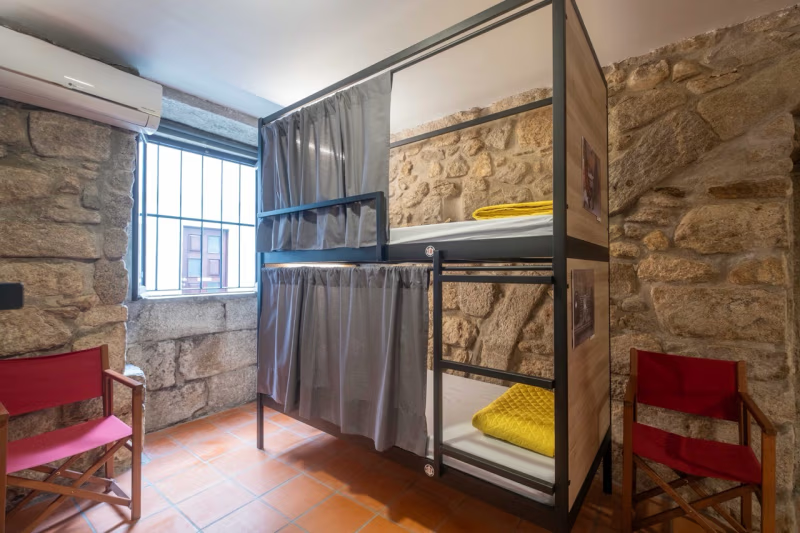
- Albergue Santiago de Caminha: a private albergue in the middle of the old town on Rua Direita, open all year, around €20 to 25 per night, reservations possible. There is no kitchen, only a microwave and a fridge.
There is no donativo albergue in Caminha. Besides these you will find a few hostels and guesthouses.
Ninja tips
- Timetable in local time: Boats run on the clock of their departure port. If you leave Caminha at 15:30, you arrive around 16:40 Spanish time.
- Several operators, one river: Besides the scheduled boat from Xacobeo Transfer, private water taxis run in season, some every ten minutes. If there is a queue at one, ask at the next.
- Sandals at hand: Some water taxis drop you on the Spanish side on the beach, in ankle-deep water.
- Where you land shapes your route: The scheduled boat goes from the town centre to Camposancos, from where it is still a few kilometres to A Guarda. Taxis from the river mouth drop you closer to the Senda Litoral.
- Carry some cash: Not every small boat takes cards.
Practical tips for pilgrims
- Credencial: The municipal albergue issues it and stamps it.
- Book online in summer: For the scheduled boat, the operator recommends booking online between May and September. The ticket is flexible: you take the next boat with a free seat.
- In a storm: If a crossing is cancelled because of weather, the scheduled boat refunds your money and sends you a message by WhatsApp.
Onward: boat or river?
By boat you cross to Galicia and, on the Senda Litoral, go around Monte Santa Trega, along one of the wildest coasts of Galicia and past the monastery of Oia. If no boat runs or you are travelling in winter, follow the Portuguese Coastal Way up the Minho via Seixas and Vila Nova de Cerveira to Valença. That is around 30 kilometres with a lot of cobblestones and some stretches along the main road. As a quieter alternative there is the flat riverside path Ecovia do Minho.
What awaits you tomorrow
On the coastal route, most Camino Ninja pilgrims spend the next night in A Guarda, a good ten kilometres further on the other bank. Above it rises Monte Santa Trega with the remains of a Celtic settlement and a wide view over the river mouth you have just crossed.
Deep dive: One river, two clocks
A long read, in case you want to learn more about Caminha. About thirteen minutes' reading.
At the end of Portugal
Caminha lies where the Minho flows into the sea. Opposite, on the other side of the river, Galicia begins, and above the far bank rises Monte Santa Trega. In the estuary itself lies a small, flat island with a star-shaped fortress. If you have come up the coast from Porto, this is where Portugal ends.
For many pilgrims, Caminha is therefore less a destination than a crossing: the last evening in one country, the last coffee with a Portuguese pastry, before the clock goes forward an hour the next morning. But this small town has more to tell than its size suggests. It is a fortress against its neighbour that was built by the neighbour's master builders. It has a church counted among the finest in northern Portugal, and an island where monks and soldiers lived side by side for centuries. And it has a river that, to this day, you cannot simply cross.
A settlement on the hill by the river
How old Caminha is cannot be said precisely. It is assumed that people lived on this hill above the estuary in prehistoric times. One source reports the foundations of a fortification from the fourth and fifth centuries, from the late period of Roman rule. That is not certain, but it fits the location: whoever holds this point controls the river and the coast at once.
History only becomes tangible in the thirteenth century. Around 1260, King Afonso the Third had a castle and town laid out on the model of a bastide, a planned, fortified settlement. His son, King Dinis, granted Caminha its town charter in 1284 and had the walls repaired and extended. From then on, the town was part of Portugal's northern line of defence. Together with Viana, Valença and Monção, it was meant to secure the country against Castile.
Loyalty in the crisis
In the years 1383 to 1385, Portugal stood on the brink. After the king's death, the country threatened to fall to Castile, and civil war broke out. Caminha sided with João, later King João the First, who in the end won the throne. The new king did not forget it. He supported the town, put a garrison in it and had a second line of walls built. In 1392 he granted the port special trading freedoms.
Caminha lived from the river and the sea. In the assemblies of the realm in 1439 and 1455, fishing and dues from Caminha were also on the table. In 1464, lordship over the town passed to Henrique de Meneses and with it to the house of the Counts of Vila Real. Around 1509, Duarte de Armas, in his Book of Fortresses compiled for King Manuel the First, also drew Caminha with its castle and walls.
Walls that kept falling
King Manuel the First confirmed the town charter in 1512 and ordered a fortress at the mouth of the river. In the wars with Spain, Caminha was hit again and again, and again and again the walls were rebuilt. After 1640, when Portugal broke away from the Spanish crown, King João the Fourth had the fortifications remodelled once more. In the war of independence that followed, Spanish troops are even said to have fired on the parish church.
Later the walls lost their purpose. Most were torn down or built over. What remains above all is the clock tower from the fifteenth century, the only surviving gate of the medieval wall. Through this gate you enter the old town today, by the same path as people five hundred years ago.
A church for a walled town
The Igreja Matriz, the parish church of Our Lady of the Assumption, is Caminha's real treasure. It had to stand inside the town walls. That is why the square in front of its façade remained cramped for a long time, and it was only opened up during restorations in the twenty-first century. A small Romanesque chapel is said to have stood here before. A walled-up doorway and a reused corbel on the north side are considered its remains.
You often read that King Manuel the First founded the church. That is not true. The foundation stone was laid on 4 April 1488, still under King João the Second, years before Manuel came to the throne. Construction dragged on and was expensive. Neither the help of the crown nor the subsidies of the town's lords were enough. The bell tower went up between 1550 and 1560, and the church was consecrated in 1556, one year before the death of King João the Third. Almost seventy years, then, lay between the first stone and the consecration.
Master builders from the other side
Who built this church? The sources attribute the ground plan and the first site management to two masters whose names already give away where they came from: João de Tolosa, a Basque, and Pero Galego, which means nothing other than Pero the Galician. Another description names two further Basques for the beginning, Tomé de Tolosa and Francisco Fial. One thing above all is certain: the church that was meant to adorn a Portuguese border town against Spain was to a large extent built by masters from Spain.
The finest example of this hangs above you as you walk in. The carved wooden ceiling of the nave was made by the Galician carver Francisco Munhoz. One description calls him a master from Tui, the town you will reach in a day or two. The ceiling was completed in 1565. It is divided into panels with fifteen rosettes, and the central one hangs down like a large, sculpted cone. Art historians see in it the influence of Mudéjar art, the woodworking tradition of Spain shaped by Moorish craftsmen. It is considered one of the best works of its kind in the whole country.
What you see inside and out
From the outside, the church looks fortified, built from the granite of the region. It is regarded as a masterpiece of the late Gothic of northern Portugal, interwoven with Renaissance ornament. The main portal on the west side is a round arch in a rectangular frame, with a rose window above it. The stone is badly weathered.
The south portal is far more rewarding. It is attributed to João de Tolosa and is considered an important work of the Renaissance. Two pilasters with fantastical ornament frame it, together with two round medallions with heads traditionally identified as King Manuel the First and Queen Maria. In niches stand Peter, Mark, Luke and Paul. At the very top sits the church's patroness, Nossa Senhora dos Anjos, with the Child, and beside her two busts that probably represent Adam and Eve.
Inside, eight round columns separate three naves. Above the arches run tile pictures, among them medallions with male portraits that no one can name with certainty to this day. One description also mentions a baroque altar of Our Lady of the Rosary with a Tree of Jesse from 1704 and a gilded tabernacle with scenes of the Passion from 1674. Much else was lost. A storm in January 1636 largely destroyed the parapet above the façade, and during a major restoration in the twentieth century several side chapels, the organs and a large part of the baroque decoration disappeared. Since 16 June 1910 the church has been a National Monument.
The Christ from the fishing net
The church's best-known chapel is the Capela dos Mareantes, the chapel of the seafarers, on the left-hand side. It is dedicated to the Senhor Jesus dos Mareantes. Its arch bears the date 1511 and is considered one of the earliest works of the Renaissance in Portugal.
This chapel comes with a story only a town by the sea could tell. In 1539, fishermen pulled a chest out of the water with their net. Inside lay a wooden figure of Christ, two gilded silver chalices and embroidered vestments. Where it came from, the sources do not say. The figure was placed in the seafarers' chapel, and it is venerated there to this day. For a town of fishermen and sailors, this was a Christ who came from their own world.
A backside for the neighbours
And then there is the figure that everyone in Caminha smiles about. On the outside of the church sits a gargoyle in human form, turning its backside towards the Galician bank. The interpretation is a local tradition, but a charming one. One Portuguese description even reads it as evidence that, besides the Basques and Galicians, Portuguese masters also worked on the building, and that this is how they immortalised themselves.
Whether it was ever meant that way, no one knows. But it sums up the history of this border well. Galician hands carved the church's ceiling, Basque hands chiselled its portal, and a Portuguese made sure the neighbours still knew where the border runs. When you walk round the apse, look out for him.
An island between river and sea
From the Camarido pine forest and from the riverside promenade, you can see the island of Ínsua de Santo Isidoro with its fortress. Here the story began not with soldiers but with monks. In 1392, Franciscans from Galicia, friars of the strict Observance, founded a monastery on the island. One source names Frei Diogo Arias as its founder. Once again, then, it was people from the other side of the river who built something at the Portuguese estuary.
The island had two treasures. One was shells. As early as 1441, the town negotiated with the Franciscans over the shells of the Ínsua, and in the fifteenth century they were burned into lime; later they were also used as fertiliser. The other treasure lies underground: a well of fresh water in the middle of the sea. Such springs are rare. The town of Caminha says only two others are known worldwide.
The Franciscans in Caminha also had a small house in the town, by the way, a hospice near the parish church that was called the houses of the poor and where one could spend the night. Who slept there, the sources do not reveal.
Monks and cannons
Because the monastery, the port and the coast were repeatedly threatened by pirates, a fortress soon joined the monastery. King João the First is said to have built a first structure, of which nothing survives. In 1471 the monastery received new cells. One Portuguese source relates that King Manuel the First ordered new works here in 1502 on his pilgrimage to Santiago. What is documented is that Manuel made a pilgrimage to Compostela at the beginning of the sixteenth century and donated a lamp to the cathedral that was to light it permanently. And in 1512 he had the complex on the island enlarged.
The fortress received its present form between 1649 and 1652 under King João the Fourth, directed by Diogo de Lima. It is a five-pointed star with five bastions and small sentry boxes, and the main gate bears the Portuguese coat of arms. What makes it special: the monastery survived in the middle of the fortress. Monks prayed in the cloister with its colonnades while cannons stood on the walls. The island is therefore one of the few fortifications in Portugal where the religious and the military were at home at the same time.
In 1705 the monastery passed to the Capuchins. King João the Fifth helped rebuild the church in 1717, and in 1767 new cells, a chapter house and a new altar were added. During the Napoleonic Wars, Spanish and French troops used the complex. In 1834 all religious orders in Portugal were dissolved, and the monks had to leave the island for good. After that it belonged to the army alone, until the last military governor was appointed in 1909. How the buildings stand today, the sources describe differently. One calls the monastery remains abandoned and damaged by vandals, another describes the complex as a whole as relatively well preserved. In 2019, the Portuguese state put the fortress out to tender for fifty years of tourist use. Whether anything came of it, we have not been able to find out.
A president from the Rua Direita
In the Rua Direita, Sidónio Pais was born, who became President of Portugal in 1918 and fell victim to an assassination in the same year. In Caminha he lives on in a very peaceful way: one of the local sweets, the Sidónios, bears his name. When you stand in one of the bakeries in the Rua de São João in the morning, you can try him.
Were there always pilgrims here?
Here we have to be honest. The coast from Porto to Galicia is today one of the most popular Ways of St James of all. On 2 February 2022, the Portuguese government officially certified the Caminho Português da Costa, from Porto to Valença over 138 kilometres, through ten municipalities, Caminha among them. The Secretary of State for Cultural Heritage, Ângela Ferreira, called the route at the time „um símbolo único do património cultural europeu“, a unique symbol of European cultural heritage. The certification was justified, among other things, by the high value of the historic routes in Porto and Viana do Castelo.
For Caminha itself, however, we have found no trace that clearly speaks of medieval pilgrims. No figure of St James in the descriptions of the church, no Santiago chapel, no recorded pilgrim who crossed the Minho here. The royal pilgrimages we know of tend to be associated with the inland route. Tradition, for example, has Queen Isabel the Saint, who made the pilgrimage to Santiago in 1325, spending a night near Valença. The note about Manuel the First on the island is the only connection we could find, and it too comes from a single source.
That does not mean pilgrims never walked here. Fishermen, traders and travellers have crossed this river for centuries, and it is quite possible that among them were people on their way to Santiago. We cannot prove it. But it does mean that the coastal route, as you walk it, is above all a story of the last few decades. You are not walking in the footsteps of a famous stream of pilgrims here. You are one of those who are only now making this route great.
The ferry that no longer runs
From 1995, a car ferry named Santa Rita de Cássia linked Caminha with the Galician bank. For pilgrims on the coastal route it was a matter of course: you stood at the jetty, waited and crossed the river in ten minutes. In March 2020 it was stopped because of the border closure during the pandemic. Then came a broken jetty on the Spanish side, sand in the river and finally the bill: a repair would have cost around 1.2 million euros. In the summer of 2025 the ferry was towed to a shipyard near A Guarda, and that alone cost 39,000 euros.
In September 2026, Mayor Liliana Silva said in the municipal assembly: „Temos que o desmantelar de uma vez por todas“, we have to dismantle it once and for all. In October 2026 the municipality publicly offered the ferry as scrap, as a boat at the end of its life. A smaller vessel with a shallow draught for fifty to sixty people is planned. A road bridge is on the region's wish list, but only as a study. This makes Caminha the only municipality in the Minho valley without its own bridge to Galicia.
When this text was written, in the autumn of 2026, crossing the Minho at Caminha was therefore once again a matter of small boats, a question of weather, tides and a little luck. A scheduled boat supported by the Xunta and the two municipalities, and private water taxis, take pilgrims across. On the other side, the clocks are an hour ahead.
What Caminha gives you
Perhaps that is the lesson of this place. A border is never just a line that divides. In Caminha, Galicians carved the church ceiling and Basques chiselled its portal, Galician monks prayed on the Portuguese island, and fishermen pulled from the river a Christ whom everyone venerates to this day. The walls against the neighbour have almost disappeared. The most beautiful thing that remains, the church, was built by people from both banks together.
And on the way to Santiago, not everything can be planned, not even in 2026. Sometimes no boat runs, and then you simply walk along the river, one day longer, through villages you would otherwise never have seen. Both routes lead to Santiago. On both, at some point, you put your clock forward an hour. And when you turn round once more on the other bank, you see the town that was built against this bank for so long, and yet would never have become what it is without it.
Where to stay in Caminha
The places pilgrims rate highest in Caminha come first.
- Top #1
 OpenReservations accepted
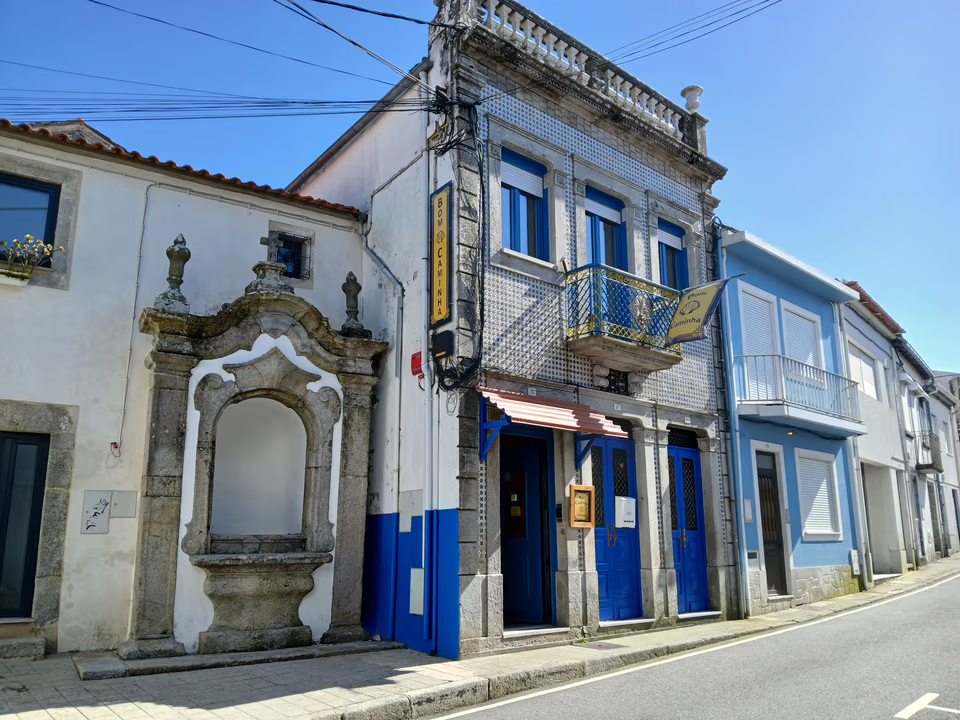
Bom Caminha
- Top #2
 OpenReservations accepted
Arca Nova Guest House & Hostel
- Top #3
 OpenReservations accepted
Albergue Santiago de Caminha


Services in Caminha
What you can find in town before the next stage.
- ATM
- Café
- Shop
- Medical clinic
- Pharmacy
- Fountain
- Post office
- Train station
- Restaurant
Source: © OpenStreetMap contributors · updated April 2026