

Town on the Camino
Portugalete
Biscay, Basque Country, Spain
- places to stay
- 6
- Caminos
- 2
- Elevation
- 48 m
Portugalete is where the Bilbao estuary meets the sea. 19.2 kilometres after Bilbao, many pilgrims end the stage here, at the foot of the Puente Bizkaia of 1893, the first iron transporter bridge and a World Heritage Site since 2006. The old town with its Gothic basilica climbs steeply above the water. 680.5 kilometres remain to Santiago.
Right now in Portugalete (as of October 2026)
- Municipal hostel in summer only: According to Albergues del Camino, the hostel in the Zubi Alde sports centre opens from 1 June to 30 September. In autumn and winter you have the private Albergue Bide Ona, which is open all year.
How long to stay?
An afternoon is enough. The stage from Bilbao is short, so you arrive early. The old town is small and steep: the basilica, the Torre Salazar, the lanes down to the estuary and, at the end, the bridge – a few hours cover it well. For a rest day the town lacks things to do, and tomorrow the sea is finally waiting.
Portugalete in Ninja numbers
- 680.5 kilometres remain from here to Santiago on the Camino del Norte. The Basque Country is almost behind you.
- 19.2 kilometres lie behind you since Bilbao, with around 670 metres up and around 660 metres down. Even the way through the towns is not flat.
- 1893 was the year the gondola of the Puente Bizkaia first crossed the estuary. It still does.
- 45 metres above the water runs the footbridge on top of the bridge.
- 2,437 overnight stays were counted by the municipal pilgrim hostel in the 2024 season, in just four summer months.
Arriving: along the left bank to the mouth
From Bilbao the way follows the left bank of the estuary through Barakaldo and Sestao. It is the most urban day on the Camino del Norte, industry and housing blocks instead of coast. Then the view opens: Portugalete lies where the Nervión flows into the Cantabrian Sea. The old town climbs from the shore up to the basilica, and down by the water stands the bridge.
In brief: a town of the Haro and of the iron age
Portugalete was founded by María Díaz de Haro, of the house of Haro, which ruled Bizkaia at the time. In 1322 the Haro also had the first church of Santa María built. The Torre Salazar, a late medieval tower house, dates from the 14th century. The old town still keeps its medieval layout, with narrow, steep lanes.
In the 19th century industry came to the estuary. The monument to Víctor Chávarri, an engineer of Bizkaia's industrialisation, and the Rialia museum tell that story. In 1893 Portugalete got its landmark: an iron bridge with no roadway, but a hanging gondola instead. It links Portugalete with Getxo on the other bank.
At the end of the estuary: what to see
Everything lies in the small old town or down by the shore.
- Basílica de Santa María: The Haro had the church built in Gothic style in 1322; it was later remodelled in Baroque style. It is a listed monument of national rank, and inside stands a high altar with carved wooden reliefs. For you it matters twice: up here you are at the highest point of the old town, and tomorrow morning the next stage starts here.
- Torre Salazar: The 14th-century tower house now holds exhibitions and documents on the history of Portugalete and the Salazar family. Next to it stands a statue of Lope García de Salazar, regarded as Bizkaia's first historian.
- Puente Bizkaia: Inaugurated on 28 July 1893, designed by Alberto de Palacio, the first transporter bridge built with a metal structure. Since 2006 it has been a UNESCO World Heritage Site. A gondola hangs from cables beneath the girder and shuttles across the estuary; on top, a footbridge runs 45 metres up. The Camino does not cross the bridge, it is a detour. We have not checked times and prices for the gondola and the footbridge.
- The old town: Steep lanes, the Plaza de la Ranchería, the Muelle de Hierro on the estuary and the convent of Santa Clara. The Poor Clares received it in the 17th century; it was destroyed in the Carlist Wars and rebuilt in the 19th century.
- Rialia: The museum shows how industry changed the estuary. We have not found opening hours.
Honestly
- The way here is city. Barakaldo and Sestao are not pilgrim scenery. Many accept it, because the coast comes the next day.
- The cheap hostel exists only in summer. From June to September you sleep for a donation in the municipal hostel; otherwise only the private one remains.
- After 22:00 you are in. The municipal hostel opens at 15:00 and closes at 22:00; after that you cannot go out freely.
- Don't count on a kitchen. The hostel's page lists a fridge and a microwave, but no stove. Eat in town.
Where pilgrims sleep
The Albergue Municipal de Peregrinos de Portugalete belongs to the town; the hospitaleros come from the Bizkaia Camino association. It is housed in the Zubi Alde sports centre, has 36 places and takes only pilgrims with a credencial. You give a donation, and you cannot book. It is open from 15:00 to 22:00, in the season from 1 June to 30 September (as of August 2026).
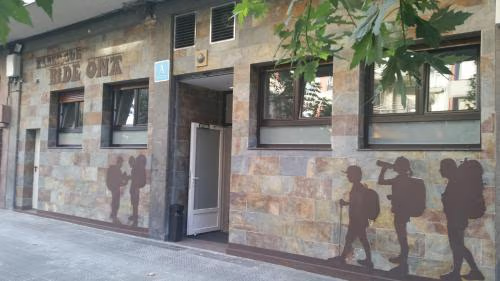
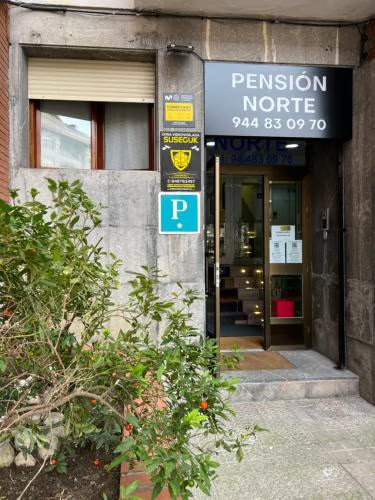
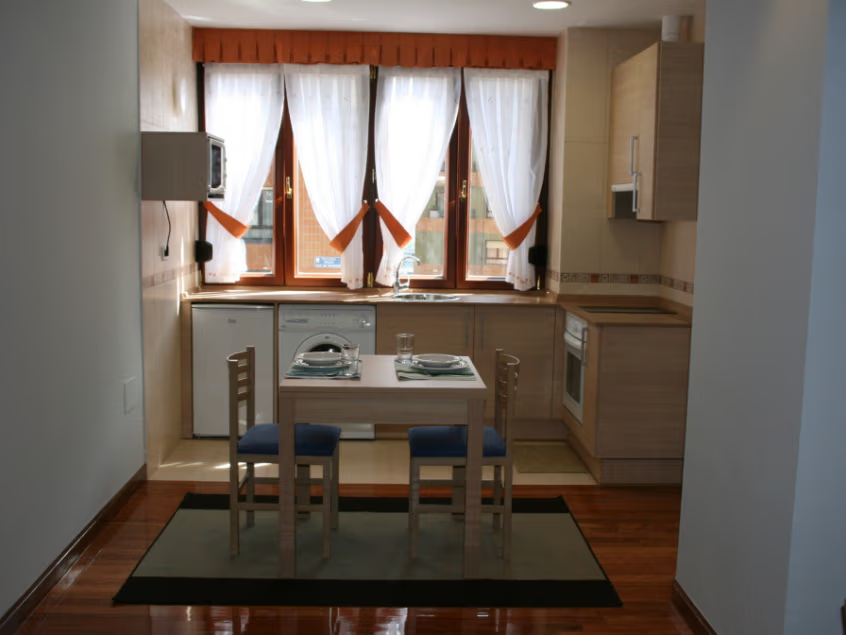
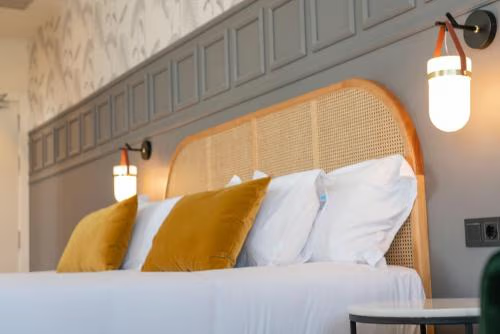
Open all year is the private Albergue Bide Ona with 34 beds. There are also guesthouses and a few hotels.
Ninja tips
- Go to the bridge in the evening. If you have a head for heights, look at it from the footbridge 45 metres up. If you'd rather not go up, ride the gondola across to Getxo and back once.
- Start tomorrow at the basilica. The stage begins there, and from here the way out of town is easiest to find.
- Buy today for tomorrow. Pobeña, the next village with a hostel, has no shop.
- Watch out on the cycle path. Tomorrow you walk a long way on the bidegorri, the Basque cycle path, which you share with cyclists.
Onward: back to the sea
From the old town the way runs along Calle Sotier de la Mier, Gregorio Uzquiano and Avenida Carlos VII onto the cycle path. It passes Monte Serantes and goes through Gallarta, where a museum recalls iron-ore mining. After an underpass you reach La Arena beach and Pobeña: 11.8 kilometres with 221 metres of ascent, the highest point at 124 metres. If you want to go further, walk on to Castro-Urdiales, 32.3 kilometres in total.
What awaits you tomorrow
Pobeña with its beach or, if you walk on, Castro-Urdiales with its harbour, castle and lighthouse. In between lies the Senda Itsaslur, a path on old ore tracks above the cliffs. After Bilbao you are finally back by the sea.
Deep dive: Where the estuary meets the sea
A short read, in case you want to learn more about Portugalete. About three minutes' reading.
A foundation of the Haro
Portugalete lies where the Nervión, Bilbao's river, flows into the Cantabrian Sea. Whoever held this mouth held the way into Bilbao. The town was founded by María Díaz de Haro. Her family, the house of Haro, was one of the most powerful noble families of Castile and for centuries held the lordship of Bizkaia. In the year 1322 the Haro had the first church of Santa María built, Gothic, on the highest point of the new town. What you see today was later rebuilt in Baroque style, but the place has stayed the same.
A tower and a chronicler
In the fourteenth century the Torre Salazar rose below the church, a tower house of the kind the powerful families of the land built. In front of the tower stands the statue of Lope García de Salazar. He is called the first historian of Bizkaia. That a chronicler of all people stands here fits a place that saw so many pass through: traders, sailors, soldiers and pilgrims.
Iron and a bridge without a roadway
In the nineteenth century the estuary became the heart of Basque industry. Ore came from the hills behind Portugalete, and blast furnaces and shipyards lined the banks. The river had to stay open for ships. The architect Alberto de Palacio designed the solution: an iron bridge from which a gondola hangs and shuttles across the water. It was inaugurated on the twenty-eighth of July 1893, the first transporter bridge of its kind made of metal. Since 2006 it has belonged to the World Heritage of humanity, and the gondola still runs.
What Portugalete gives you
Every year around the feast of Saint James in July, Portugalete holds an international folk festival, and has done so for more than forty years. Most pilgrims, though, reach Portugalete on ordinary days, after a stage through suburbs and industry, often tired from the tarmac. In the evening you stand at the river mouth, and ahead of you lies the open sea. The bridge above you does not stop the river, it only carries across. That may not be a bad image for what you are doing here.
Where to stay in Portugalete
Places to stay in Portugalete.
 OpenReservations accepted
Albergue Bide-Ona
 ClosedReservations not accepted
Albergue Municipal de Peregrinos de Portugalete
 OpenReservations accepted
Buenavista Ostatua
Services in Portugalete
What you can find in town before the next stage.
- ATM
- Café
- Shop
- Tobacco
- Medical clinic
- Pharmacy
- Fountain
- Post office
- Train station
- Restaurant
Source: © OpenStreetMap contributors · updated February 2026
Town 14 of 49