

Town on the Camino
Bullay
Germany
- places to stay
- 9
- Camino
- 1
- Elevation
- 118 m
Bullay is the railway hub of the Mosel-Camino: a wine village below the Hunsrück, where Germany's first double-deck bridge carries trains and cars one above the other across the Mosel. The long stage over the heights from Treis ends here, and the station makes Bullay the best place to join or leave the route.
How long to stay?
An evening is enough. After 26.1 kilometres from Treis, what you want most is to arrive. A short stroll is enough for a look at the bridge, the church and the half-timbered houses on Lindenplatz. The next morning the Marienburg is waiting just beyond the village.
Bullay in Ninja numbers
- 62.5 kilometres lie behind you since Koblenz-Stolzenfels, and 94.7 remain to Trier on the Mosel-Camino.
- 314 metres is the length of the double-deck bridge, built from 1875 to 1878: the railway on top, the road below.
- 427 metres is the height you reach on the stage from Beilstein before descending to Bullay at 118 metres.
- 1.5 kilometres beyond the village you climb up to the Marienburg the next morning.
Arriving: from the heights into the valley
From Beilstein you climb onto the Hunsrück heights, pass the Lindenhäuschen chapel and at kilometre 56.1 reach the highest point of the day at 427 metres. Then comes a long descent to Bullay. From Beilstein it is 12.6 kilometres with 315 metres of ascent and 311 metres of descent; the whole stage from Treis is 26.1 kilometres.
In brief: a wine village that became a station
Bullay is an old wine-growing village, as its half-timbering from the 16th and early 17th centuries still shows; the tithe house dates from 1593. But the village gained its importance with the railway. For the Kanonenbahn, the "cannon railway" from Berlin to Metz, the bridge over the Mosel was built from 1875 to 1878, the first double-deck bridge in Germany. Since then Bullay has been a junction; the station building of around 1905 was extended in a modern style and won an architecture prize from the state.
Between the bridge and Lindenplatz: what to see
- The double-deck bridge: 314 metres long, with the Mosel railway line on top and the road running underneath. For pilgrims it is the landmark of a place where it is easy to leave or arrive.
- St. Maria Magdalena: The Catholic parish church is a neo-Gothic hall church of 1873, extended in 1936; the tower stands separately beside it and dates from the 1950s.
- Half-timbering and tithe house: In Zehnthausstraße stands the tithe house of 1593, along with other half-timbered houses from the 16th and early 17th centuries.
- The fountain on Lindenplatz: The people of Bullay dedicated it to their best-known vineyard, the Bullayer Brautrock, around which a legend of an impoverished count and a rich bride has grown.
Honestly
- The stage before is the longest on the route. 26.1 kilometres from Treis over the heights, with hardly anywhere to stop between Beilstein and Bullay.
- No pilgrim hostel. You sleep in guesthouses, holiday flats or hotels.
- The sights are limited. If you are looking for a picturesque Mosel town, you will find it tomorrow in Zell.
Where pilgrims sleep
There is no pilgrim hostel in Bullay. Camino Ninja shows guesthouses, holiday flats and hotels in the village, many of them around Lindenplatz and Bahnhofstraße. The next real pilgrim hostel is in Traben-Trarbach.
Ninja tips
- Join or leave here. Trains on the Koblenz–Trier line stop at Bullay station; the Moselweinbahn to Traben-Trarbach also starts from here.
- Split the long stage beforehand. If 26.1 kilometres from Treis is too much, sleep at the Maria Engelport monastery or in Beilstein.
- Save the Marienburg for the morning. It is only 1.5 kilometres beyond the village, with a view over the Mosel loop.
Onward: over the Marienburg to Zell
In the morning you climb in zigzags up to the Marienburg and down to Zell (Mosel), just 5.4 kilometres. To Traben-Trarbach it is 21.2 kilometres with 645 metres of ascent and 635 metres of descent.
What awaits you tomorrow
Tomorrow the finest panorama of the stage comes right at the start: from the Marienburg you look down on the Zell loop of the Mosel. You have lunch in Zell by the fountain with the Schwarze Katz, and in the afternoon you reach Traben-Trarbach with its pilgrim hostel.
Deep dive: A bridge for cannons
A short read, in case you want to learn more about Bullay. About two minutes' reading.
A railway for the army
After the war of 1870 and 1871, the German Empire wanted a fast railway connection from Berlin to Metz, for troops and supplies. It was called the Kanonenbahn, the cannon railway. Its line also ran through the Mosel valley, and at Bullay it had to cross the river.
Two storeys above the Mosel
From 1875 to 1878 a bridge 314 metres long was built here, and it was given two levels: the tracks on top, the road below. It was the first double-deck bridge in Germany. The wine village became a railway village, and that is what Bullay still is today.
What Bullay gives you
The bridge was built for the army; today it carries commuters, wine tourists and pilgrims. When you climb over the heights to the Marienburg tomorrow morning, you will see it once more from above: a structure meant for war that serves peace.
Where to stay in Bullay
Places to stay in Bullay.
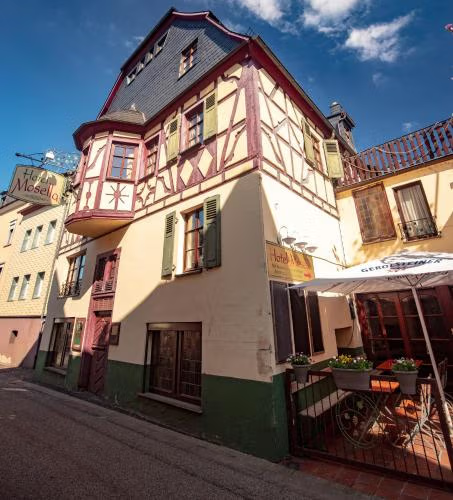 OpenReservations accepted
Hotel Mosella
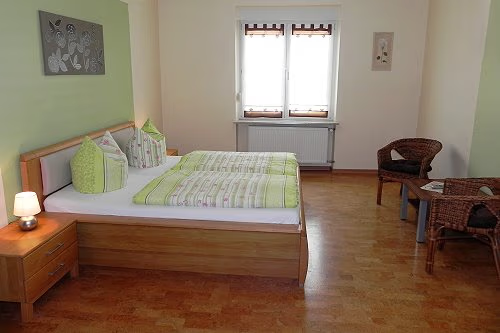 OpenReservations accepted
Gästehaus Cafe Görgen
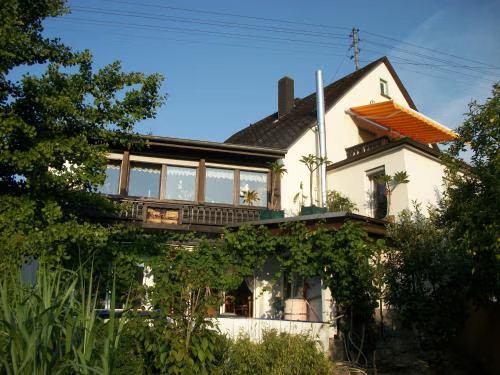 ClosedReservations accepted
Gästehaus Spies


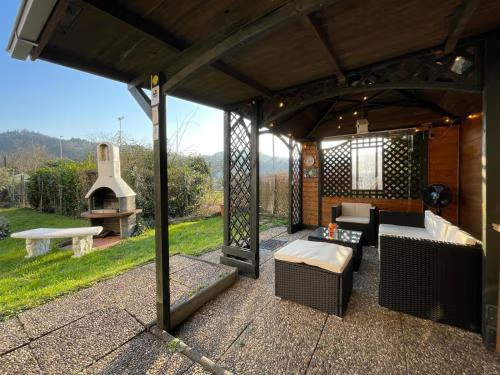

Services in Bullay
What you can find in town before the next stage.
- ATM
- Café
- Shop
- Medical clinic
- Fountain
- Train station
- Bus station
- Restaurant
Source: © OpenStreetMap contributors · updated April 2026
Town 7 of 13