

Stage town on the Camino
Padrón
A Coruña, Galicia, Spain
- places to stay
- 29
- Caminos
- 6
- Elevation
- 6 m
Padrón is where the story of the Camino begins: this is where the boat carrying the Apostle's body is said to have landed, and the stone it was tied to lies beneath the altar of the Iglesia de Santiago. According to Camino Ninja, the cathedral is still 25.3 kilometres away. An afternoon is enough.
Right now in Padrón (as of October 2026)
- Albergues in winter: The private albergues A Barca de Pedra, Camiño do Sar and Corredoiras close at the end of October, Murgadán at the end of November. The public albergue and several private ones stay open all year.
- Pedronía: The pilgrim certificate costs two euros in 2026.
How long to stay?
An afternoon is enough. Padrón is small, and what draws you here as a pilgrim is close together: the stone beneath the altar of the Iglesia de Santiago, the 136 steps up to Santiaguiño do Monte and, a little further out, Rosalía de Castro's house. The Colegiata of Iria Flavia is one kilometre further along the Camino, but on weekdays it only opens in the evening. Your best bet is to visit it on the day you arrive. Tomorrow Santiago is waiting, and you'll want to be well rested for it.
Padrón in Ninja numbers
- 25.3 kilometres from Padrón to Santiago. One more stage.
- 136 steps lead up to Santiaguiño do Monte, where the Apostle is said to have preached his last sermon. Some people climb them barefoot.
- 17 wayside crosses line the waterway of the Variante Espiritual between the Ría de Arousa and Pontecesures, most of them since the years 1963 to 1965.
- €2 for the Pedronía (as of 2026), the certificate for everyone who has made it to the stone where the Apostle arrived.
Arriving: across the Ulla to the Sar
Coming from Caldas de Reis, 18.7 kilometres away, you walk the Camino Portugués Central through perhaps the most beautiful scenery of the Galician section, with stretches of woodland and climbs that are more frequent but moderate. In Pontecesures you cross the Ulla and enter the province of A Coruña. From there it is another 3.4 kilometres to Padrón.
If you come via the Variante Espiritual, you also land in Pontecesures: the boat from Vilanova de Arousa travels about an hour up the Ulla, past the crosses of the Vía Crucis. You walk the last 2.7 kilometres to Padrón. The variant ends here, and from here on everyone walks the same way.
In brief: the port that left only a stone behind
Two kilometres northeast of today's town, the Romans founded Iria Flavia under the Flavian emperors. Bishops resided there, and Galicia's first cathedral stood there. It was a bishop of Iria who, in the ninth century, "found" the Apostle's tomb near Compostela. Later the bishop's see moved to Santiago, and Padrón remained the port on the Sar. Archbishop Gelmírez had a quay built in the twelfth century. In 1164 King Fernando II granted the town special privileges, expressly because the Apostle's body is said to have arrived here.
In the seventeenth century the Sar washed in so much sand that the sea retreated and the port disappeared. What remained is a stone that gave the town its name. And two great names in literature: Rosalía de Castro, who died here in 1885, and Camilo José Cela, who was born in Iria Flavia in 1916.
Where the boat landed: the Pedrón
Beneath the high altar of the Iglesia de Santiago lies a block of granite. It was originally a Roman altar dedicated to Neptune, god of the sea. In the Middle Ages people told a different story: the disciples Teodoro and Atanasio had brought the Apostle's body from Palestine in a stone boat, up the Ulla, and tied it to this stone. Pilgrims embraced the stone, and the "pedrón" gave the town its name. Until the fifteenth century it stood on the left bank of the Sar.
What this means for you: tomorrow in Santiago you'll arrive at the tomb. Here, at the Pedrón, the Apostle himself arrived, at least according to legend. If you've seen both, you know the beginning and the end of the story. Since 2010 the town of Padrón has even certified this with its own certificate, the Pedronía.
At the origin: what to see
The church and Santiaguiño are in town, Rosalía's house and the Colegiata of Iria Flavia are each just under a kilometre outside.
- Iglesia de Santiago: Today's church is neoclassical and was built in 1876 on the remains of a twelfth-century Romanesque church. Inside you'll see a fifteenth-century pulpit, and beneath the high altar, the Pedrón. This is where you get the stamp for the Pedronía. In winter it is open Mondays 18:00 to 19:30, Tuesdays to Saturdays 10:00 to 13:00 and 17:00 to 19:30, Sundays 10:00 to 12:00 (as of May 2026).
- Santiaguiño do Monte: Behind the Convento do Carme and the public albergue the path climbs Monte San Gregorio, then 136 steps lead to the fifteenth-century chapel. James is said to have preached up here. A spring beneath the chapel is said to have appeared when he struck the rock three times with his staff, and according to tradition, whoever drinks from it is washed clean of sins. Among the rocks there are three holes, Gloria, Infierno and Purgatorio, through which pilgrims used to crawl. On 25 July a procession carries the "Apóstol Parrandeiro" from the Iglesia de Santiago through the town, followed by an open-air mass.
- Casa-Museo Rosalía de Castro: In this house in A Matanza, Rosalía de Castro died in 1885, the poet whose "Cantares gallegos" of 1863 Galicia commemorates every year with its Day of Galician Literature. Her tomb is now in Santiago, in San Domingos de Bonaval, which you can reach tomorrow. From the church it is about 900 metres towards Herbón, across the railway and then left. From October to June, Tuesdays to Saturdays 10:00 to 13:30 and 16:00 to 19:00, Sunday mornings, closed on Mondays. Admission €2 to €3 (as of October 2026).
- Colegiata de Santa María de Iria Flavia: Galicia's first cathedral, seat of the bishops before they moved to Santiago. Almanzor destroyed the church in 997; it was then rebuilt and remodelled several times. In the cemetery of Adina in front of the church, Rosalía lay until 1891, and next to an old olive tree lies Camilo José Cela, winner of the 1989 Nobel Prize in Literature. Opposite, the Fundación Camilo José Cela honours him. The Colegiata is right on the Camino to Santiago, but can only be visited Mondays to Saturdays 18:15 to 19:30 and Sundays 10:30 to 12:30 (as of May 2026).
Food and drink
Padrón is famous for its peppers, called pementos de Herbón in Galicia, with protected designation of origin since 2009. Franciscans are said to have brought them from Mexico to Herbón at the end of the sixteenth century. They come to the table fried with coarse salt, and the saying goes "uns pican e outros non": some are hot, others aren't. You'll find the women who sell them near the market hall.
For pulpo there are several pulperías around the church and the public albergue, especially on the Praza das Traviesas and the Praza de Macías. On Sundays, producers sell cheese, chorizo, bread and empanadas on the Espolón and around the market hall, good for supplies for the last stage.
Honestly
- The last stage is no beauty. Between Padrón and Santiago you walk a lot on asphalt and through built-up areas, along the N-550, which you cross up to four times. The most beautiful part of the Galician route is behind you, not ahead of you.
- Iria Flavia is closed when you pass by. In the morning on your way to Santiago you'll find the doors locked. Walk the kilometre out on the day you arrive, around 18:15.
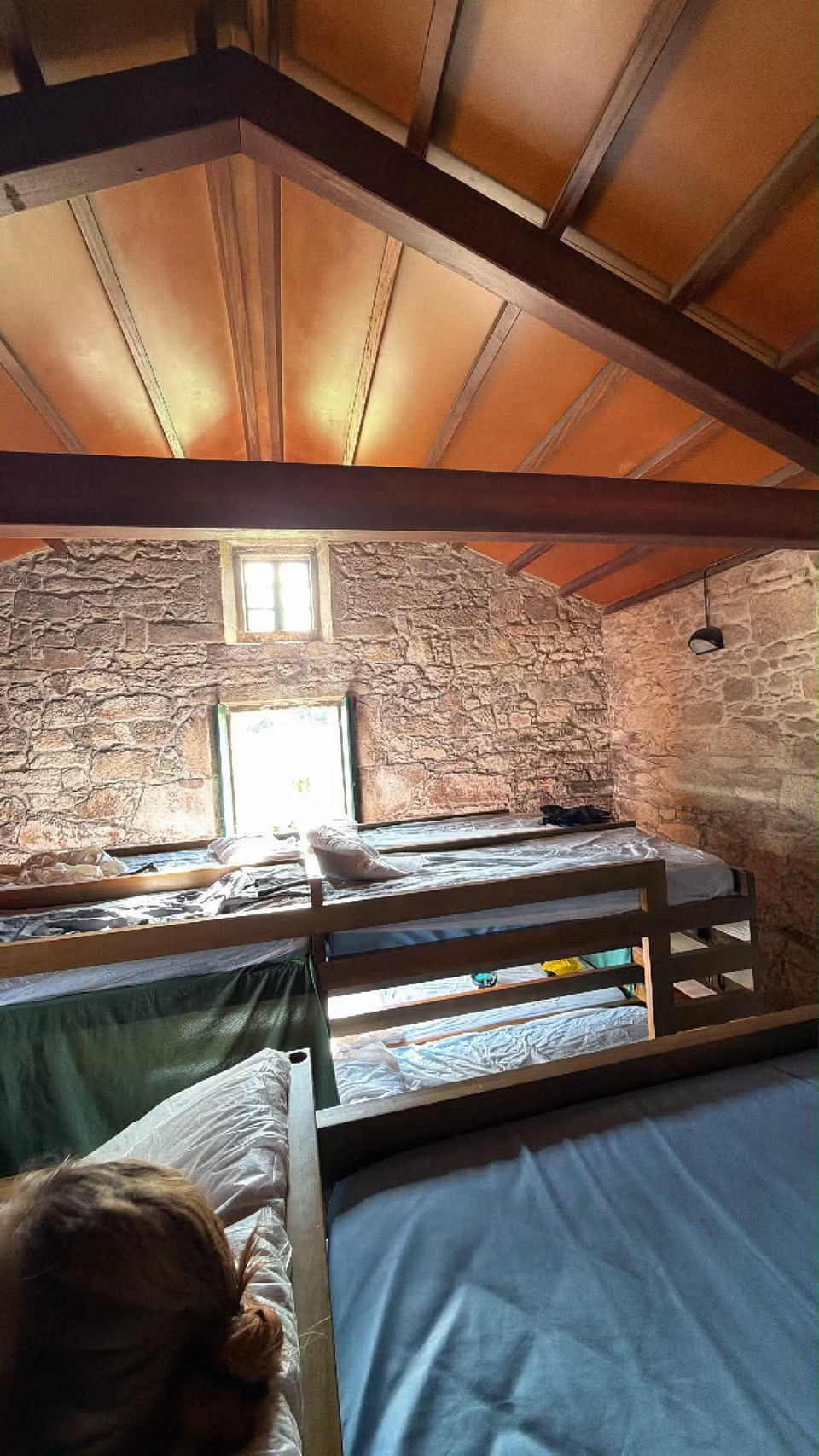
- In the public albergue you sleep close together. Pilgrims report that the beds stand very close to each other. There is no washing machine. Earplugs help.
- In winter the choice gets smaller. Several private albergues close from the end of October (see box).
Where pilgrims sleep
- Albergue de peregrinos de Padrón: the Xunta's public albergue, at the foot of the Convento do Carme and close to the old town, opened in 1998, renovated in 2012. €10 per night with disposable bed linen, open all year, no reservations. Check-in from 13:00, and in the morning you have to be out by 09:00. Bring your credencial and ID.
- Hospital de Peregrinos San Antonio de Herbón: the albergue in Herbón, where a small Franciscan community still lives in the convent. It is run by volunteer hospitaleros of the Galician Camino association AGACS. It lies off the route; the turn-off is signposted about 100 metres past the church of San Xulián in Pontecesures. It does not take groups or pilgrims with support vehicles.
There are also several private albergues. A dorm bed there usually costs €17 to €27 (as of August 2026).
Ninja tips
- Get the Pedronía: Have the Iglesia de Santiago stamp your credencial, then collect the certificate from the town. You can also get it if you arrive via the Coastal Way or the Variante Espiritual.
- Up to Santiaguiño in the evening: The climb starts almost right at the public albergue. At the top there's a rest area with tables and the spring beneath the chapel.
- Iria Flavia the evening before: Combine your visit to the Colegiata with the evening mass at 19:00 (Mondays to Saturdays) and Cela's grave. In the morning you then simply walk past.
- Peppers from the market, not from the plate: Buy them from the sellers near the market hall. On Sundays there's also a market.
- Split the last stage: If you don't want to walk the 25 kilometres in one go, you can stay overnight in O Milladoiro. Monbus runs regularly along the N-550 if you want to go back to Padrón for a night.
Practical tips for pilgrims
- Mass: In the Iglesia de Santiago from October to June on weekdays at 19:30, on Sundays and holidays at 09:30 and 12:30 (as of May 2026).
- Mondays: The Rosalía museum is closed.
- Shopping and services: ATM, pharmacy, medical care, groceries, butcher and bakery are all in town.
- Getting here and away: Padrón has a train station and a bus station. Buses run along the N-550 to Santiago.
Onward: the last stage to Santiago
From Padrón you walk the last 25.3 kilometres of the Camino Portugués Central to Santiago. After 0.9 kilometres you pass the Colegiata of Iria Flavia, after 6.2 kilometres you reach A Escravitude. The only climb worth mentioning leads up to the Agro dos Monteiros in O Milladoiro. On this stretch everyone walks together: the main route, the Coastal Way and the Ruta Padre Sarmiento. The Camino A Orixe ends here in Padrón.
What awaits you tomorrow
Tomorrow you arrive. Before that, you pass Galicia's first cathedral in Iria Flavia, then climb to O Milladoiro, and at the end the cathedral of Santiago de Compostela is waiting. Yesterday at the stone where the Apostle arrived, tomorrow at his tomb.
Deep dive: Where the story came ashore
A long read, in case you want to learn more about Padrón. About twenty minutes' reading.
On the banks of the Sar
You are standing in a small town on the Sar, just before it flows into the Ulla. The sea is a good way off from here, and of the ships that once sailed this far you see nothing anymore. And yet, if you follow the old stories, the whole history of the Camino begins in this place. This is where the boat is said to have landed that brought the dead Apostle from the Holy Land. This is where he is said to have preached while still alive. And it was from here, they say, that he was carried inland, to the place where the cathedral of Santiago stands today.
Tomorrow you arrive there. Today you are at the place where the story itself arrived. In Padrón they say the Apostle was here both alive and dead. That is a big claim for a small town of just over eight thousand people. To understand it, you need to know three places that lie close together: a stone beneath an altar, a rock above the town and an old church one kilometre further along the Way, in Iria Flavia. Add to that two writers, a green vegetable and a river that swallowed the port.
Iria, the city of the Flavians
Long before there was Padrón, there was Iria. Where the Sar and the Ulla meet stood a settlement of the Gallaeci, the main town of a tribe the Romans called the Capori. The Romans reached this area in the last quarter of the century before the birth of Christ. Around the year 74, Emperor Vespasian, founder of the Flavian dynasty, made the place a municipium, a town with Roman rights. Ever since, it has been called Iria Flavia. It lay on the coastal road from Bracara Augusta, today's Braga, to Asturica Augusta, today's Astorga, and it had a port. In the twentieth century archaeologists found shards of Roman tableware in the area, bronzes, roof tiles and loom weights.
The Roman town became a bishop's seat early on. By the sixth century at the latest, perhaps as early as around the year 400, Iria had a bishop. A certain Andrés signed the decrees of the first two councils of Braga. In the list of churches drawn up under the Suebi around 572 to 582, Iria appears among the nine dioceses of Galicia. Later, bishops of Iria signed at the councils of the Visigoths in Toledo. So Iria was a place of weight long before anyone spoke of an Apostle's tomb.
A boat of stone
Then came the legend, and it changed Iria forever. It tells how James, the son of Zebedee, went to the Iberian Peninsula after the death of Jesus to preach, and that he preached first in Iria. Afterwards he returned to Jerusalem, where King Herod Agrippa had him executed around the year 44. His disciples Teodoro and Atanasio, the story goes on, took the body and the severed head and laid them in a boat made of stone. The boat crossed the sea, entered the Ría de Arousa, sailed up the Ulla and landed here. The disciples tied it to a large stone.
The third book of the Codex Calixtinus, the great pilgrim manuscript from the middle of the twelfth century, tells what happened next. The disciples took the body from Padrón on an ox cart to the forest of Libredón, where they buried it. In between lies one of the most colourful stories of the whole Camino. The disciples ask a wealthy woman named Lupa for land for the tomb. Lupa wants to be rid of them and sends them to the governor of Duio, who pursues them and dies in the attempt. Then she sends the disciples up Monte Ilicino, today's Pico Sacro, to fetch two oxen. There a dragon guards a cave said to be the entrance to Hell. A cross strikes the dragon down, and the wild bulls waiting there instead of tame oxen become gentle as lambs. Lupa realises she has lost, has herself baptised and helps to build the tomb.
That is a legend, and nobody in Padrón claims otherwise. But it gave meaning to the landscape you are walking through these days. And the stone to which the boat is said to have been tied, you can touch today.
The stone that named the town
In the Iglesia de Santiago, beneath the high altar, lies a block of granite. This is the Pedrón, the big stone. People named the place after it, and the Pedrón became Padrón. Over time the new name took hold, life shifted to the settlement on the Sar, and Iria became a simple hamlet. Only in more recent times has the old name Iria Flavia been made official again.
Until the fifteenth century the stone stood on the left bank of the Sar. Then it was brought into the church, where it still lies. In the Middle Ages pilgrims embraced it. They were embracing, so they believed, the stone where the Apostle had arrived. On the base of the stone you can make out letters that are read as a dedication. In essence it says that the forum of the people of Iria gave this altar to Neptune, at its own expense. When the town of Padrón created its own pilgrim certificate in 2010, the Pedronía, it took up another inscription of the church, the one above the east door: Hic fuit corpus Beati Jacobi. Here was the body of blessed James. The Pedronía stamp shows a boat moored to a stone.
A pagan altar for an Apostle
Here you have to look honestly, and Padrón makes it easy for you. The stone where the Apostle is said to have arrived is a Roman altar, dedicated to the god of the sea. It was already there when the legend arose, and the legend made it its own. Whether James was ever in Hispania, alive or dead, cannot be proven by any document from his time. The early sources about the Apostle know only of his death in Jerusalem. The story of his preaching in the far West appears only centuries later, and the tale of the stone boat is younger still.
You can read that as an exposure: a piece of paganism was given a Christian meaning, and a whole town has lived off it ever since. But you can also see it differently. An altar to the god who ruled the sea, at a port where ships came in, became the sign of an arrival across the sea. The people who embraced it were looking for something bigger than themselves, the Romans just as much as the pilgrims. What you make of it is up to you. The stone itself is real, it is almost two thousand years old, and it has lain beneath the altar for centuries.
The bishop from Iria
But Iria has more than a legend. It has a man who really lived and without whom there would be no Santiago. His name was Teodomiro, and he was bishop of Iria from about 818 to 847. According to tradition, around the year 830 a hermit named Pelayo told him of lights above a patch of forest inland. Teodomiro had the place searched, found an old tomb and declared it to be the tomb of the Apostle James. He reported the find to King Alfonso the Second of Asturias, who had a first church built over it.
The bishop from Iria was buried not in his own episcopal town but beside the new tomb. In 1955, excavations beneath the cathedral of Santiago turned up a tombstone bearing his name, with bones beside it. In 2024 a research team including Stockholm University examined the bones with genetic, isotopic and radiocarbon methods. They belong to an adult man of at least 45 who had eaten, among other things, fish and seafood. The dating fits roughly with his time. The geneticist Anders Götherström put it this way: there is nothing in it that disputes the remains being those of Bishop Teodomiro. The researchers stress that this is a possible identification, not a final one.
For Iria the discovery had a bitter consequence. The more important the tomb in the forest became, the less important the old bishop's town on the river. In the year 858 a Viking fleet destroyed the town. The bishops went on calling themselves bishops of Iria, but they sat in Compostela. On 5 December 1095 Pope Urban the Second drew a line under it: with a bull he moved the see entirely to Compostela. Iria had found its Apostle and lost itself in the process.
The first cathedral of Galicia
One kilometre beyond Padrón, right on the Way to Santiago, stands the Colegiata de Santa María de Iria Flavia. It is called the first cathedral of Galicia. It stands over a Roman temple from the first century. What later became a Christian church on the site was destroyed by Almanzor, the military leader of the Caliphate of Córdoba, in the year 997 on his campaign against Santiago. Between 1037 and 1068 the church was rebuilt. In the twelfth century Archbishop Diego Gelmírez made it the second cathedral of Compostela and had further work done on it.
What you see today is mostly the result of a major rebuilding in the seventeenth century under Archbishop Monroy, carried out by the master builder Pedro García de Cotobade over six years. Above the portal with its three arches, the tympanum shows the Adoration of the Magi. Inside, the church has three naves and a transept. The largest altarpiece is by Miguel de Romay, and there is a stone figure of the Virgin from the fifteenth century. The remains of twenty-eight bishops are said to rest in the church. The forecourt is paved with the tombstones of former clergy, and excavations around the church have turned up graves cut in human shape and medieval figures.
Two tombs deserve a closer look. One belongs to Rodrigo de Luna, a fifteenth-century archbishop of Santiago, with a recumbent figure on the sarcophagus. The other is empty. It belongs to Alonso de la Peña Montenegro, who was born in Padrón in 1596 and was a canon of Iria. Philip the Fourth made him bishop of Quito, in today's Ecuador, in 1653. He stayed there for thirty-four years, wrote a handbook for pastoral work among the Indigenous peoples that argued they should not be forced to convert, and died in 1687 at the age of 91. He was buried in Quito. In Iria only his stone figure prays above an empty tomb, a man from Padrón who stayed at the other end of the world.
In front of the church lies the small cemetery of Adina. We will come back to it, because the two most famous names of this area lay here, and one still does.
The church above the stone
The Iglesia de Santiago in Padrón is the church of the Pedrón, and its history is a history of rebuilding. In the twelfth century Gelmírez had a Romanesque church built. An inscription in today's church gives the year 1133 for this new building, other sources say 1123. In the fifteenth century Archbishop Lope de Mendoza had a Gothic church built. Its pulpit survives, and you can still see it today. The church you are standing in is neoclassical and was finished in 1876.
In a Gothic gallery stands a fifteenth-century figure of Santiago Peregrino, James as a pilgrim, just as you have seen him all along the Way in stone and wood. Beneath the high altar lies the Pedrón. This is where you get the stamp for the Pedronía. From here, on 25 July, the Apostle's feast day, the procession carries the Apóstol Parrandeiro through the town, a figure in a red robe and a broad-brimmed hat, up to the Santiaguiño.
In Padrón the Puente de Santiago crosses the Sar. Today's bridge with its three arches dates from 1852, built on the site of an older structure destroyed by a flood. That too belongs to Padrón: the river that made the town great has harmed it again and again.
The preacher on the rock
Behind the Convento do Carme and the public albergue, the path climbs Monte San Gregorio. For the last stretch, 136 steps lead to the chapel of Santiaguiño do Monte, the little Santiago of the hill. Some climb them barefoot. One source even counts around three hundred steps from the convent, and popular saying has it that whoever climbs them without stopping will not die that year.
Up here is the place where James is said to have been while alive. According to tradition, around the year 40 he preached his last sermon in Hispania on these rocks before returning to Jerusalem. It is said that he hid from his pursuers among the rocks. When a woman was thirsty, he is said to have struck the stone three times with his staff, and water flowed. The spring beneath the chapel is still there. Its water is cold and tastes slightly of iron, and whoever drinks it, so people believe, is washed clean of sin. Pilgrims used to wash here before walking the last stretch to Santiago.
At the top lie great boulders with three openings called Gloria, Infierno and Purgatorio, Heaven, Hell and Purgatory. Whoever crawled through them in life, it was believed, was freed of their sins. Whoever failed to do so had to make up for it after death. Nearby a stone ledge is pointed out, the Cama del Santo, where the Apostle is said to have rested.
The chapel dates from the fifteenth century. Archbishop Rodrigo de Luna had it rebuilt, and his coat of arms sits on the façade. Above the old east door a relief shows James baptising Queen Lupa. At the altar stands a stone Apostle, worn smooth by the hands of pilgrims over the centuries. Inside lies the Gothic tomb of Saint Gregorio, a canon of Iria who is said to have supported the chapel with his own money. Above the main door is the year 1895, the year of the last major restoration. Down by the car park stands a replica of the Pedrón.
Port, galleys and a king
In the Middle Ages Padrón was no sleepy place but a port that mattered. In the tenth and eleventh centuries Vikings and Normans sailed up the Ulla again and again in search of plunder, lured by the treasures of the cathedral of Santiago. Further down the river, in Catoira, the remains of the Torres do Oeste still stand, a fortress meant to stop these raids. After that, Padrón enjoyed its best times in the twelfth and thirteenth centuries.
The man behind it was Diego Gelmírez, the first archbishop of Santiago. His father commanded the Torres do Oeste. Gelmírez had a quay built on the Sar, and according to tradition the first galleys of a Galician fleet were launched from the shipyards of Padrón. An archbishop with warships sounds strange, but Gelmírez thought in terms of power, and Padrón was his port.
In 1164 King Fernando the Second of León granted the town its own charter, a foro. He gave as his explicit reason that the Apostle's body had arrived here. The legend had become a legal foundation. Later kings confirmed Padrón's privileges again and again, up to Philip the Fifth in the year 1701.
In the fifteenth century Padrón once again became a stage for high politics. Archbishop Rodrigo de Luna lived in Padrón for two full years with the cathedral chapter of Santiago, to protect himself from the Counts of Altamira. In 1467 a brotherhood of Irmandiños formed in Padrón too, the rebellious peasants and townspeople who tore down the castles of the nobility across the country. Here they destroyed the fortress of Rocha Branca in Iria Flavia and the Torre Moucha.
Pilgrims through the centuries
Whoever made the pilgrimage to Santiago in the Middle Ages did not automatically come here. Padrón lay on the way of pilgrims from the south and from the coast; for everyone else it was a detour of a good twenty kilometres. And yet they came, because the beginning of the story lay here. They embraced the stone on the banks of the Sar. They climbed the hill, crawled through the rocks and drank from the spring. At the Fonte do Carme, from the sixteenth century and renewed in 1789, a plaque recalls an indulgence of forty days.
In its book on the translation of the body, the Codex Calixtinus mentions Padrón as the place from which the disciples carried the Apostle inland. With that, by the middle of the twelfth century Padrón was anchored in the most important pilgrim text of the Middle Ages.
One son of the town went the other way. Juan Rodríguez del Padrón was born here at the end of the fourteenth century, became a cleric, travelled through Italy and to European courts and wrote the Siervo libre de amor, an early work of Spanish romantic prose. In 1441 he gave up his church benefices, became a Franciscan and withdrew to Jerusalem. He spent his last years in the friary of Herbón, a few kilometres from here. He admired another poet from Padrón, the troubadour Macías, who went down in literature as Macías el Enamorado, Macías the Lover.
The Nuremberg physician Hieronymus Münzer came to Santiago on the Portuguese Way in the winter of 1494. Whether he stopped at the Pedrón, no source we have found tells us. Of most of the pilgrims who came here we know nothing. Their traces are the hands that have worn smooth the stone Apostle up on the hill over the centuries.
In our own time Padrón has deliberately revived its pilgrim tradition. In 2010 the town began issuing the Pedronía, a certificate for everyone who has come to Padrón on foot, by bike or on horseback over at least eighteen kilometres. It is the small counterpart to the Compostela you will receive tomorrow: here the certificate for the Apostle's arrival, there the certificate for yours.
When the sea left
The port that had made Padrón great slowly disappeared. In the seventeenth century the Sar washed down so much soil and sand that the water retreated and ships could no longer reach the town. Padrón looked for other ways. In the seventeenth century textile making began here and lasted until the middle of the nineteenth century. In 1752 the Convento do Carme was built above the town, set on bare rock, funded according to one source with money from Alonso de la Peña Montenegro, the bishop of Quito.
The river remained a difficult neighbour. Again and again the Sar flooded the streets. In 1881 Rosalía de Castro wrote a piece about Padrón and the floods. In 1994 a canal was built to divert floodwater around the town. It brought new problems, water shortages in the old riverbed and the death of trout and other fish.
Rosalía: on the banks of the Sar
If one name belongs to Padrón, it is this one. Rosalía de Castro was born in Santiago on 23 February 1837, the daughter of an unmarried woman from impoverished minor nobility and a priest. Her father, José Martínez Viojo, was chaplain at the church of Iria. Because he was a priest, he could not acknowledge her. She was baptised as the child of unknown parents. She spent her first years with her father's sisters, and at just over five she was living with her mother in Padrón. Only in 2021 was a document from 1843 found in which her mother acknowledged her before a notary as her daughter.
On 17 May 1863 her collection of poems Cantares gallegos appeared, songs in Galician, at a time when Galician was regarded as the language of peasants and was hardly ever printed. That is why 17 May is still the Day of Galician Literature, a public holiday throughout Galicia. Since 1963 a different writer who wrote in Galician has been honoured on this day each year. Her last collection of poems, published in Spanish in 1884, is called En las orillas del Sar, On the Banks of the Sar. It is the river you are standing beside.
Rosalía was married to the historian Manuel Murguía and had seven children. One son died as a small child after a fall, one daughter was stillborn. Her health was frail all her life. From 1882 the family lived in the house La Matanza, in the parish of Iria, today the museum you can visit. From 1883 a cancer grew steadily worse. At midday on 15 July 1885 she died there after three days of agony, aged 48. A contemporary records that she asked her daughter Alejandra to open the window because she wanted to see the sea. From Padrón you cannot see the sea. And she asked her children to burn her unpublished work.
The next day she was buried in the cemetery of Adina in front of the Colegiata of Iria, a cemetery she had written about herself. On 15 May 1891 her remains were taken to Santiago, to the convent of San Domingos de Bonaval, today home to the Panteón de Galegos Ilustres, the resting place of great Galicians. When you are in Santiago tomorrow, you can visit her there. On the Espolón, the promenade along the Sar, her statue stands looking north.
Cela: Viva Iria Flavia
Opposite Rosalía, on the same Espolón, stands a second writer, looking south. Camilo José Cela was born on 11 May 1916 in the parish of Iria Flavia and baptised in the Colegiata. His father was Galician, his mother a Galician with English and Italian ancestors. He left the area as a child: the family moved to Vigo in 1921 and to Madrid in 1925.
In 1942 his first novel appeared, La familia de Pascual Duarte, the life confession of a murderer. His novel La colmena, The Hive, could not be published in Spain and came out in Buenos Aires in 1951. In 1989 Cela received the Nobel Prize in Literature. The Academy praised a rich and intensive prose which with restrained compassion forms a challenging vision of man's vulnerability. The Cervantes Prize followed in 1995. On 17 May 1996, of all days the Day of Galician Literature, King Juan Carlos the First made him Marqués de Iria Flavia, with a title created especially for him.
Cela is a controversial figure, and that belongs to the story. In 1943 and 1944 he worked as a censor for the Franco regime, and he was an informer for the political police. Later he faced accusations of plagiarism. He was no saint, and those who read him may know that.
Still, he was attached to Iria. In 1995 he founded a magazine called El Extramundi y los papeles de Iria Flavia and edited it until his death. He left his literary estate to the foundation that today occupies the Casas dos Cóengos opposite the Colegiata, the eighteenth-century houses of the canons. He died in Madrid on 17 January 2002. His last words are said to have been: Viva Iria Flavia. He is buried in the cemetery of Adina, next to one of the hundred-year-old olive trees, in the same cemetery where Rosalía lay for almost six years.
Uns pican e outros non
There is a saying in Galicia you will surely hear these days: Os pementos de Padrón, uns pican e outros non. Padrón peppers, some are hot and some are not. The small green pods grow mainly in the valley of Herbón. They are picked unripe, fried in oil and eaten with coarse salt.
This is how people tell their arrival: Franciscans from the friary of Herbón, where a small community still lives today, brought the seeds from Mexico in the sixteenth century. It is the same friary where Juan Rodríguez del Padrón spent his last years, and where pilgrims sleep today in an albergue. Since 2009 a designation of origin has protected the name Pemento de Herbón, and the European Union has recognised it since 2010. Every year in early August Herbón holds its own festival for its peppers, first held in 1979, in the oak grove by the friary.
Why some are hot and others are not has a sober explanation. The riper the pods get, the more heat they develop, and plants that suffer from drought produce hotter fruit. Peppers from August and September are therefore hotter on average than those from June and July. So the gamble on your plate has a timetable, it is just that nobody knows it while eating.
Up the river: the Variante Espiritual
If you came by the Variante Espiritual, you have lived the last part of the legend yourself. The boat runs from Vilanova de Arousa through the Ría de Arousa and up the Ulla to Pontecesures, just as the Apostle's stone boat is said to have sailed. This waterway is called the Traslatio, after the translation of the body.
Along the banks stand seventeen stone crosses, twelve right at the water's edge and five in and around the ports. The idea came in the sixties from José Luis Sánchez-Agustino López, who lived from 1935 to 2010 and was an early promoter of the Camino. Most of the crosses were put up between 1963 and 1965, donated by the Church, municipalities, institutions and private individuals. The route is called the only Way of the Cross in the world on sea and river. In 1999 the Xunta de Galicia declared it an asset of cultural interest. The last cross was recovered from the water and today stands in Pontecesures on the Praza dos Valeiros. On the trip you also pass the Torres do Oeste in Catoira, the old fortress against the Vikings.
What began in the sixties as one man's idea is today a route of its own with many pilgrims. For 2024 the friends of the Portuguese Way estimated that more than 34,000 people walked the Variante Espiritual, about a fifth of the pilgrims passing through Pontevedra. All of them arrive in Padrón, at the stone where the stone boat arrived too.
Padrón today
Padrón today is a small town of just over eight thousand people; in 2023 there were 8,355. Here the main Portuguese Way, the Coastal Way, the Variante Espiritual and other routes meet, and from here everyone walks the last stage together.
On 25 July the Apóstol Parrandeiro climbs to the Santiaguiño once more, there is an open-air Mass, muiñeira dancing and food on the hill. In July the town holds a medieval festival, in August Herbón celebrates its peppers. On Sundays there is a market on the Espolón, beneath the statues of Rosalía and Cela. And in the church the old altar of Neptune lies beneath the altar of the Apostle, as it has for centuries.
What Padrón gives you
Padrón is a place of beginnings, which is strange, because for you it is almost the end. Tomorrow you walk the last twenty-five kilometres, past the first cathedral of Galicia and into the city that might never have come into being without this small port on the Sar. Then you will have seen both, the stone where the story came ashore and the tomb it led to.
Perhaps you take something simple with you from here. A Roman stone for a sea god became the stone of an arrival, and people embraced it for centuries without asking whom it originally belonged to. Whether or not you believe in the Apostle, by now you know the feeling of arriving somewhere after a long journey and wanting to hold on to something. That is what the pilgrims did here. Before you set off tomorrow, you can do it too.
Where to stay in Padrón
The places pilgrims rate highest in Padrón come first.
- Top #1
 ClosedReservations accepted
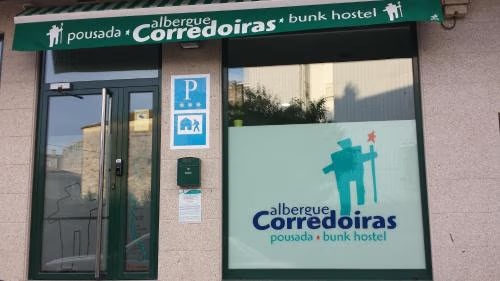
Albergue Corredoiras
- Top #2
 ClosedReservations accepted
Albergue Camiño do Sar
- Top #3
 OpenReservations accepted
Night Day




Services in Padrón
What you can find in town before the next stage.
- ATM
- Café
- Shop
- Tobacco
- Pharmacy
- Fountain
- Post office
- Train station
- Restaurant
Source: © OpenStreetMap contributors · updated April 2026
Town 28 of 31