

Camino Krk
The Camino Krk circles the Croatian island of Krk in seven official stages: from the cathedral square in Krk town via Malinska, Omišalj, Dobrinj, Vrbnik and Baška to the Church of St. James in Kornić – plus a good five kilometers back to the start, 161.7 kilometers in all. Around 4,400 meters of climbing over karst plateaus, vineyards and coastal paths, a moon plateau without shade, Glagolitic inscriptions from the year 1100, no pilgrim hostels, but around two dozen stamp boxes. Waymarked since October 2019, since 2025 a recognized member of the European Camino family.
- 01At a Glance
- 02Overview
- 03Other Names
- 04Who It's Ideal For—and Who It's Not So Ideal For
- 05Route & Landscape
- 06Stages, Terrain, and Difficulty
- 07An Alphabet in Stone: Glagolitic Script from Porat to the Baška Tablet
- 08Pilgrim Passport, Stamps, Certificate: the Formalities
- 09Highlights Along the Way
- 10How Pilgrims Find Their Way onto This Path
- 11Continue the pilgrimage?
- 12Preparation & Practical Information
- 13What the journey will cost you
- 14Getting Here
At a Glance
- Start / Finish: Trg Kamplin at the cathedral of Krk town / parish church of St. James in Kornić; the Camino Ninja map adds the 5.1 kilometers from Kornić back to Krk
- Length: 161.7 km as a loop Krk – Kornić – Krk; the official 7 stages add up to 151.9 km
- Duration: 7 official stages, avg. around 22 km, plus the way back to Krk
- Elevation: ↗ 4,443 m / ↘ 4,445 m – the operator gives ↗ 3,862 m, our unsmoothed track comes out higher
- Highest point: 565 m at km 142.7 on the karst plateau at the Obzova between Batomalj and Punat; at 569 m the Obzova is the island's highest peak
- Landscape: coastal paths in the west, the healing-mud bay of Soline, vineyards near Vrbnik, the bare moon plateau before Baška, karst with dry-stone walls in the south
- Waymarking: blue signs with yellow shell and arrow, around 350 signposts
- Pilgrim passport: Croatian Credencial for 2 € in the web shop or at the tourist offices; the „Camino Krk Compostela“ certificate is free of charge
- Traces of St. James: finishing church of St. James from 1865 with the altar of an abandoned St. James chapel near Lakmartin; Croatian brotherhoods of St. James documented since 1203
- Accommodation: no pilgrim hostels; apartments, guesthouses, hotels, campsites – or a base plus taxi
- Connecting routes: none on foot; the nearest Way of St. James in the Camino Ninja network is the Camino Slovenia (Dolenjska) from Zagreb
- Best time: April to June and September to October; in high summer the sun beats down on the shadeless karst, from January to March the Bora wind closes the Krk Bridge at times
Overview
The Camino Krk is Croatia's first modern Way of St. James. In October 2019 around twenty volunteers set off with Credencial and blessing and waymarked the first hundred kilometers to Kornić. In 2021 the route grew to cover the whole island: 350 signposts, 16,000 printed maps, since then more than 15,000 Credenciales issued. In September 2025 the Camino Europa Compostela Federation officially admitted the route to the family of European Ways of St. James, and in 2026 the Croatian Brotherhood of St. James received the Elías Valiña Prize of the Xunta de Galicia for its overall project.
Nothing here leads to Santiago – the route begins and ends on the same island. In return you get the whole island in seven days: bays in the west, healing mud at Soline, vineyards below Vrbnik, the moon plateau before Baška, the plateau at the Obzova – and churches whose Glagolitic inscriptions go back to the year 1100. Honestly, this is more long-distance hiking with a pilgrim passport than hostel-to-hostel pilgrimage: there are no albergues, you sleep in apartments and guesthouses or take a taxi back to your base in the evening.
Other Names
The operator calls the route Camino Krk, in Croatian hodočasnička ruta, pilgrim route. At Camino Croatia it is listed as part of the Island Route. In German-language reports you read Jakobsweg Krk. The certificate at the end is called Camino Krk Compostela, although it has nothing to do with Santiago – it confirms that you have circled the island.
Who It's Ideal For—and Who It's Not So Ideal For
Ideal if you have a week and want a Way of St. James that begins and ends in the same town. Ideal if you are drawn to history set in stone: on Krk, around 1100, the name Croatia was written in Croatian for the first time. Ideal too for anyone who wants to walk from a base.
Honestly, though, it is not for you if you are looking for hostel romance: there are no pilgrim hostels, and you may not meet another pilgrim for days. Not for you either in July and August, when the karst is without shade and the accommodation is expensive and full. And not for you if you expect flat coastal strolls: the last two stages have over 800 and 1,000 meters of ascent respectively on stony karst, in wind. A Croatian travel blog wrote in 2022 of blisters and knee pain even among the experienced – and of having fallen „head over heels“ in love with the route all the same.
Route & Landscape
West coast and north (km 0–66): From the Trg Kamplin at the cathedral of Krk the route climbs to Vrh (km 8.7) and runs through the villages of the Šotovento via Skrbčići and Pinezići to Brzac (km 23.8). The second stage follows the west coast to Porat (km 37.5) with its Franciscan monastery, then to Malinska (km 46.6). Via Kijac and Njivice (km 51.5) you reach Omišalj (km 66.1) on its rock above the sea, opposite Rijeka Airport.
East and south (km 66–161.7): The northernmost stage begins in Dubec Park and leads via Rudine (km 84.6) to Čižići (km 88.4) on Soline Bay. Then the route climbs to Dobrinj (km 93.4) and runs via Sveti Vid Dobrinjski to Vrbnik (km 108.9). Stage 6 crosses the Vrbnik field and the moon plateau above the Vrženica canyon before dropping steeply to Baška (km 133.3). The queen stage leads via Jurandvor (km 137.0) and Batomalj (km 137.6) up to the plateau at the Obzova – 565 meters at km 142.7 – and down to Punat (km 150.8) and Kornić (km 156.6). If you want to get back to the start, walk the last 5.1 kilometers to Krk.
Stages, Terrain, and Difficulty
We show the route in 8 sections: the operator's 7 official stages and the way back from Kornić to Krk, which the Camino Ninja map adds so that the loop closes at the starting point. The kilometers are calibrated to the 161.7 kilometers of our route data; the operator counts 151.9 kilometers for its 7 stages. The elevation figures come from our map points and are around 15 percent above the official values.
- Krk → Brzac (23.8 km) — ↗ 680 m / ↘ 530 m. Up from the old town to Vrh, through the Šotovento to Brzac. The operator allows 5 to 6 hours.
- Brzac → Malinska (22.8 km) — ↗ 485 m / ↘ 635 m. Via Glavotok to Porat with its Franciscan monastery of 1480, then on to Malinska.
- Malinska → Omišalj (19.5 km) — ↗ 415 m / ↘ 320 m. The shortest stage, via Njivice to Omišalj.
- Omišalj → Čižići (22.3 km) — ↗ 320 m / ↘ 420 m. The northernmost stage, via Rudine down to Soline Bay; on the way the Biserujka cave with a stamp box.
- Čižići → Vrbnik (20.5 km) — ↗ 630 m / ↘ 600 m. Past the healing mud of Soline up to Dobrinj, via Sveti Vid Dobrinjski to Vrbnik.
- Vrbnik → Baška (24.4 km) — ↗ 825 m / ↘ 845 m. Through the Vrbnik vineyards, across the moon plateau – karst without shade or water – and steeply down to Baška.
- Baška → Kornić (23.3 km) — ↗ 1,010 m / ↘ 945 m. Via Jurandvor and Batomalj up to the plateau at the Obzova, 565 meters, then down to Punat and the Church of St. James in Kornić. The hardest stage, 6 to 7 hours.
- Kornić → Krk (5.1 km) — ↗ 80 m / ↘ 150 m. Way back to the start, not part of the official 7 stages.
The surface alternates between asphalt, macadam, forest tracks and stony karst. A family report from May 2023 sums it up like this: „Der Weg ist sehr gut markiert, Probleme hatten wir nur in den Orten.“ (The route is very well marked; we only had problems in the villages.) The difficulty lies in heat, wind and water: on the moon plateau and at the Obzova there is neither shade nor springs, and the same report names the wind at the Lipica pass as the hardest part of the week.
An Alphabet in Stone: Glagolitic Script from Porat to the Baška Tablet
On this route you walk through an alphabet that hardly anyone can still read: the Glagolitic script, the oldest Slavic writing. On 1 January 1100 Dobrinj was first mentioned in the Glagolitic deed of donation of Dragoslav; the founding charter of the church of Sveti Vid Dobrinjski is considered the oldest Croatian legal document in Glagolitic script. In 1388 Vrbnik gave itself a town statute, the second oldest in Croatia, also Glagolitic. In Omišalj the rose window, chapel and extension of the basilica bear Glagolitic inscriptions from 1405, 1442 and 1525. And in the monastery of Porat, which Ivan Frankopan handed over to the Franciscan Tertiaries in 1480, the Glagoljaši copied Glagolitic books.
The high point comes on the last stage: in the church of Sv. Lucija in Jurandvor stood the Baška Tablet, a limestone slab of 199 by 99.5 centimeters and around 800 kilograms, inscribed around 1100. The text records that King Zvonimir donated land to the Benedictine abbey. Above all, though, this is where the name Croatia appears for the first time in the Croatian language – which is why the Croats call the tablet the birth certificate of their culture; it was pictured on the 100-kuna banknote. It was found on 15 September 1851 by Petar Dorčić; the original is in Zagreb, in Jurandvor you see the replica.
In practical terms: take your time on stage 5 for Dobrinj and Sveti Vid, on stage 7 for Jurandvor, and in Baška walk the Glagolitic Path, 34 stone sculptures of the Glagolitic letters.
Pilgrim Passport, Stamps, Certificate: the Formalities
Credencial. The Croatian Brotherhood of St. James issues its own pilgrim passport, in the Camino Croatia web shop for 2 € (as of September 2026); according to the brotherhood it is valid on all Ways of St. James. Locally you can get it at the tourist office in Krk town, in Baška, Šilo and at the Hotel Kanajt in Punat; the operator does not publish the price there.
Stamps. Along the route there are around two dozen stamp boxes – depending on the source, the operator gives 24, 26 or 27. The boxes hang, among other places, at the Trg Kamplin, at the monastery of Porat, in Omišalj, Dobrinj, Vrbnik, on the moon plateau, in Baška, Jurandvor, Batomalj, Punat, on Košljun and in Kornić.
Certificate. The „Camino Krk Compostela“ is available free of charge at the tourist offices of Krk, Malinska-Dubašnica, Omišalj, Punat and Baška – not in the finishing church and not in Kornić itself (as of September 2026). Honestly, the operator contradicts itself on the conditions: the certificate page requires at least two day stages, the stamp page all seven. If you circle the island and get stamps everywhere, you are on the safe side.
Highlights Along the Way
- Cathedral of the Assumption, Krk (km 0.2) — church of the 5th/6th century above a Roman bath, first mentioned in 1186, St. Barbara's chapel around 1450, bell tower 1515; next to it the early Christian double church of Sv. Kvirin. First stamp at the Trg Kamplin.
- Franciscan monastery of Porat (km 37.5) — handed to the Franciscan Tertiaries in 1480, extended in 1557, lapidarium with a cast of the Baška Tablet.
- Omišalj (km 66.1) — Romanesque basilica from the end of the 12th century with Glagolitic inscriptions from 1405 to 1525; down in the bay, Rijeka Airport, opened in 1970.
- Dobrinj and Sveti Vid Dobrinjski (km 93.4 and 94.6) — Dobrinj first mentioned in 1100, 200 meters above the healing-mud bay; the Romanesque church of Sv. Vid from the 12th century was abandoned around 1788 and restored between 1940 and 2000.
- Vrbnik (km 108.9) — small town on a rock above the sea, home of the Vrbnik Statute of 1388, in front of it the vineyards.
- Moon plateau (Mjesečeva ploha) (stage 6) — karst desert around 380 meters high above the Vrženica canyon, criss-crossed by dry-stone walls; to the north the Kuntrep bird reserve with griffon vultures.
- Sv. Lucija, Jurandvor (km 137.0) — Benedictine church with the replica of the Baška Tablet.
- Majka Božja od Gorice, Batomalj (km 137.6) — Marian shrine probably from the 11th century, the largest in the diocese and one of the oldest in Croatia.
- Karst plateau at the Obzova (km 142.7) — 565 meters, the highest point of the route just below the island's summit, with the restored Lipica sheepfold.
- Punat and Košljun (km 150.8) — off Punat Bay the monastery island of Košljun: Benedictines documented in 1186, Franciscans since about 1447, church of 1480, library with around 15,000 volumes including a Ptolemy atlas of 1511. Boat from Punat, stamp on the island.
- Parish church of St. James, Kornić (km 156.6) — the official finish, built in 1865 as the village, first mentioned in 1503, grew. The altar comes from the ruined chapel of Sv. Jakov near Lakmartin, whose hamlet was abandoned because of malaria from the nearby lake.
How Pilgrims Find Their Way onto This Path
Most come by car over the Krk Bridge, which has linked the island to the mainland since 1980 and has been toll-free since June 2020, or by bus from Rijeka to Krk town. If you fly, you practically land on the route: Rijeka Airport is not in Rijeka but near Omišalj on the island, the stage town between stages 3 and 4. The largest group of pilgrims are Slovenes, followed by locals, German speakers and Italians.
No Way of St. James leads onto the island on foot. The nearest in the Camino Ninja network is the Camino Slovenia (Dolenjska), which begins in Zagreb and runs 181.3 kilometers to Ljubljana; the Camino Slovenia (Primorska) from Ljubljana to Trieste comes within about 90 kilometers of Krk as the crow flies at Razdrto. Both are routes in their own right, not feeders.
Continue the pilgrimage?
No, not on foot. The Camino Krk does not join any other Way of St. James; once you have arrived in Kornić, you walk the 5.1 kilometers back to Krk or take a bus or taxi.
If you want to keep filling your pilgrim passport afterwards, travel to Zagreb: that is where the Camino Slovenia (Dolenjska) begins, running 181.3 kilometers to Ljubljana, from where the Primorska branch continues to Trieste.
Preparation & Practical Information
Pilgrim passport and app. As on all official Ways of St. James you need a pilgrim passport (Credencial) to collect the stamps and receive the certificate at the end; here it is the Croatian brotherhood's passport for 2 € (as of September 2026). Order it in good time from the web shop or pick it up at the tourist office in Krk town. With the Camino Ninja App you have map and track offline; the easiest way is to plan the route directly in the app, where you put your stages together and plan suitable accommodation at the same time.
Base or stage towns. There are no pilgrim hostels; you stay in apartments, guesthouses, hotels or on campsites. Many pilgrims take a base in Krk town and travel by taxi to the start of the stage and back – bus services are thin, taxi companies offer stage transfers and luggage transport on request. Outside July and August accommodation is cheaper and easier to find; whether enough is open in winter, the sources do not say.
Water, heat, wind. Take at least two liters of water, more on the moon plateau and at the Obzova: there are no springs on the karst, you find water in the villages, at churches and cemeteries. In summer the afternoon heat on the exposed sections is a real problem, noticeable as early as late May. The Bora is fiercest from January to March – the record on Krk is 221.8 km/h in November 2013.
What the journey will cost you
The formalities are almost free: Credencial 2 €, certificate free of charge (as of September 2026). The bus from Rijeka to Krk costs 9.80 to 10.40 €. Honestly, we cannot give you reliable prices for accommodation – the operator publishes none, and there are no pilgrim hostels with fixed prices. A family report from May 2023 came to around 170 € per person for seven days with a tent and three nights of camping.
Expect the apartment and guesthouse prices of an Adriatic island, considerably cheaper in the off-season. On top of that come taxi rides from your base – prices only on request –, the boat to Košljun and food from supermarket and konoba.
Getting Here
To the start. You reach Krk town by bus from Rijeka in around an hour and a half, 9.80 to 10.40 € (as of September 2026). If you fly, you land near Omišalj on the island; the shuttle bus only runs if booked 24 hours in advance. By car you come over the toll-free Krk Bridge, which is closed at times in strong Bora winds.
From the finish. Kornić lies five kilometers before Krk town; on foot you are back at the starting point in a good hour, otherwise by bus or taxi. If you want to cut a stage short, you will usually depend on a taxi.
- Info: caminocroatia.com — map, stages, stamping points, accommodation
- Certificate: Camino Krk Compostela — issuing points and conditions
- Tourism: visitkrk.city — Krk town tourist office, Credencial on site, printed maps ---
Partners
Partner for Camino Krk
Camino Ninja is cooperating with official partners. For this camino the partner is:


Get your pilgrim credential and shell
Everything you need for the Camino Krk, shipped to your door.
Visit Camino Shop
Other Caminos
 Appenzeller Weg
Appenzeller Weg
52.6 km from Rankweil across the Rhine to St. Peterzell: St. James Chapel (1464), 163 Years of the Wedding Trail, connection to the Via Jacobi. Stages, costs, how to get there.
Read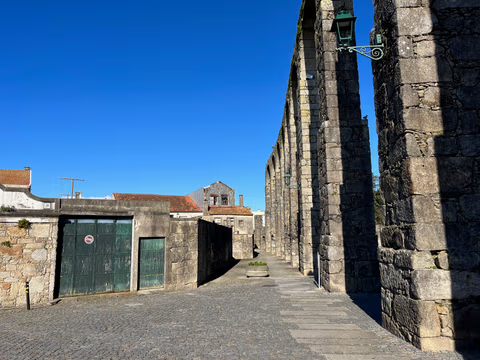
Aqueduct Trail – A path running along the Vila do Conde Aqueduct
From the Coastal Trail to the Camino Central: 12.9 km along the aqueduct from Vila do Conde to São Pedro de Rates. Route, stage, hostels, costs—explained honestly.
Read
Augsburg Way of St. James
The Augsburg Way of St. James runs 231.7 km in 11 stages from Oettingen in the Ries via Donauwörth, Augsburg, Bad Wörishofen and Ottobeuren to Ermengerst in the Allgäu — the Fuggerei, the Jakobervorstadt, a pilgrim of 1446 and Mozart's organ duel. Stages, hostels, costs.
Read

