

Camino Slovakia
The Camino Slovakia, in Slovak Svätojakubská cesta, crosses the entire country from east to west: 650.8 kilometers from St. Elisabeth Cathedral in Košice through the Spiš region, Liptov, the old mining towns and the Little Carpathians to Wolfsthal in Austria. It has been waymarked since 2013; the impetus came from a Colombian who came to Bratislava to study in 1984. There are no yellow arrows, only scallop-shell stickers on the signposts of the Slovak hiking trail network, and according to the Camino Ninja map more than 16,000 meters of elevation gain. In Wolfsthal, the Way of St. James in Austria takes over.
- 01At a Glance
- 02Overview
- 03Other Names
- 04Who It's Ideal For—and Who It's Not So Ideal For
- 05Route & Landscape
- 06Stages, Terrain, and Difficulty
- 07No Yellow Arrows Allowed: How a Colombian Waymarked Slovakia
- 08Highlights Along the Way
- 09Three Ways, One Ruin: The Bratislava Junction
- 10How Pilgrims Find Their Way onto This Path
- 11Continue the pilgrimage?
- 12Preparation & Practical Information
- 13What the journey will cost you
- 14Getting Here
At a Glance
- Start / Finish: St. Elisabeth Cathedral in Košice / Wolfsthal in Lower Austria, just past the Slovak–Austrian border
- Length: 650.8 km, of which about 637 km in Slovakia
- Duration: 28 stages, so four to five weeks including rest days
- Elevation: ↗ 16,072 m / ↘ 16,132 m according to the Camino Ninja map
- Highest point: 1,169 m at km 27.4, in the uplands between Predná Holica and Perlová
- Landscape: mountain forest in the Ore Mountains, the Spiš region below the High Tatras, Liptov and the Low Tatras, mining valleys, the Váh lowlands, the vineyards of the Little Carpathians
- Waymarking: a yellow shell on a dark-blue background, stuck as a sticker on the signposts of the Klub slovenských turistov, with the colored hiking blazes in between, and shell paving stones in Košice and Nitra
- Traces of St. James: the Basilica of St. James in Levoča with Master Paul's 18.62-meter-high altar, the ruins of the St. James Chapel beneath Námestie SNP in Bratislava, St. James's Church in Trnava; the country once had 31 churches dedicated to St. James
- Accommodation: guesthouses, mountain huts, dormitories, the occasional parish house
- Connecting routes: Way of St. James in Austria from Wolfsthal, Camino Húngaro arriving in Bratislava
- Best time: May to October; pilgrim passport: the association's Slovak credencial, €4.50 (as of October 2026)
Overview
The Camino Slovakia is a Way of St. James you have to earn, quite literally. It starts at St. Elisabeth Cathedral in Košice, begun around 1378 and finished with the choir in 1508, and it starts uphill: the first stage climbs out of the city into the forest, and by kilometer 27.4 you have already reached the highest point of the entire route at 1,169 meters. After that come the Spiš region with Levoča and Spiš Castle, Liptov below the Low Tatras, the mining towns of Banská Bystrica and Banská Štiavnica, the Benedictine monastery of Hronský Beňadik, Nitra, Trnava, the Little Carpathians and Bratislava. Several places on or near the route are UNESCO World Heritage Sites.
The route is young; the idea behind it is not. A Slovak study cites a reference to a pilgrimage from the territory of today's Slovakia to Compostela as early as 1307, and in 2013 the association opened the first waymarked section in Košice. In between lie 700 years in which the Way of St. James here consisted almost entirely of church dedications. So, honestly, you are not retracing a historic path but following a modern hiking network past old St. James sites—and that is a gift, because Slovakia has one of the densest trail networks in Europe. Walk here and you learn a sentence worth reading aloud: the Camino Slovakia has no yellow arrows because the law forbids them.
Other Names
In Slovak the route is called Svätojakubská cesta, literally "Way of Saint James," often with the addition na Slovensku; the association also promotes it as Camino de Santiago on its site caminodesantiago.sk. In German you will read Jakobsweg Slowakei or Slowakischer Jakobsweg, internationally Camino Slovakia or Way of St. James in Slovakia. A word of caution when researching: the older name Jakubská cesta belongs to a different organization with its own routes, from which the association explicitly distances itself.
Who It's Ideal For—and Who It's Not So Ideal For
Ideal if you are looking for a long route where you can go days without meeting another pilgrim, and if Gothic churches, mining history and mountain forest tempt you more than pilgrim infrastructure. Ideal, too, if you like walking with a GPS track: in the east and center you are almost always on mountain paths in the shade of the forest, pleasant even in high summer. And ideal if you want to walk it in sections: the four days from Košice to Levoča make a complete little Camino of their own.
Honestly, though, it's not for you if you expect yellow arrows and albergues every 20 kilometers. You have to find your own accommodation and usually call ahead, on public holidays a whole village can be booked out, and without a few words of Slovak that phone call gets tricky. Not for you if you don't like long mountain days: several stages run over 30 kilometers, and the stretch over Magurka climbs above 1,000 meters. And not for you if the thought of bears makes you nervous—they live in the Low Tatras and the Great Fatra, and you walk right through the middle.
Route & Landscape
Košice to Levoča (km 0–98.9): Via Bankov (km 6.3) and Predná Holica (km 18.6) the route climbs out of Košice into the Slovak Ore Mountains, up onto the ridge with the highest point (1,169 m, km 27.4) and down via Perlová to the little mining town of Gelnica (km 41.5). Via Krompachy (km 54.8) and Žehra (km 69.4) with its Church of the Holy Spirit you reach Spišské Podhradie (km 74.6) below Spiš Castle, then via Uloža (km 91.5, 884 m) the town of Levoča, which lies about 600 meters off the trail.
Levoča to Banská Štiavnica (km 98.9–366.1): Via Kežmarok (km 121.8), south of the High Tatras via Poprad (km 139.0, 700 m off the trail) and Važec (km 166.2) into Liptov to Liptovský Hrádok (km 194.1) and Partizánska Ľupča (km 228.1). That is where the mountain section begins: over Magurka (1,030 m, km 244.6) to Liptovská Lúžna, via Donovaly (km 272.8, 985 m) down into the copper towns of Staré Hory and Špania Dolina to Banská Bystrica (km 304.8). Via Sampor and Zvolen, which lies a kilometer off the route, you continue to Banská Štiavnica (km 366.1, 1.2 km off the trail).
Banská Štiavnica to Wolfsthal (km 366.1–650.8): Via Rudno nad Hronom (km 396.3) and Nová Baňa the route climbs once more onto Veľký Inovec (859 m, km 412.3) and drops to the Benedictine abbey of Hronský Beňadik (km 422.5). Then it flattens out: via Nitra (km 490.3) and the Váh lowlands, with the lowest point at 124 meters, to Trnava (km 554.6). From Budmerice (km 574.5) you climb into the Little Carpathians, via Pezinok (km 600.2) and Biely kríž (499 m) to Marianka (km 622.8) and down to Bratislava (km 637.3). The last 13.5 kilometers lead across the Danube to Wolfsthal.
Stages, Terrain, and Difficulty
We show the route in 28 stages, with distances from the Camino Ninja map, calibrated exactly to 650.8 km. The stage towns have accommodation; daily distances range from 13.5 to 33.9 kilometers. The association's stage ends differ from ours in places.
- Košice → Predná Holica (18.6 km) — A steep start out of the city via Bankov and Jahodná into the mountain forest.
- Predná Holica → Gelnica (22.9 km) — Over the highest point (1,169 m) and down via Perlová into the Hnilec valley; waymarking patchy in places.
- Gelnica → Spišské Podhradie (33.1 km) — The toughest stage in the east, via Krompachy and Žehra to the foot of Spiš Castle.
- Spišské Podhradie → Levoča (24.3 km) — Over Uloža at 884 m and down to the Basilica of St. James.
- Levoča → Kežmarok (22.9 km) — Rolling Spiš countryside with your first Tatra panorama.
- Kežmarok → Poprad (17.2 km) — A short day via Huncovce and Veľká Lomnica.
- Poprad → Važec (27.2 km) — Below the High Tatras via Svit and Štrba.
- Važec → Liptovský Hrádok (27.9 km) — Into Liptov, via Svarín and Kráľova Lehota.
- Liptovský Hrádok → Lazisko (17.2 km) — Via Liptovský Ján and Pavčina Lehota at the foot of the Low Tatras.
- Lazisko → Partizánska Ľupča (16.8 km) — A short day before the mountain section.
- Partizánska Ľupča → Liptovská Lúžna (26.7 km) — Mountain stage over Magurka at 1,030 m; bring provisions.
- Liptovská Lúžna → Donovaly (18.0 km) — Via Liptovská Osada up to the Donovaly pass.
- Donovaly → Banská Bystrica (32.0 km) — A long descent through the copper villages of Staré Hory and Špania Dolina.
- Banská Bystrica → Zvolen (27.4 km) — Along the Hron valley via Sampor.
- Zvolen → Banská Štiavnica (33.9 km) — The longest stage, via Banský Studenec to the mining town.
- Banská Štiavnica → Rudno nad Hronom (30.2 km) — Via Štiavnické Bane and Vysoká down into the Hron valley.
- Rudno nad Hronom → Hronský Beňadik (26.2 km) — Via Nová Baňa onto Veľký Inovec (859 m) and on to the abbey.
- Hronský Beňadik → Topoľčianky (20.5 km) — Into the hill country via Machulince.
- Topoľčianky → Žirany (24.7 km) — Via Velčice; the Remitáž charterhouse lies 2.6 km off the route.
- Žirany → Nitra (22.6 km) — Through fields and villages to the country's oldest episcopal city.
- Nitra → Veľké Zálužie (17.4 km) — Flat, via Lehota.
- Veľké Zálužie → Šintava (25.0 km) — Via Báb and Pata to the Váh, with the lowest point of the route.
- Šintava → Trnava (21.9 km) — Farm tracks into the "Slovak Rome."
- Trnava → Budmerice (19.9 km) — Via Biely Kostol and Cífer to the edge of the Little Carpathians.
- Budmerice → Pezinok (25.7 km) — Via Píla through the Little Carpathians to the wine town.
- Pezinok → Marianka (22.6 km) — Via Limbach, Svätý Jur and Biely kríž to the Marian pilgrimage site.
- Marianka → Bratislava (14.5 km) — Through the city forest down into the capital.
- Bratislava → Wolfsthal (13.5 km) — Across the Danube and flat into Austria.
In the east and center the surface is almost entirely mountain path and forest road, unsuitable for bikes and strollers; in the west, farm tracks and minor roads become more frequent. The map's total elevation gain looks high because the profile counts many small blips in the forested valleys; the real mountain sections are the Ore Mountains, Magurka–Donovaly and the Štiavnica Mountains.
No Yellow Arrows Allowed: How a Colombian Waymarked Slovakia
Cástor Sánchez came from Colombia to study in what was then Czechoslovakia in 1984, and he stayed. He walked to Compostela three times, on three different routes, and in 2012 he walked with a Spanish friend from Bratislava to Hainburg to see whether a Camino could be connected here. In June 2013 he and fellow enthusiasts founded the association Priatelia Svätojakubskej cesty na Slovensku; in the fall of that same year the first section, to Levoča, was opened in Košice, and by May 2019 about 80 percent was waymarked. The Slovak Bishops' Conference approved and blessed the project, and the Klub slovenských turistov and the Slovenský cykloklub are partners.
The problem every pilgrim notices right away: painting yellow arrows on trees and rocks is simply not allowed in Slovakia without permits. So the association sticks its symbol, a yellow shell on a dark-blue background, onto the hiking club's signposts and has pilgrims follow the red, blue, green or yellow marked hiking trails in between—three horizontal stripes, roughly ten by ten centimeters, white on the outside. In Košice and Nitra, bronze and ceramic shells are set into the pavement. The association explicitly warns against the occasional yellow arrows painted by others: those marks are unsystematic and may well lead nowhere.
And why a Way of St. James here at all? Because the traces are there if you look. The newspaper Štandard counts 31 historic churches of St. James in the country, the most prominent being the Basilica of St. James in Levoča. Association member Jaroslav Drábik says: "Verím, že časom sa objaví viac historických záznamov o prvých pútnikoch zo Slovenska" ("I believe that over time more historical records of the first pilgrims from Slovakia will turn up"). Until then, the rule holds: the oldest Way of St. James in Slovakia is the one you are walking right now.
Highlights Along the Way
- St. Elisabeth Cathedral, Košice (km 0) — Slovakia's largest church, built from around 1378 to 1508, south tower from 1461; Prince Francis II Rákóczi has rested in the crypt since 1906.
- Žehra and Spiš Castle (km 69.4–74.6) — the Church of the Holy Spirit in Žehra and the castle ruins above Spišské Podhradie, a UNESCO World Heritage Site since 1993; Levoča was added in 2009.
- Basilica of St. James, Levoča (km 98.9, 600 m off the trail) — begun in the 14th century, with eleven Gothic altars; the high altar by Master Paul of Levoča stands 18.62 meters tall and is considered the tallest medieval altarpiece in the world.
- Kežmarok (km 121.8) — opened its section of the route on November 14, 2014.
- Banská Štiavnica (km 366.1, 1.2 km off the trail) — a silver-mining town, a UNESCO World Heritage Site since 1993.
- Hronský Beňadik (km 422.5) — a Benedictine abbey, endowed in 1075 by King Géza I with one of the oldest charters relating to Slovakia; home to the relic of the Holy Blood since 1483, fortified against the Ottomans from 1572.
- Trnava (km 554.6) — seat of the Archbishops of Esztergom from 1543, with so many churches that it is called the Slovak Rome, a St. James's Church among them.
- Marianka (km 622.8) — Slovakia's oldest pilgrimage site: King Louis I the Great laid the foundation stone in 1377, the church stood by 1380, and the Paulines looked after it until 1786.
- St. James Chapel, Bratislava (km 637.3) — torn down by the city itself in the spring of 1529 for fear of the Ottomans; rediscovered in 1994 during cable work beneath Námestie SNP.
Three Ways, One Ruin: The Bratislava Junction
At the excavated St. James Chapel beneath Námestie SNP, three Ways of St. James converge. The Slovak one comes from Košice, the Camino Húngaro from Budapest via Rajka, and the Way of St. James in Austria takes its first step here before leading across the Danube to Wolfsthal. The chapel and its ossuary now lie under glass and open only once or twice a year; you can still see the remains of the walls from above.
That pilgrims from the old Kingdom of Hungary, to which Slovakia belonged, really did reach Santiago is documented: the nobleman Tari Lőrinc, cupbearer to King Sigismund, received his royal permission to go on pilgrimage on January 10, 1408, prayed at the tomb of St. James and in 1411 descended into St. Patrick's Purgatory in Ireland. Whether his route led through Pressburg, today's Bratislava, is not documented.
How Pilgrims Find Their Way onto This Path
The route begins in Košice and has no feeder route from the east in the Camino Ninja network; most pilgrims arrive by train or plane. A second entry point is Bratislava: if you walk the Camino Húngaro from Budapest, you meet the Slovak route here and walk the last 13.5 kilometers to Wolfsthal together with it.
Many walk the route in sections over several years; nearly all of the association's section ends have train stations.
Continue the pilgrimage?
Yes, and a long way at that: in Wolfsthal the Way of St. James in Austria connects, running via Carnuntum and Vienna, Salzburg and Innsbruck to Rankweil in Vorarlberg. From there it continues through Switzerland and France; from Wolfsthal to Santiago it is about 3,400 kilometers.
If Wolfsthal is enough for you, take the S-Bahn commuter train to Vienna or walk back to Bratislava.
Preparation & Practical Information
Pilgrim passport and app. As on all recognized Ways of St. James, you need a pilgrim passport (credencial) to collect stamps along the way and receive your Compostela in Santiago at the end. Ideally, order it online in advance so it reaches you in time for the start of your trip. The association sells its own Slovak credencial, registered with the Pilgrim's Office in Santiago, for €4.50 (as of October 2026); you can get stamps in churches, information centers, accommodations and inns. Since you won't be following arrows, a GPS track is a must: with the Camino Ninja App you have the map and route offline, and the easiest way to plan is right in the app, where you put together your stages and line up suitable accommodation at the same time.
Slovak certificate. After at least 100 kilometers walked, the association issues its own pilgrim certificate, handed out in Hronský Beňadik and in Bratislava. Check with the association before you arrive about where and when it is currently available.
Accommodation and season. Call one or two days ahead, earlier before public holidays. The best time is May to October; in winter the ridge paths in the Ore Mountains and on Magurka are under snow. In bear country, it's best to walk in daylight, not alone off the trails, and to make yourself heard by talking.
What the journey will cost you
Slovakia is cheaper than Austria or Germany, and you pay in euros. A bed in a student dormitory in Košice costs about €18, guesthouses and mountain huts are mostly €25 to €45 per person, and a set lunch at an inn €8 to €12 (as of October 2026). Parish houses occasionally take in pilgrims for a donation, but you can't count on it.
Budget €40 to €60 a day for accommodation and food; if you self-cater from the supermarket, you'll get by for less.
Getting Here
To the start. Košice has an airport with connections to Vienna, among other places, and a train station with direct trains from Bratislava, about five hours' ride. From German-speaking countries you travel via Vienna. The route starts at St. Elisabeth Cathedral in the old town, a ten-minute walk from the station.
From the finish. From Wolfsthal, ÖBB's S7 commuter line runs via Vienna Airport into the city, a little over an hour to Wien Hauptbahnhof. Back to Bratislava it is 13.5 kilometers on foot or a short detour via Vienna.
- Rail in Slovakia: zssk.sk — timetables and tickets of the Slovak state railway
- Rail in Austria: oebb.at — S7 Wolfsthal–Vienna
- Route, stages and credencial: caminodesantiago.sk
Partners
Partner for Camino Slovakia
Camino Ninja is cooperating with official partners. For this camino the partner is:


Get your pilgrim credential and shell
Everything you need for the Camino Slovakia, shipped to your door.
Visit Camino Shop
Other Caminos
 Appenzeller Weg
Appenzeller Weg
52.6 km from Rankweil across the Rhine to St. Peterzell: St. James Chapel (1464), 163 Years of the Wedding Trail, connection to the Via Jacobi. Stages, costs, how to get there.
Read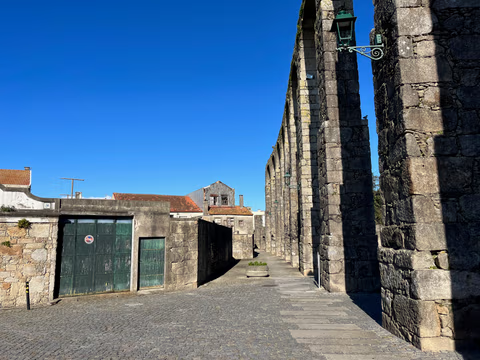
Aqueduct Trail – A path running along the Vila do Conde Aqueduct
From the Coastal Trail to the Camino Central: 12.9 km along the aqueduct from Vila do Conde to São Pedro de Rates. Route, stage, hostels, costs—explained honestly.
Read
Augsburg Way of St. James
The Augsburg Way of St. James runs 231.7 km in 11 stages from Oettingen in the Ries via Donauwörth, Augsburg, Bad Wörishofen and Ottobeuren to Ermengerst in the Allgäu — the Fuggerei, the Jakobervorstadt, a pilgrim of 1446 and Mozart's organ duel. Stages, hostels, costs.
Read

