

Camino Vasco del Interior
The Camino Vasco del Interior runs 202.6 kilometers from Irún on the French border straight across the Basque Country to Santo Domingo de la Calzada in La Rioja, where it meets the Camino Francés. It follows the valley of the Oria through Tolosa and Beasain, climbs through the Sierra de Aizkorri to the San Adrián tunnel and, just beyond it, reaches its highest point at 1,134 meters. From there it crosses the plain of Álava to Vitoria-Gasteiz, passes through the Burgos enclave of La Puebla de Arganzón and runs over the vineyards of Haro to the finish. Nine stages, 3,477 meters of climbing, and a rock cave whose saint is the product of a mishearing.
- 01At a Glance
- 02Overview
- 03Other Names
- 04Who It's Ideal For—and Who It's Not So Ideal For
- 05Route & Landscape
- 06Stages, Terrain, and Difficulty
- 07The Saint Who Never Was: How the Holy Trinity Became San Adrián
- 08Highlights Along the Way
- 09Two Routes, One Plain: the 17 Towns Shared with the Camino de las Asturias
- 10How Pilgrims Find Their Way onto This Path
- 11Continue the pilgrimage?
- 12Preparation & Practical Information
- 13What the journey will cost you
- 14Getting Here
At a Glance
- Start / Finish: Irún on the Bidasoa / Santo Domingo de la Calzada (La Rioja), junction with the Camino Francés; the cathedral lies a good half kilometer from the end of the map line
- Length: 202.6 km, of which 54.8 km between Agurain and Armiñón run on the same track as the Camino de las Asturias
- Duration: 9 stages, averaging a little over 22 km; experienced walkers manage it in 8 days
- Elevation: ↗ 3,477 m / ↘ 2,845 m
- Highest point: 1,134 m at km 90.3, summit of the calzada on the Gipuzkoa–Álava border, just past the San Adrián tunnel
- Landscape: the green hills of Gipuzkoa, the industrial Oria valley, beech forest in the Sierra de Aizkorri, the grain plain of the Llanada Alavesa, and finally vineyards along the Ebro and the Oja
- Operator / Waymarking: yellow arrows and scallop-shell markers from the Basque pilgrim associations; revived since 2005 on the initiative of the Basque government
- Traces of St. James: the San Adrián tunnel and calzada as a UNESCO World Heritage site (2015), Santiagomendi near Astigarraga, the Santiago chapel in Vitoria's cathedral, the pilgrim hospital of Agurain (documented in 1487), the chicken miracle of Santo Domingo
- Accommodation: pilgrim albergues in Irún, Andoain, Beasain, Zegama, Zalduondo, Agurain, La Puebla and Haro (mostly 10 €), plus guesthouses; no albergue in Hernani
- Connecting routes: Camino Francés in Santo Domingo, Camino del Norte and Saint-Jean-Pied-de-Port – Irun in Irún, Camino de las Asturias between Agurain and Armiñón
- Best time: May to June and September to October; in winter, snow and fog on the Aizkorri, in high summer no shade between Haro and Santo Domingo
Overview
The Camino Vasco del Interior answers a question every pilgrim coming from France asks in Irún: coast or interior? The Camino del Norte sticks to the sea; this route turns south, through the valley of the Oria and over the mountains, and after 202.6 kilometers puts you on the Camino Francés—long before Burgos, in the heart of La Rioja. It follows the Roman road from Astorga to Bordeaux. Gronze calls it probably the “ruta terrestre más utilizada por los peregrinos” between the 9th and 12th centuries—the overland route pilgrims used most.
Then it fell into oblivion, and only from 2005 on did it “renació” (come back to life) as a pilgrimage route, after a campaign by the culture and tourism departments of the Basque government; associations waymarked it and set up albergues. Today you walk through towns that Alfonso X founded in 1256 specifically as bases along this road, through a 55-meter rock cave at 1,000 meters, and through medieval Vitoria, founded in 1181 as Nova Victoria. They say kings had to doff their hats here—and it's actually true, for architectural reasons.
Other Names
In Spanish the route is called Camino Vasco del Interior or simply Camino del Interior; older guidebooks call it the Vía de Bayona or Ruta de Bayona, because the pilgrims came from Bayonne. Since 2015 UNESCO has listed it as the Camino del Interior del País Vasco y La Rioja (in English, the Interior Way). German guides call it the Baskischer Binnenweg (Basque Inland Way) or the Tunnelweg (Tunnel Way), after the San Adrián tunnel. Many towns have two official names, such as Agurain/Salvatierra or Vitoria-Gasteiz.
Who It's Ideal For—and Who It's Not So Ideal For
Ideal if you've already walked a Camino and want a run-up of your own to the Francés: nine days in the Basque Country, one real mountain day, and an arrival in Santo Domingo with the feeling that you're bringing something with you. Ideal if towns appeal to you—Tolosa, Segura, Vitoria and Haro aren't places to pass through but reasons for a half rest day. And ideal if you love to eat: pintxos in Vitoria, cheese in Idiazabal, Rioja in Haro.
Honestly, though, it's not for you if you expect nature all the way: the first three days often run on bike paths and asphalt through the Oria valley, next to the highway, the railroad and factories. Not for you if you only want to sleep in albergues—there are none in Hernani, and the one in La Puebla has only eight beds. And not for you in fog or snow on the Aizkorri: Gronze rates the stage over San Adrián as hard, 4 out of 5, and the limestone on the calzada is slippery when wet.
Route & Landscape
Irún to Zegama (km 0–81.8): From Irún you climb via Gurutze and Oiartzun (km 10.8) into the hills, over the saddle of Santiagomendi with its chapel and youth hostel, and down to Astigarraga (km 22.7) and Hernani (km 26.2). Then the river takes over: via Urnieta, Andoain (km 34.2), Villabona and Anoeta the route follows the Oria to Tolosa (km 47.2). Beyond Alegia and Itsasondo come Ordizia (km 62.7) and Beasain (km 65.3), then the valley narrows: Idiazabal (km 72.6), Segura (km 76.3) and Zegama (km 81.8) at the foot of the Sierra de Aizkorri. Lazkao and Zerain lie just under a kilometer off the route.
Zegama to Santo Domingo (km 81.8–202.6): From Zegama you climb through pastures and beech forest to the house of the Miqueletes (km 88.7, 948 m) and the San Adrián tunnel, then along the calzada to the summit at km 90.3 and down to Zalduondo (km 97.0); Araia lies 2 km off the route. After Agurain/Salvatierra (km 103.2) the Llanada Alavesa begins, a broad grain plain with villages every two or three kilometers: Gazeo, Elburgo, Argandoña, Arkaia, then Vitoria-Gasteiz (km 131.9). Beyond the city the route runs via Subijana to La Puebla de Arganzón (km 151.1) and Armiñón (km 158.0), then via Berantevilla and Zambrana to walled Salinillas de Buradón (km 173.7), over the Portillo de la Lobera and steeply down to Briñas on the Ebro and on to Haro (km 182.4). The final day runs without shade through wheat and vines via Zarratón and Bañares to Santo Domingo de la Calzada (km 202.6).
Stages, Terrain, and Difficulty
We show the route in 9 stages ending in places with an albergue or guesthouse; distances come from the Camino Ninja map, calibrated exactly to 202.6 km. If you'd like to split the long penultimate stage, sleep in Salinillas de Buradón (km 173.7) at the private albergue La Bodega.
- Irún → Hernani (26.2 km) — Up and down via Oiartzun and Santiagomendi, steep descent to Astigarraga; only guesthouses in Hernani.
- Hernani → Tolosa (21.0 km) — Flat along the Oria, lots of bike path and asphalt through Urnieta, Andoain and Villabona.
- Tolosa → Beasain (18.1 km) — Valley walk via Alegia, Legorreta and Ordizia; pilgrim albergue in the old mill of Igartza.
- Beasain → Zegama (16.5 km) — Short and green via Idiazabal and Segura, meant to save your strength for the mountain.
- Zegama → Agurain/Salvatierra (21.4 km) — The queen stage: about 840 meters of climbing to the San Adrián tunnel, calzada through beech forest, descent via Zalduondo and Ordoñana.
- Agurain/Salvatierra → Vitoria-Gasteiz (28.7 km) — Long but flat across the Llanada Alavesa, Romanesque churches in almost every village.
- Vitoria-Gasteiz → La Puebla de Arganzón (19.2 km) — Out of the city, about 200 meters of climbing at the San Miguel pass, finish in the Burgos enclave.
- La Puebla de Arganzón → Haro (31.3 km) — The longest day with a broken profile: Salinillas, the Portillo de la Lobera and a tough descent to Briñas.
- Haro → Santo Domingo de la Calzada (20.2 km) — Easy, but without a single tree: grain and vines all the way to the Camino Francés.
Only the section at San Adrián is technically demanding, because of the altitude and the slippery paving. Otherwise it's distance and surface that challenge you: hard pavement in the Oria valley, wide farm tracks in the sun on the Llanada and in La Rioja.
The Saint Who Never Was: How the Holy Trinity Became San Adrián
The chapel in the tunnel was originally dedicated to the Holy Trinity, in Latin Sancta Trinitate. Basque tongues wore the name down to “Sandrati”, and Spanish ears heard a Saint Adrian in it—so says the Spanish Wikipedia, citing local research. The name stuck to the cave, the pass and the route. Yet to this day the celebration takes place on Trinity Sunday, with a pilgrimage up to the rock chamber: the saint is wrong, but the feast stayed right.
The cave itself is a natural passage about 55 meters long at roughly 1,000 meters of altitude, beneath the Aitzkorri. During excavations in 2008, archaeologists found flint tools they dated to 13,000 to 15,000 years ago; back in 1964, belt buckles, rings, keys and more than a hundred coins had already turned up, minted under Sancho IV of Navarre in the 11th century and Alfonso VIII of Castile in the 12th. In the darkness of the tunnel, quite a few travelers apparently came out poorer than they went in. After 1200, Castile fortified the pass with walls, gates and arrow slits at both entrances.
Then the travelers. The German Servite friar Hermann Künig von Vach passed through the tunnel in 1495 on his way back from Santiago. Antoine de Lalaing, a courtier traveling in the retinue of Philip the Handsome, noted in the early 16th century that there was a tunnel at the top, “requisito previo para llegar a Santiago”—a mandatory stop on the way to Santiago. In 1572 the Italian J. B. Venturino found the cave “oscura y aterradora”, dark and terrifying; in 1599 Jacob Cuelvis saw there the “gran devoción de los peregrinos que vienen del camino de Francia”, the great devotion of the pilgrims coming from the road from France. And the alcaide boasted that he was one of the most exalted men in Europe, since even kings had to doff their hats before him—the entrance was so low that every rider had to dismount and stoop.
In practical terms: today's chapel dates from the end of the 19th century and stands against the north wall; inside the tunnel it's cool and damp, and a headlamp won't hurt. Beyond the exit lies the calzada from two building phases, an older 16th-century stretch about 2.30 meters wide and an early 18th-century expansion up to 3.75 meters wide for carriages. The inn and the Miqueletes barracks on the climb burned down in 1915; you'll know the ruins from the map as Mikeleteen etxea. Since July 2015, the tunnel and calzada have been part of the UNESCO World Heritage site of the Routes of Santiago in northern Spain as a component in their own right.
Highlights Along the Way
- Santiagomendi (between Oiartzun and Astigarraga) — the “Mount of St. James” with a chapel and youth hostel, the first St. James site after the border.
- Tolosa (km 47.2) — granted its charter by Alfonso X in 1256, capital of Gipuzkoa from 1844 to 1854; the church of Santa María, rebuilt from 1548 after the fire of 1503, and a carnival that survived Franco as a “spring festival.”
- Segura (km 76.3) — laid out in 1256 as a walled new town to protect the trade road to Castile; Gothic parish church, Poor Clares convent from 1519.
- Zegama (km 81.8) — parish church of San Martín from the 15th and 16th centuries with the mausoleum of the Carlist general Tomás de Zumalacárregui, inaugurated in 1886.
- Agurain/Salvatierra (km 103.2) — town charter in 1256, when Alfonso X renamed the village of Hagurahin Salvatierra; fortified churches of San Juan and Santa María, and in 1487 a pilgrim hospital, San Lázaro y la Magdalena.
- Gazeo (km 107.2) — the unassuming church of San Martín, where Gothic murals from the early 14th century came to light on September 7, 1967.
- Vitoria-Gasteiz (km 131.9) — founded in 1181 by Sancho VI of Navarre as Nova Victoria, European Green Capital in 2012; Cathedral of Santa María with its Santiago chapel.
- Salinillas de Buradón (km 173.7) — walled village founded by Alfonso X in 1264, with 107 inhabitants, a salt works until the late 19th century.
- Haro (km 182.4) — wine capital of the Rioja Alta; on September 7, 1890, the first electric streetlights were switched on here, hence the saying “Haro, París y Londres”. On June 29, the Wine Battle at the Riscos de Bilibio.
- Santo Domingo de la Calzada (km 202.6) — cathedral from 1158, a 15th-century henhouse with a live rooster and hen, the saint's pilgrim hospital, a Parador since 1965.
Two Routes, One Plain: the 17 Towns Shared with the Camino de las Asturias
In Agurain you get company, at least on the map. This is where the Camino de las Asturias joins, coming from Pamplona through the Burunda valley and heading for Oviedo. For the next 54.8 kilometers both routes run on the same track: Agurain, Gazeo, Ezkerekotxa, Alegría-Dulantzi, Elburgo, Villafranca, Argandoña, Askartza, Arkaia, Elorriaga, Vitoria-Gasteiz, Gometxa, Subijana de Álava, La Puebla de Arganzón, Burgueta, Estavillo and Armiñón—17 places, two names. Beyond Armiñón they part ways: the Asturias route turns west into the monastery country of Valdegovía, while the Vasco heads south to the Ebro.
That's no quirk of cartography but of geography. The Llanada Alavesa is the only easy corridor between the mountains of the north and the Meseta, and this is where the Roman road crossed the early medieval pilgrim routes to Oviedo. In practical terms: on this section the albergues and arrows are the same for both routes, and anyone you meet between Vitoria and Armiñón may have come from Irún or from Pamplona. Just past the shared stretch, at Estavillo, the old Vía de Bayona also branches off via Miranda de Ebro to Burgos—our map follows the branch to La Rioja.
How Pilgrims Find Their Way onto This Path
Most people start in Irún. If you're coming on foot from France, you reach the town on the Saint-Jean-Pied-de-Port – Irun, the link from the great French pilgrim hub to the coast, or on the first stretch of the Camino del Norte from Bayonne. In Irún, coast and interior part ways: the Norte climbs up the Jaizkibel, the Vasco up to Gurutze.
A second entry point is Agurain. If you're walking the Camino de las Asturias from Pamplona, you can switch to the Vasco there and, instead of heading for Oviedo, reach the Francés via Vitoria and Haro. Short on time? Start in Vitoria-Gasteiz: from there it's still about 70 kilometers, three to four days.
Continue the pilgrimage?
Yes—and on the best-known route of all: in Santo Domingo de la Calzada you're standing on the Camino Francés, with albergues such as the one run by the Cofradía del Santo right next to the cathedral. Westward it goes via Burgos and León to Santiago de Compostela—and pilgrim life changes abruptly: in summer the albergues here fill up early.
If you prefer the Burgos branch of the Vía de Bayona, turn off at Estavillo and reach the Camino Francés only in Burgos; on our map, this branch is not part of this route.
Preparation & Practical Information
Pilgrim passport and app. As on all Spanish routes, you need a pilgrim passport (credencial) to stay in the albergues and to receive the Compostela at the end. It's best to order it online in advance so it reaches you in time for the start of your trip. Because the albergues are farther apart than on the Francés, planning ahead pays off—and the easiest way to do that is right in the Camino Ninja App, where you put together your stages and plan suitable accommodation along with them.
Albergues. There are pilgrim albergues in Irún (Jakobi, with breakfast), Andoain, Beasain, Zegama (30 beds, open year-round), Zalduondo, Agurain, La Puebla (8 beds, key at the town hall) and Haro; in Vitoria you sleep at the Albergue de la Catedral in the old town. On top of that there's Zuloaga Txiki before Tolosa and the Santiagomendi youth hostel. For Hernani and Briñas you'll need a guesthouse.
Season and gear. The Basque Country is green because it rains—a rain jacket belongs in your pack. Check the forecast before the Zegama–Agurain stage; for the last day in La Rioja the opposite applies: start early, carry plenty of water.
What the journey will cost you
The pilgrim albergues in Zegama, Agurain and Haro cost 10 € each, the municipal albergue in Alegría-Dulantzi 4 €, Korta in Araia 12 €, the Santiagomendi youth hostel 10 €. At the Albergue de la Catedral in Vitoria you pay 18 to 26 € in a dorm depending on season and age, bed linen included, and the private albergue in Salinillas about 20 €. In Santo Domingo, the albergues of the Cofradía cost 13 € and of the Cistercian nuns 13 to 15 € (as of October 2026).
Guesthouses in the Basque Country run 40 to 60 € for a single room, more in Vitoria and Hernani. Budget 30 to 45 € a day with albergue, breakfast in a bar and a menú del día; with guesthouses, more like 60 to 80 €. Honestly, the Basque Country is more expensive than the rest of northern Spain, and the pintxos counter is the most dangerous place on the entire route for your budget.
Getting Here
To the start. Irún lies directly across from Hendaye in France: the TGV runs from Paris to Hendaye, and from there it's just a few minutes across the border. Irún has a Renfe station with long-distance trains to Madrid and Barcelona, and the Basque railway Euskotren connects Hendaye and Irún with San Sebastián. San Sebastián airport is in neighboring Hondarribia; for bigger connections, use Bilbao or Biarritz.
From the finish. Santo Domingo de la Calzada has no train station; buses run to Logroño and Burgos, and from there trains continue to Madrid or Bilbao.
- Rail, Spain: renfe.com — Irún, Vitoria-Gasteiz, Logroño, Burgos
- Rail, France: sncf-connect.com — TGV to Hendaye
- Basque railway: euskotren.eus — Hendaye, Irún, San Sebastián

Get your pilgrim credential and shell
Everything you need for the Camino Vasco del Interior, shipped to your door.
Visit Camino Shop
Other Caminos
 Appenzeller Weg
Appenzeller Weg
52.6 km from Rankweil across the Rhine to St. Peterzell: St. James Chapel (1464), 163 Years of the Wedding Trail, connection to the Via Jacobi. Stages, costs, how to get there.
Read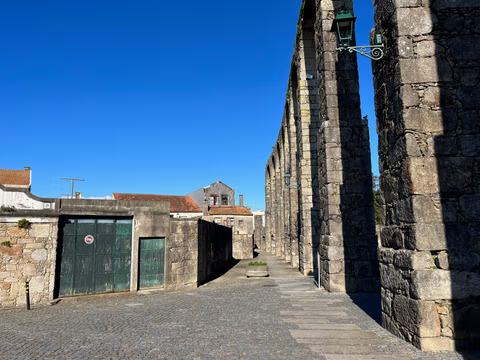
Aqueduct Trail – A path running along the Vila do Conde Aqueduct
From the Coastal Trail to the Camino Central: 12.9 km along the aqueduct from Vila do Conde to São Pedro de Rates. Route, stage, hostels, costs—explained honestly.
Read
Augsburg Way of St. James
The Augsburg Way of St. James runs 231.7 km in 11 stages from Oettingen in the Ries via Donauwörth, Augsburg, Bad Wörishofen and Ottobeuren to Ermengerst in the Allgäu — the Fuggerei, the Jakobervorstadt, a pilgrim of 1446 and Mozart's organ duel. Stages, hostels, costs.
Read

