

Jakobsweg Fulda – Trier
The Fulda–Trier Way of St. James stretches 337.9 km from the tomb of St. Boniface through the Kinzig Valley and the Rhine-Main region, and along the Roman Ausonius Road in the Hunsrück Mountains to the Porta Nigra—the great westward traverse through the heart of Germany.
- 01At a Glance
- 02Overview
- 03Other Names
- 04Who It's Ideal For—and Who It's Not So Ideal For
- 05Route & Landscape
- 06Stages, Terrain & Difficulty
- 07Boniface: The journey begins at an apostle's tomb
- 08On the Poet's Trail: Ausoniusstraße through the Hunsrück
- 09Highlights Along the Way
- 10How Pilgrims Find Their Way onto This Path
- 11Continue the pilgrimage?
- 12Preparation & Practical Information
- 13What the journey will cost you
- 14Getting There
At a Glance
- Start / Finish: Fulda (Cathedral, Boniface's Tomb) → Trier (St. Peter's Cathedral)
- Length: 337.9 km
- Elevation gain: ↗ 3,842 m / ↘ 3,959 m
- Duration: about 13–15 days
- Marking: Yellow scallop on a blue background
- Difficulty: easy to moderate
- Best time to visit: April through October
- Connection: Trier – Le Puy, heading toward France and Santiago
Overview
The Fulda–Trier Way of St. James is the great westward route across central Germany: 337.9 km from the tomb of St. Boniface at Fulda Cathedral, through the Kinzig Valley, across Frankfurt and Mainz to the Rhine—and then, following the route of a Roman road, across the Hunsrück to the Porta Nigra in Sort.
Hardly any other German trail is steeped in so much history: half-timbered towns like Steinau and Gelnhausen, the Brothers Grimm, Gutenberg’s Mainz, Hildegard of Bingen—and, at the end, Germany’s oldest city. Yet the trail remains gentle: its highest point is the Hunsrück ridge at just over 600 meters.
And Trier is not a final destination, but a hub: this is where the Ways of St. James from Koblenz and Cologne converge, and the connecting route to Le Puy marks the start of the classic route toward France and Santiago.
Other Names
The official name of the route is The Way of St. James: Fulda – Mainz – Trier. The Mainz–Fulda section is also known as Boniface Route well-known (in the opposite direction), and the Bingen–Trier section is named Ausonius Trail or the Hunsrück Way of St. James. On our map, you'll find the route as Fulda - Trier.
Who It's Ideal For—and Who It's Not So Ideal For
This route is ideal for you if you’re looking for a long, multi-stage trip through Germany with maximum variety: City and countryside alternate in a way rarely seen elsewhere, each section has its own theme—Grimm Country, Rhine Romanticism, the Roman Road—and with Frankfurt and Mainz, there are two major rail hubs along the route that make stage-by-stage pilgrimage a breeze.
It’s probably not for you if you’re looking for nothing but nature the whole way: the Rhine-Main metropolitan area is part of the route, with suburban and paved stretches around Frankfurt and Mainz. Traditional pilgrim hostels are rare—you’ll be staying in guesthouses, monasteries, and inns.
Route & Landscape
Fulda → Frankfurt (approx. 110 km): From Boniface's grave, the trail follows the Kinzig Valley between the Vogelsberg and the Spessart — through Steinau on the Road, the town where the Brothers Grimm spent their childhood, and the town of Barbarossa Gelnhausen with its Imperial Palace, until the Frankfurt skyline comes into view.
Frankfurt → Bingen (approx. 75 km): Cross the Main River and walk through the city's green spaces to reach Mainz with its cathedral and Gutenberg heritage, the trail then follows the Rhine to Bingen — Hildegard's town, across from the Mäuseturm, at the gateway to the Upper Middle Rhine Valley UNESCO World Heritage Site.
Bingen → Trier (approx. 118 km): Now the quietest chapter begins: On the Ausonius Trail you climb up into the Hunsrück and spend days following the dead-straight course of a Roman road through forests and hilltop villages—passing through Simmern and the Belginum Archaeological Park—until the path descends into the Moselle Valley and into Sort ends.
Stages, Terrain & Difficulty
The route typically consists of 13–15 stages ranging from 20 to 30 km. The terrain is moderate: the climbs are spread out, and only the ascent from Bingen to the Hunsrück and the undulating terrain of the Kinzig Valley require a certain level of fitness. The route is roughly divided as follows:
- Fulda → Gelnhausen (approx. 75 km, 3 stages) — Kinzig Valley, Schlüchtern, Steinau
- Gelnhausen → Frankfurt (approx. 35 km, 1–2 stages) — through the Wetterau region to the Main metropolis
- Frankfurt → Mainz (approx. 40 km, 2 stages) — along the Main River to the cathedral
- Mainz → Bingen (approx. 35 km, 1–2 stages) — Rheinhessen and the banks of the Rhine
- Bingen → Simmern (approx. 40 km, 2 stages) — Hike up the Hunsrück, Ausonius Trail
- Simmern → Trier (approx. 78 km, 3–4 stages) — Roman Road, Belginum, descent into the Moselle Valley
Boniface: The journey begins at an apostle's tomb
Just as Santiago is the guardian of the tomb of the Apostle James, Fulda is the guardian of the tomb of the Boniface — the “Apostle of the Germans.” After his martyrdom in 754 in Friesland, his remains were transported in a solemn procession via Mainz to Fulda; the modern Boniface Route retraces exactly this path of mourning, and the first leg of your journey follows it in the opposite direction. So you’ll be starting at one of Germany’s most significant pilgrimage destinations.
At the other end, the next major sanctuary awaits: Trier Cathedral, Germany’s oldest episcopal church, houses the Holy Rock, the Tunic of Christ, which has drawn hundreds of thousands of pilgrims since the Middle Ages. A pilgrimage from the Apostle’s tomb to a treasure trove of relics—it’s hard to pack more pilgrimage history into two weeks.
On the Poet's Trail: Ausoniusstraße through the Hunsrück
Between Bingen and Trier, you'll walk along one of the best-preserved Roman roads north of the Alps: the Ausonius Street, which connected Mainz and Trier as early as the 4th century. It takes its name from the Roman poet Ausonius, who immortalized the journey around the year 371 in his poem “Mosella”—so you’re literally following a 1,650-year-old travelogue.
Since 2013, the route has been officially designated as the Hunsrück Way of St. James. Along the way, the Archaeology Park tells the story Belginum about the history of Roman settlements and the Schinderhannesturm in Simmern, named after the Hunsrück’s most famous bandit—and the mountain trails offer a tranquility one would never expect to find in the densely populated West.
Highlights Along the Way
- Fulda — Baroque cathedral with the tomb of St. Boniface, first-day postmark
- Steinau on the Road — The Grimm brothers' hometown, featuring a castle and a town hall
- Gelnhausen — Barbarossa's Imperial Palace and the Half-Timbered Old Town
- Frankfurt am Main — Imperial Cathedral, Romans, and the Skyline Contrast
- Mainz — St. Martin's Cathedral, Gutenberg Museum, Chagall stained-glass windows in St. Stephen's Cathedral
- Bingen — Hildegard von Bingen, the Mouse Tower, and the Gateway to the Middle Rhine Valley
- Hunsrück & Ausonius Road — Roman Road, Simmern, Belginum Archaeological Park
- Sort — Porta Nigra, Cathedral with the Holy Robe — Germany's oldest city
How Pilgrims Find Their Way onto This Path
Fulda is a natural gathering place: Anyone traveling on the Via Regia Those making the pilgrimage westward through Thuringia reach the Fulda region via Vacha and can continue seamlessly toward the Rhine from there. It’s also easy to join the route from northern and southern Germany—Fulda lies on the Hamburg–Frankfurt–Munich ICE corridor.
If you don't want to ride the entire route, you can board the train at the Frankfurt, Mainz, or Bingen hubs—the final stretch through the Hunsrück is particularly popular as a standalone one-week tour.
Continue the pilgrimage?
Everything comes together in Trier: The Mosel-Camino from Koblenz and the Via Coloniensis Those coming from Cologne also end up here—and from there, everyone continues on the connecting path Trier – Le Puy across France to Le Puy-en-Velay, where the Via Podiensis begins and crosses the Pyrenees into the Camino Francés flows into.
The distance along this route from Fulda to Santiago is well over 2,500 km—the Fulda–Trier section of the Way of St. James is its starting point in Germany.
Preparation & Practical Information
The best time to visit is from April through October; the Kinzig Valley blooms in the spring, and the Hunsrück glows in the fall. Be sure to pack rain gear, and for the high-altitude stretches between Bingen and Trier, it’s a good idea to keep an eye on your water supply—the villages are farther apart there.
Accommodations include guesthouses, inns, and a few monasteries; traditional pilgrim hostels are rare, but there’s a wide selection in the cities. Plan your Hunsrück stages one to two days in advance, and the easiest way to put together your itinerary is directly in the Camino Ninja app, where you can also plan suitable accommodations right away.
As on all German roads, you need a Pilgrim's Pass (Credencial), if you want to stay overnight in church-run accommodations and collect stamps—stamps are available at churches and tourist information offices from Fulda to Trier. It's best to order it online in advance.
What the journey will cost you
Plan on a daily budget of 55–85 € per person. Guesthouse rates are usually between €50 and €80 per night, though in Frankfurt and Mainz they can be significantly higher depending on trade show schedules—so it’s worth booking early there. Rates are lower in the Hunsrück region, and shopping opportunities are available almost every day (as of August 2026).
Getting There
To Fulda You can get there easily by ICE: The train station is located on the Hamburg–Frankfurt–Munich high-speed rail line, and the cathedral is a 15-minute walk away.
Back from Trier There are direct trains to Koblenz and Saarbrücken with connections in all directions; Luxembourg Airport (LUX) is only 40 km away.
- Fulda: Hamburg–Frankfurt–Munich ICE Hub — bahn.de
- Frankfurt / Mainz / Bingen: Stops with frequent service along the route
- Sort by: Regional trains to Koblenz and Saarbrücken, with connections to ICE/TGV trains
- Airports: Frankfurt (FRA) for the outbound flight, Luxembourg (LUX) for the return flight

Get your pilgrim credential and shell
Everything you need for the Jakobsweg Fulda – Trier, shipped to your door.
Visit Camino Shop
Other Caminos

Appenzeller Weg
52.6 km from Rankweil across the Rhine to St. Peterzell: St. James Chapel (1464), 163 Years of the Wedding Trail, connection to the Via Jacobi. Stages, costs, how to get there.
Read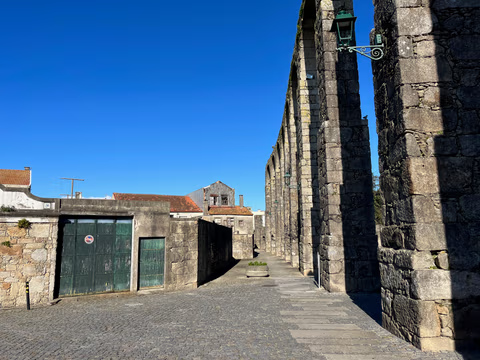
Aqueduct Trail – A path running along the Vila do Conde Aqueduct
From the Coastal Trail to the Camino Central: 12.9 km along the aqueduct from Vila do Conde to São Pedro de Rates. Route, stage, hostels, costs—explained honestly.
Read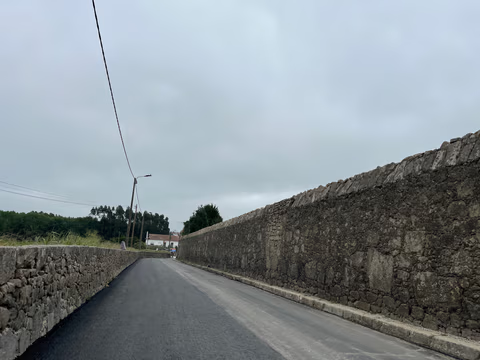
Ave Trail (Costa Station – Central Station)
A 9.2-kilometer route connecting two of Portugal's most popular pilgrimage trails: If you want to switch from the Coastal Route to the Central Route in Vila do Conde after the first day, take this short connecting path to Arcos.
Read


