

Hegauer Jakobsweg
71.5 kilometers from Wald Monastery via Stockach and the Bodanrück ridge to Konstanz: the western branch of the Via Beuronensis — with volcanic cones as a backdrop, the Gnadensee and the monastic island of Reichenau as a detour.
- 01At a Glance
- 02Overview
- 03Other Names
- 04Who This Route Is Ideal For — and Who It's Not
- 05Route & Landscape
- 06Stages, Terrain & Difficulty
- 07The Monastic Island of Reichenau: 1,300 Years — and a Detour Worth Taking
- 08Highlights Along the Way
- 09How Pilgrims Reach This Route
- 10Continue Your Pilgrimage?
- 11Preparation & Practical Information
- 12What the Journey Will Cost You
- 13Getting There
At a Glance
- Start / Finish: Wald Monastery → Konstanz
- Length: 71.5 km
- Elevation: ↗ 828 m / ↘ 1,082 m
- Duration: 3 days
- Waymark: yellow ray bundle on a blue field — signposted toward Konstanz only
- Special feature: a marked detour to the UNESCO World Heritage monastic island of Reichenau, waymarked in both directions
- Character: the western branch of the Via Beuronensis: hill country, the Bodanrück ridge, lakeshore along the Gnadensee
Overview
The Hegauer Jakobsweg is the western of the two closing branches of the Via Beuronensis: from Wald Monastery it runs via Stockach down to Lake Constance, crosses the Bodanrück ridge and reaches Konstanz via Radolfzell and Allensbach along the shore of the Gnadensee — 71.5 kilometers in three stages.
In the village of Wald pilgrims face a choice: the Linzgau Way of St. James heads east via Pfullendorf and Überlingen, the Hegau route west via Stockach and the Untersee. Both end in Konstanz, both take three days — but they show entirely different country.
The destination is the same in either case, and anything but arbitrary: the Mauritius rotunda at Konstanz Minster with its replica of the Holy Sepulchre. It was a pilgrimage destination in its own right in the Middle Ages — and from Konstanz the Schwabenweg carries pilgrims on through Switzerland.
Other Names
The route is named after the Hegau, the volcanic landscape west of the Überlinger See. In German you also find “Hegauer Jakobusweg”; within the network it runs under the name Via Beuronensis, in the operator's system as the section “Kloster Wald–Konstanz”. In English it is the Hegau Way of St. James.
Who This Route Is Ideal For — and Who It's Not
Ideal for a long weekend with substance: three stages, a World Heritage site right beside the trail, lakeshore, nature reserves and a university city with a minster at the end. It also works as a finale for anyone walking the Via Beuronensis from Tübingen or Ulm who prefers the western close to the Linzgau one.
Not your route if you are after real solitude: the Untersee is popular, and in summer you share the shore with cyclists and swimmers. And although the route is short, it has more up and down than the lakeside setting suggests — over 800 meters of climbing across 71 kilometers, spread over the ridges between Stockach and Radolfzell.
Route & Landscape
From Wald Monastery with its abbey church of St. Bernhard the way leads south through Upper Swabian hill country to Stockach, the main town between Linzgau and Hegau. It then drops to the western tip of Lake Constance at Bodman-Ludwigshafen — where the pilgrim route, the Lake Constance circular trail and the SeeGang premium trail all meet.
The middle section belongs to the Bodanrück, the wooded moraine ridge between the Überlinger See and the Untersee, with the Mindelsee as its quiet highlight. Via Radolfzell and Markelfingen the route reaches the shore of the Gnadensee and follows it through Allensbach and the Wollmatinger Ried to Konstanz. To the west, the silhouette of the Hegau volcanic cones keeps you company almost the whole way.
Stages, Terrain & Difficulty
The operator describes the route in three day stages:
- Wald Monastery → Stockach — through woods and hills from the monastery down toward the lake
- Stockach → Markelfingen — the longest stage: across the Bodanrück past the Mindelsee to the Untersee
- Markelfingen → Konstanz — along the Gnadensee via Allensbach and the Wollmatinger Ried into the minster city
The terrain is easy to moderate: no mountain stages, but steady up and down across the moraine ridges. The waymark is the yellow ray bundle on a blue field, whose focal point shows the walking direction — and as everywhere in this network, signposting generally covers only the direction of Konstanz and thus Santiago. Walking it in reverse means bringing a map or an app.
The Monastic Island of Reichenau: 1,300 Years — and a Detour Worth Taking
On the final stage an island lies in the water that lifts the whole route: the monastic island of Reichenau, a UNESCO World Heritage Site since 2000. The monastery was founded in 724 by the itinerant bishop Pirmin on the “rich meadow” — in 2024 the island celebrated its 1,300th anniversary. Between 800 and 1100 Reichenau was one of the intellectual centers of Europe: the manuscripts produced here now belong to UNESCO's Memory of the World.
Three churches make up the World Heritage site, and all three can be linked on foot in a day: St. George in Oberzell with its monumental Ottonian murals from the 10th century, the minster of St. Mary and St. Mark in Mittelzell, a Carolingian cruciform church consecrated as early as 816, and St. Peter and St. Paul in Niederzell with apse paintings of exceptional quality. In between: vegetable fields and greenhouses, because the island is still the region's market garden.
The detour is explicitly built in: unlike the rest of the route, the stretch between the Reichenau marina and the Wollmatingen church of St. Martin is waymarked in both directions — so you can cross the causeway, walk the island and return the same way to the main route. Allow half a day to a full day; it is the best extra day this route has to offer.
Highlights Along the Way
- Wald Monastery — a former Cistercian convent founded in 1212; the abbey church of St. Bernhard is the official starting point and the very spot where the Hegau and Linzgau routes part.
- Stockach and its Fools' Court — the town is home to the “Hohes Grobgünstiges Narrengericht zu Stocken”: on the Thursday before Lent a leading politician is publicly indicted here and sentenced to buckets of wine. Angela Merkel stood trial in 2001, Karl Lauterbach in 2024. Legend traces the custom to the court jester Kuony von Stocken; the first mention in Stockach council records dates from 1661.
- Bodman-Ludwigshafen — at the western end of the Überlinger See the pilgrim route, the Lake Constance circular trail and the SeeGang premium trail cross; a fine place for a long break by the water.
- Bodanrück and Mindelsee — the wooded moraine ridge between the Überlinger See and the Untersee, with the glacial Mindelsee in one of the oldest nature reserves on the lake.
- Radolfzell — the minster of Our Lady, an old town by the harbor and the Mettnau peninsula with its spa tradition.
- The monastic island of Reichenau — UNESCO World Heritage since 2000, founded by Pirmin in 724, three churches from Carolingian to Romanesque with murals of European rank. The marked detour crosses the causeway.
- Wollmatinger Ried — the largest nature reserve on Lake Constance, managed by NABU; guided walks start at the NABU Lake Constance center. For birdwatchers, the high point of the route.
- Konstanz Minster and the Mauritius rotunda — the goal of the route: the rotunda with its replica of the Holy Sepulchre was a pilgrimage destination in the Middle Ages. The Schwabenweg into Switzerland starts here.
How Pilgrims Reach This Route
Most arrive on foot: Wald is where the northern half of the Via Beuronensis ends. Anyone who has crossed the Swabian Alb comes in on the Beuron Way of St. James to Meßkirch and on to Wald — the village is the fork where you choose between the Hegau route and the Linzgau Way of St. James.
For a direct start, travel via Pfullendorf or Stockach: Wald Monastery lies between the two and is reachable by bus. If you only want the closing stages, join at Radolfzell — the station is on the Black Forest railway and just fifteen minutes from Konstanz.
Continue Your Pilgrimage?
Konstanz is the classic handover point: at the minster begins the Schwabenweg, which as part of the Via Jacobi leads through the cantons of Thurgau, Zurich and Schwyz to Einsiedeln Abbey and on to Geneva.
Then France takes over: from Le Puy-en-Velay the Via Podiensis, and from the Pyrenees the Camino Francés. From Konstanz to Santiago some 2,300 kilometers still lie ahead — the three days of the Hegau route are the overture, not the end.
Preparation & Practical Information
The best season is May to October; the Lake Constance climate is mild, though the shore towns are busy at the height of summer. For Reichenau and Radolfzell it pays to book ahead — in July and August you will find almost nothing at short notice.
You get your pilgrim credential from the pilgrim office of the Beuron pilgrim community (via-beuronensis.de); stamps await in churches and tourist offices. From 100 documented kilometers the community issues a pilgrim certificate — at 71.5 kilometers this route alone stays below that, but combined with the way from Hechingen or Tübingen you clear it easily.
Three stages are easy to adapt, and almost every town on the Untersee has a train or bus connection — easiest directly in the Camino Ninja app, where you build your stages and plan matching accommodation as you go.
What the Journey Will Cost You
Budget €60–100 per day for lodging and food (as of August 2026). Inland around Wald and Stockach is cheaper, the Untersee and Konstanz markedly pricier; monastery lodgings and simple guesthouses lower the average. The Reichenau detour needs no ticket — the causeway is free to walk.
Getting There
Wald Monastery is reached by train to Stockach or the Pfullendorf area and onward by bus. Konstanz is very well connected: the Black Forest railway via Singen, the Seehas line to Radolfzell, plus Swiss connections right behind the station in Kreuzlingen.
- Getting to Wald Monastery: Deutsche Bahn — train to Stockach or Pfullendorf, then bus.
- Return from Konstanz: Deutsche Bahn — connections from Konstanz station.
- Mid-route access: Radolfzell and Allensbach lie on the Singen–Konstanz railway (bahn.de).

Get your pilgrim credential and shell
Everything you need for the Hegauer Jakobsweg, shipped to your door.
Visit Camino Shop
Other Caminos

Appenzeller Weg
52.6 km from Rankweil across the Rhine to St. Peterzell: St. James Chapel (1464), 163 Years of the Wedding Trail, connection to the Via Jacobi. Stages, costs, how to get there.
Read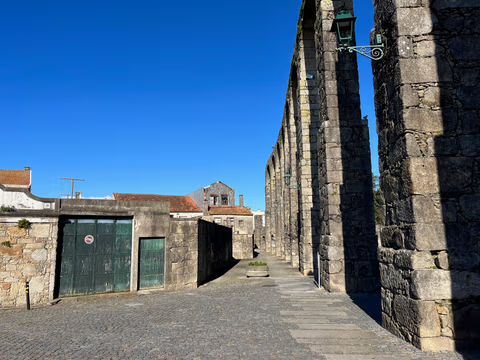
Aqueduct Trail – A path running along the Vila do Conde Aqueduct
From the Coastal Trail to the Camino Central: 12.9 km along the aqueduct from Vila do Conde to São Pedro de Rates. Route, stage, hostels, costs—explained honestly.
Read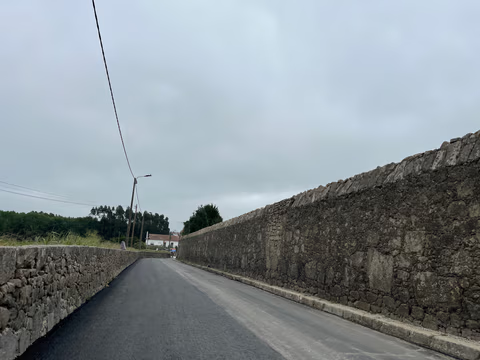
Ave Trail (Costa Station – Central Station)
A 9.2-kilometer route connecting two of Portugal's most popular pilgrimage trails: If you want to switch from the Coastal Route to the Central Route in Vila do Conde after the first day, take this short connecting path to Arcos.
Read


