

Portuguese Coastal Trail
The Portuguese Coastal Route (Caminho Português da Costa) leads northward from Porto along the Portuguese Atlantic coast to Santiago de Compostela —passing through fishing towns, wide beaches, and the breathtaking basilica in Viana do Castelo, before a ferry takes you across the Miño River to Spain.

- 01At a Glance
- 02Overview
- 03Other Names
- 04Who It's Ideal For—and Who It's Not So Ideal For
- 05Route & Landscape
- 06Stages, Terrain & Difficulty
- 07The Coastal Trail and Its Siblings: What “Coast” Really Means Here
- 08Kings, Monks, and an Inscription from 862: Evidence of the Coastal Route
- 09By Boat to Spain: Crossing the Minho River at Caminha
- 10Cannon Monks and the Caravel Pinta: Stories from the Galician Stages
- 11Highlights Along the Way
- 12How Pilgrims Find Their Way onto This Path
- 13The Spiritual Variation
- 14Continuing the Pilgrimage to the End of the World: Fisterra and Muxía
- 15Preparation & Practical Information
- 16What the journey will cost you
- 17Getting There
At a Glance
- Start / Finish: Porto → Santiago de Compostela
- Length: approx. 270 km
- Elevation gain: about 3,000 m uphill
- The stage: 11–13 days
- Difficulty: Medium
- Season: All year round; ideal from March through October
- Special feature: Ferry across the Minho River from Caminha to A Guarda (Spain)
Overview
The Portuguese Coastal Way (Caminho Português da Costa) takes you from Porto from along the Portuguese Atlantic coast northward to Saint James of Compostela. If you’re wondering why this trail is called the “Coastal Trail” when it doesn’t always run right along the water—the answer is: it connects Portugal’s coastal towns, but stays closer to the sea than the central trail. The sea is almost always in sight, the wind is often palpable, and the towns you pass through have the salt of the coast deeply embedded in their very essence.
Together with the Central Portuguese Way and the Coastal Trail The da Costa route is one of the three major Portuguese Ways of St. James starting in Porto. Together, these three routes now attract more pilgrims than the The French Way— Together, they are the most popular Way of St. James in the world. Along the route, you’ll repeatedly encounter pilgrims from the other two routes, and at Redondela In Spain, all three come together.
The route begins in Porto and leads through Vila do Conde with its impressive shoreline, through the fishing village Esposende, through the charming Viana do Castelo with its magnificent basilica on the hill — and ends in Caminha on the Miño River, where a ferry crosses over to Spain. From A Guarda in Galicia, the route continues through Baiona and Vigo on to Santiago.
Other Names
In English, this path is called Coastal Route of the Portuguese Way or simply Coastal Portuguese Way. In Portuguese, the full name is Coastal Trail — “Path along the coast.” In Spanish, it is The Portuguese Coastal Way.
It should not be confused with the Coastal Trail, the actual coastal path, which runs even closer to the water in Portugal than the Caminho da Costa. The name “Coastal Trail” can therefore be misleading: the Senda Litoral is the trail that literally runs along the beach—the Caminho da Costa, on the other hand, stays a bit further from the water while connecting the coastal towns to one another.
Who It's Ideal For—and Who It's Not So Ideal For
The da Costa route is ideal for you if you want to experience the sea on the Way of St. James but don’t want to walk exclusively along the beach. The mix of village streets, small stretches of beach, coastal trails, and paved paths keeps the route interesting. The stages are moderately long (25–32 km), and the terrain is mostly flat with a few hilly sections.
The trail isn't the best choice if you're looking for complete solitude—it gets quite crowded, especially in the summer. On the other hand, if you love the Senda Litoral and want to see more of the coastal towns, you can combine both trails wonderfully: during the day, take the da Costa through the towns, and switch to the Senda Litoral along the way when the next stretch of beach beckons.
Route & Landscape
From the starting point in Porto From there, the trail initially follows the coastline north of the city, past the surfing beaches of Matosinhos and through the characteristic fishing villages of the Minho district. Vila do Conde With its long waterfront promenade and imposing monastery, it’s the first highlight. Shortly after that, you’ll find Póvoa de Varzim — a lively seaside resort.
From Esposende the landscape becomes more open and expansive. The coast remains a constant companion, but the route also winds through pine forests, over sand dunes, and along wide river estuaries. The highlight of the Portuguese section is Viana do Castelo — one of Portugal's most beautiful cities, with a basilica overlooking the city that you can see from a distance. After Caminha The ferry across the Miño awaits, and on the other side, Galicia welcomes you with its granite trails, eucalyptus forests, and the unmistakable Galician light.
Stages, Terrain & Difficulty
The da Costa is mostly flat on the Portuguese side, with a few hills and stretches of beach. The Spanish section begins at Vigo It's a bit hillier, but still easy to walk. The routes alternate between paved roads, coastal trails, forest paths, and cobblestone streets in the towns.
Are you planning to take the ferry to Caminha, check the departure times in advance—the ferry doesn't run all the time. Outside of peak season, it runs less frequently.
Strictly speaking, the standalone Coastal Route ends in Valença: Here, it officially merges with the Camino Portugués Central, which crosses the border bridge into Tui. Both routes then follow the same path through Spain to Santiago. For simplicity’s sake, the Coastal Way is presented here as a separate route all the way to Santiago—because pilgrims simply don’t notice the transition along the way.
- Porto → Vila do Conde (31 km) — Coastal trail, surfers, monastery complex
- Vila do Conde → Esposende (31 km) — wide beaches, dunes, fishing villages
- Esposende → Viana do Castelo (32 km) — Pine forest, river mouths, basilica on the horizon
- Viana do Castelo → Caminha (26 km) — idyllic small town, ferry terminal
- Caminha → Baiona (22 km, including the ferry) — Ferry across the Miño River, Galician Atlantic coast
- Baiona → Vigo (23 km) — Ría de Vigo, a bustling port city
- Vigo → Redondela (18 km) — Junction with the Central and Senda Litoral trails
- Redondela → Pontevedra (23 km) — medieval old town, Plaza de Verdura
- Pontevedra → Caldas de Reis (22 km) — Hot springs, green valleys
- Caldas de Reis → Padrón (20 km) — Birthplace of Rosalía de Castro
- Padrón → Santiago de Compostela (24 km) — the final stretch to the finish line
The Coastal Trail and Its Siblings: What “Coast” Really Means Here
Three Routes of St. James connect Porto with Santiago: the Central Portuguese Way, the Coastal Trail and the Coastal Trail. All three follow the Atlantic coast of Portugal northward, all three lead to Santiago, and all three have their own unique character.
The name “da Costa” (= the coast) is unambiguous—but the Senda Litoral runs even closer to the water, sometimes literally on the beach. The difference: The da Costa connects coastal towns via paved paths and with more infrastructure, while the Senda Litoral runs along shoreline trails right by the water. “Senda” means path, “Litoral” means coastal strip—so it’s the coastal path, and that’s exactly what it is: a path right along the shore.
In practice, many pilgrims combine both routes: sometimes taking the Senda Litoral for spectacular stretches along the beach, and sometimes the da Costa when the towns beckon or the sand is too deep. This is expressly permitted—and the Camino Ninja App It supports exactly that: You can flexibly combine the three routes to create a coherent itinerary, no matter which sections you choose. A special appeal of all three routes: They all run in the immediate vicinity of the Porto Airport. You can literally start walking right from the airport—each of the three trails is just a few minutes away.
Kings, Monks, and an Inscription from 862: Evidence of the Coastal Route
The coastal trail is not a tourist invention—its origins date back surprisingly far. In the church of Neiva Castle, right along the route past Viana do Castelo, the Bishop of Coimbra had already consecrated 862 a temple dedicated to St. James—one of the oldest dedications to St. James outside of Spain. Between Oia and Baiona, Cistercian monks had been maintaining a veritable “monastic route” since the 12th century.
There is also evidence of prominent pilgrims: King Manuel I of Portugal He took Coastal Route 1501 on his way back from Compostela; the Italian priest Giovanni Battista Confalonieri described it in 1594, and even Cosimo III de’ Medici passed through here in 1669. Modern recognition came late, however: it wasn’t until 2010 that the Xunta de Galicia designated the coastal route as an official Way of St. James—it had been signposted since 1993, and Portugal certified its section in 2022.
By Boat to Spain: Crossing the Minho River at Caminha
Crossing the border is perhaps the most beautiful ritual of the Coastal Trail—because it’s done by boat. In Caminha You cross over to Spain via the wide mouth of the Minho: a ferry or a pilgrim taxi boat will take you from port to port to the shore near In Guarda — without getting your feet wet and all year round, since specialized tour operators now operate even outside the ferry season. Hardly any other major Camino de Santiago route crosses the border by water.
Over there, Galicia welcomes you with a bang: Rising above the river estuary is the Mount Santa Trega featuring the ruins of a Celtic castrum settlement and one of the most spectacular views along the entire route—the Atlantic Ocean, the Minho River, and two countries all in one glance. If you’d like, plan on setting aside a good hour extra for this detour.
Cannon Monks and the Caravel Pinta: Stories from the Galician Stages
And Yes The only Cistercian monastery on the Iberian Atlantic coast stands right on the shore—and it has made history: In 1624, the monks used their cannons to drive off five Turkish pirate ships and sank one. King Philip IV ennobled the monastery as the “Real e Imperial Monasterio” for this feat, and its inhabitants went down in history as the “artillery monks.” The trail leads right past the monastery’s entrance.
One day later, Bayona with a world-historical milestone: On March 1, 1493, the caravel set sail from here Surface — making Baiona the first place in Europe to learn of the discovery of the Americas. Every year in late February, the city celebrates this with the Festa da Arribada, a festival of international tourist interest that includes a medieval spectacle at the harbor.
Highlights Along the Way
- St. John the Baptist Monastery, Vila do Conde — A Gothic monastery right along the trail, featuring 999 arches of the historic aqueduct
- Basilica of Santa Luzia, Viana do Castelo — Perched on a hill overlooking the city, with a panoramic view of the Atlantic Ocean and the Miño River
- Caminha — A cobblestone-paved old town, a peaceful atmosphere, the last Portuguese town before the ferry
- Ferry across the Miño — Crossing the border into Spain by water: a defining moment of new beginnings
- Bayona — Historic Galician coastal town, the first European city to learn of the discovery of the Americas
- Bay of Vigo — A spectacular bay, oyster farms in the water, with Vigo in the background
- Redondela — This is where all three Portuguese Routes of St. James converge
- Pontevedra — One of the most beautiful historic centers in Galicia, almost car-free
How Pilgrims Find Their Way onto This Path
The route begins at Porto Cathedral—thanks to the airport, this is the most convenient starting point for the Camino in Portugal. You’ll share the first few meters with the Central Portuguese Way, then the coastal trail branches off toward the Atlantic Ocean.
There are convenient cross-connections along the way: The Ave Trail and the Aqueduct Trail connect the coast and the inland areas at Vila do Conde, and starting from Vila Nova de Cerveira, the Lady of the North A quiet alternative for crossing the border into Vigo.
The Spiritual Variation
From Pontevedra There is a special option available: the Variante Espiritual, an alternative route that follows the legendary sea passage of the Apostle James. Instead of heading straight north, it first turns west via Combarro and Armenteira Monastery to Vilanova de Arousa — and from there a boat carries you up the Ría de Arousa and the Río Ulla to Padrón, where the route rejoins the Central. Don't let the numbers fool you: its 79.9 km stand against 40.4 direct Central kilometres between Pontevedra and Padrón — but around 31 of them are covered by boat. On foot you walk only about 49 km, barely 10 km more than on the direct route, and you need at most one extra day. People choose it not for the kilometres anyway, but for the connection to the myth: this is held to be the route by which the Apostle's body was once brought to Galicia by ship.
Continuing the Pilgrimage to the End of the World: Fisterra and Muxía
In Santiago, the coastal trail officially comes to an end—but for many, the epilogue is still to come. The Road to Fisterra The route continues for about 91 km over 3–4 days to Cape Fisterra, the “end of the world” in ancient times: kilometer marker 0.0 at the lighthouse, sunset over the Atlantic, and a special certificate from the Fisterrana. For many pilgrims, this is where the journey truly ends.
It's only a day's walk from Fisterra to Muxía: The Camino to Fisterra-Muxía connects the cape to the Marian shrine via just under 29 kilometers of rugged coastline Virgin of the Boat — famous for its wobbly rocks right in the surf. The entire Santiago–Fisterra–Muxía loop and back, on the other hand, is a little adventure in its own right, lasting about a week: You’ll take the return trip (or the opposite direction) along the Path to Muxía (about 88 km) — or you can simply take the bus back to Santiago from Muxía. Either way, the Atlantic Ocean makes for a more beautiful finale.
Preparation & Practical Information
The best time to visit is from April through October—in the spring, Portugal is beautifully green, and in the fall, the weather is mild and quieter. July and August are the hottest months, but it’s still pleasant along the coast thanks to the Atlantic breeze. In the winter, the trail is technically passable, but some hostels close.
Accommodations are available along the entire route at pilgrim hostels (albergues) as well as private guesthouses and hotels. During peak season, it is advisable to make a reservation in advance, especially in Viana do Castelo and in the Galician cities starting from Vigo.
As on all Portuguese and Spanish Routes of St. James, you'll need a Pilgrim's Pass (Credencial), so you can stay at the hostels along the way and receive your Compostela at the end. It’s best to order it online in advance so it arrives in time for the start of your trip. To plan your stages—and if you want to combine the da Costa with the Senda Litoral or the Central—the easiest way to do this is directly in the Camino Ninja App, where you can plan your itinerary and book suitable accommodations at the same time.
What the journey will cost you
The Caminho da Costa is less expensive in the Portuguese section than in the Spanish section. Pilgrim hostels (albergues) cost between 10 and 18 euros per night in Portugal (as of July 2026), while in Spain they usually cost 12–20 euros. The “Menú del Peregrino” is available in Spain for about 11–15 euros, and is slightly cheaper in Portugal.
The daily budget, including a night's stay at the albergue, breakfast, and dinner, is approximately 35–55 euros. If you opt for private accommodations from time to time, expect to spend 60–90 euros per day.
Getting There
The natural starting point is Porto — and all three Portuguese Routes of St. James run very close to the Porto Airport (OPO). From there, you can literally start exploring right away: Senda Litoral is just a few minutes’ walk from the coast, and da Costa and Central are both easily accessible via metro or shuttle from downtown. You don’t have to go into the city first—you can get started right after you land.
For the Return trip from Santiago We recommend taking the bus operated by Freire Company From Praza de Galicia to Santiago Airport (SCQ) — travel time approx. 30 minutes, fare approx. 3 euros (as of July 2026). Trains and other bus connections depart from the Santiago de Compostela train station.
- Airplane: Porto (OPO) direct from Germany, Austria, and Switzerland; long-haul flights via Lisbon (LIS)
- Train: Porto Campanhã (IC/AP from Lisbon, Braga, Guimarães)
- There will be: FlixBus and national long-distance buses to Porto
- Return trip from SCQ: Freire Bus company from Galicia Square → Airport, ~30 min., ~3 EUR

Get your pilgrim credential and shell
Everything you need for the Portuguese Coastal Trail, shipped to your door.
Visit Camino Shop
Other Caminos

Appenzeller Weg
52.6 km from Rankweil across the Rhine to St. Peterzell: St. James Chapel (1464), 163 Years of the Wedding Trail, connection to the Via Jacobi. Stages, costs, how to get there.
Read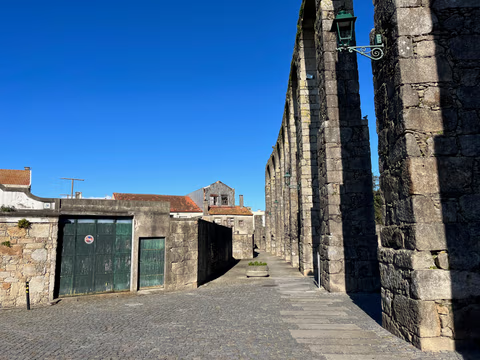
Aqueduct Trail – A path running along the Vila do Conde Aqueduct
From the Coastal Trail to the Camino Central: 12.9 km along the aqueduct from Vila do Conde to São Pedro de Rates. Route, stage, hostels, costs—explained honestly.
Read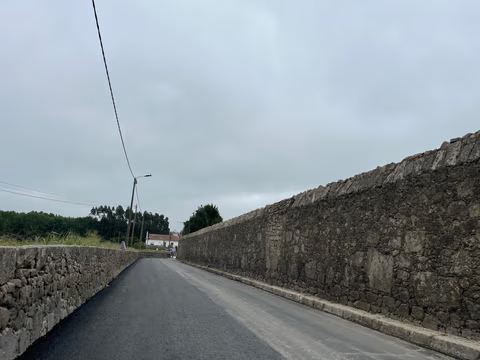
Ave Trail (Costa Station – Central Station)
A 9.2-kilometer route connecting two of Portugal's most popular pilgrimage trails: If you want to switch from the Coastal Route to the Central Route in Vila do Conde after the first day, take this short connecting path to Arcos.
Read


