

Badischer Jakobsweg
The Baden Way of St. James stretches about 300 km from Laudenbach through Heidelberg, Baden-Baden, and the Kaiserstuhl to Breisach am Rhein—Germany’s sun-drenched pilgrimage route through vineyards, spa towns, and a UNESCO World Heritage Site.
- 01At a Glance
- 02Overview
- 03Other Names for the Baden Way of St. James
- 04Who the Baden Way of St. James Is Ideal For—and Who It's Not So Ideal For
- 05Route & Landscape
- 06Stages, Terrain & Difficulty
- 07Heidelberg, Baden-Baden, and the Kaiserstuhl: Three Worlds Along One Trail
- 08How Pilgrims Find Their Way onto This Path
- 09Continue the pilgrimage?
- 10Highlights Along the Way
- 11Preparation & Practical Information
- 12How Much the Baden Way of St. James Will Cost You
- 13Getting There
At a Glance
- Length: approx. 300 km
- Start / Finish: Laudenbach → Breisach am Rhein
- Elevation gain: 3,200 m uphill / 3,100 m downhill
- Highest point: 570 m (Königstuhl near Heidelberg)
- The stage: 16
- Duration: 15–17 days
- Difficulty: easy to moderately difficult
- Best time of year: April through October (ideally: May/June and September)
Overview
The Baden Way of St. James stretches about 300 kilometers from northern Baden to the Rhine—from Laudenbach on the Hessian border through the Bergstraße, via Heidelberg and Baden-Baden, through the wine-growing region of the Ortenau and the Kaiserstuhl all the way to Breisach on the Rhine. It is Germany’s sun-drenched pilgrimage route: mild, varied, and a culinary delight—and at the same time a full-fledged Way of St. James with authentic history and spiritual depth.
The route was developed in three sections between 2008 and 2019 and follows historic trade and pilgrimage trails through one of Germany’s most charming regions. Those who walk the trail will experience three completely different landscapes: the rolling Bergstraße with its orchards and the first vineyards, the spa town atmosphere of Baden-Baden and the Ortenau wine region, and finally the vast Rhine Valley with the unique volcanic massif of the Kaiserstuhl's.
From Breisach am Rhein, the path opens up toward the west: Those who wish to continue their pilgrimage cross the Rhine and enter Alsace. From there, various routes lead on toward Santiago de Compostela—via Colmar and Strasbourg to the Via Turonensis or south via Basel and Switzerland.
Other Names for the Baden Way of St. James
The route is officially known as the Baden Way of St. James, and is sometimes referred to simply as Baden Pilgrimage Route It is maintained by the Badische St. Jakobusgesellschaft e.V. and is marked throughout with the scallop shell symbol on a blue background. It is well documented in German-speaking countries; internationally, it does not yet have its own English name, but is listed as part of the German Way of St. James network.
Who the Baden Way of St. James Is Ideal For—and Who It's Not So Ideal For
If you’re looking for a German Way of St. James that not only offers enjoyable hiking but also treats you to culinary and cultural delights, you’ve come to the right place. The Baden Way of St. James is one of the most accessible pilgrimage routes in Germany: the stages are easy to plan, the infrastructure is excellent, and—unlike alpine routes—the elevation changes are moderate. It’s particularly appealing to pilgrims who want to tackle individual sections—thanks to dense population and good public transportation connections, getting to and from any stage location is easy.
The trail does not require exceptional physical conditioning, but it does require a basic level of hiking fitness. Anyone who can comfortably cover 18–22 kilometers a day will have no trouble. However, those seeking a wild, solitary experience in nature—remote trails, minimal civilization, true adventure—will not find it here. The Baden Way of St. James is a A Pilgrimage Through the Culture of Culinary Delights: Roadside taverns, thermal baths, UNESCO World Heritage sites—not a journey of deprivation, but one of mindful slowness.
Route & Landscape
The trail begins in Laudenbach on the border between Hesse and Baden and immediately climbs up into the Bergstraße—one of Germany’s mildest climate zones, known for its early almond blossoms and abundant fruit orchards. Via Weinheim and the Königstuhl (570 m, the highest point of the trail) you reach Heidelberg, whose castle ruins are among Germany’s most famous historical monuments. The route then continues through Bruchsal and Karlsruhe to Ettlingen, the starting point of the middle section of the trail.
In the second section, the trail winds its way into the foothills of the Black Forest and, via Gernsbach, reaches the world-famous spa town Baden-Baden – A UNESCO World Heritage Site and known as a spa town since Roman times. Further south, the Ortenau region opens up with its vineyards and wine taverns. In the third section, the trail leads through the flat Rhine Valley, past Europa-Park in Rust, into the Kaiserstuhl – a unique volcanic massif home to Germany’s warmest vineyards – and finally to Breisach on the Rhine, high above the river, within sight of Alsace.
Stages, Terrain & Difficulty
Depending on your pace, the Baden Way of St. James can be divided into 16 stages:
- Laudenbach → Weinheim (18 km) — Start on Bergstraße with an ascent to Wachenburg; magnificent views over the Rhine Valley.
- Weinheim → Heidelberg (20 km) — Over the Königstuhl (570 m) and down to the romantic old town; the most challenging stage of the trail.
- Heidelberg → Bruchsal (25 km) — The longest stage, through the Neckar Valley and over rolling hills to the Baroque Bruchsal Palace.
- Bruchsal → Karlsruhe (20 km) — Through the Rhine Valley to the "Fan-Shaped City" with its unique layout.
- Karlsruhe → Ettlingen (15 km) — The shortest stage; the historic town of Ettlingen with its well-preserved old town.
- Ettlingen → Gernsbach (22 km) — The gateway to the Black Forest foothills; Gernsbach, with its historic half-timbered old town in the Murg Valley.
- Gernsbach → Baden-Baden (18 km) — Through forests to the world-famous spa town; Lichtental Monastery along the way.
- Baden-Baden → Bühl (20 km) — The first vineyards of the Ortenau region; wine taverns and regional cuisine.
- Bühl → Achern (18 km) — Through the orchards and vineyards of the Ortenau; wine taverns along the way.
- Achern → Oberkirch (16 km) — The heart of the Baden wine region, with distilleries and wineries in Oberkirch.
- Oberkirch → Offenburg (22 km) — Descent to the capital of the Ortenau region; good amenities for a rest day.
- Offenburg → Schutterwald (15 km) — To St. James’ Church in Schutterwald, a junction with other German St. James’ Ways.
- Schutterwald → Rest (20 km) — Flat Rhine Valley; stage passes by Europa-Park Rust.
- Rest → Endings (18 km) — To the Kaiserstuhl; Endingen, with its medieval charm and excellent wines.
- The ending → Ihringen (12 km) — Through the Kaiserstuhl vineyards; Ihringen is considered the warmest place in Germany.
- Ihringen → Breisach (15 km) — Final leg to the Rhine; arrival at St. Stephen's Cathedral, featuring Schongauer's fresco.
The terrain is varied but never extreme. The climb up the Königstuhl to 570 meters is the biggest challenge—the rest of the trail is moderate with manageable elevation changes. Overall, the trail is considered easy to moderately difficult and is therefore suitable for hikers of all ages.
Heidelberg, Baden-Baden, and the Kaiserstuhl: Three Worlds Along One Trail
Few German routes along the Way of St. James pass through such a concentration of world-class attractions as the Baden Way of St. James. The second stage ends in Heidelberg – Germany’s most famous university town, whose castle ruins and Old Bridge attract millions of visitors each year. For pilgrims, Heidelberg offers something rare: a city that’s large enough to truly immerse yourself in, yet compact enough to explore on foot. The cathedral and the Studentenkarzer are must-see stops on a walk through the Old Town.
Seven stages later, Baden-Baden – Europe’s most elegant spa town, known as a resort since Roman times and now a UNESCO World Heritage Site. Pilgrims who stop here for a night’s rest experience a striking contrast: the world-famous casino, the Trinkhalle, the Friedrichsbäder—and then, the next morning, back to their walking sticks and backpacks. Baden-Baden is the point along the Baden Way of St. James where indulgence and a slower pace of life come together most clearly.
In the final third of the course, the Kaiserstuhl: a unique volcanic massif in the Rhine Valley that is home to Germany’s warmest and driest vineyards. The landscape feels more Mediterranean than anything one would expect north of the Alps—vast terraced slopes, rows of vines, loess-lined sunken paths, and views of the Vosges Mountains across the Rhine. The Kaiserstuhl has its own serene tranquility—and makes for a fitting finale before reaching your destination in Breisach.
How Pilgrims Find Their Way onto This Path
You can reach Laudenbach an der Bergstraße by train via Weinheim (S-Bahn from Mannheim/Heidelberg). The Baden Way of St. James is the major north-south feeder route along the Upper Rhine—if you live further north, you can simply join the route along the way: Heidelberg, Karlsruhe, and Baden-Baden are located directly on the route.
From Breisach, you have a choice: cross the Rhine into Alsace toward the Vosges—or take the train to Basel, where you can Baslerweg and the Three Lakes Trail The Swiss network begins here. Incidentally, running parallel through the Black Forest is the Kingdom of Heaven: The Way of St. James– The Wild Siblings Trail.
Continue the pilgrimage?
The Baden Way of St. James ends in Breisach on the Rhine – not in Santiago de Compostela. From Breisach, there are several possible routes to choose from:
- Via Turonensis / Alsatian Trail — From Breisach across the Rhine into Alsace; on through Colmar and Strasbourg toward Tours—the classic route taken by German and Alsatian pilgrims to France.
- Via Jacobi (Swiss Way of St. James) — For those on a pilgrimage through Switzerland: from Basel via the Via Jacobi through Einsiedeln and Lausanne to Geneva, then Via Gebennensis to Le Puy-en-Velay.
The Compostela You’ll only receive it after arriving in Santiago de Compostela, once you can prove that you walked the final 100 kilometers. The Baden Way of St. James is the starting point—and an exceptionally beautiful one at that.
Highlights Along the Way
- Bergstraße & Wachenburg — The first ascent offers sweeping views of the Rhine Valley; a paradise for early-blooming flowers in the spring.
- Heidelberg Castle — Germany's most famous castle ruin; pilgrims enter the city along the historic path through the Neckar Valley.
- Bruchsal Palace — A Baroque residence featuring the famous staircase designed by Balthasar Neumann; one of the most beautiful Baroque palaces in southwestern Germany.
- Karlsruhe, the "Fan-Shaped City" — A unique city layout radiating outward from the castle; the capital of the former Grand Duchy of Baden.
- Baden-Baden — UNESCO World Heritage Site; Europe’s most elegant spa town, featuring a casino, a drinking hall, thermal baths, and Lichtental Abbey.
- Ortenau Vineyards & Wine Taverns — The culinary heart of the route: Pinot Noir and Pinot Gris in idyllic farm taverns.
- Kaiserstuhl — A volcanic landscape with a Mediterranean feel; Germany’s warmest vineyards and panoramic views of the Vosges Mountains.
- St. Stephen's Cathedral in Breisach — Destination and finale: a Romanesque-Gothic cathedral housing Schongauer’s 15th-century masterpiece.
Preparation & Practical Information
The best time to hike the Baden Way of St. James is April through October, with a clear favorite: May/June and September. That’s when temperatures and weather conditions are ideal, the vineyards are at their most vibrant, and the crowds of tourists—especially in Heidelberg and Baden-Baden—are still manageable. In the height of summer, it can get very hot in the Rhine Valley; light, breathable clothing and plenty of water are a must.
Since the route is well-developed, you hardly need to book in advance—except in Heidelberg, Baden-Baden, and Breisach, where demand for lodging is high. In smaller towns along the route, booking the day before is sufficient. The Camino Ninja App helps you find suitable accommodations along the route and plan your stages.
One Pilgrim's Pass (Credencial) You can order it for 5 euros from the Badische St. Jakobusgesellschaft e.V. Stamps are available at churches, tourist offices, and town halls along the route. The pilgrim passport serves as a souvenir and entitles you to pilgrim discounts in some places; however, to receive the Compostela, you must walk at least 100 kilometers starting from Breisach.
How Much the Baden Way of St. James Will Cost You
The Baden Way of St. James runs through a well-developed tourist area with a correspondingly wide range of prices. Affordable guesthouses start at around 25–30 euros per night; monastery accommodations such as the Neuburg Abbey near Heidelberg or the Lichtental Monastery in Baden-Baden offer a special atmosphere for 15–25 euros. Bed-and-breakfasts and hotels range from 45–80 euros, whereas in Heidelberg and Baden-Baden it's more like 60–120 euros (As of July 2026).
With a daily budget of 50–70 euros You can get by just fine; if you treat yourself to meals at wine taverns and local restaurants, you'd better expect to pay 80–100 euros per day. Credit cards are accepted everywhere; however, it’s still a good idea to have cash on hand at rural taverns.
Getting There
The Starting Point Laudenbach is located on the border between Hesse and Baden, right off the A5. By train, you can travel from Frankfurt via Mannheim to Laudenbach (Bergstraße) in about 50 minutes; from Stuttgart, it takes about 1.5 hours via Heidelberg.
Breisach on the Rhine The final stop is a 30-minute ride by regional train from Freiburg. Freiburg has ICE connections to Frankfurt (about 1.5 hours), Basel (about 20 minutes), and Zurich (about 1 hour). The EuroAirport Basel-Mulhouse-Freiburg offers direct flights to many European cities.
- Train to Laudenbach (DB Regio) — Via Mannheim or Heidelberg; check DB for schedules and tickets.
- EuroAirport Basel-Mulhouse-Freiburg (BSL/MLH) — International Three-Country Airport; Ryanair, easyJet, Swiss, and other airlines.
- Basel SBB — Direct trains to Zurich, Paris, and Frankfurt; a short connection to Breisach via Freiburg.
- Long-distance bus (FlixBus) — Affordable connections to Freiburg and Basel in all directions.

Get your pilgrim credential and shell
Everything you need for the Badischer Jakobsweg, shipped to your door.
Visit Camino Shop
Other Caminos

Appenzeller Weg
52.6 km from Rankweil across the Rhine to St. Peterzell: St. James Chapel (1464), 163 Years of the Wedding Trail, connection to the Via Jacobi. Stages, costs, how to get there.
Read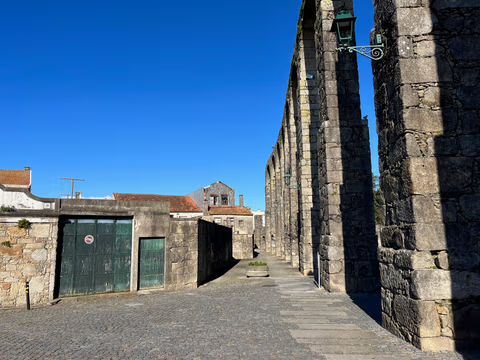
Aqueduct Trail – A path running along the Vila do Conde Aqueduct
From the Coastal Trail to the Camino Central: 12.9 km along the aqueduct from Vila do Conde to São Pedro de Rates. Route, stage, hostels, costs—explained honestly.
Read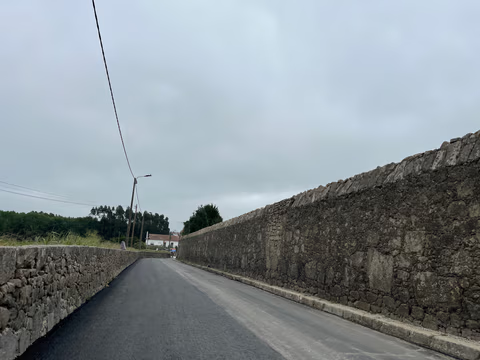
Ave Trail (Costa Station – Central Station)
A 9.2-kilometer route connecting two of Portugal's most popular pilgrimage trails: If you want to switch from the Coastal Route to the Central Route in Vila do Conde after the first day, take this short connecting path to Arcos.
Read


