

Camino San Salvador
The Camino San Salvador is the steep, little-known gem among the Ways of St. James: 120.6 kilometers from León across the Cantabrian Mountains to Oviedo—to the Cathedral of San Salvador with its reliquary, around which a proverb had already taken root in the Middle Ages: Whoever goes to Santiago and skips San Salvador “visits the servant and forgets the Lord.” Five to seven days, 3,600 meters of elevation gain, a distinct route with its own certificate—and perhaps the most beautiful mountain crossing in the world of the Camino.

- 01At a Glance
- 02Overview
- 03“Whoever skips the Savior is visiting the servant and forgetting the Lord.”
- 0430 meters of elevation gain per kilometer — the mountain stage
- 05The Missing Piece of the Puzzle Between Francés and Primitivo
- 06Other Names
- 07Who It's Ideal For—and Who It's Not So Ideal For
- 08Route & Landscape
- 09Stages, Terrain & Difficulty
- 10Highlights Along the Way
- 11How Pilgrims Find Their Way onto This Path
- 12Preparation & Practical Information
- 13What the journey will cost you
- 14Getting Here
At a Glance
- Start / Finish: León Cathedral → San Salvador Cathedral in Oviedo
- Length: 120.6 km — across the Cantabrian Mountains, from the Francés to the Primitivo
- Elevation gain: ↗ 3,636 m / ↘ 4,228 m — 30 m/km, making it steeper in percentage terms than any other classic Camino
- Duration: 5–7 days; the traditional route is divided into 5 stages
- Waymarking: Yellow arrow and seashell; the Camino Ninja app has the entire route on board
- Pilgrims: A select few—the Salvador is considered a trail for connoisseurs, with its own certificate, the Salvadorana
- Hostels: A small but well-maintained network, partly funded by donations; limited in winter
- Connection: starts on Camino Francés in León and flows into the [river] in Oviedo Camino Primitivo
- Character: Short, steep, quiet—high mountain ridges, deserted valleys, and, at the end, a cathedral filled with royal treasures
Overview
The Camino San Salvador answers a question that thousands of people in León ask themselves every year: should I continue straight ahead on the Camino Francés — or turn right into the mountains? Those who take this turn are following a medieval tradition: 120.6 kilometers across the Cantabrian Mountains to Oviedo, to the Cathedral of San Salvador, whose collection of relics was considered so significant in the Middle Ages that the detour was regarded as a duty.
Today, the Salvador route is for seasoned hikers: five to seven days, 3,636 meters of elevation gain, secluded ridge trails above the Pajares Pass, and hostels where all the day’s pilgrims can gather around a single table in the evening. At the destination, not only does the Cámara Santa await, but also the perfect continuation: From Oviedo, the Camino Primitivo, the oldest of all the Routes of St. James, continuing on to Santiago.
“Whoever skips the Savior is visiting the servant and forgetting the Lord.”
No other side road has a slogan like this one from the Middle Ages: Quien va a Santiago y no al Salvador, visita al criado y olvida al Señor — Whoever goes to Santiago and not to San Salvador visits the servant and forgets the Lord. The implication was: James is merely the apostle; in Oviedo, however, in the Cathedral of San Salvador, relics of the Savior himself are kept. For medieval pilgrims, therefore, this detour was not optional but almost a requirement.
The treasure in question remains to this day in the Cámara Santa: the Arca Santa, a reliquary whose contents are said to originate from Jerusalem. Alfonso II had it brought to St. Michael’s Chapel next to his newly founded Church of El Salvador in the 9th century; King Alfonso VI ceremoniously opened it in 1075. Also on display are the Cruz de los Ángeles and the Cruz de la Victoria—the crosses that today adorn the coats of arms of the city and the region—and the famous Shroud of Oviedo, which is displayed only on a few days each year. The Cámara Santa is a UNESCO World Heritage Site.
30 meters of elevation gain per kilometer — the mountain stage
The raw numbers don’t lie: 3,636 meters of elevation gain over just 120.6 kilometers—that’s about 30 meters of elevation gain per kilometer, more than on any other classic Camino. The highlight is the crossing of the Cantabrian Mountains between La Robla and Pajares: ridge trails at cloud level, heather, wind turbines on the horizon, and valleys where there are more cows than people.
It is precisely these two or three days in the mountains that have earned the Salvador cult status among experienced pilgrims. It’s alpine pilgrimage on a smaller scale: short distances, grand gestures. Anyone walking the stage from Poladura over the pass to Pajares in clear weather will see the Castilian plateau behind them and green Asturias ahead—two worlds in a single day of hiking. And anyone unlucky enough to encounter fog will understand why you have to trust the trail markers and the app here.
The Missing Piece of the Puzzle Between Francés and Primitivo
On the map of the Way of St. James, the Salvador route serves as an elegant link: It begins right in the middle of the Camino Francés in León and ends exactly where the Camino Primitivo begins — at the Cathedral of Oviedo, from where King Alfonso II set out in the 9th century for the newly discovered tomb of the Apostle, thus establishing the oldest of all the Routes of St. James.
That’s why this combination is so popular: the Francés to León, the Salvador to Oviedo, and the Primitivo to Santiago—a route that combines the best of three worlds and elegantly avoids the crowds on the final stretch of the Francés from Sarria. Those who walk it even collect two certificates along the way: the Salvadorana in Oviedo and the Compostela in Santiago. Connoisseurs simply call this combination the most beautiful way to reach Santiago.
Other Names
In Spanish, the route is called the Camino de San Salvador or Camino del Salvador, named after the patron saint of Oviedo Cathedral—the Savior, San Salvador. Internationally, it is known as the San Salvador Way or Salvador Route. It should not be confused with the Camino del Norte section around Oviedo: The Salvador is the south-to-north crossing from León, a distinct historical route with its own charter.
Who It's Ideal For—and Who It's Not So Ideal For
The Salvador is ideal for Rock Anchor with just under a week to spare — as a standalone tour or as the centerpiece of the Francés–Salvador– Primitivo. If you're traveling along the Francés and find yourself in León feeling that you've had enough of the hustle and bustle, this is the perfect spot to head up into the hills. Also for Repeat Offender, for those seeking something genuine and peaceful, it is a gift.
This isn’t the right route for pilgrims who prefer flat stages, daily coffee breaks, and full hostels: Between León and Oviedo, there are long stretches without places to stop, the mountain stages require stamina and sure footing, and caution is needed in bad weather—in winter, there may be snow on the pass. Those who prefer a gentler route should stay on the Camino Francés or choose the Northern Coast.
Route & Landscape
From the cathedral in León, the trail begins on flat ground through the surrounding countryside and the Bernesga Valley to La Robla—a warm-up for what’s to come. Then the ascent begins: through hamlets and high pastures to Poladura de la Tercia and on to the ridge of the Cantabrian Mountains, where the trail winds in wide arcs along the Pajares Pass. This is the Salvador’s defining moment: Castile behind you, Asturias at your feet.
The descent into Asturias is long and green—through beech forests, past pre-Romanesque chapels and villages with cider barrels, down into the valley of Pola de Lena. The final stage follows the valley all the way to the old town of Oviedo, where the trail ends right in front of the Cathedral of San Salvador—and where, the next morning, anyone who wishes can Camino Primitivo begins.
Stages, Terrain & Difficulty
Traditionally, you approach the Salvador by Stage 5; if you spread out the mountain days, take 6 or 7. The distances are moderate, but the elevation gain is not—plan for short mountain stages and long breaks. In some places, there are neither stores nor bars between towns: you’ll need to pack provisions in your backpack.
- León → La Robla: approx. 27 km — a gentle start through the Bernesga Valley
- La Robla → Poladura de la Tercia: about 24 km — up into the high pastures; the mountains draw closer
- Poladura de la Tercia → Pajares: About 15 km — short but intense: the ridge crossing above the Pajares Pass
- Pajares → Pola de Lena: about 25 km — the long, green descent into Asturias
- Pola de Lena → Oviedo: about 34 km — through the valley to the front of San Salvador Cathedral
All stage distances are rounded—the total distance of 120.6 km from León to Oviedo is the official figure. Those who continue their pilgrimage from Oviedo along the Camino Primitivo still have a good 300 kilometers ahead of them to Santiago—together, this is arguably the most beautiful mountain route on the Camino.
Highlights Along the Way
- León Cathedral — Saying goodbye to the Francés, home to some of Spain's most beautiful stained-glass windows
- Bernesga-Tal — a gentle start along the river
- The High Pastures of La Tercia — Mountain villages where time moves more slowly
- Ridge Trail at the Pajares Pass — the big day in the mountains, with a view of two worlds
- Trip to Asturias — Beech forests, patches of fog, and the first signs of spring in the north
- Pre-Romanesque Churches of the Lena Valley — small structures from the Asturian Royal Period
- Pola de Lena — Sidra-Land: Asturian cider for after work
- Oviedo — the elegant old town with the Cathedral of San Salvador
- Cámara Santa — The Arca Santa, the Royal Crosses, and the Shroud of Oviedo: UNESCO World Heritage Site
- Salvadorana — my own certificate of the route, issued in Oviedo
How Pilgrims Find Their Way onto This Path
Most people arrive on foot via the Camino Francés to León and turn off there—the Salvador route is designed and built as a continuation of that route. Those who take it as a standalone tour can easily travel to León: by express train from Madrid or via the León airport itself, or via Oviedo/Asturias on the other end.
Once you arrive in Oviedo, all doors are open: continue on the Camino Primitivo On to Santiago (a good 300 km), then across to the coast to the Camino del Norte—or simply call it a day, with the Salvadorana in my pocket. The Salvador isn’t enough on its own to earn the Compostela; it’s the connecting link, not the final leg of the journey.
Preparation & Practical Information
The best time to visit is May through October — Snow remains on the ridges until spring, and even in summer, fog and sudden changes in weather can make the mountain stages challenging. In winter, the trail is only recommended for very experienced hikers with the proper equipment; some lodges are closed.
Pack as if you were going on a short mountain hike: Your backpack should no more than 10 percent of body weight backpack, plus rain and wind protection, provisions, and enough water for the mountain stages. The trail is well marked, but in the fog, orientation is everything—with the Camino Ninja App you'll be on the safe side: It has the entire route on board, including all stages, hostels, and elevation profiles.
For the Salvadorana You collect stamps along the way at the Credencial and pick up your certificate at the cathedral in Oviedo. If you continue your pilgrimage to Santiago, you’ll use the same credential—from Oviedo onward, the Primitivo route counts toward the Compostela just as usual.
What the journey will cost you
El Salvador is inexpensive: The daily budget is typically around 25 to 40 € (As of August 2026). The small albergues along the route cost about 8–15 €, some rely on donations — give generously; your contributions keep this initiative alive. A daily special is available for 11–15 €; to round off your visit to Oviedo, spend an evening at a sidrería, where the cider is poured in a high arc.
Getting Here
According to León You can get there by express train from Madrid in just over two hours; the city also has a small airport. If you're coming from Francés, you're already there—Salvador starts right at the cathedral.
By Oviedo From there, you can fly back via Asturias Airport (OVD) or continue your journey by train and bus—to Santiago, the coast, or home. If you’re doing the full itinerary, you’ll only need one ticket anyway: the one home from Santiago (SCQ).
- Getting to the starting point: Madrid–León express train; alternatively, León Airport or traveling on foot as a Francés pilgrim
- Intermediate entry: Pola de Lena and Mieres by train from Oviedo — for individual mountain stages
- Return trip: from Oviedo/Asturias (OVD) or continue the pilgrimage and fly home from Santiago (SCQ)

Get your pilgrim credential and shell
Everything you need for the Camino San Salvador, shipped to your door.
Visit Camino Shop
Other Caminos

Appenzeller Weg
52.6 km from Rankweil across the Rhine to St. Peterzell: St. James Chapel (1464), 163 Years of the Wedding Trail, connection to the Via Jacobi. Stages, costs, how to get there.
Read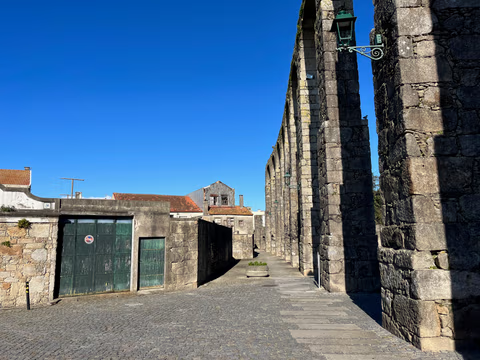
Aqueduct Trail – A path running along the Vila do Conde Aqueduct
From the Coastal Trail to the Camino Central: 12.9 km along the aqueduct from Vila do Conde to São Pedro de Rates. Route, stage, hostels, costs—explained honestly.
Read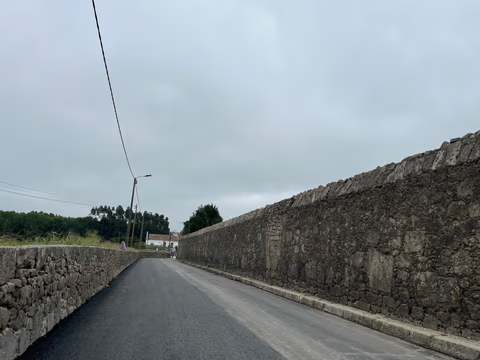
Ave Trail (Costa Station – Central Station)
A 9.2-kilometer route connecting two of Portugal's most popular pilgrimage trails: If you want to switch from the Coastal Route to the Central Route in Vila do Conde after the first day, take this short connecting path to Arcos.
Read


