

Schiermonnikoog – Münster
494 kilometers from the Wadden island of Schiermonnikoog to St. Lambert's Church in Münster – a young Way of St. James through two countries, in the footsteps of Saint Ludger and along the river Ems.

- 01At a Glance
- 02Overview
- 03By ferry to the island – the first stage
- 04Other Names
- 05Who This Route Is Ideal For – and Who It's Not
- 06Route & Landscape
- 07Stages, Terrain & Difficulty
- 08Two countries, one story – in the footsteps of Ludger
- 09Highlights Along the Way
- 10Continue your pilgrimage?
- 11Preparation & Practical Information
- 12What the journey will cost you
- 13Getting There
At a Glance
- Start / Finish: Schiermonnikoog → Münster
- Length: 494 km (24 stages)
- Duration: about 24 days on foot
- Character: a flat lowland pilgrim route through the Netherlands and northern Germany
- Organizer: Pelgrimeren in Groningen foundation (SPIG) with Het Stille Goud (Interreg DE–NL)
Overview
The Schiermonnikoog – Münster Way of St. James is a young, cross-border pilgrim route that links the history of two countries. It begins at the monastery on the Wadden island of Schiermonnikoog and ends at St. Lambert's Church in Münster. Back on the mainland the river Ems runs through the route like a thread.
It's a walk through a rich, quiet history: the terp landscape of Groningen with its red-brick churches, polders and dikes, the Dollart estuary and today's characteristic nature reserves. In Münster, the international hub of the Ways of St. James to Santiago de Compostela and Rome, the route connects to the great routes heading south.
By ferry to the island – the first stage
The journey begins with the crossing to the car-free island of Schiermonnikoog. The ferry leaves from Lauwersoog, where there is parking, and the crossing takes about 45 minutes (a fast ferry does it in around 20). It is run by Wagenborg Passagiersdiensten. A ticket is always a return ticket and costs from €16.65 for adults (incl. tourist tax; as of June 2026); the fast ferry adds a surcharge per leg. Since 2025 a reservation is mandatory – book your ticket in advance online with Wagenborg or at the counter in Lauwersoog. On the island the Way begins at the monastery; the first stage then takes the ferry back to the mainland toward Kloosterburen.
Other Names
- Dutch: Camino Schiermonnikoog – Münster
- German: Jakobsweg Schiermonnikoog – Münster
Also "in the footsteps of Ludger" – after the missionary and founder of Münster.
Who This Route Is Ideal For – and Who It's Not
Ideal if you want a flat, contemplative route through wide lowland landscapes, are drawn to church, monastery and Reformation history, and would like a cross-border opening to a longer journey to Santiago or Rome.
Less suitable if you seek mountains and big climbs: the route runs almost entirely flat through polder, moor and river landscape.
Route & Landscape
From the island monastery on Schiermonnikoog (UNESCO World Heritage Wadden Sea) you take the ferry back to the mainland and cross northern Groningen: over Kloosterburen, Winsum and Uithuizen through the terp land with its medieval brick churches, on over Delfzijl on the Dollart, Winschoten and the star fortress of Bourtange to the monastery town of Ter Apel.
Beyond Nieuw-Dordrecht the route reaches the German border and, in the Emsland, follows the Ems over Meppen, Lingen and Emsbüren to Bentlage Monastery near Rheine. Over Emsdetten and Greven it ends at St. Lambert's Church in Münster. Two extra stages lead through the city of Groningen; from Twist-Bült a four-stage variant also branches off over Frenswegen Monastery to Oldenzaal.
Stages, Terrain & Difficulty
The route consists of 24 daily stages totaling 494 kilometers (averaging about 20 km a day). The terrain is flat and easy to walk; the challenge lies more in the distance than in any climb. Thanks to good train and bus links in Groningen and the Emsland, the stages can be flexibly shortened or combined.
Two countries, one story – in the footsteps of Ludger
The route is a walk through history. You follow Ludger, the missionary and founder of the city and diocese of Münster and of many medieval churches in North Groningen. You meet Bernhard von Galen, the Prince-Bishop of Münster, nicknamed "Bommen Berend" by the people of Groningen for his sieges of Groningen and Bourtange. And you see the beginning and end of the Eighty Years' War: its start at the Battle of Heiligerlee and its end in the Peace Hall of the old town hall in Münster, where the Peace of Westphalia was concluded in 1648.
- Plan time by the sea on Schiermonnikoog before lacing up your boots.
- In Münster, St. Lambert's Church and the Peace Hall are worth a good stop.
- A detailed guidebook by Fokko Bosker (Uitgeverij Zilt) accompanies the route.
Highlights Along the Way
- Schiermonnikoog – a Wadden island with a monastery, UNESCO World Heritage Wadden Sea.
- Groningen terp land – medieval brick churches on dwelling mounds, polders and dikes.
- Delfzijl & the Dollart – a wide estuary and sea landscape.
- Bourtange – a star-shaped fortress town from the Eighty Years' War.
- Ter Apel – a famous medieval monastery.
- Bentlage Monastery near Rheine – a monastery complex on the Ems.
- Münster – St. Lambert's Church and the Peace Hall of the Peace of Westphalia.
Continue your pilgrimage?
Münster is the international hub of the Ways of St. James to Santiago de Compostela and Rome – from here the great routes continue south (for example over the Rhineland and France to Santiago). If you start on Schiermonnikoog, you can see the route as the northern opening of a long journey. Via the variant over Frenswegen Monastery you also reach Oldenzaal, where the Camino from Twente connects. In practice, that means: from Münster, the Westfälischer Jakobsweg takes over, leading via Dortmund and the Bergisches Land to Cologne — the next major waypoint toward Santiago.
Preparation & Practical Information
The best time is spring to autumn. The route is cared for by the Pelgrimeren in Groningen foundation together with Het Stille Goud and is freely walkable. Accommodation is in guesthouses, inns and pilgrim lodgings – book early in season. A pilgrim credential is useful for stamps.
What the journey will cost you
The Netherlands and Germany are relatively expensive. Budget roughly €50–85 per day for accommodation and food; simple lodgings and self-catering lower the cost. Add the one-off ferry crossing to the island (from €16.65 return; as of June 2026).
Getting There
The starting point is the Wadden island of Schiermonnikoog, reached by ferry from Lauwersoog (see above). You reach Lauwersoog by train and bus; the finish, Münster, is a central rail hub.
- To Lauwersoog: train to Groningen, then bus. NS – Dutch rail connections.
- Return from Münster: Deutsche Bahn – connections from Münster.
The route is initiated and provided by the Pelgrimeren in Groningen foundation – spig.nl.

Get your pilgrim credential and shell
Everything you need for the Schiermonnikoog – Münster, shipped to your door.
Visit Camino Shop
Other Caminos

Appenzeller Weg
52.6 km from Rankweil across the Rhine to St. Peterzell: St. James Chapel (1464), 163 Years of the Wedding Trail, connection to the Via Jacobi. Stages, costs, how to get there.
Read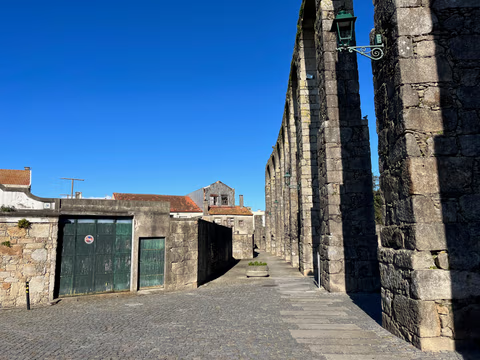
Aqueduct Trail – A path running along the Vila do Conde Aqueduct
From the Coastal Trail to the Camino Central: 12.9 km along the aqueduct from Vila do Conde to São Pedro de Rates. Route, stage, hostels, costs—explained honestly.
Read
Ave Trail (Costa Station – Central Station)
A 9.2-kilometer route connecting two of Portugal's most popular pilgrimage trails: If you want to switch from the Coastal Route to the Central Route in Vila do Conde after the first day, take this short connecting path to Arcos.
Read


