

Via Francigena (Italy)
Across the Alps to Rome: about 1,020 kilometers from the Great St. Bernard Pass through the Aosta Valley, the Po Valley, and Tuscany to St. Peter’s Basilica—the main Italian section of the Via Francigena.

- 01At a Glance
- 02Overview
- 03Other Names
- 04Who This Route Is Ideal For—and Who It's Not
- 05Route & Landscape
- 06Stages, Terrain & Difficulty
- 07Tuscany and St. Peter's Basilica—the heart of the journey
- 08Highlights Along the Way
- 09How Pilgrims Find Their Way onto This Path
- 10Continue the pilgrimage?
- 11Preparation & Practical Information
- 12What the journey will cost you
- 13Getting There
At a Glance
- Start / Finish: Great St. Bernard → Rome
- Length: 1,019.9 km
- Elevation gain:↗ 30.478 m / ↘ 32.908 m
- Duration: about 45–52 days on foot
- Other names: Via Francigena, Frankenweg
- Character: A long, historic pilgrimage route across the Alps and through Tuscany to Rome
Overview
Along with the Way of St. James, the Via Francigena is Europe’s most important pilgrimage route—though its destination is not Santiago, but Rome and the tomb of the Apostle Peter. Its main Italian section begins at the top of the Great St. Bernard Pass, descends into the Aosta Valley, crosses the Po Valley, and winds through the famous hills of Tuscany to St. Peter’s Basilica.
The route follows the itinerary that Archbishop Sigerich of Canterbury recorded in 990—one of the oldest surviving pilgrimage routes in the world. History, art, and landscape come together here to form a great European journey.
Other Names
- Italian: Via Francigena
- English: Via Francigena, Frankish Way
- German: Frankenweg
“Francigena” means “the road coming from the Frankish Kingdom”—the route connected northern Europe with Rome.
Who This Route Is Ideal For—and Who It's Not
This is ideal if you're looking for a long, historic journey off the beaten path of the Camino de Santiago and love art, Tuscany, and Rome. If you have the time and stamina, you'll experience one of the most magnificent trails in Europe.
Less suitable if you're looking for a well-developed pilgrimage infrastructure like the one on the The French Way What to expect: The Via Francigena is less developed, the stages are longer, and accommodations are sometimes fewer and farther between. A basic knowledge of Italian is very helpful.
Route & Landscape
From the Great St. Bernard Pass, the route descends into the lush Aosta Valley with its castles and vineyards, then into the vast Po Valley around Pavia and Piacenza.
Crossing the Apennines (Passo della Cisa), the route reaches Tuscany—Lucca, San Gimignano, Siena, and the Val d'Orcia—before passing through Lazio and finally arriving in Rome and St. Peter's Basilica.
Stages, Terrain & Difficulty
At over 1,000 kilometers and with more than 30,000 meters of elevation gain, the Via Francigena is a major undertaking: an alpine start, the flat Po Valley, hilly Tuscany, and crossings of the Apennines. Technically mostly straightforward, but long and hot in the summer.
Most pilgrims take about 45 to 52 days to complete the entire route; many walk only certain sections (e.g., just Tuscany). The trail markings and infrastructure are better than they used to be, but less extensive than on the Spanish routes.
Tuscany and St. Peter's Basilica—the heart of the journey
The scenic highlight is Tuscany: San Gimignano with its family towers, medieval Siena, and the rolling Val d'Orcia. Here, a simple walk becomes a stroll through a Renaissance painting.
The actual destination is St. Peter's Basilica in Rome. At the end of their journey, pilgrims receive the Testimonium, the equivalent of the Compostela.
- Plan for the Tuscany and for Room One for each day off—both are worth a trip of their own.
- Set out early in the summer and carry plenty of water, especially in the Po Valley and in Lazio.
- Basic Italian vocabulary and pre-booked accommodations make the long stages easier.
Highlights Along the Way
- Great St. Bernard – Alpine pass with the famous hospice.
- Aosta Valley – Castles, vineyards, and traces of Roman history.
- Tuscany – Lucca, San Gimignano, Siena, Val d'Orcia.
- Viterbo – a medieval papal city in Lazio.
- Room – St. Peter's Basilica and St. Peter's Tomb, the destination of the journey.
How Pilgrims Find Their Way onto This Path
The Italian section is the final link in a long chain: It begins in Canterbury with the Via Francigena (England), moves with the Via Francigena (France) through the Champagne and Jura regions and hands over the Via Francigena (Switzerland) at the Great St. Bernard Pass—right where this trail begins.
But you don’t have to start at the top of the pass: Aosta, Pavia, Lucca, and Siena are classic entry points with good train connections. If you just want the Testimonium, start in Acquapendente or Viterbo—the final 100 kilometers or so to Rome.
Continue the pilgrimage?
The Via Francigena ends in Rome—but it is part of an even larger network of trails. Before that comes the Swiss section (Via Francigena CH) over the Great St. Bernard Pass. From Rome, the Southern Via Francigena Continue south to Santa Maria di Leuca at the tip of Apulia—historically the route to the ports from which pilgrims set out for the Holy Land. And for those who’d rather go to Santiago than Rome, there’s a remarkable detour along the way: In Piacenza, the Via Domitia, which runs through Turin and over the Col de Montgenèvre to Arles—the direct connection from the Via Francigena network to the Way of St. James.
Preparation & Practical Information
The best time to visit is spring and fall; midsummer is very hot in the Po Valley and in Lazio, and the St. Bernard Pass is snow-free only in summer. Accommodations are available at pilgrim hostels (ostelli), monasteries, and guesthouses—advance booking is recommended. You’ll need a pilgrim credential; the certificate of completion is called a Testimonium.
What the journey will cost you
Italy is more expensive than Spain. Roughly speaking, budget 35–60 € per day. Basic hostels cost 10–20 €, plus meals; prices are higher in cities and in Tuscany.
Getting There
The starting point is the Great St. Bernard Pass (usually reached via Martigny or Aosta); many people also start in Aosta.
- Traveling through Switzerland: Take the train to Martigny, then the bus to the pass. Good morning– Swiss Railways, Routes, and Tickets.
- Traveling via Italy: Train to Aosta. Italian Railways– Italian railways, routes, and tickets.
- Return trip from Rome: international airport and rail hub. Italian Railways– Connections from Rome.

Get your pilgrim credential and shell
Everything you need for the Via Francigena (Italy), shipped to your door.
Visit Camino Shop
Other Caminos

Appenzeller Weg
52.6 km from Rankweil across the Rhine to St. Peterzell: St. James Chapel (1464), 163 Years of the Wedding Trail, connection to the Via Jacobi. Stages, costs, how to get there.
Read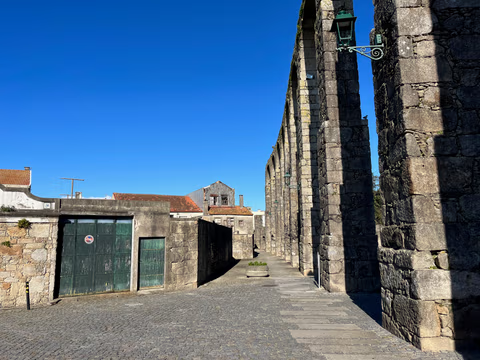
Aqueduct Trail – A path running along the Vila do Conde Aqueduct
From the Coastal Trail to the Camino Central: 12.9 km along the aqueduct from Vila do Conde to São Pedro de Rates. Route, stage, hostels, costs—explained honestly.
Read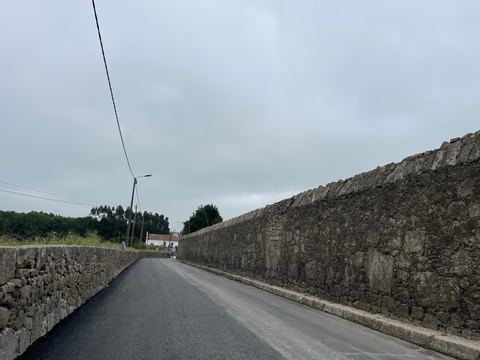
Ave Trail (Costa Station – Central Station)
A 9.2-kilometer route connecting two of Portugal's most popular pilgrimage trails: If you want to switch from the Coastal Route to the Central Route in Vila do Conde after the first day, take this short connecting path to Arcos.
Read


