

Voie de Rocamadour
Via Podiensis detour from Figeac to Cahors, via the sacred rock-hewn town of Rocamadour—the second most popular pilgrimage destination in France after Mont-Saint-Michel.

- 01At a Glance
- 02Overview
- 03Other Names
- 04Who It's Ideal For—and Who It's Not So Ideal For
- 05Route & Landscape
- 06Stages, Terrain & Difficulty
- 07Rocamadour: A Holy City Perched on a Cliff
- 08Highlights Along the Way
- 09How Pilgrims Find Their Way onto This Path
- 10Continue the pilgrimage?
- 11Preparation & Practical Information
- 12What the journey will cost you
- 13Getting There
At a Glance
- Start / Junction: Figeac (downtown, on the GR 65)
- Back on the GR 65: Cahors
- Overall length:~122 km
- Reusable:~1.5 days compared to the direct route GR 65 from Figeac to Cahors
- Duration: 4–5 days
- Difficulty: Easy to Moderate
- Marking: GR 652 / GR 46 (red and white)
- Country / Region: France, Quercy / Lot Department
Overview
And Figeac, one of the most beautiful medieval old towns in France, branches off from the Via Podiensis A detour that’s well worth it like few others: the Voie de Rocamadour. Instead of continuing directly to Cahors on the GR 65, you turn north onto the GR 652—heading toward one of Europe’s most important Marian pilgrimage sites. The detour takes only a day and a half, but it brings you to a destination that has drawn pilgrims from all over Europe since the Middle Ages.
The route winds through the heart of Quercy: across barren limestone plateaus (Causse), through quiet oak forests, past Romanesque chapels and medieval castle ruins. The trail follows natural paths almost the entire way—hardly any asphalt, little traffic, and plenty of peace and quiet. The terrain is gentler than on the Célé Trail: No extreme climbs, but a rhythmic alternation between plateaus and valley cuts. The highlight comes just before Rocamadour, when you climb through the narrow Alzou Gorge and the town suddenly emerges from the rock face before you.
And Rocamadour Take a break—for at least half a day. Then the trail continues along the GR 46 through the Lot Valley to To, where the Voie de Rocamadour ends. From here, the route continues along the Lot on the Voie du Célé to Cahors—one of the most important stops on the Way of St. James in France, home to the Gothic Pont Valenté, where you’ll rejoin the Via Podiensis.
Other Names
The Voie de Rocamadour is officially known as GR 652 and is marked with the red-and-white symbols of the Grandes Randonnées. As part of the Compostela trail network, it is known by the combined designation GR 6-652-46. It is often simply called “le chemin de Rocamadour” or referred to as the “Variante par Rocamadour” of the Via Podiensis. In some pilgrimage guides, you’ll also find it listed as the “Voie du Quercy.”
Who It's Ideal For—and Who It's Not So Ideal For
The Voie de Rocamadour is ideal for anyone traveling along the Via Podiensis who wants to do more than just rack up kilometers. It appeals to pilgrims who are willing to take detours to visit special places—and Rocamadour is one such place. The route is also well-suited for beginners or for anyone looking for a slightly easier alternative to the more challenging Voie du Célé: the terrain is gentler, navigation is easier, and there are slightly more amenities available.
The Voie de Rocamadour is less suitable for those who want to make as much progress as possible or prefer the lively atmosphere of the main route. On this detour, you’ll encounter even fewer pilgrims than you would on the Via Podiensis. And for those who want to hike through spectacular karst gorges in addition to a spiritual highlight, the Voie du Célé offers a more intense hiking experience—both routes have their own unique character.
Route & Landscape
From Figeac From there, the GR 652 initially heads north through the hilly Quercy region: gentle limestone plateaus (causses), dense forests of downy oaks and holm oaks, and scattered bastide villages. The trail is exceptionally well-maintained along old mule tracks—almost no asphalt, but rather gravel paths and a network of medieval trails. Shortly before Rocamadour The terrain slopes down into the Alzou Gorge: a narrow, deep cut in the limestone through which a small stream flows. The last few kilometers before reaching the town lead through this quiet valley—until you stand at the foot of the cliff and see Rocamadour above you.
After Rocamadour, the trail joins the GR 46 and follows the Lot Valley westward. The landscape opens up: wide river floodplains, vineyards, and cornfields. The Voie de Rocamadour ends in Vers—here, the trail seamlessly transitions into the Voie du Célé, along which you’ll continue walking along the Lot River all the way to Cahors. Shortly before Cahors The valley narrows again, and you reach the medieval town with its Gothic Pont Valenté—a UNESCO World Heritage Site since 1998. Here, the Voie de Rocamadour rejoins the Via Podiensis, and you’ll be walking on the same cobblestones as millions of pilgrims on the Way of St. James who came before you.
Stages, Terrain & Difficulty
The Voie de Rocamadour can be divided into four to five daily stages. The first half (Figeac–Rocamadour) takes about two days to complete across the Causse; the second half (Rocamadour–Cahors) takes two and a half days. A typical itinerary:
- Figeac → Gramat (~30 km, ~500 hm) – Start on the Causse, the first secluded spot in Quercy
- Gramat → Rocamadour (~26 km, ~350 hm) – Alzou Gorge, spectacular arrival at the rock-cut city
- Rocamadour → Labastide-Murat (~30 km, ~400 hm) – GR 46, the Quercy Highlands on the way to the Lot
- Labastide-Murat → Vers (~21 km, ~300 hm) – the final stretch across the Causse to the banks of the Lot
- Toward → Cahors (~17 km, ~250 hm) – from here, follow the Voie du Célé along the Lot River to Pont Valenté, where the route joins the Via Podiensis
Terrain and Difficulty: The terrain is mostly easygoing. Paved nature trails and old mule trails alternate with occasional gravel paths. The only somewhat steeper section is the descent into the Alzou Gorge just before Rocamadour—it’s well-marked and safe to walk. In summer, the sun can beat down fiercely on the open Causses; however, with plenty of water and an early start, the trail is well within the reach of even beginners.
Rocamadour: A Holy City Perched on a Cliff
No other pilgrimage site in France makes such an unforgettable first impression as Rocamadour. The town clings to a 120-meter-high limestone cliff on several levels, high above the Alzou Canyon. Its narrow streets, churches, and chapels seem to blend into the rock—not built, but grown. In 1166, the intact tomb of Saint Amadour, a hermit, was discovered here, marking the beginning of one of the most significant pilgrimage stories of the Middle Ages. In 1244, Saint Louis IX knelt at this site, accompanied by his mother, Blanche of Castile. Today, Rocamadour is the second-most-visited site in France—after Mont-Saint-Michel.
Inside the Cité, eight churches and chapels await you. Across the 216 steps of the Grand Escalier – or, if you prefer, on your knees, as medieval pilgrims did – you’ll reach the Chapelle Notre-Dame with the Black Virgin: a small black wooden statue revered as the patron saint of sailors from all over the world. Since 1998, the Basilique Saint-Sauveur, along with the crypt of Saint Amadour, has been a UNESCO World Heritage Site. The ramparts feature 14th-century fortification walls offering a breathtaking panoramic view of the Alzou Canyon.
Highlights Along the Way
- Rocamadour: Medieval pilgrimage fortress carved into limestone cliffs, a UNESCO World Heritage Site, featuring the Vierge Noire in the Chapelle Notre-Dame
- Alzou Gorge: A quiet limestone gorge with the stream that gives it its name; a spectacular hike to the rock-cut city
- Padirac Chasm: One of France's most impressive chasms—103 meters deep, with an underground river and huge stalactites (a worthwhile detour near the route)
- Lacave Caves: A labyrinth of underground caves with stalactites and stalagmites in the Lot Valley
- The Monkey Forest: Over 150 wild Barbary macaques in a 20-hectare forest near Rocamadour—surprisingly approachable (March–November)
- Château des Anglais in Vers: A troglodytic castle from the Hundred Years' War, carved into the limestone cliff
- Valenté Bridge in Cahors: Gothic fortified bridge, a UNESCO World Heritage Site and an iconic destination on the Way of St. James
- Rocamadour Goat Cheese (AOP): A small, round soft cheese made from goat's milk from the Causse region—documented since the 15th century, AOP since 1996
How Pilgrims Find Their Way onto This Path
The Voie de Rocamadour is a key link in the Quercy region: The traditional way to get there is by train to Figeac or Gramat. Those who are already on the Via Podiensis Most travelers planning a detour to the rock sanctuary usually start from Figeac.
It pairs well with the Célé Trail: First through the Célé Valley, then up to Rocamadour—and back toward Cahors via the main route. That turns a week in Podiensis into two weeks in Quercy.
Continue the pilgrimage?
The Voie de Rocamadour leads back to Cahors, one of the most important stops on the Way of St. James in France. With the Cathedral of Saint-Étienne, the Gothic Pont Valenté, and several pilgrim hostels, Cahors is a true pilgrimage hub. From here, the route continues along the GR 65—through Moissac with its magnificent Romanesque cloister, through Condom in Gascony, and finally to Saint-Jean-Pied-de-Port, the gateway to the Way of St. James across the Pyrenees to Spain.
Preparation & Practical Information
The Voie de Rocamadour is well-marked and offers plenty of lodging options during the season (April–October). In Figeac, Gramat, Rocamadour, and the towns along the Lot Valley, there are pilgrim hostels (gîtes d'étape), bed-and-breakfasts, and small hotels. During peak season, reservations are recommended, especially in Rocamadour itself, which also attracts many day-trippers.
As on all French routes of the Camino de Santiago, you'll need a Pilgrim's Pass (Credencial), to stay overnight at the hostels and receive the Compostela at the end. In Figeac, you can get your first stamp at the Église Saint-Sauveur or the Hôpital Saint-Jacques (a UNESCO World Heritage Site). It’s best to order your pilgrim passport online in advance so that you have it in time for the start of your journey. The best time to travel is May through June and September—in July and August, Rocamadour is overrun with mass tourism, which greatly overshadows the town’s pilgrimage atmosphere. The easiest way to plan your stages is directly in the Camino Ninja app, where you can also book suitable accommodations right away.
What the journey will cost you
A day of pilgrimage on the Voie de Rocamadour costs an average of 30–55 euros (as of July 2026), depending on whether you stay at a gîte d'étape (12–22 €), a chambre d’hôtes (35–55 €), or a hotel. Rocamadour itself is slightly more expensive than the trail average—the high volume of tourists drives up prices. Many lodgings offer a communal pilgrim dinner (table d’hôtes) in the evening for 12–17 euros. For the entire route (4–5 stages), a budget of 180–300 euros is realistic. Those who camp will spend less; there are scattered camping spots along the route.
Getting There
Most pilgrims who walk the Voie de Rocamadour are already on the Via Podiensis on the way—and reach the turnoff in Figeac Simply on foot. The route is a variation of the GR 65: You branch off onto the GR 652 in Figeac, walk the loop via Rocamadour, and return to Cahors Back onto the Via Podiensis—from where the GR 65 continues toward Saint-Jean-Pied-de-Port. If you’re planning your trip, you’ll find the most common connections to Figeac below.
Figeac The best way to get there is by train: Regional trains run directly to Figeac from Brive-la-Gaillarde or Capdenac. From Paris, you can reach Brive-la-Gaillarde by TGV in about 4 hours. If you’re already traveling along the Via Podiensis, you can walk there—Figeac is located on the GR 65, about 670 kilometers from Le Puy-en-Velay. Returning home: From Cahors, there are regular train connections to Brive-la-Gaillarde, Toulouse, or directly to Paris.
From Germany:
- Fly to Toulouse or Bordeaux, then take the train or rent a car to Figeac
- Train: ICE/TGV Frankfurt → Paris → Brive-la-Gaillarde → Figeac (approx. 7–8 hours)
- By car: A5/A8 toward Strasbourg → A35 → Lyon → A75 → Figeac (about 8–9 hours from Frankfurt)

Get your pilgrim credential and shell
Everything you need for the Voie de Rocamadour, shipped to your door.
Visit Camino Shop
Other Caminos

Appenzeller Weg
52.6 km from Rankweil across the Rhine to St. Peterzell: St. James Chapel (1464), 163 Years of the Wedding Trail, connection to the Via Jacobi. Stages, costs, how to get there.
Read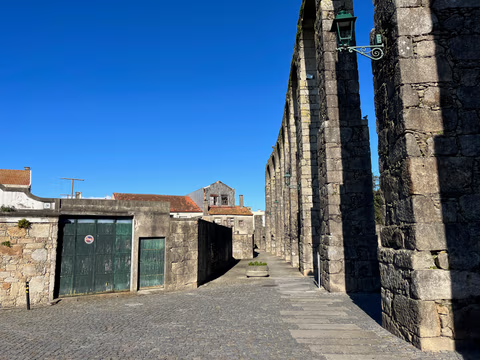
Aqueduct Trail – A path running along the Vila do Conde Aqueduct
From the Coastal Trail to the Camino Central: 12.9 km along the aqueduct from Vila do Conde to São Pedro de Rates. Route, stage, hostels, costs—explained honestly.
Read
Ave Trail (Costa Station – Central Station)
A 9.2-kilometer route connecting two of Portugal's most popular pilgrimage trails: If you want to switch from the Coastal Route to the Central Route in Vila do Conde after the first day, take this short connecting path to Arcos.
Read


